×
Request Free Sample ×

Kindly complete the form below to receive a free sample of this Report

* Please use a valid business email

Leading companies partner with us for data-driven Insights

clients tt-cursor
Hero Background

US Benzaldehyde Market

ID: MRFR/CnM/13718-CR
111 Pages
Chitranshi Jaiswal
December 2023

US Benzaldehyde Market

Share:
Download PDF ×

We do not share your information with anyone. However, we may send you emails based on your report interest from time to time. You may contact us at any time to opt-out.

US Benzaldehyde Market Infographic
Purchase Options

US Benzaldehyde Market Summary

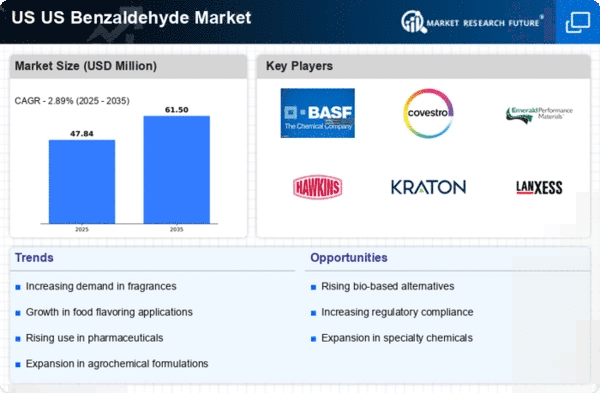
As per analysis, the US Benzaldehyde Market is projected to grow from USD 46.5 Million in 2024 to USD 61.5 Million by 2035, exhibiting a compound annual growth rate (CAGR) of 2.57% during the forecast period (2025 - 2035).

Key Market Trends & Highlights

The US Benzaldehyde Market is experiencing a notable shift towards natural products and sustainable practices.

  • The flavoring agent segment remains the largest contributor to the US Benzaldehyde Market, driven by its extensive use in food and beverage applications.
  • Pharmaceutical applications are emerging as the fastest-growing segment, reflecting an increasing reliance on benzaldehyde for drug synthesis.
  • Technological advancements in production methods are enhancing efficiency and compliance with safety standards across the industry.
  • The growing demand in the fragrance industry and the expansion of pharmaceutical applications are key drivers propelling market growth.

Market Size & Forecast

2024 Market Size 46.5 (USD Million)
2035 Market Size 61.5 (USD Million)
CAGR (2025 - 2035) 2.57%

Major Players

BASF SE (DE), Covestro AG (DE), Emerald Performance Materials LLC (US), Hawkins Inc. (US), Kuraray Co. Ltd. (JP), Lanxess AG (DE), Solvay SA (BE), SABIC (SA)

Our Impact
Enabled $4.3B Revenue Impact for Fortune 500 and Leading Multinationals
Partnering with 2000+ Global Organizations Each Year
30K+ Citations by Top-Tier Firms in the Industry

US Benzaldehyde Market Trends

The US Benzaldehyde Market is currently experiencing a notable evolution, driven by various factors that influence demand and supply dynamics. Benzaldehyde, a key aromatic aldehyde, finds extensive applications in the production of flavors, fragrances, and pharmaceuticals. The market appears to be shaped by the increasing preference for natural and organic products, which may lead to a shift in sourcing and production methods. Furthermore, the growing awareness regarding the environmental impact of synthetic chemicals could potentially drive innovation in sustainable practices within the industry. As consumer preferences evolve, manufacturers are likely to adapt their strategies to align with these trends, thereby influencing market growth. In addition, regulatory frameworks in the United States are becoming more stringent, which may impact the production and distribution of benzaldehyde. Compliance with safety and environmental standards is essential for companies operating in this sector. This regulatory landscape could encourage investments in research and development, fostering advancements in production technologies. Overall, the US Benzaldehyde Market seems poised for transformation, with a focus on sustainability and compliance shaping its future trajectory.

Shift Towards Natural Products

There is a discernible trend in the US Benzaldehyde Market towards the adoption of natural and organic products. This shift is largely driven by consumer preferences for ingredients perceived as safer and more environmentally friendly. As a result, manufacturers may increasingly explore natural sources of benzaldehyde, which could alter traditional production methods.

Regulatory Compliance and Safety Standards

The regulatory environment surrounding the US Benzaldehyde Market is becoming increasingly stringent. Companies are required to adhere to safety and environmental regulations, which may necessitate changes in production processes. This trend indicates a potential increase in operational costs but also encourages innovation in safer manufacturing practices.

Technological Advancements in Production

Technological innovation is likely to play a crucial role in the US Benzaldehyde Market. Advances in production techniques may enhance efficiency and reduce waste, aligning with sustainability goals. Companies that invest in modern technologies could gain a competitive edge, as they adapt to changing market demands and regulatory requirements.

US Benzaldehyde Market Drivers

Rising Use in Agrochemicals

The US Benzaldehyde Market is also benefiting from the rising use of benzaldehyde in agrochemical formulations. Benzaldehyde is utilized as a precursor in the production of various pesticides and herbicides, which are essential for modern agricultural practices. With the increasing emphasis on food security and sustainable agriculture, the demand for effective agrochemicals is on the rise. The US agrochemical market is projected to grow significantly, potentially reaching USD 50 billion by 2027. This growth is likely to positively impact the US Benzaldehyde Market, as manufacturers align their production strategies to cater to the needs of the agrochemical sector.

Innovations in Synthesis Techniques

The US Benzaldehyde Market is poised for growth due to innovations in synthesis techniques. Recent advancements in chemical engineering and production processes have led to more efficient and environmentally friendly methods of producing benzaldehyde. These innovations not only reduce production costs but also enhance the overall quality of the product. As sustainability becomes a focal point for many industries, the US Benzaldehyde Market is likely to benefit from these developments, attracting new investments and partnerships. Furthermore, companies that adopt these innovative techniques may gain a competitive edge in the market, positioning themselves favorably for future growth.

Growing Demand in Fragrance Industry

The US Benzaldehyde Market is experiencing a notable surge in demand, particularly from the fragrance sector. Benzaldehyde is a key ingredient in the formulation of various perfumes and scented products, which are increasingly popular among consumers. The market for fragrances in the United States is projected to grow at a compound annual growth rate (CAGR) of approximately 4.5% over the next few years. This growth is driven by changing consumer preferences towards personal care and grooming products, which often incorporate benzaldehyde for its pleasant almond-like aroma. As a result, manufacturers in the US Benzaldehyde Market are likely to expand their production capacities to meet this rising demand, thereby enhancing their market presence.

Expansion of Pharmaceutical Applications

The US Benzaldehyde Market is witnessing an expansion in its applications within the pharmaceutical sector. Benzaldehyde serves as a vital intermediate in the synthesis of various pharmaceutical compounds, including analgesics and anti-inflammatory drugs. The increasing focus on research and development in the pharmaceutical industry, coupled with the growing prevalence of chronic diseases, is expected to drive the demand for benzaldehyde. According to industry reports, the pharmaceutical market in the United States is anticipated to reach USD 600 billion by 2025, which may further bolster the US Benzaldehyde Market as pharmaceutical companies seek reliable sources of benzaldehyde for their production processes.

Increased Focus on Sustainable Practices

The US Benzaldehyde Market is increasingly influenced by a growing focus on sustainable practices. As consumers and regulatory bodies demand more environmentally friendly products, manufacturers are compelled to adopt sustainable sourcing and production methods. This shift is evident in the rising interest in bio-based benzaldehyde, which is derived from renewable resources. The US government has also introduced various initiatives aimed at promoting sustainability in chemical manufacturing. Consequently, companies within the US Benzaldehyde Market that prioritize sustainability may not only enhance their brand reputation but also tap into new market segments that value eco-friendly products.


Market Segment Insights

By Application: Flavoring Agent (Largest) vs. Pharmaceutical (Fastest-Growing)

In the US Benzaldehyde Market, the application segment is diverse, encompassing Flavoring Agent, Fragrance, Chemical Intermediate, and Pharmaceuticals. Currently, Flavoring Agent holds the largest market share, driven by its extensive use in food and beverage industries for enhancing flavors. Fragrance follows closely, as benzaldehyde's pleasant almond scent makes it a popular choice in personal care and household products.

Pharmaceuticals (Dominant) vs. Chemical Intermediate (Emerging)

In the landscape of benzaldehyde applications, Pharmaceuticals stand out as a dominant segment, leveraging the compound's utility in synthesizing various drugs and active pharmaceutical ingredients. This dominance is underscored by increasing research and development in the pharmaceutical sector, aiming for innovative compounds. Conversely, the Chemical Intermediate segment is emerging, attributed to the growing demand for benzaldehyde in the manufacture of agrochemicals and specialty chemicals. This evolving market dynamic signifies an expanding acceptance of benzaldehyde across various industries, driving both segments' relevance.

By End Use: Food and Beverage (Largest) vs. Pharmaceuticals (Fastest-Growing)

In the US Benzaldehyde Market, the 'End Use' segment showcases a diverse distribution of applications among Food and Beverage, Cosmetics, Pharmaceuticals, and Agriculture. Food and Beverage dominates this segment due to its essential role in flavoring and fragrance. Pharmaceuticals, while smaller in share, are emerging rapidly as innovative applications of benzaldehyde in drug formulation come to the forefront. This suggests a well-segmented market with varying degrees of reliance on benzaldehyde across industries.

Food and Beverage: Dominant vs. Pharmaceuticals: Emerging

Food and Beverage remains the dominant application in the US Benzaldehyde market, primarily leveraging its aromatic properties as a key flavoring agent. As consumer demand for natural flavors increases, this segment is well-positioned to capitalize on market trends. Conversely, Pharmaceuticals are emerging as a fast-growing segment, driven by advancements in medicinal chemistry and increasing research into new therapeutic agents utilizing benzaldehyde. As drug formulations evolve, this segment is likely to see significant investment and innovation, heightening its importance in the overall market landscape.

By Formulation Type: Liquid (Largest) vs. Solid (Fastest-Growing)

In the US Benzaldehyde market, the formulation type segment showcases a diverse distribution among liquid, solid, and gas forms. Liquid formulations represent the largest segment, widely utilized due to their versatility and effectiveness across various applications. Solid formulations, while smaller in current market share, are gaining traction as industries seek more concentrated and efficient forms of benzaldehyde for specialized uses. Gas formulations, though niche, serve specific applications relevant to certain industrial processes.

Formulation Type: Liquid (Dominant) vs. Solid (Emerging)

Liquid benzaldehyde remains the dominant formulation type in the US market, favored for its ease of use and broader application range, including in flavoring and fragrance industries. Solid benzaldehyde, though currently an emerging segment, is rapidly gaining popularity among manufacturers seeking higher content and reduced transportation costs. Its solid form enables more efficient storage and handling, catering to specific demands in chemical synthesis and potentially restrictive regulatory environments. As the market evolves, these formulations indicate a shift towards more innovative and functional uses of benzaldehyde in diverse applications.

By Production Method: Synthetic Production (Largest) vs. Natural Extraction (Fastest-Growing)

In the US Benzaldehyde Market, the production methods are dominated by synthetic production, which holds the largest share due to its cost-effectiveness and efficiency. Natural extraction, while smaller in market share, is gaining traction among consumers who prioritize sustainability and natural ingredients. Biotechnological methods are also present but account for a minor portion of the market.

Production Method: Synthetic Production (Dominant) vs. Natural Extraction (Emerging)

Synthetic production is recognized as the dominant method in the US Benzaldehyde Market, characterized by its ability to produce high volumes at lower costs. This method appeals to manufacturers seeking efficiency and reliability. Conversely, natural extraction is emerging as a significant player, driven by consumer preferences for eco-friendly and sustainably sourced products. This method often faces challenges related to supply variability and cost but is gaining momentum as brands lean towards natural ingredients to align with changing consumer sentiments. Biotechnological methods, while innovative, remain on the fringes of significant market influence but offer a glimpse into future trends towards greener production technologies.

Get more detailed insights about US Benzaldehyde Market

Key Players and Competitive Insights

The Benzaldehyde Market is characterized by a competitive landscape that is increasingly shaped by innovation, sustainability, and strategic partnerships. Key players such as BASF SE (Germany), Emerald Performance Materials LLC (US), and Solvay SA (Belgium) are actively pursuing strategies that enhance their market positioning. BASF SE (Germany) focuses on expanding its product portfolio through innovation, while Emerald Performance Materials LLC (US) emphasizes local manufacturing to meet regional demand. Solvay SA (Belgium) is leveraging its expertise in sustainable practices to differentiate itself in the market. Collectively, these strategies contribute to a dynamic competitive environment, where companies are not only vying for market share but also striving to lead in sustainability and technological advancements.
In terms of business tactics, companies are increasingly localizing manufacturing and optimizing supply chains to enhance efficiency and responsiveness to market demands. The competitive structure of the market appears moderately fragmented, with several players holding significant shares. However, the influence of major companies is substantial, as they set benchmarks for quality and innovation, thereby shaping the overall market dynamics.
In December 2025, BASF SE (Germany) announced a strategic partnership with a leading technology firm to develop advanced production techniques for benzaldehyde, aiming to reduce environmental impact and improve efficiency. This move is likely to enhance BASF's competitive edge by aligning with the growing demand for sustainable chemical production methods. The partnership underscores the importance of technological innovation in maintaining market leadership.
In November 2025, Emerald Performance Materials LLC (US) expanded its manufacturing capabilities by investing in a new facility in the Midwest. This strategic investment is expected to increase production capacity and improve supply chain logistics, allowing the company to better serve its North American customers. Such expansions are indicative of a broader trend where companies are prioritizing local production to mitigate supply chain disruptions and enhance customer service.
In October 2025, Solvay SA (Belgium) launched a new line of eco-friendly benzaldehyde derivatives, targeting industries focused on sustainable sourcing. This initiative not only reflects Solvay's commitment to sustainability but also positions the company to capture a growing segment of environmentally conscious consumers. The introduction of these products may significantly influence market trends, as competitors may feel pressured to innovate in response.
As of January 2026, the competitive trends in the Benzaldehyde Market are increasingly defined by digitalization, sustainability, and the integration of advanced technologies such as AI. Strategic alliances are becoming more prevalent, as companies recognize the value of collaboration in driving innovation and efficiency. Looking ahead, competitive differentiation is likely to evolve from traditional price-based competition to a focus on innovation, technological advancements, and supply chain reliability. This shift suggests that companies that prioritize these areas will be better positioned to thrive in an increasingly complex market.

Key Companies in the US Benzaldehyde Market include

Future Outlook

US Benzaldehyde Market Future Outlook

The US Benzaldehyde Market is projected to grow at a 2.57% CAGR from 2025 to 2035, driven by increasing demand in the fragrance and pharmaceutical sectors.

New opportunities lie in:

  • Expansion into bio-based benzaldehyde production methods. Development of customized benzaldehyde formulations for niche applications. Strategic partnerships with fragrance manufacturers for exclusive supply agreements.

By 2035, the market is expected to solidify its position as a key player in specialty chemicals.

Market Segmentation

US Benzaldehyde Market End Use Outlook

  • Food and Beverage
  • Cosmetics
  • Pharmaceuticals
  • Agriculture

US Benzaldehyde Market Application Outlook

  • Flavoring Agent
  • Fragrance
  • Chemical Intermediate
  • Pharmaceuticals

US Benzaldehyde Market Formulation Type Outlook

  • Liquid
  • Solid
  • Gas

US Benzaldehyde Market Production Method Outlook

  • Natural Extraction
  • Synthetic Production
  • Biotechnological Methods

Report Scope

MARKET SIZE 2024 46.5(USD Million)
MARKET SIZE 2025 47.85(USD Million)
MARKET SIZE 2035 61.5(USD Million)
COMPOUND ANNUAL GROWTH RATE (CAGR) 2.57% (2024 - 2035)
REPORT COVERAGE Revenue Forecast, Competitive Landscape, Growth Factors, and Trends
BASE YEAR 2024
Market Forecast Period 2025 - 2035
Historical Data 2019 - 2024
Market Forecast Units USD Million
Key Companies Profiled BASF SE (DE), Covestro AG (DE), Emerald Performance Materials LLC (US), Hawkins Inc. (US), Kuraray Co. Ltd. (JP), Lanxess AG (DE), Solvay SA (BE), SABIC (SA)
Segments Covered Application, End Use, Formulation Type, Production Method
Key Market Opportunities Growing demand for natural flavoring agents in food and beverage sectors enhances US Benzaldehyde Market opportunities.
Key Market Dynamics Rising demand for benzaldehyde in fragrances and flavorings drives competitive dynamics in the US market.
Countries Covered US
Leave a Comment
Download Free Sample

Kindly complete the form below to receive a free sample of this Report

Compare Licence

×
Features License Type
Single User Multiuser License Enterprise User
Price $4,950 $5,950 $7,250
Maximum User Access Limit 1 User Upto 10 Users Unrestricted Access Throughout the Organization
Free Customization
Direct Access to Analyst
Deliverable Format
Platform Access
Discount on Next Purchase 10% 15% 15%
Printable Versions