×
Request Free Sample ×

Kindly complete the form below to receive a free sample of this Report

* Please use a valid business email

Leading companies partner with us for data-driven Insights

clients tt-cursor
Hero Background

US Baking Mixes Market

ID: MRFR/FnB/18235-HCR
200 Pages
Snehal Singh
February 2026

US Baking Mixes Market Size, Share, Industry Trend & Analysis Research Report: By Product Type (Cookies & Biscuit Mixes, Bread Mixes, Cake, Pastry, And & Muffin Mixes, Others), By Category (Gluten-Free, Conventional), By End-Use (Retail Customers, Food Service) andBy Distribution Channel (Stored-Based, Non-Store-Based)- Forecast to 2035

Share:
Download PDF ×

We do not share your information with anyone. However, we may send you emails based on your report interest from time to time. You may contact us at any time to opt-out.

US Baking Mixes Market Infographic
Purchase Options

US Baking Mixes Market Summary

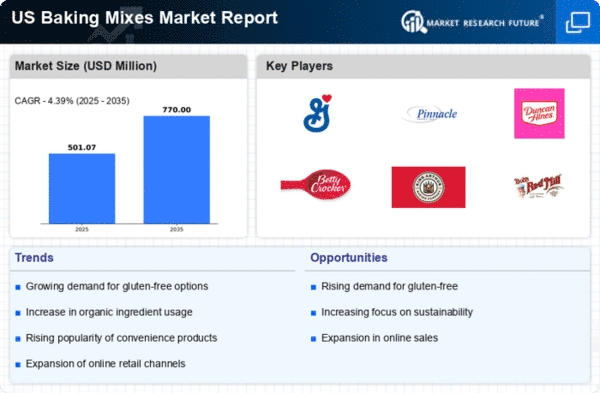
As per Market Research Future analysis, the US baking mixes market Size was estimated at 480.0 USD Million in 2024. The US baking mixes market is projected to grow from 501.07 USD Million in 2025 to 770.0 USD Million by 2035, exhibiting a compound annual growth rate (CAGR) of 4.3% during the forecast period 2025 - 2035

Key Market Trends & Highlights

The US baking mixes market is experiencing a dynamic shift towards health-conscious and convenient options.

  • Health-conscious options are gaining traction as consumers increasingly prioritize nutritional value in their baking choices.
  • Convenience and accessibility are driving the popularity of baking mixes, particularly among busy households seeking quick solutions.
  • Flavor innovation is becoming a focal point, with brands introducing unique and diverse flavors to attract adventurous bakers.
  • The rising demand for home baking and the increased focus on clean label products are key drivers propelling market growth.

Market Size & Forecast

2024 Market Size 480.0 (USD Million)
2035 Market Size 770.0 (USD Million)
CAGR (2025 - 2035) 4.39%

Major Players

General Mills (US), Pinnacle Foods (US), Duncan Hines (US), Betty Crocker (US), King Arthur Baking Company (US), Bob's Red Mill (US), Pillsbury (US), Wilton Brands (US)

Our Impact
Enabled $4.3B Revenue Impact for Fortune 500 and Leading Multinationals
Partnering with 2000+ Global Organizations Each Year
30K+ Citations by Top-Tier Firms in the Industry

US Baking Mixes Market Trends

The baking mixes market is currently experiencing a notable transformation, driven by evolving consumer preferences and lifestyle changes. Increasingly, individuals are seeking convenient solutions that align with their busy schedules, leading to a rise in demand for ready-to-use baking mixes. This trend is further supported by a growing interest in home baking, as more people explore culinary activities as a form of relaxation and creativity. The market appears to be adapting to these shifts, with manufacturers introducing innovative products that cater to diverse dietary needs, including gluten-free and organic options. Moreover, the influence of social media and online platforms cannot be overlooked. Consumers are increasingly inspired by visually appealing recipes and baking tutorials shared across various channels. This has resulted in a surge in interest for unique flavors and artisanal products, prompting brands to diversify their offerings. As the baking mixes market continues to evolve, it seems poised for sustained growth, reflecting broader trends in health consciousness and culinary exploration.

Health-Conscious Options

There is a growing trend towards health-oriented baking mixes, as consumers increasingly prioritize nutritional value. This shift is evident in the rising demand for organic, gluten-free, and low-sugar alternatives, reflecting a broader movement towards healthier eating habits.

Convenience and Accessibility

The baking mixes market is witnessing a surge in products designed for convenience. Busy lifestyles drive consumers to seek quick and easy solutions, leading to the popularity of single-serve and ready-to-use mixes that simplify the baking process.

Flavor Innovation

Innovation in flavors is becoming a key focus within the baking mixes market. Manufacturers are experimenting with unique and exotic flavor profiles to attract adventurous consumers, thereby expanding the traditional boundaries of baking.

US Baking Mixes Market Drivers

Influence of Culinary Trends

The baking mixes market is significantly shaped by the influence of culinary trends, which drive consumer interest and innovation within the industry. As food culture evolves, consumers are increasingly drawn to unique flavors and artisanal products that reflect contemporary tastes. This trend encourages manufacturers to experiment with new ingredients and flavor combinations, thereby expanding their product lines. The baking mixes market is responding by introducing limited-edition mixes and collaborations with renowned chefs, which can create buzz and attract attention. Recent surveys indicate that approximately 45% of consumers are eager to try new flavors in baking mixes, suggesting a strong appetite for innovation. As brands capitalize on these culinary trends, they not only enhance their market offerings but also foster a sense of excitement and engagement among consumers.

Rising Demand for Home Baking

The baking mixes market experiences a notable surge in demand as more consumers engage in home baking activities. This trend is driven by a desire for homemade goods, which are perceived as fresher and healthier compared to store-bought alternatives. According to recent data, the market is projected to grow at a CAGR of approximately 5.5% over the next five years. The baking mixes market benefits from this shift, as consumers increasingly seek convenient solutions that allow them to replicate bakery-quality products at home. This inclination towards home baking is further fueled by social media platforms showcasing baking tutorials and recipes, encouraging individuals to experiment with various mixes. As a result, brands are expanding their product lines to cater to diverse consumer preferences, including gluten-free and organic options, thereby enhancing their market presence.

Expansion of E-commerce Platforms

The baking mixes market is significantly influenced by the rapid expansion of e-commerce platforms, which provide consumers with convenient access to a wide variety of products. Online shopping has become increasingly popular, particularly among younger demographics who prefer the ease of purchasing from home. This shift has prompted many baking mixes market players to enhance their online presence and invest in digital marketing strategies. Recent statistics reveal that online sales in the baking mixes segment have grown by over 30% in the past year alone. As consumers continue to embrace the convenience of e-commerce, brands that effectively leverage these platforms are likely to capture a larger share of the market. This trend not only facilitates greater product visibility but also allows for targeted promotions and personalized shopping experiences.

Growing Interest in Specialty Diets

The baking mixes market is experiencing a notable increase in demand for products catering to specialty diets, such as gluten-free, vegan, and low-carb options. As consumers become more health-conscious and seek to align their diets with specific lifestyle choices, the market is responding by diversifying its offerings. The baking mixes market is witnessing a rise in innovative formulations that meet these dietary needs, appealing to a broader audience. Data suggests that gluten-free baking mixes alone have seen a growth rate of approximately 20% in recent years. This trend indicates a shift in consumer preferences, as individuals seek alternatives that not only accommodate their dietary restrictions but also deliver on taste and quality. Consequently, brands that prioritize inclusivity in their product development are likely to thrive in this evolving landscape.

Increased Focus on Clean Label Products

The baking mixes market is witnessing a significant shift towards clean label products, reflecting consumers' growing awareness of ingredient transparency. Shoppers are increasingly scrutinizing food labels, seeking products that contain natural ingredients without artificial additives. This trend is particularly pronounced among health-conscious consumers who prioritize quality and sustainability. The baking mixes market is adapting to this demand by reformulating existing products and introducing new lines that emphasize clean labels. Data indicates that approximately 60% of consumers are willing to pay a premium for clean label products, which presents a lucrative opportunity for manufacturers. As brands align their offerings with these consumer preferences, they not only enhance their market appeal but also contribute to a broader movement towards healthier eating habits.


Market Segment Insights

By Product Type: Cookies & Biscuit Mixes (Largest) vs. Cake, Pastry, And Muffin Mixes (Fastest-Growing)

The US baking mixes market shows a diverse distribution among product types, where Cookies & Biscuit Mixes hold the largest market share, appealing to consumers' impulse and convenience-driven purchasing behavior. This segment thrives due to the growing preference for easy-to-make dessert options, rendering it a staple in many households. In contrast, Cake, Pastry, And Muffin Mixes are witnessing a rapid increase in popularity as consumers seek gourmet home baking solutions, thereby driving innovation within the segment. Moreover, the shift towards more artisan and homemade baked goods is propelling growth in Cake, Pastry, And Muffin Mixes, positioning it as the fastest-growing category in the market. The trend towards healthier baking options and the demand for premium-quality ingredients further contribute to this momentum. As the culinary landscape evolves, brands are responding with specialized products catering to diverse consumer preferences, enhancing their market appeal and growth potential.

Cookies & Biscuit Mixes (Dominant) vs. Cake, Pastry, And Muffin Mixes (Emerging)

Cookies & Biscuit Mixes are the dominant force in the US baking mixes market, characterized by their broad appeal and convenience. This segment offers a variety of flavors and formulations, catering to consumer demands for indulgence and ease of use. On the other hand, Cake, Pastry, And Muffin Mixes represent an emerging category, driven by a growing trend towards gourmet baking at home. This shift is fueled by consumers' desire for quality ingredients and unique flavors, leading brands to innovate and expand their offerings. While Cookies & Biscuit Mixes dominate sales, the rapid evolution of the Cake segment showcases the market's dynamic nature, reflecting changing consumer preferences toward bespoke and quality baking experiences.

By Category: Gluten-Free (Largest) vs. Conventional (Fastest-Growing)

In the US baking mixes market, the two primary categories—Gluten-Free and Conventional—exhibit distinct market share distribution dynamics. Gluten-Free mixes have emerged as a dominant force, catering to the growing demand for alternative dietary options among health-conscious consumers. Conventional mixes, while still significant, are gradually losing share as the trend toward gluten-free options continues to attract more buyers seeking variety and convenience. Growth trends within these categories reveal that Gluten-Free mixes are consistently favored by consumers, driven by increasing awareness of gluten-related health issues and the rise of clean eating. On the other hand, Conventional mixes are experiencing an uptick in innovation, with brands introducing new flavors and premium ingredients, establishing them as the fastest-growing segment. This dynamic interplay between the two categories reflects changing consumer preferences and a competitive market landscape.

Gluten-Free (Dominant) vs. Conventional (Emerging)

Gluten-Free baking mixes represent a dominant segment in the market, characterized by their ability to address health concerns related to gluten consumption. This category appeals to a broad customer base including those with gluten intolerance, celiac disease, or those simply opting for gluten-free diets. As more consumers become adventurous in their baking, the range of gluten-free options expands, with diverse flavors and ingredients gaining popularity. Conversely, Conventional baking mixes remain an emerging segment, focusing on quality enhancements and unique offerings. These products leverage traditional preferences while incorporating contemporary trends, aiming to attract consumers seeking nostalgia combined with innovation. Together, these segment values shape the evolving landscape of the baking mixes market.

By End-Use: Retail Customers (Largest) vs. Food Service (Fastest-Growing)

In the US baking mixes market, the Retail Customers segment holds the largest share, as consumers increasingly opt for convenient and time-saving baking solutions available in supermarkets and grocery stores. The growing trend of home baking among consumers, influenced by the rise of baking shows and social media, is driving demand for these products. On the other hand, the Food Service segment is experiencing rapid growth, with restaurants and cafes adopting baking mixes to enhance their offerings and streamline kitchen operations. This has led to an uptick in partnerships between baking mix manufacturers and food service providers to meet this emerging demand. Growth trends for the US baking mixes market's end-use segments reveal a landscape characterized by shifting consumer preferences towards convenience and quality. The Retail Customers segment is boosted by the increasing popularity of home-cooked meals and the desire for healthier ingredients in baking mixes. Simultaneously, the Food Service segment is benefiting from the rapid growth in the food industry and the demand for innovative and versatile baking solutions in the culinary sector. As both segments continue to evolve, they are expected to attract new players and innovative products that cater to changing consumer needs.

Retail Customers (Dominant) vs. Food Service (Emerging)

The Retail Customers segment is dominant in the US baking mixes market, characterized by a diverse range of products that cater to various baking needs, from cakes to cookies. This segment benefits greatly from consumer trends toward home baking and convenience, as busy lifestyles prompt individuals to seek simple, quick solutions. Consequently, major retailers are expanding their offerings to include premium and specialty mixes to meet the evolving demands of their customers. In contrast, the Food Service segment is emerging rapidly, as establishments in the culinary industry adopt baking mixes to enhance their menus and ensure consistency in product quality. This segment is influenced by both the increasing number of dining establishments and a focus on efficient time management in food preparation, driving the demand for high-quality, ready-to-use baking mixes.

By Distribution Channel: Store-Based (Largest) vs. Non-Store-Based (Fastest-Growing)

In the US baking mixes market, store-based channels dominate with a substantial market share, largely due to the wide presence of grocery stores and supermarkets that cater to consumers seeking convenience. These traditional retail channels provide consumers with easy access to a variety of baking mixes, reinforcing their position as the largest distribution channel. On the other hand, non-store-based channels, including e-commerce platforms and direct-to-consumer sales, are rapidly expanding, capturing a growing segment of tech-savvy consumers who prefer online shopping for its convenience and variety. The growth trends for distribution channels in the US baking mixes market indicate a shift towards non-store-based options, driven by increased internet penetration and changing consumer preferences. The rise of e-commerce has empowered brands to reach consumers directly, offering more personalized shopping experiences and expanding product availability. This growth is fueled by the convenience of online shopping and the ability to ship products directly to consumers, making non-store-based channels the fastest-growing segment in the market.

Distribution Channel: Store-Based (Dominant) vs. Non-Store-Based (Emerging)

Store-based distribution channels in the US baking mixes market remain dominant due to their established presence and the ability to offer a hands-on shopping experience. Grocery stores and supermarkets excel in product variety and accessibility, making them the preferred choice for many consumers. Conversely, non-store-based channels are emerging as a significant force, appealing particularly to younger consumers who value convenience and the ability to shop from home. These channels are characterized by rapid technological advancements and a focus on digital marketing, enabling brands to engage with a wider audience. As e-commerce continues to grow, both segments demonstrate unique strengths, with store-based channels maintaining dominance while non-store-based options are quickly gaining traction.

Get more detailed insights about US Baking Mixes Market

Key Players and Competitive Insights

The baking mixes market exhibits a dynamic competitive landscape characterized by innovation and strategic positioning among key players. Companies such as General Mills (US), Duncan Hines (US), and King Arthur Baking Company (US) are at the forefront, leveraging their brand equity and product diversification to capture market share. General Mills (US) emphasizes innovation in product development, focusing on health-conscious options and organic ingredients, which aligns with evolving consumer preferences. Meanwhile, Duncan Hines (US) has adopted a strategy of expanding its product line to include gluten-free and specialty mixes, catering to niche markets. King Arthur Baking Company (US) positions itself as a premium brand, emphasizing quality and sustainability, which resonates with a growing segment of environmentally conscious consumers.The baking mixes market appears moderately fragmented, with several players competing for consumer attention. Key tactics such as localizing manufacturing and optimizing supply chains are prevalent among these companies, allowing them to respond swiftly to market demands and reduce operational costs. The collective influence of these major players shapes a competitive structure where innovation and product differentiation are paramount, as companies strive to maintain relevance in a rapidly evolving market.

In October General Mills (US) announced the launch of a new line of organic baking mixes, reflecting its commitment to health and wellness trends. This strategic move not only enhances its product portfolio but also positions the company to capture a growing demographic that prioritizes organic ingredients. The introduction of these mixes is likely to strengthen General Mills' market presence and appeal to health-conscious consumers seeking convenient baking solutions.

In September Duncan Hines (US) unveiled a partnership with a popular food influencer to promote its new gluten-free baking mixes. This collaboration aims to leverage social media platforms to reach a broader audience, particularly younger consumers who are increasingly influenced by digital content. The strategic importance of this partnership lies in its potential to enhance brand visibility and drive sales through targeted marketing efforts, aligning with current trends in consumer engagement.

In August King Arthur Baking Company (US) launched an initiative to source all its ingredients from sustainable farms by 2026. This ambitious goal underscores the company's commitment to sustainability and ethical sourcing, which are becoming critical factors for consumers. By prioritizing sustainability, King Arthur Baking Company (US) not only differentiates itself in the market but also appeals to a growing base of environmentally conscious consumers who value transparency in food production.

As of November the baking mixes market is increasingly defined by trends such as digitalization, sustainability, and the integration of technology in product development. Strategic alliances among companies are shaping the competitive landscape, fostering innovation and collaboration. Looking ahead, competitive differentiation is likely to evolve from traditional price-based competition to a focus on innovation, technology, and supply chain reliability. Companies that successfully navigate these trends will likely secure a competitive edge in an ever-changing market.

Key Companies in the US Baking Mixes Market include

Industry Developments

The US Baking Mixes Market has seen significant developments recently, particularly with companies such as Krusteaz and General Mills expanding their product lines to include gluten-free and organic options, responding to the growing demand for healthier baking alternatives. In October 2023, Bob's Red Mill launched a new range of baking mixes that cater to vegan consumers, reflecting the shifting preferences in dietary requirements. Furthermore, the market is witnessing growth in valuation, with Kraft Heinz also focusing on enhancing its portfolio through the introduction of innovative products aimed at convenience and ease of use.

Notably, King Arthur Baking Company announced an acquisition of a smaller organic flour brand in September 2023, aimed at strengthening its market position and expanding its distribution capabilities. In terms of market impact, these trends have triggered a competitive landscape, prompting brands like Betty Crocker and Duncan Hines to invest in marketing strategies that emphasize quality and sustainability. Over the last few years, there has been a steady increase in e-commerce sales, particularly since 2021, where consumer behavior shifted towards online shopping for baking essentials during the pandemic.

Future Outlook

US Baking Mixes Market Future Outlook

The Baking Mixes Market is projected to grow at a 4.39% CAGR from 2025 to 2035, driven by increasing consumer demand for convenience and innovation in product offerings.

New opportunities lie in:

  • Development of gluten-free and organic baking mixes
  • Expansion into e-commerce platforms for direct consumer sales
  • Introduction of subscription-based delivery services for baking mixes

By 2035, the baking mixes market is expected to achieve robust growth and diversification.

Market Segmentation

US Baking Mixes Market End-Use Outlook

  • Retail Customers
  • Food Service

US Baking Mixes Market Category Outlook

  • Gluten-Free
  • Conventional

US Baking Mixes Market Product Type Outlook

  • Cookies & Biscuit Mixes
  • Bread Mixes
  • Cake, Pastry, And & Muffin Mixes
  • Others

US Baking Mixes Market Distribution Channel Outlook

  • Store-Based
  • Non-Store-Based

Report Scope

MARKET SIZE 2024 480.0(USD Million)
MARKET SIZE 2025 501.07(USD Million)
MARKET SIZE 2035 770.0(USD Million)
COMPOUND ANNUAL GROWTH RATE (CAGR) 4.39% (2025 - 2035)
REPORT COVERAGE Revenue Forecast, Competitive Landscape, Growth Factors, and Trends
BASE YEAR 2024
Market Forecast Period 2025 - 2035
Historical Data 2019 - 2024
Market Forecast Units USD Million
Key Companies Profiled General Mills (US), Pinnacle Foods (US), Duncan Hines (US), Betty Crocker (US), King Arthur Baking Company (US), Bob's Red Mill (US), Pillsbury (US), Wilton Brands (US)
Segments Covered Product Type, Category, End-Use, Distribution Channel
Key Market Opportunities Growing demand for gluten-free and organic options in the baking mixes market presents significant opportunities.
Key Market Dynamics Rising consumer preference for convenient baking solutions drives innovation and competition in the baking mixes market.
Countries Covered US
Leave a Comment

FAQs

What is the expected market size of the US Baking Mixes Market in 2024?

The US Baking Mixes Market is expected to be valued at 500.0 USD Million in 2024.

What is the projected market size for the US Baking Mixes Market by 2035?

By 2035, the US Baking Mixes Market is projected to reach a value of 800.0 USD Million.

What is the expected CAGR for the US Baking Mixes Market from 2025 to 2035?

The expected CAGR for the US Baking Mixes Market from 2025 to 2035 is 4.365%.

Which product type is expected to dominate the US Baking Mixes Market in 2024?

Cookies & Biscuit Mixes are expected to dominate the US Baking Mixes Market with a value of 150.0 USD Million in 2024.

What is the market value of Bread Mixes in 2035?

Bread Mixes are expected to have a market value of 200.0 USD Million by the year 2035.

Who are the key players in the US Baking Mixes Market?

Major players in the US Baking Mixes Market include Krusteaz, Bob's Red Mill, and Betty Crocker among others.

What will be the market value of Cake, Pastry, and Muffin Mixes in 2035?

The market value for Cake, Pastry, and Muffin Mixes is projected to be 280.0 USD Million in 2035.

What are the growth drivers for the US Baking Mixes Market?

Growth drivers for the US Baking Mixes Market include increasing consumer demand for convenience and easy-to-use baking products.

What is the expected value of the 'Others' category in the US Baking Mixes Market by 2035?

The 'Others' category is expected to reach a value of 80.0 USD Million by 2035.

How has the market growth rate varied by product type since 2024?

The market growth rate for each product type in the US Baking Mixes Market is expected to reflect the overall CAGR of 4.365% from 2025 to 2035.

Download Free Sample

Kindly complete the form below to receive a free sample of this Report

Compare Licence

×
Features License Type
Single User Multiuser License Enterprise User
Price $4,950 $5,950 $7,250
Maximum User Access Limit 1 User Upto 10 Users Unrestricted Access Throughout the Organization
Free Customization
Direct Access to Analyst
Deliverable Format
Platform Access
Discount on Next Purchase 10% 15% 15%
Printable Versions