×
Request Free Sample ×

Kindly complete the form below to receive a free sample of this Report

* Please use a valid business email

Leading companies partner with us for data-driven Insights

clients tt-cursor
Hero Background

US Application Hosting Market

ID: MRFR/ICT/11767-HCR
100 Pages
MRFR Team
February 2026

US Application Hosting Market Size, Share and Trends Analysis Report By Hosting Type (Managed, Cloud, Colocation), By Services Type (Database Administration, Backup & Recovery, Application Security), By Application Type (Web Application, Mobile Application), And By Region (North America, Europe, Asia-Pacific, And Rest Of The World) –Market Forecast Till 2035.

Share:
Download PDF ×

We do not share your information with anyone. However, we may send you emails based on your report interest from time to time. You may contact us at any time to opt-out.

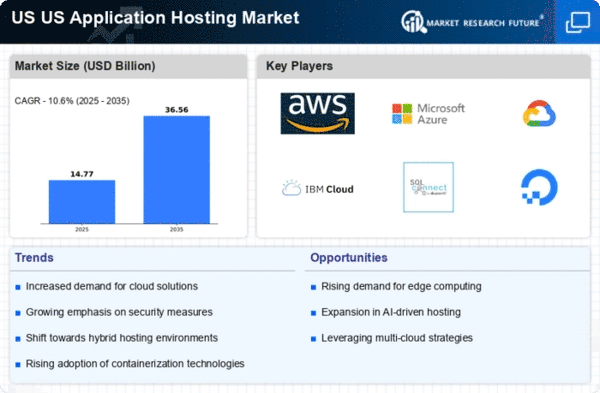
US Application Hosting Market Infographic
Purchase Options

US Application Hosting Market Summary

As per analysis, the US Application Hosting Market is projected to grow from USD 13.35 Billion in 2024 to USD 36.56 Billion by 2035, exhibiting a compound annual growth rate (CAGR) of 9.59% during the forecast period (2025 - 2035).

Key Market Trends & Highlights

The US Application Hosting Market is experiencing robust growth driven by cloud adoption and evolving security needs.

  • The Web Hosting segment remains the largest, catering to diverse business needs across various industries.
  • E-commerce Hosting is the fastest-growing segment, reflecting the increasing shift towards online retail and digital transactions.
  • Public Cloud continues to dominate the market, while Hybrid Cloud solutions are rapidly gaining traction due to their flexibility.
  • Key market drivers include the increased demand for scalability and a growing emphasis on security solutions.

Market Size & Forecast

2024 Market Size 13.35 (USD Billion)
2035 Market Size 36.56 (USD Billion)
CAGR (2025 - 2035) 9.59%

Major Players

Amazon Web Services (US), Microsoft Azure (US), Google Cloud (US), IBM Cloud (US), Oracle Cloud (US), DigitalOcean (US), Rackspace (US), Linode (US), Heroku (US)

Our Impact
Enabled $4.3B Revenue Impact for Fortune 500 and Leading Multinationals
Partnering with 2000+ Global Organizations Each Year
30K+ Citations by Top-Tier Firms in the Industry

US Application Hosting Market Trends

The US Application Hosting Market is currently experiencing a dynamic evolution, driven by the increasing demand for cloud-based solutions and the need for businesses to enhance their operational efficiency. Organizations across various sectors are increasingly migrating their applications to hosted environments, which offer scalability, flexibility, and cost-effectiveness. This shift is largely influenced by the growing reliance on digital transformation initiatives, as companies seek to modernize their IT infrastructure and improve service delivery. Furthermore, the rise of remote work and the necessity for robust cybersecurity measures are propelling the adoption of application hosting services. As a result, service providers are continuously innovating to meet the diverse needs of their clients, leading to a competitive landscape characterized by rapid technological advancements. In addition, the regulatory environment in the United States plays a crucial role in shaping the application hosting landscape. Compliance with data protection laws and industry-specific regulations is paramount for organizations, which often necessitates the selection of hosting solutions that ensure data security and privacy. This has led to an increased focus on hybrid and multi-cloud strategies, allowing businesses to optimize their hosting environments while adhering to compliance requirements. Overall, the US Application Hosting Market appears poised for sustained growth, as organizations increasingly recognize the strategic advantages of leveraging hosted solutions to drive their digital agendas.

Cloud Adoption Accelerates

The trend towards cloud adoption continues to gain momentum within the US Application Hosting Market. Businesses are increasingly recognizing the benefits of cloud-based hosting solutions, which provide enhanced scalability and flexibility. This shift is driven by the need for organizations to adapt quickly to changing market conditions and customer demands.

Focus on Security and Compliance

As data breaches and cyber threats become more prevalent, the emphasis on security and compliance within the US Application Hosting Market intensifies. Organizations are prioritizing hosting solutions that offer robust security features and adhere to regulatory standards, ensuring the protection of sensitive information and maintaining customer trust.

Rise of Hybrid Hosting Solutions

The demand for hybrid hosting solutions is on the rise in the US Application Hosting Market. Companies are increasingly adopting hybrid models that combine on-premises infrastructure with cloud services. This approach allows organizations to optimize their resources, enhance performance, and maintain control over critical applications.

US Application Hosting Market Drivers

Adoption of Managed Services

The US Application Hosting Market is increasingly characterized by the adoption of managed services. Organizations are recognizing the benefits of outsourcing their application hosting needs to specialized providers, allowing them to focus on core business functions. Recent data suggests that nearly 55 percent of US companies are opting for managed hosting solutions to enhance operational efficiency. This trend is driven by the desire for expert management of complex hosting environments, which can be resource-intensive. Managed services offer businesses access to advanced technologies and skilled personnel, reducing the burden on internal IT teams. Consequently, this shift is reshaping the competitive landscape, as hosting providers that offer comprehensive managed services are likely to gain a competitive edge in the market.

Increased Demand for Scalability

The US Application Hosting Market is experiencing a notable surge in demand for scalable solutions. As businesses increasingly seek to adapt to fluctuating workloads, the ability to scale applications seamlessly has become paramount. According to recent data, approximately 70 percent of US enterprises prioritize scalability in their hosting solutions. This trend is driven by the need for agility in operations, allowing organizations to respond swiftly to market changes. Furthermore, the rise of e-commerce and digital services has intensified the requirement for hosting providers to offer flexible resources. Consequently, companies are gravitating towards application hosting services that can accommodate growth without compromising performance. This shift not only enhances operational efficiency but also positions businesses to capitalize on emerging opportunities in the digital landscape.

Shift Towards Green Hosting Solutions

The US Application Hosting Market is witnessing a notable shift towards green hosting solutions. As environmental concerns gain prominence, businesses are increasingly seeking hosting providers that prioritize sustainability. Recent surveys indicate that approximately 45 percent of US companies consider eco-friendly practices when selecting an application hosting service. This trend is driven by a growing awareness of the environmental impact of data centers and the desire to reduce carbon footprints. Hosting providers are responding by adopting energy-efficient technologies and utilizing renewable energy sources. This shift not only aligns with corporate social responsibility goals but also appeals to environmentally conscious consumers. As the demand for green hosting solutions continues to rise, it is likely to influence the competitive dynamics of the US Application Hosting Market.

Growing Emphasis on Security Solutions

In the current landscape, the US Application Hosting Market is witnessing an increasing emphasis on security solutions. With the proliferation of cyber threats, organizations are prioritizing the protection of sensitive data and applications. Recent statistics indicate that over 60 percent of US businesses consider security a critical factor when selecting an application hosting provider. This heightened focus on security is prompting hosting companies to invest in advanced security measures, including encryption, firewalls, and compliance with industry regulations. As a result, the market is evolving to meet the stringent security requirements of various sectors, including finance and healthcare. This trend not only enhances customer trust but also ensures compliance with regulatory frameworks, thereby fostering a more secure hosting environment.

Integration of Artificial Intelligence

The integration of artificial intelligence (AI) is emerging as a transformative driver in the US Application Hosting Market. Hosting providers are increasingly leveraging AI technologies to optimize performance, enhance security, and improve customer experiences. Recent analyses indicate that AI-driven solutions can reduce operational costs by up to 30 percent for hosting companies. This trend is particularly relevant as businesses seek to harness the power of data analytics and automation. By incorporating AI into their hosting services, providers can offer predictive analytics, automated scaling, and enhanced security protocols. This not only streamlines operations but also positions hosting companies as innovative leaders in a competitive market. As AI continues to evolve, its impact on the application hosting landscape is expected to grow, potentially reshaping service offerings.


Market Segment Insights

By Application: Web Hosting (Largest) vs. E-commerce Hosting (Fastest-Growing)

In the US Application Hosting Market, Web Hosting commands the largest share, serving as the backbone for countless businesses establishing their online presence. Following closely, Database Hosting and Application Development have significant portions of the market, catering to the increasing demand for data management and software solutions. Content Management solutions also play a crucial role, facilitating dynamic content delivery for businesses, while E-commerce Hosting is swiftly gaining traction, driven by the booming online retail sector. The growth trajectory in this segment is heavily influenced by the rapid digital transformation many businesses are undertaking. As companies migrate to cloud-based solutions and prioritize scalable, reliable hosting services, E-commerce Hosting emerges as a key player, reflecting consumer behavior shifting towards online shopping. The importance of robust security measures and customized hosting solutions further fuels demand, especially for sectors relying on extensive customer data management.

Web Hosting (Dominant) vs. E-commerce Hosting (Emerging)

Web Hosting stands out as the dominant player in the US Application Hosting Market, offering essential services that support a diverse array of businesses. Its extensive service offerings encompass shared, dedicated, and VPS hosting, making it adaptable to both small startups and large enterprises. On the other hand, E-commerce Hosting, labeled as an emerging segment, addresses the growing need for tailored hosting solutions specifically designed for online retail platforms. This niche requires enhanced security, increased uptime, and specific payment processing integrations, thereby creating a unique market position. As more retailers pivot to online sales, E-commerce Hosting solutions are becoming increasingly sophisticated, featuring user-friendly interfaces and scalable resources that evolve in tandem with market demands. The distinction between these two segments highlights the essential foundation that Web Hosting provides, while also recognizing E-commerce Hosting's rapid development in response to changing consumer behaviors.

By Deployment Model: Public Cloud (Largest) vs. Hybrid Cloud (Fastest-Growing)

In the US Application Hosting Market, the deployment model segment is characterized by a diverse distribution of shares among Public Cloud, Private Cloud, Hybrid Cloud, and On-Premises options. Among these, the Public Cloud remains the largest segment, benefiting from wide acceptance due to its scalability, cost-effectiveness, and ease of implementation. On the other hand, the Private Cloud is favored by organizations requiring enhanced security and control, while Hybrid Cloud is rapidly gaining traction as it combines the benefits of both Public and Private Clouds, offering flexibility.

Public Cloud (Dominant) vs. Hybrid Cloud (Emerging)

The Public Cloud continues to dominate the US Application Hosting Market due to its extensive features, such as scalability, robust infrastructure, and lower operational costs. Major players in this sector leverage advanced technologies and invest heavily in data center capabilities, ensuring high availability and performance. Alternatively, the Hybrid Cloud is emerging as a preferred solution for businesses looking for a balance between public and private infrastructure. This model enables organizations to leverage both environments for varying workloads, ensuring flexibility, improved compliance, and enhanced security, thus appealing to firms embracing digital transformation.

By End User: Small and Medium Enterprises (Largest) vs. Large Enterprises (Fastest-Growing)

In the US Application Hosting Market, small and medium enterprises (SMEs) hold the largest share, driven by their need for cost-effective, scalable hosting solutions that can adapt to their evolving demands. Their adoption of cloud technologies and application hosting services has surged, allowing them to compete effectively with larger firms. On the other hand, large enterprises are not far behind, showcasing robust growth trends as they migrate to more integrated and advanced hosting solutions to optimize their operations and improve performance. This competition between SMEs and large enterprises shapes the landscape of application hosting services.

Small and Medium Enterprises: Dominant vs. Large Enterprises: Emerging

The small and medium enterprises segment in the US Application Hosting Market is characterized by its high demand for flexible and budget-friendly hosting solutions. SMEs prioritize quick deployments and agile solutions that enable them to scale operations without substantial upfront capital. In contrast, large enterprises are rapidly moving towards more sophisticated hosting services that offer enhanced security, compliance, and support for their complex operational environments. While SMEs focus on affordability and customization, large enterprises leverage advanced technologies and vendor partnerships to innovate and streamline their applications, marking a clear distinction in their hosting requirements and market strategies.

By Service Type: Software as a Service (Largest) vs. Managed Hosting (Fastest-Growing)

In the US Application Hosting Market, the service type segment showcases distinct preferences among businesses. Software as a Service (SaaS) holds a significant market share, appealing to companies seeking scalable and cost-effective solutions. On the other hand, Infrastructure as a Service (IaaS) and Platform as a Service (PaaS) also cater to a niche audience with specialized needs. Managed Hosting rounds out this segment, providing dedicated resources for clients looking for enhanced performance and support. The growth trajectory of the service type segment is driven by the increasing demand for cloud-based solutions. The proliferation of remote work and the necessity for real-time collaboration have propelled the SaaS sector, establishing it as a staple for businesses. Meanwhile, Managed Hosting is witnessing rapid adoption as companies aim for robust and secure hosting solutions amidst growing cybersecurity concerns.

Software as a Service (Dominant) vs. Managed Hosting (Emerging)

Software as a Service (SaaS) continues to dominate the US Application Hosting Market due to its flexibility and user-centric approach, catering to a vast array of business applications from CRM to project management. The ability to access software over the cloud eliminates the need for substantial upfront investment, making it a viable option for both small businesses and large enterprises. In contrast, Managed Hosting is emerging as a popular choice among businesses that prioritize controlled environments with dedicated resources. By offering tailored solutions, enhanced security, and compliance capabilities, Managed Hosting attracts organizations seeking seamless management of critical applications. As the digital landscape evolves, both segments cater to unique user needs, shaping the overall growth of the application hosting market.

By Industry Vertical: Healthcare (Largest) vs. Finance (Fastest-Growing)

In the US Application Hosting Market, the distribution of market share among industry verticals reveals that the healthcare sector holds the largest share, driven by an increasing demand for secure and reliable application hosting solutions. The retail and telecommunications sectors also contribute significantly, while finance is emerging as a prominent player due to regulatory requirements and the necessity for enhanced security measures to safeguard sensitive information. Growth trends indicate that the finance vertical is the fastest-growing segment, fueled by digital transformation initiatives and the shift towards cloud-based solutions. The healthcare sector continues to innovate with telehealth services and electronic health record systems, while retail is adapting to changing consumer behaviors with improved digital experiences. Telecommunications is enhancing its application hosting capabilities to support a surge in connectivity requirements, making it a competitive segment as well.

Healthcare (Dominant) vs. Finance (Emerging)

The healthcare sector is characterized by stringent regulatory standards that necessitate robust application hosting solutions to ensure data confidentiality and accessibility. Major players in this segment focus on providing HIPAA-compliant services and innovative solutions that meet the ever-growing demand for telemedicine and patient engagement tools. In contrast, the finance sector is rapidly evolving, with firms prioritizing security and efficiency in application hosting to comply with industry regulations and to provide better services to customers. This sector's continual adoption of modern technologies, such as AI and blockchain, highlights its emerging status within the market as it adapts to meet the requirements of a digital economy.

Get more detailed insights about US Application Hosting Market

Key Players and Competitive Insights

The Application Hosting Market in the US is characterized by a dynamic competitive landscape, driven by rapid technological advancements and increasing demand for cloud-based solutions. Major players such as Amazon Web Services (US), Microsoft Azure (US), and Google Cloud (US) are at the forefront, leveraging their extensive infrastructure and innovative capabilities to capture market share. These companies focus on enhancing their service offerings through continuous innovation, strategic partnerships, and regional expansion, thereby shaping a competitive environment that is both robust and evolving.

Key business tactics employed by these companies include optimizing supply chains and localizing services to better meet customer needs. The market structure appears moderately fragmented, with a mix of established giants and emerging players. This fragmentation allows for diverse service offerings, yet the collective influence of key players like IBM Cloud (US) and Oracle Cloud (US) ensures that competition remains intense, pushing all participants to innovate and improve their service delivery.

In December 2025, Amazon Web Services (US) announced the launch of its new serverless computing platform, which aims to enhance scalability and reduce operational costs for businesses. This strategic move is significant as it positions AWS to better compete against rivals by offering more flexible and cost-effective solutions, thereby attracting a broader customer base. The introduction of this platform could potentially redefine how businesses approach application hosting, emphasizing efficiency and adaptability.

In November 2025, Microsoft Azure (US) expanded its partnership with a leading telecommunications provider to enhance its edge computing capabilities. This collaboration is crucial as it allows Microsoft to extend its reach into new markets while providing customers with faster and more reliable services. The strategic importance of this partnership lies in its potential to drive innovation in application hosting, particularly for industries requiring low-latency solutions.

In October 2025, Google Cloud (US) unveiled a new suite of AI-driven tools designed to optimize application performance and security. This initiative reflects a growing trend towards integrating artificial intelligence into hosting services, which could significantly enhance user experience and operational efficiency. The strategic importance of this development is underscored by the increasing demand for intelligent solutions that can adapt to changing business needs.

As of January 2026, current competitive trends in the Application Hosting Market are heavily influenced by digitalization, sustainability initiatives, and the integration of AI technologies. Strategic alliances are becoming increasingly vital, as companies seek to leverage complementary strengths to enhance their service offerings. Looking ahead, competitive differentiation is likely to evolve from traditional price-based competition to a focus on innovation, technological advancements, and supply chain reliability, suggesting a transformative shift in how companies position themselves in the market.

Key Companies in the US Application Hosting Market include

Future Outlook

US Application Hosting Market Future Outlook

The US Application Hosting Market is projected to grow at a 9.59% CAGR from 2025 to 2035, driven by cloud adoption, digital transformation, and increased demand for scalable solutions.

New opportunities lie in:

  • Development of hybrid cloud solutions for enhanced flexibility
  • Expansion of managed hosting services targeting SMEs
  • Integration of AI-driven analytics for performance optimization

By 2035, the market is expected to be robust, reflecting substantial growth and innovation.

Market Segmentation

US Application Hosting Market End User Outlook

  • Small and Medium Enterprises
  • Large Enterprises
  • Government Organizations
  • Educational Institutions

US Application Hosting Market Application Outlook

  • Web Hosting
  • Database Hosting
  • Application Development
  • Content Management
  • E-commerce Hosting

US Application Hosting Market Service Type Outlook

  • Infrastructure as a Service
  • Platform as a Service
  • Software as a Service
  • Managed Hosting

US Application Hosting Market Deployment Model Outlook

  • Public Cloud
  • Private Cloud
  • Hybrid Cloud
  • On-Premises

US Application Hosting Market Industry Vertical Outlook

  • Healthcare
  • Retail
  • Finance
  • Telecommunications

Report Scope

MARKET SIZE 202413.35(USD Billion)
MARKET SIZE 202514.77(USD Billion)
MARKET SIZE 203536.56(USD Billion)
COMPOUND ANNUAL GROWTH RATE (CAGR)9.59% (2024 - 2035)
REPORT COVERAGERevenue Forecast, Competitive Landscape, Growth Factors, and Trends
BASE YEAR2024
Market Forecast Period2025 - 2035
Historical Data2019 - 2024
Market Forecast UnitsUSD Billion
Key Companies ProfiledAmazon Web Services (US), Microsoft Azure (US), Google Cloud (US), IBM Cloud (US), Oracle Cloud (US), DigitalOcean (US), Rackspace (US), Linode (US), Heroku (US)
Segments CoveredApplication, Deployment Model, End User, Service Type, Industry Vertical
Key Market OpportunitiesGrowing demand for cloud-native applications drives innovation in the US Application Hosting Market.
Key Market DynamicsRising demand for cloud-based solutions drives competition and innovation in the US Application Hosting Market.
Countries CoveredUS
Leave a Comment

FAQs

What is the current valuation of the US Application Hosting Market?

The US Application Hosting Market was valued at 13.35 USD Billion in 2024.

What is the projected market size for the US Application Hosting Market by 2035?

The market is projected to reach 36.56 USD Billion by 2035.

What is the expected CAGR for the US Application Hosting Market during the forecast period?

The expected CAGR for the market from 2025 to 2035 is 9.59%.

Which companies are the key players in the US Application Hosting Market?

Key players include Amazon Web Services, Microsoft Azure, Google Cloud, IBM Cloud, and Oracle Cloud.

What are the main segments of the US Application Hosting Market?

The main segments include Web Hosting, Database Hosting, Application Development, and E-commerce Hosting.

How does the market perform in terms of deployment models?

The market segments by deployment model include Public Cloud, Private Cloud, Hybrid Cloud, and On-Premises.

What is the market size for Software as a Service in the US Application Hosting Market?

Software as a Service was valued at 5.0 USD Billion in 2024 and is expected to grow significantly.

What is the market size for large enterprises in the US Application Hosting Market?

Large enterprises accounted for 5.0 USD Billion in 2024, with growth anticipated in the coming years.

Which industry verticals are driving growth in the US Application Hosting Market?

Key industry verticals include Healthcare, Finance, Retail, and Telecommunications.

What is the expected growth for small and medium enterprises in the US Application Hosting Market?

Small and medium enterprises were valued at 3.5 USD Billion in 2024 and are projected to expand to 9.8 USD Billion by 2035.

Download Free Sample

Kindly complete the form below to receive a free sample of this Report

Compare Licence

×
Features License Type
Single User Multiuser License Enterprise User
Price $4,950 $5,950 $7,250
Maximum User Access Limit 1 User Upto 10 Users Unrestricted Access Throughout the Organization
Free Customization
Direct Access to Analyst
Deliverable Format
Platform Access
Discount on Next Purchase 10% 15% 15%
Printable Versions