×
Request Free Sample ×

Kindly complete the form below to receive a free sample of this Report

* Please use a valid business email

Leading companies partner with us for data-driven Insights

clients tt-cursor
Hero Background
English
Chinese
French
Japanese
Korean
German
Spanish

US Antimicrobial Plastics Market Trends

ID: MRFR/CnM/12430-HCR
111 Pages
Chitranshi Jaiswal
February 2026

US Antimicrobial Plastics Market Research Report Information By Additive (Inorganic (Silver, Zinc, Copper) and Organic (ОВРА, Triclosan)), By Type (Commodity Plastics (PP, PE, PVC, PS, PMMA, PET, PUR) and Engineering Plastics (ABS, PC, PA, POM, Others)), By Application (Packaging, Medical & Healthcare, Automotive, Building & Construction, Consumer Goods, and Others), - Market Forecast Till 2035

Share:
Download PDF ×

We do not share your information with anyone. However, we may send you emails based on your report interest from time to time. You may contact us at any time to opt-out.

US Antimicrobial Plastics Market Infographic
Purchase Options

Market Trends

Key Emerging Trends in the US Antimicrobial Plastics Market

The US Antimicrobial Plastics Market is currently experiencing notable trends that underscore the increasing importance of hygiene and safety in various industries. One prominent trend is the growing demand for antimicrobial plastics in the healthcare sector. With a heightened emphasis on infection control and prevention, antimicrobial plastics are being utilized in the manufacturing of medical devices, equipment, and surfaces to inhibit the growth of harmful microorganisms. This trend is driven by the ongoing efforts to maintain aseptic environments in healthcare facilities, reducing the risk of healthcare-associated infections and enhancing patient safety.

Moreover, the consumer goods and packaging industry is contributing to the momentum of the US Antimicrobial Plastics Market. Antimicrobial additives and technologies are being incorporated into plastic packaging materials to extend the shelf life of food products and prevent the growth of bacteria on surfaces. This trend aligns with the consumer demand for food safety and packaging solutions that enhance product freshness and quality. The use of antimicrobial plastics in consumer goods reflects a broader awareness of hygiene considerations in everyday products.

Technological advancements in antimicrobial additives are shaping market trends. Innovations such as silver-based compounds, quaternary ammonium compounds, and other antimicrobial agents are being integrated into plastic formulations to provide effective and long-lasting protection against bacteria, viruses, and fungi. This trend is crucial for meeting the evolving requirements of industries where maintaining a clean and hygienic environment is paramount, such as in healthcare, food processing, and packaging.

The ongoing global health challenges, including the COVID-19 pandemic, have accelerated the adoption of antimicrobial plastics. The heightened awareness of the importance of surface hygiene and the transmission of pathogens has led to increased demand for plastics with antimicrobial properties. Industries such as transportation, hospitality, and public spaces are incorporating antimicrobial plastics in high-touch surfaces to reduce the risk of surface-mediated transmission of infections, contributing to a safer and more hygienic environment.

E-commerce is influencing the distribution channels of antimicrobial plastic products in the US. The convenience of online platforms for product discovery, comparison, and purchase is reshaping the buying behavior of consumers and businesses. Manufacturers of antimicrobial plastics are adapting to this trend by enhancing their online presence, providing detailed product information, and offering efficient delivery services. The accessibility of antimicrobial plastic products through e-commerce platforms contributes to increased market awareness and ease of procurement.

Sustainability considerations are becoming a significant factor in shaping market dynamics in the US Antimicrobial Plastics Market. As the industry focuses on developing environmentally friendly solutions, there is an increasing demand for sustainable antimicrobial additives and biodegradable plastics. This trend aligns with the broader movement towards eco-conscious practices in plastic manufacturing, aiming to reduce the environmental impact of antimicrobial plastic products.

Regulatory considerations and standards are playing a pivotal role in shaping market trends. Compliance with safety and quality standards is essential for antimicrobial plastic manufacturers, especially in industries like healthcare where stringent regulations govern the use of materials. The industry actively engages with regulatory bodies to ensure that antimicrobial plastics meet or exceed the required standards, providing assurances to consumers, businesses, and regulatory authorities about the safety and efficacy of antimicrobial plastic applications.

Strategic collaborations and partnerships are emerging as trends in the US Antimicrobial Plastics Market. Companies are exploring synergies through joint ventures, alliances, and collaborations to enhance research, development, and commercialization efforts. The collaborative approach allows for the exchange of expertise, resources, and market insights, fostering innovation and ensuring the continuous growth of the antimicrobial plastics industry.

Author
Chitranshi Jaiswal
Team Lead - Research

Chitranshi is a Team Leader in the Chemicals & Materials (CnM) and Energy & Power (EnP) domains, with 6+ years of experience in market research. She leads and mentors teams to deliver cross-domain projects that equip clients with actionable insights and growth strategies. She is skilled in market estimation, forecasting, competitive benchmarking, and both primary & secondary research, enabling her to turn complex data into decision-ready insights. An engineer and MBA professional, she combines technical expertise with strategic acumen to solve dynamic market challenges. Chitranshi has successfully managed projects that support market entry, investment planning, and competitive positioning, while building strong client relationships. Certified in Advanced Excel & Power BI she leverages data-driven approaches to ensure accuracy, clarity, and impactful outcomes.

Leave a Comment

FAQs

What is the current valuation of the U.S. Antimicrobial Plastics Market?

<p>The U.S. Antimicrobial Plastics Market was valued at 9.121 USD Billion in 2024.</p>

What is the projected market size for the U.S. Antimicrobial Plastics Market by 2035?

<p>The market is projected to reach 21.71 USD Billion by 2035.</p>

What is the expected CAGR for the U.S. Antimicrobial Plastics Market during the forecast period?

<p>The expected CAGR for the market from 2025 to 2035 is 8.2%.</p>

Which companies are considered key players in the U.S. Antimicrobial Plastics Market?

<p>Key players include BASF SE, DuPont de Nemours Inc, Eastman Chemical Company, and others.</p>

What are the main segments of the U.S. Antimicrobial Plastics Market?

<p>The main segments include Additive, Type, and Application.</p>

What is the valuation range for the Additive segment in the U.S. Antimicrobial Plastics Market?

<p>The Additive segment is valued between 9.121 USD Billion and 21.71 USD Billion.</p>

How does the Commodity Plastics segment perform in the U.S. Antimicrobial Plastics Market?

<p>The Commodity Plastics segment is projected to grow from 5.0 USD Billion to 12.0 USD Billion.</p>

What applications are driving growth in the U.S. Antimicrobial Plastics Market?

<p>Key applications include Medical & Healthcare, Packaging, and Automotive.</p>

What is the projected valuation for the Medical & Healthcare application by 2035?

<p>The Medical & Healthcare application is expected to reach 5.5 USD Billion by 2035.</p>

How does the performance of Organic additives compare to Inorganic additives in the market?

<p>Organic additives are projected to grow from 5.621 USD Billion to 13.71 USD Billion, while Inorganic additives range from 3.5 USD Billion to 8.0 USD Billion.</p>

Who are the key players in the US Antimicrobial Plastics Market?

Major players in the US Antimicrobial Plastics Market include Polyone Corporation, Microban International, and BASF.

What amount is the Zinc additive segment expected to reach in 2035?

The Zinc additive segment is expected to reach a value of 100.0 million USD by 2035.

What are the key applications driving growth in the US Antimicrobial Plastics Market?

Key applications driving growth in the market include consumer goods, healthcare, and packaging.

What challenges does the US Antimicrobial Plastics Market face in the coming years?

Challenges in the market include regulatory hurdles and competition from alternative materials.

What impact do emerging trends have on the US Antimicrobial Plastics Market?

Emerging trends like sustainability and increased demand for hygiene products are positively impacting the market.

Market Summary

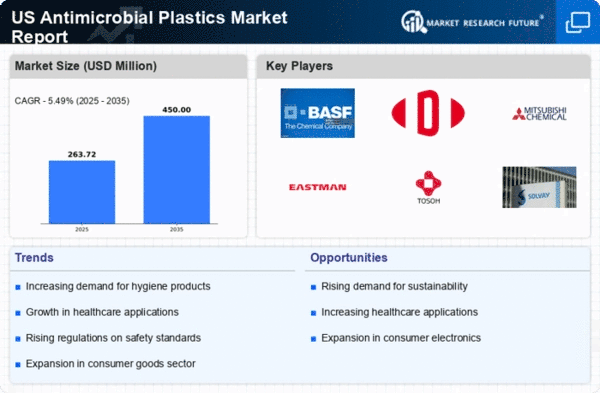
As per Market Research Future analysis, the US antimicrobial plastics market size was estimated at 250.0 USD Million in 2024. The US antimicrobial plastics market is projected to grow from 263.72 USD Million in 2025 to 450.0 USD Million by 2035, exhibiting a compound annual growth rate (CAGR) of 5.4% during the forecast period 2025 - 2035

Key Market Trends & Highlights

The US antimicrobial plastics market is experiencing robust growth driven by increasing demand across various sectors.

  • The healthcare sector emerges as the largest segment, reflecting a heightened focus on hygiene and infection control. Sustainability trends are influencing the market, with eco-friendly solutions gaining traction among consumers and manufacturers. Regulatory support is fostering innovation, as standards for antimicrobial properties become more stringent. Key market drivers include increased awareness of hygiene and rising demand in food packaging, which are shaping consumer preferences.

Market Size & Forecast

2024 Market Size 250.0 (USD Million)
2035 Market Size 450.0 (USD Million)
CAGR (2025 - 2035) 5.49%

Major Players

<p>BASF SE (DE), DuPont de Nemours Inc (US), Mitsubishi Chemical Corporation (JP), Eastman Chemical Company (US), Tosoh Corporation (JP), Solvay SA (BE), Covestro AG (DE), SABIC (SA), LG Chem Ltd (KR)</p>

Market Trends

The antimicrobial plastics market is experiencing notable growth, driven by increasing awareness regarding hygiene and the need for materials that can inhibit microbial growth. This trend is particularly relevant in sectors such as healthcare, food packaging, and consumer goods, where the presence of bacteria and other pathogens poses significant risks. The incorporation of antimicrobial agents into plastics not only enhances their durability but also extends their lifespan, making them more appealing to manufacturers and consumers alike. As a result, the demand for these specialized materials is likely to rise, reflecting a shift towards safer and more sustainable product options. Moreover, advancements in technology are facilitating the development of innovative antimicrobial solutions that are both effective and environmentally friendly. Regulatory bodies are also playing a crucial role in shaping the market landscape by establishing guidelines that promote the use of safer additives in plastic production. This regulatory support, combined with growing consumer preferences for antimicrobial properties in everyday products, suggests a robust future for the antimicrobial plastics market. As industries continue to prioritize health and safety, the integration of these materials into various applications appears to be a strategic move that aligns with broader public health goals.

Rising Demand in Healthcare Sector

The healthcare sector is increasingly adopting antimicrobial plastics due to their ability to reduce infection rates. Hospitals and clinics are utilizing these materials in medical devices, surfaces, and equipment to enhance patient safety and improve hygiene standards.

Sustainability and Eco-Friendly Solutions

There is a growing emphasis on sustainability within the antimicrobial plastics market. Manufacturers are exploring bio-based and biodegradable options that maintain antimicrobial properties while minimizing environmental impact, appealing to eco-conscious consumers.

Regulatory Support and Standards

Regulatory bodies are establishing guidelines that encourage the use of antimicrobial additives in plastics. This support is likely to drive innovation and compliance, ensuring that products meet safety and efficacy standards, thereby boosting market growth.

US Antimicrobial Plastics Market Market Drivers

Increasing Awareness of Hygiene

The U.S. Antimicrobial Plastics Market is experiencing a notable surge in demand driven by heightened awareness of hygiene and cleanliness. Consumers and businesses alike are increasingly prioritizing products that offer antimicrobial properties, particularly in environments such as hospitals, schools, and public spaces. This trend is reflected in market data, which indicates that the antimicrobial plastics segment is projected to grow at a compound annual growth rate of approximately 8% over the next five years. As awareness of the importance of hygiene continues to rise, manufacturers are likely to innovate and expand their product lines to meet consumer expectations, thereby further propelling the U.S. Antimicrobial Plastics Market.

Rising Demand in Consumer Goods

The U.S. Antimicrobial Plastics Market is witnessing a rising demand in the consumer goods sector, where antimicrobial properties are increasingly sought after in everyday products. From kitchenware to personal care items, consumers are becoming more conscious of the materials used in the products they purchase. This shift in consumer behavior is prompting manufacturers to incorporate antimicrobial technologies into their offerings, thereby enhancing product appeal and functionality. Market data indicates that the consumer goods segment is expected to grow steadily, driven by the increasing emphasis on health and wellness. As a result, the U.S. Antimicrobial Plastics Market is likely to benefit from this trend, with manufacturers focusing on innovation to meet evolving consumer preferences.

Regulatory Support and Standards

The U.S. Antimicrobial Plastics Market benefits from a robust framework of regulatory support and standards that promote the use of antimicrobial materials. Government agencies are increasingly recognizing the importance of antimicrobial plastics in various applications, particularly in healthcare and food packaging. This regulatory environment encourages manufacturers to invest in research and development, leading to the introduction of new and improved antimicrobial products. Furthermore, compliance with stringent safety and efficacy standards enhances consumer confidence, which is crucial for market growth. As a result, the U.S. Antimicrobial Plastics Market is likely to see sustained growth as regulations evolve to support innovation and safety.

Growth in the Food Packaging Sector

The U.S. Antimicrobial Plastics Market is significantly influenced by the growth in the food packaging sector, where antimicrobial plastics are increasingly utilized to extend shelf life and enhance food safety. With rising consumer demand for fresh and safe food products, manufacturers are adopting antimicrobial materials to prevent microbial contamination. Market data suggests that the food packaging segment is expected to account for a substantial share of the antimicrobial plastics market, driven by innovations in packaging technologies. This trend not only addresses consumer concerns regarding food safety but also aligns with the broader objectives of reducing food waste, thereby contributing to the overall growth of the U.S. Antimicrobial Plastics Market.

Technological Innovations in Material Science

Technological innovations in material science are playing a pivotal role in shaping the U.S. Antimicrobial Plastics Market. Advances in polymer chemistry and nanotechnology are enabling the development of more effective antimicrobial agents that can be integrated into plastic materials. These innovations not only enhance the performance of antimicrobial plastics but also expand their applications across various industries, including healthcare, consumer goods, and automotive. As manufacturers continue to explore new formulations and processing techniques, the U.S. Antimicrobial Plastics Market is poised for significant growth. The ability to create tailored solutions that meet specific industry needs is likely to drive further adoption of antimicrobial plastics.

Market Segment Insights

By Additive: Inorganic (Largest) vs. Organic (Fastest-Growing)

<p>In the U.S. Antimicrobial Plastics Market, the Inorganic additives, primarily consisting of silver, zinc, and copper, hold a significant share due to their proven efficacy in microbial resistance. These inorganic compounds leverage their natural properties to inhibit bacterial growth, making them a preferred choice in various industrial applications. Conversely, Organic additives like OVRAs and Triclosan are gaining momentum, appealing to manufacturers for their adaptability and effectiveness in diverse environments.</p>

<p>Inorganic (Dominant) vs. Organic (Emerging)</p>

<p>The Inorganic segment, particularly silver nanoparticles, is characterized by its robust antimicrobial properties and long-lasting effectiveness, positioning it as the dominant player in the market. Its widespread usage in medical devices, food packaging, and consumer products bolsters its market presence. On the other hand, Organic additives like OVRAs and Triclosan are emerging, driven by their versatility and ability to cater to varying manufacturing needs. They are becoming increasingly popular in personal care products and coatings, although regulatory scrutiny may hinder their growth in certain applications.</p>

By Type: Commodity Plastics (Largest) vs. Engineering Plastics (Fastest-Growing)

<p>In the U.S. Antimicrobial Plastics Market, commodity plastics such as PP, PE, PVC, PS, PMMA, PET, and PUR hold the largest market share. These materials are widely utilized in various applications due to their cost-effectiveness and availability. The adoption of antimicrobial properties in commodity plastics enhances their appeal in sectors requiring hygiene and safety, further fortifying their dominant position. Meanwhile, engineering plastics, including ABS, PC, PA, and POM, are gaining traction due to their superior strength and versatility. These materials cater to higher-performance applications, reflecting a growing trend among manufacturers seeking innovative solutions. The growth trends in this segment are driven by increasing health concerns and stringent regulations regarding hygiene and safety in several industries. The pandemic has made antimicrobial properties more appealing, especially in packaging and medical applications. As consumers become more informed about the benefits of antimicrobial plastics, demand continues to rise, and engineering plastics are becoming the fastest-growing segment due to their advanced features. Innovations in manufacturing technologies and material formulations are further propelling the growth of both commodity and engineering plastics, with a strong focus on sustainability and reducing environmental impact.</p>

<p>Commodity Plastics (Dominant) vs. Engineering Plastics (Emerging)</p>

<p>Commodity plastics are characterized by their mass production and low cost, making them the dominant segment in the U.S. Antimicrobial Plastics Market. These materials typically provide adequate resistance to microbial growth and are primarily used in everyday applications, from packaging to consumer goods. Their wide availability and established manufacturing processes allow for a robust supply chain. On the other hand, engineering plastics are emerging as critical players in the market, offering enhanced properties such as higher durability, chemical resistance, and thermal stability. As industries evolve and demand more specialized materials, engineering plastics are increasingly utilized in high-end applications, signaling a shift towards more sophisticated antimicrobial solutions.</p>

By Application: Packaging (Largest) vs. Medical & Healthcare (Fastest-Growing)

<p>In the U.S. Antimicrobial Plastics Market, the application segment reveals a diverse distribution of demand. Packaging leads as the largest segment, reflecting its critical role in maintaining product safety and shelf life. The demand for antimicrobial plastics in packaging is driven by the increased need for hygiene and safety across food and consumer goods. Following closely, the Medical & Healthcare sector has emerged as a dynamic segment, gaining traction due to the heightened focus on infection control and hygiene standards, particularly post-pandemic.</p>

<p>Packaging (Dominant) vs. Medical & Healthcare (Emerging)</p>

<p>The Packaging segment is the dominant force in the U.S. Antimicrobial Plastics Market, characterized by its extensive applications in food packaging, pharmaceuticals, and consumer goods. This segment thrives due to regulatory requirements for safety and the increasing consumer demand for materials that provide longer shelf life and enhanced protection against microbial contamination. Conversely, the Medical & Healthcare segment is emerging rapidly, bolstered by advancements in medical technology and heightened awareness around healthcare-associated infections. The rising utilization of antimicrobial plastics in medical devices, surgical instruments, and protective equipment underscores its significance as a vital area for growth. This segment's alignment with innovation and improvement in healthcare delivery further propels its upward trajectory.</p>

Get more detailed insights about US Antimicrobial Plastics Market Research Report - Forecast by 2035

Regional Insights

North America : Market Leader in Antimicrobial Plastics

The North American market for antimicrobial plastics is driven by increasing health awareness and stringent regulations regarding hygiene in various sectors, including healthcare and food packaging. The U.S. holds the largest market share at approximately 70%, followed by Canada at around 15%. Regulatory bodies are promoting the use of antimicrobial materials to enhance public health safety, further boosting demand. The competitive landscape is characterized by major players such as DuPont de Nemours Inc and Eastman Chemical Company, which are investing in innovative solutions to meet rising consumer expectations. The presence of established manufacturers and a robust distribution network enhances market accessibility. Additionally, ongoing research and development efforts are expected to introduce advanced antimicrobial technologies, solidifying North America's leadership in this sector.

Europe : Emerging Market with Growth Potential

Europe is witnessing a growing demand for antimicrobial plastics, driven by increasing regulations aimed at improving public health standards. The region is projected to hold a market share of approximately 20%, with Germany and the UK being the largest contributors. Regulatory frameworks, such as the EU Biocidal Products Regulation, are encouraging the adoption of antimicrobial materials in various applications, including medical devices and consumer goods. Leading countries in this market include Germany, the UK, and France, where key players like BASF SE and AkzoNobel N.V. are actively involved in product innovation. The competitive landscape is marked by collaborations between manufacturers and research institutions to develop advanced antimicrobial solutions. This synergy is expected to enhance product offerings and expand market reach across Europe.

Asia-Pacific : Rapidly Growing Antimicrobial Sector

The Asia-Pacific region is rapidly emerging as a significant player in the antimicrobial plastics market, driven by increasing industrialization and urbanization. Countries like China and Japan are leading the market, collectively holding around 15% of the global share. The rising awareness of hygiene and health standards, coupled with government initiatives promoting antimicrobial solutions, is fueling market growth in this region. China is the largest market, with a strong presence of local manufacturers and international players like Mitsubishi Chemical Corporation. The competitive landscape is evolving, with companies focusing on innovation and sustainability to meet consumer demands. As the region continues to develop, the demand for antimicrobial plastics in sectors such as healthcare, packaging, and automotive is expected to rise significantly, further enhancing market dynamics.

Middle East and Africa : Untapped Market with Potential

The Middle East and Africa region presents untapped opportunities in the antimicrobial plastics market, driven by increasing health concerns and a growing demand for hygiene products. The market share in this region is currently around 5%, with countries like South Africa and the UAE leading the way. Government initiatives aimed at improving healthcare infrastructure are expected to catalyze market growth in the coming years. The competitive landscape is still developing, with a mix of local and international players entering the market. Companies are focusing on establishing partnerships and collaborations to enhance their product offerings. As awareness of antimicrobial solutions increases, the demand for these materials in sectors such as healthcare and consumer goods is anticipated to grow, paving the way for future market expansion.

Key Players and Competitive Insights

The antimicrobial plastics market is currently characterized by a dynamic competitive landscape, driven by increasing demand for hygiene and safety across various sectors, including healthcare, food packaging, and consumer goods. Key players such as DuPont de Nemours Inc (US), BASF SE (DE), and Eastman Chemical Company (US) are actively shaping the market through strategic initiatives focused on innovation and sustainability. DuPont, for instance, emphasizes its commitment to developing advanced antimicrobial solutions that enhance product longevity and safety, thereby positioning itself as a leader in this niche. Meanwhile, BASF is leveraging its extensive research capabilities to introduce novel antimicrobial additives, which are expected to bolster its market share and enhance its competitive edge. In terms of business tactics, companies are increasingly localizing manufacturing to reduce lead times and optimize supply chains. This approach appears to be particularly effective in a moderately fragmented market, where the collective influence of key players can significantly impact pricing and availability. The competitive structure is evolving, with larger firms like Covestro AG (DE) and SABIC (SA) focusing on strategic partnerships and collaborations to enhance their product offerings and market reach.

In October Eastman Chemical Company (US) announced a partnership with a leading healthcare provider to develop antimicrobial plastics specifically designed for medical applications. This collaboration is likely to enhance Eastman's reputation in the healthcare sector, as it aligns with the growing demand for safe and effective materials in medical devices. The strategic importance of this partnership lies in its potential to open new revenue streams and solidify Eastman's position as a trusted supplier in a highly regulated industry.

In September DuPont de Nemours Inc (US) launched a new line of antimicrobial plastics that incorporate bio-based materials, reflecting a growing trend towards sustainability. This initiative not only addresses environmental concerns but also meets the increasing consumer demand for eco-friendly products. The introduction of these materials is expected to strengthen DuPont's market presence and appeal to environmentally conscious consumers, thereby enhancing its competitive positioning.

In August BASF SE (DE) expanded its production capacity for antimicrobial additives in North America, responding to the rising demand from various industries. This strategic move is indicative of BASF's commitment to maintaining a robust supply chain and ensuring product availability. By increasing production capacity, BASF is likely to enhance its competitive advantage and better serve its customers in a rapidly evolving market.

As of November the competitive trends in the antimicrobial plastics market are increasingly influenced by digitalization, sustainability, and the integration of advanced technologies such as AI. Strategic alliances are becoming more prevalent, as companies recognize the need to collaborate to innovate and meet evolving consumer demands. The shift from price-based competition to a focus on innovation and technology is evident, suggesting that future competitive differentiation will hinge on the ability to deliver reliable supply chains and cutting-edge solutions.

Key Companies in the US Antimicrobial Plastics Market include

Industry Developments

August 2020: The United States business A. Schulman, which specializes in tailored plastic compounds, was purchased by LyondellBasell Industries N.V. The goal of the acquisition was to increase LyondellBasell's market penetration and product line in the worldwide plastics sector.

Future Outlook

US Antimicrobial Plastics Market Future Outlook

<p>The antimicrobial plastics market is projected to grow at a 5.49% CAGR from 2025 to 2035, fueled by rising demand in healthcare, consumer goods, and food packaging.</p>

New opportunities lie in:

  • <p>Development of antimicrobial coatings for consumer electronics Expansion into biodegradable antimicrobial plastics for sustainable packaging Integration of smart technology in antimicrobial plastic products</p>

<p>By 2035, the market is expected to achieve substantial growth, driven by innovation and diverse applications.</p>

Market Segmentation

US Antimicrobial Plastics Market Type Outlook

  • Commodity Plastics
  • Engineering Plastics
  • Performance Plastics

US Antimicrobial Plastics Market Additive Outlook

  • Silver
  • Zinc
  • Oxybisphenoxarsine

US Antimicrobial Plastics Market Application Outlook

  • Packaging
  • Automotive
  • Healthcare
  • Medical

Report Scope

MARKET SIZE 2024 250.0(USD Million)
MARKET SIZE 2025 263.72(USD Million)
MARKET SIZE 2035 450.0(USD Million)
COMPOUND ANNUAL GROWTH RATE (CAGR) 5.49% (2025 - 2035)
REPORT COVERAGE Revenue Forecast, Competitive Landscape, Growth Factors, and Trends
BASE YEAR 2024
Market Forecast Period 2025 - 2035
Historical Data 2019 - 2024
Market Forecast Units USD Million
Key Companies Profiled BASF SE (DE), DuPont de Nemours Inc (US), Mitsubishi Chemical Corporation (JP), Eastman Chemical Company (US), Tosoh Corporation (JP), Solvay SA (BE), Covestro AG (DE), SABIC (SA), LG Chem Ltd (KR)
Segments Covered Application, Additive, Type
Key Market Opportunities Growing demand for sustainable antimicrobial plastics driven by environmental regulations and consumer preferences.
Key Market Dynamics Rising demand for antimicrobial plastics driven by stringent regulations and heightened consumer awareness of hygiene.
Countries Covered US

FAQs

What is the current valuation of the U.S. Antimicrobial Plastics Market?

<p>The U.S. Antimicrobial Plastics Market was valued at 9.121 USD Billion in 2024.</p>

What is the projected market size for the U.S. Antimicrobial Plastics Market by 2035?

<p>The market is projected to reach 21.71 USD Billion by 2035.</p>

What is the expected CAGR for the U.S. Antimicrobial Plastics Market during the forecast period?

<p>The expected CAGR for the market from 2025 to 2035 is 8.2%.</p>

Which companies are considered key players in the U.S. Antimicrobial Plastics Market?

<p>Key players include BASF SE, DuPont de Nemours Inc, Eastman Chemical Company, and others.</p>

What are the main segments of the U.S. Antimicrobial Plastics Market?

<p>The main segments include Additive, Type, and Application.</p>

What is the valuation range for the Additive segment in the U.S. Antimicrobial Plastics Market?

<p>The Additive segment is valued between 9.121 USD Billion and 21.71 USD Billion.</p>

How does the Commodity Plastics segment perform in the U.S. Antimicrobial Plastics Market?

<p>The Commodity Plastics segment is projected to grow from 5.0 USD Billion to 12.0 USD Billion.</p>

What applications are driving growth in the U.S. Antimicrobial Plastics Market?

<p>Key applications include Medical & Healthcare, Packaging, and Automotive.</p>

What is the projected valuation for the Medical & Healthcare application by 2035?

<p>The Medical & Healthcare application is expected to reach 5.5 USD Billion by 2035.</p>

How does the performance of Organic additives compare to Inorganic additives in the market?

<p>Organic additives are projected to grow from 5.621 USD Billion to 13.71 USD Billion, while Inorganic additives range from 3.5 USD Billion to 8.0 USD Billion.</p>

Who are the key players in the US Antimicrobial Plastics Market?

Major players in the US Antimicrobial Plastics Market include Polyone Corporation, Microban International, and BASF.

What amount is the Zinc additive segment expected to reach in 2035?

The Zinc additive segment is expected to reach a value of 100.0 million USD by 2035.

What are the key applications driving growth in the US Antimicrobial Plastics Market?

Key applications driving growth in the market include consumer goods, healthcare, and packaging.

What challenges does the US Antimicrobial Plastics Market face in the coming years?

Challenges in the market include regulatory hurdles and competition from alternative materials.

What impact do emerging trends have on the US Antimicrobial Plastics Market?

Emerging trends like sustainability and increased demand for hygiene products are positively impacting the market.

  1. EXECUTIVE SUMMARY
  2. MARKET INTRODUCTION
    1. Definition
    2. Scope of the Study
      1. Research Objective
      2. Assumptions
      3. Limitations
  3. RESEARCH METHODOLOGY
    1. Overview
    2. Data Mining
    3. Secondary Research
    4. Primary Research
      1. Primary Interviews and Information Gathering Process
      2. Breakdown of Primary Respondents
    5. Forecasting Model
    6. Market Size Estimation
      1. Bottom-Up Approach
      2. Top-Down Approach
    7. Data Triangulation
    8. Validation
  4. MARKET DYNAMICS
    1. Overview
    2. Drivers
    3. Restraints
    4. Opportunities
  5. MARKET FACTOR ANALYSIS
    1. Value Chain Analysis
    2. Porter’s Five Forces Analysis
      1. Bargaining Power of Suppliers
      2. Bargaining Power of Buyers
      3. Threat of New Entrants
      4. Threat of Substitutes
      5. Intensity of Rivalry
    3. COVID-19 Impact Analysis
      1. Market Impact Analysis
      2. Regional Impact
      3. Opportunity and Threat Analysis
  6. US Antimicrobial Plastics Market, BY ADDITIVE
    1. Overview
    2. Inorganic
      1. Silver
      2. Zinc
      3. Copper
    3. Organic
      1. ОВРА
      2. Triclosan
  7. US Antimicrobial Plastics Market, BY TYPE
    1. Overview
    2. Commodity Plastics
      1. PP
      2. PE
      3. PVC
      4. PS
      5. PMMA
      6. PET
      7. PUR
    3. Engineering Plastics
      1. ABS
      2. PC
      3. PA
      4. POM
      5. Others
  8. US Antimicrobial Plastics Market, BY APPLICATION
    1. Overview
    2. Packaging
    3. Medical & Healthcare
    4. Automotive
    5. Building & Construction
    6. Consumer Goods
    7. Others
  9. COMPETITIVE LANDSCAPE
    1. Overview
    2. Competitive Analysis
    3. Market Share Analysis
    4. Major Growth Strategy in the US Antimicrobial Plastics Market,
    5. Competitive Benchmarking
    6. Leading Players in Terms of Number of Developments in the US Antimicrobial Plastics Market,
    7. Key developments and Growth Strategies
      1. New Product Launch/Service Deployment
      2. Merger & Acquisitions
      3. Joint Ventures
    8. Major Players Financial Matrix
      1. Sales & Operating Income, 2022
      2. Major Players R&D Expenditure. 2022
  10. COMPANY PROFILES
    1. DuPont De Nemours, Inc. (US)
      1. Company Overview
      2. Financial Overview
      3. Products Offered
      4. Key Developments
      5. SWOT Analysis
      6. Key Strategies
    2. MICROBAN INTERNATIONAL (US)
      1. Company Overview
      2. Financial Overview
      3. Products Offered
      4. Key Developments
      5. SWOT Analysis
      6. Key Strategies
    3. BASF SE (Germany)
      1. Company Overview
      2. Financial Overview
      3. Products Offered
      4. Key Developments
      5. SWOT Analysis
      6. Key Strategies
    4. SANITIZED AG (GERMANY)
      1. Company Overview
      2. Financial Overview
      3. Products Offered
      4. Key Developments
      5. SWOT Analysis
      6. Key Strategies
    5. Biocote Limited (UK)
      1. Company Overview
      2. Financial Overview
      3. Products Offered
      4. Key Developments
      5. SWOT Analysis
      6. Key Strategies
    6. Avient Corporation (US)
      1. Company Overview
      2. Financial Overview
      3. Products Offered
      4. Key Developments
      5. SWOT Analysis
      6. Key Strategies
    7. KING PLASTIC CORPORATION (US)
      1. Company Overview
      2. Financial Overview
      3. Products Offered
      4. Key Developments
      5. SWOT Analysis
      6. Key Strategies
  11. APPENDIX
    1. References
    2. Related Reports
  12. LIST OF TABLES
  13. US ANTIMICROBIAL PLASTICS MARKET, SYNOPSIS, 2018-2032
  14. US ANTIMICROBIAL PLASTICS MARKET, ESTIMATES & FORECAST, 2018-2032 (USD BILLION)
  15. US Antimicrobial Plastics Market, BY ADDITIVE, 2018-2032 (USD BILLION)
  16. US Antimicrobial Plastics Market, BY TYPE, 2018-2032 (USD BILLION)
  17. US Antimicrobial Plastics Market, BY APPLICATION, 2018-2032 (USD BILLION)
  18. LIST OF FIGURES
  19. RESEARCH PROCESS
  20. MARKET STRUCTURE FOR THE US ANTIMICROBIAL PLASTICS MARKET
  21. MARKET DYNAMICS FOR THE US ANTIMICROBIAL PLASTICS MARKET
  22. US ANTIMICROBIAL PLASTICS MARKET, SHARE (%), BY ADDITIVE, 2022
  23. US ANTIMICROBIAL PLASTICS MARKET, SHARE (%), BY TYPE, 2022
  24. US ANTIMICROBIAL PLASTICS MARKET, SHARE (%), BY APPLICATION, 2022
  25. US ANTIMICROBIAL PLASTICS MARKET: COMPANY SHARE ANALYSIS, 2022 (%)
  26. DUPONT DE NEMOURS, INC. (US): FINANCIAL OVERVIEW SNAPSHOT
  27. DUPONT DE NEMOURS, INC. (US): SWOT ANALYSIS
  28. MICROBAN INTERNATIONAL (US): FINANCIAL OVERVIEW SNAPSHOT
  29. MICROBAN INTERNATIONAL (US): SWOT ANALYSIS
  30. BASF SE (GERMANY): FINANCIAL OVERVIEW SNAPSHOT
  31. BASF SE (GERMANY): SWOT ANALYSIS
  32. SANITIZED AG (GERMANY): FINANCIAL OVERVIEW SNAPSHOT
  33. SANITIZED AG (GERMANY): SWOT ANALYSIS
  34. BIOCOTE LIMITED (UK).: FINANCIAL OVERVIEW SNAPSHOT
  35. BIOCOTE LIMITED (UK).: SWOT ANALYSIS
  36. AVIENT CORPORATION (US): FINANCIAL OVERVIEW SNAPSHOT
  37. AVIENT CORPORATION (US): SWOT ANALYSIS
  38. KING PLASTIC CORPORATION (US): FINANCIAL OVERVIEW SNAPSHOT
  39. KING PLASTIC CORPORATION (US): SWOT ANALYSIS

US Antimicrobial Plastics Market Segmentation

Market Segmentation Overview

  • Detailed segmentation data will be available in the full report
  • Comprehensive analysis by multiple parameters
  • Regional and country-level breakdowns
  • Market size forecasts by segment
Infographic

Free Sample Request

Kindly complete the form below to receive a free sample of this Report

Get Free Sample

Customer Strories

Compare Licence

×
Features License Type
Single User Multiuser License Enterprise User
Price $4,950 $5,950 $7,250
Maximum User Access Limit 1 User Upto 10 Users Unrestricted Access Throughout the Organization
Free Customization
Direct Access to Analyst
Deliverable Format
Platform Access
Discount on Next Purchase 10% 15% 15%
Printable Versions