×
Request Free Sample ×

Kindly complete the form below to receive a free sample of this Report

* Please use a valid business email

Leading companies partner with us for data-driven Insights

clients tt-cursor
Hero Background

US Antimicrobial Packaging Market

ID: MRFR/PCM/18664-HCR
111 Pages
Snehal Singh
February 2026

US Antimicrobial Packaging Market Research Report By Type (Bags, Pouches, Carton Packages, Others), By Material (Plastic, Paper & Paperboard, Others) and By Application (Food & beverages, Healthcare, Personal Care, Others) - Forecast to 2035

Share:
Download PDF ×

We do not share your information with anyone. However, we may send you emails based on your report interest from time to time. You may contact us at any time to opt-out.

US Antimicrobial Packaging Market Infographic
Purchase Options

US Antimicrobial Packaging Market Summary

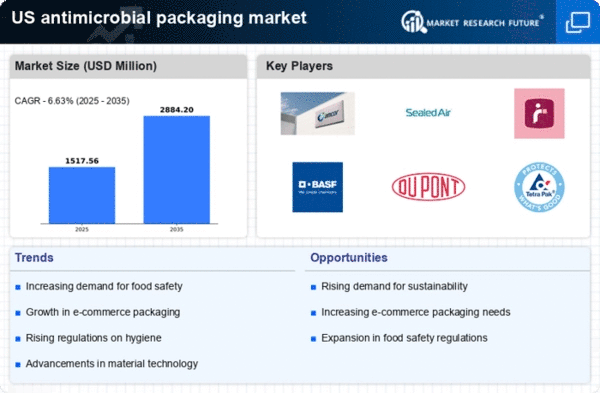
As per Market Research Future analysis, the US antimicrobial packaging market size was estimated at 1423.2 USD Million in 2024. The US antimicrobial packaging market is projected to grow from 1517.56 USD Million in 2025 to 2884.2 USD Million by 2035, exhibiting a compound annual growth rate (CAGR) of 6.6% during the forecast period 2025 - 2035

Key Market Trends & Highlights

The US antimicrobial packaging market is poised for growth driven by sustainability and technological innovation.

  • The largest segment in the US antimicrobial packaging market is the food packaging sector, which continues to expand due to rising consumer demand for safe and fresh products.
  • Technological advancements in materials are enhancing the effectiveness and functionality of antimicrobial packaging solutions.
  • The fastest-growing segment is healthcare packaging, reflecting the increasing need for sterile and safe medical supplies.
  • Key market drivers include rising consumer awareness regarding food safety and the growth in e-commerce and online retail, which necessitate effective packaging solutions.

Market Size & Forecast

2024 Market Size 1423.2 (USD Million)
2035 Market Size 2884.2 (USD Million)
CAGR (2025 - 2035) 6.63%

Major Players

Amcor (AU), Sealed Air (US), Mondi (GB), BASF (DE), DuPont (US), Tetra Pak (SE), Smurfit Kappa (IE), WestRock (US), Avery Dennison (US)

Our Impact
Enabled $4.3B Revenue Impact for Fortune 500 and Leading Multinationals
Partnering with 2000+ Global Organizations Each Year
30K+ Citations by Top-Tier Firms in the Industry

US Antimicrobial Packaging Market Trends

The antimicrobial packaging market is currently experiencing notable growth, driven by increasing consumer awareness regarding food safety and hygiene. This heightened focus on health has led to a rising demand for packaging solutions that can inhibit microbial growth, thereby extending shelf life and maintaining product integrity. Various industries, including food and beverage, pharmaceuticals, and personal care, are actively seeking innovative packaging materials that offer antimicrobial properties. As a result, manufacturers are investing in research and development to create advanced materials that meet these evolving consumer needs. Moreover, regulatory frameworks in the US are becoming more stringent, emphasizing the necessity for safe and effective packaging solutions. This regulatory landscape encourages companies to adopt antimicrobial technologies that comply with safety standards. The integration of sustainable practices within the antimicrobial packaging market is also gaining traction, as consumers increasingly prefer eco-friendly options. Consequently, the market is likely to witness a shift towards biodegradable and recyclable materials that do not compromise on antimicrobial efficacy. Overall, the current trends suggest a dynamic and rapidly evolving landscape, where innovation and compliance play crucial roles in shaping the future of packaging solutions.

Rising Demand for Sustainable Solutions

There is a growing trend towards eco-friendly materials in the antimicrobial packaging market. Consumers are increasingly concerned about environmental impact, prompting manufacturers to explore biodegradable and recyclable options that still provide effective antimicrobial properties.

Technological Advancements in Materials

Innovations in material science are driving the development of new antimicrobial packaging solutions. Enhanced technologies are enabling the creation of packaging that not only prevents microbial growth but also maintains product quality over extended periods.

Regulatory Compliance and Safety Standards

The regulatory environment is becoming more stringent, necessitating adherence to safety standards in packaging. Companies are focusing on developing antimicrobial solutions that comply with these regulations, ensuring consumer safety and product integrity.

US Antimicrobial Packaging Market Drivers

Increasing Consumer Awareness

The antimicrobial packaging market is experiencing growth due to rising consumer awareness regarding food safety and hygiene. As consumers become more informed about the risks associated with foodborne illnesses, they increasingly seek products that offer enhanced protection. This trend is particularly evident in the food and beverage sector, where antimicrobial packaging can significantly reduce microbial contamination. According to recent data, the demand for antimicrobial packaging solutions in the food industry is projected to grow at a CAGR of approximately 7.5% over the next five years. This heightened awareness is driving manufacturers to innovate and adopt antimicrobial technologies, thereby expanding the market's potential.

Regulatory Support for Food Safety

Regulatory support for food safety is a driving force behind the antimicrobial packaging market. Government agencies are increasingly implementing stringent regulations to ensure food safety and quality, which in turn encourages the adoption of antimicrobial packaging solutions. The Food and Drug Administration (FDA) has established guidelines that promote the use of materials that can inhibit microbial growth in food packaging. This regulatory framework is expected to bolster the market, as manufacturers align their practices with safety standards. The antimicrobial packaging market is likely to benefit from these regulations, fostering innovation and compliance in the industry.

Rising Demand in Healthcare Sector

The healthcare sector's increasing demand for antimicrobial packaging is significantly influencing the antimicrobial packaging market. With the growing emphasis on infection control and patient safety, healthcare providers are seeking packaging solutions that minimize contamination risks. Antimicrobial packaging is utilized for medical devices, pharmaceuticals, and other healthcare products to ensure sterility and safety. The healthcare packaging market is projected to grow at a CAGR of around 8% through 2026, indicating a robust demand for antimicrobial solutions. This trend underscores the importance of antimicrobial packaging in maintaining product integrity and safety in the healthcare industry.

Innovation in Packaging Technologies

Innovation in packaging technologies is a critical driver for the antimicrobial packaging market. Advances in materials science have led to the development of new antimicrobial agents and packaging formats that enhance product shelf life and safety. For instance, the incorporation of nanotechnology in packaging materials has shown promising results in effectively combating microbial growth. The market for antimicrobial packaging is expected to reach approximately $5 billion by 2026, driven by these technological advancements. As companies strive to differentiate their products, the integration of innovative antimicrobial solutions is likely to become a standard practice in the industry.

Growth in E-commerce and Online Retail

The surge in e-commerce and online retail is a notable driver for the antimicrobial packaging market. As more consumers opt for online shopping, the need for packaging that ensures product safety during transit becomes paramount. Antimicrobial packaging helps in maintaining the integrity of products, particularly perishables, by inhibiting microbial growth. The e-commerce sector in the US has seen a remarkable increase, with sales reaching over $900 billion in 2025. This growth necessitates the adoption of advanced packaging solutions, thereby propelling the demand for antimicrobial packaging in the logistics and supply chain sectors.


Market Segment Insights

By Application: Food Packaging (Largest) vs. Pharmaceutical Packaging (Fastest-Growing)

In the US antimicrobial packaging market, Food Packaging holds the largest share. This segment is driven by the increasing demand for longer shelf life and food safety. The popularity of convenience foods further fuels the growth of this segment, establishing Food Packaging as a cornerstone of the market. On the other hand, Pharmaceutical Packaging is the fastest-growing segment. The rising focus on healthcare and the necessity for advanced packaging solutions that meet regulatory compliance have accelerated its growth. This segment is characterized by the need for enhanced protection and patient safety, making it a critical area for innovation. Growth trends in the US antimicrobial packaging market reveal a shift towards sustainable practices across all applications. As consumers gravitate towards environmentally-friendly packaging, all segments are adapting by integrating biodegradable materials without sacrificing antimicrobial properties. The rise in e-commerce has also propelled the need for robust packaging solutions across all applications, particularly in Consumer Goods Packaging, which increasingly demands durability in transit. Furthermore, the ongoing impacts of the global pandemic have reinforced the importance of hygiene, thus driving investment in antimicrobial solutions across every sector.

Food Packaging (Dominant) vs. Medical Device Packaging (Emerging)

Food Packaging stands out as the dominant segment within the US antimicrobial packaging market due to its essential role in preserving food quality and safety. This segment leverages advanced materials and technologies to enhance user experience while maintaining food hygiene. In contrast, Medical Device Packaging represents an emerging segment that is gaining traction, fueled by increased healthcare regulations and the importance of sterility and safety in medical applications. As healthcare providers continue to emphasize patient safety and compliance, Medical Device Packaging is evolving to meet stringent standards, thereby expanding its market share. The development of innovative solutions, such as tamper-evident and easy-to-open packaging, highlights the sector's focus on both security and usability.

By Type: Active Packaging (Largest) vs. Intelligent Packaging (Fastest-Growing)

In the US antimicrobial packaging market, the segment distribution reveals Active Packaging as the clear leader, commanding a significant share due to its effectiveness in extending shelf life and preserving product quality. Intelligent Packaging, while currently smaller in share compared to Active Packaging, is rapidly gaining traction among manufacturers and consumers alike, largely driven by increased demand for smart features that help monitor freshness and provide real-time information. The trends within the segment indicate that Active Packaging is growing steadily as its applications in food packaging and pharmaceuticals thrive. Conversely, Intelligent Packaging is experiencing the fastest growth, fueled by technological advancements and consumer awareness regarding the benefits of real-time monitoring systems. This segment is expected to attract investments and innovation as companies seek to enhance user experience and trust in products.

Active Packaging (Dominant) vs. Intelligent Packaging (Emerging)

Active Packaging is characterized by its ability to interact with the contents it encloses, actively enhancing product life and safety through various mechanisms. This segment is widely adopted in sectors such as food, pharmaceuticals, and personal care due to its proven effectiveness and reliability. On the other hand, Intelligent Packaging, which encompasses advanced technologies such as sensors and indicators, is emerging as a complementary solution, offering consumers insights into product conditions. Although currently less established, the potential for Intelligent Packaging is immense, particularly as manufacturers adapt to the increasing demand for innovative products that boost consumer confidence and engagement. As technology advances, both segments are likely to co-evolve, positioning themselves as integral components of modern packaging solutions.

By Material: Plastic (Largest) vs. Paper and Paperboard (Fastest-Growing)

In the US antimicrobial packaging market, the distribution of market share among materials shows that plastic remains the largest segment, attributed to its versatility, durability, and cost-effectiveness. Following plastic, paper and paperboard are gaining traction due to their eco-friendly nature, attracting businesses aiming to enhance sustainability in packaging solutions. Metal and glass, though important, hold relatively smaller shares as they are often used for specific applications where higher protection is paramount. Growth trends indicate a favorable shift towards sustainable packaging solutions, with paper and paperboard quickly emerging as the fastest-growing segment. This shift is driven by increasing consumer awareness regarding environmental issues and a demand for recyclable and biodegradable materials. Moreover, innovations in antimicrobial coatings are being integrated into these materials, enhancing their appeal in the market and ensuring their relevance in diverse industries.

Plastic (Dominant) vs. Paper and Paperboard (Emerging)

Plastic packaging is currently the dominant force in the US antimicrobial packaging market, favored for its adaptability and ability to integrate advanced antimicrobial technologies. Its lightweight nature and resistance to moisture make it suitable for a wide range of products, appealing to manufacturers across various sectors. On the other hand, paper and paperboard are emerging as vital competitors, increasingly utilized in sectors that prioritize sustainability. Their production processes are becoming more eco-friendly, and advancements in coatings for antimicrobial properties are enhancing their market position. As companies focus on reducing their environmental footprint, the appeal of paper and paperboard continues to rise, positioning them as a strong alternative to traditional plastic packaging.

By End Use: Food Industry (Largest) vs. Healthcare Industry (Fastest-Growing)

The US antimicrobial packaging market exhibits a diverse distribution among its key end-use segments, with the food industry holding the largest market share. This dominance is attributed to the escalating demand for food safety and preservation, spurred by changing consumer preferences and regulatory frameworks. Meanwhile, the healthcare industry is rapidly gaining traction, reflecting increased investments in medical technology and a growing focus on infection control in healthcare settings. Growth trends within the US antimicrobial packaging market are primarily driven by innovations in materials and technologies, alongside heightened awareness of hygiene and safety. The healthcare industry's increasing adoption of antimicrobial packaging solutions is facilitating its rapid growth, making it the fastest-growing segment in the market. As the demand for durable and effective packaging solutions intensifies, both segments are poised for significant advancements in the coming years.

Food Industry: Dominant vs. Healthcare Industry: Emerging

The food industry remains the dominant force in the US antimicrobial packaging market, characterized by its extensive use of innovative packaging solutions that enhance food safety and longevity. Companies in this segment are increasingly leveraging antimicrobial technologies to tackle issues such as microbial contamination and spoilage, thereby boosting consumer confidence. On the other hand, the healthcare industry represents an emerging segment where the demand for antimicrobial packaging is driven by a significant increase in medical device packaging and pharmaceuticals. The rise in healthcare-associated infections has accelerated the need for effective antimicrobial solutions, presenting substantial opportunities for growth. Together, these segments illustrate the dynamic landscape of antimicrobial packaging, emphasizing the pivotal roles each play in meeting distinct consumer needs.

Get more detailed insights about US Antimicrobial Packaging Market

Key Players and Competitive Insights

The antimicrobial packaging market is currently characterized by a dynamic competitive landscape, driven by increasing consumer demand for food safety and longer shelf life. Key players such as Amcor (AU), Sealed Air (US), and DuPont (US) are strategically positioned to leverage innovation and sustainability in their offerings. Amcor (AU) focuses on developing advanced materials that enhance product protection while minimizing environmental impact. Sealed Air (US) emphasizes its commitment to smart packaging solutions that integrate technology for better supply chain management. Meanwhile, DuPont (US) is investing heavily in research and development to create next-generation antimicrobial solutions, which collectively shape a competitive environment that prioritizes innovation and sustainability.The market structure appears moderately fragmented, with several players vying for market share through localized manufacturing and optimized supply chains. Companies are increasingly localizing their production to reduce lead times and enhance responsiveness to regional market demands. This strategy not only improves operational efficiency but also allows for better alignment with local regulations and consumer preferences. The collective influence of these key players fosters a competitive atmosphere where agility and adaptability are paramount.

In September Sealed Air (US) announced a partnership with a leading technology firm to develop smart packaging solutions that utilize IoT technology for real-time monitoring of product conditions. This strategic move is likely to enhance the company's product offerings, providing customers with greater transparency and control over their supply chains. Such innovations may position Sealed Air (US) as a leader in the integration of technology within the antimicrobial packaging sector.

In October DuPont (US) unveiled a new line of antimicrobial films designed specifically for the food packaging industry. This launch is significant as it reflects the company's commitment to addressing the growing concerns around food safety and spoilage. By introducing these advanced materials, DuPont (US) not only strengthens its product portfolio but also reinforces its position as a key innovator in the market.

In August Amcor (AU) expanded its production capabilities in North America by investing in a new facility dedicated to sustainable packaging solutions. This expansion is indicative of Amcor's strategy to meet the rising demand for eco-friendly packaging options, aligning with global sustainability trends. Such initiatives may enhance the company's competitive edge by appealing to environmentally conscious consumers and businesses alike.

As of November current trends in the antimicrobial packaging market indicate a strong focus on digitalization, sustainability, and the integration of artificial intelligence. Strategic alliances among key players are shaping the landscape, fostering innovation and enhancing supply chain reliability. The competitive differentiation is likely to evolve from traditional price-based competition to a more nuanced approach that emphasizes technological advancements and sustainable practices. Companies that can effectively leverage these trends may secure a more favorable position in the market, ultimately driving growth and profitability.

Key Companies in the US Antimicrobial Packaging Market include

Industry Developments

The US Antimicrobial Packaging Market has witnessed significant developments recently, particularly in the realm of partnerships and innovations aimed at enhancing food safety and extending shelf life. In September 2023, Berry Global expanded its product line with the inclusion of advanced antimicrobial technologies, targeting the food and pharmaceutical sectors. Concurrently, Sealed Air introduced innovative antimicrobial packaging solutions designed for meat and dairy products, aimed at reducing spoilage. In terms of market dynamics, the acquisition trend has been notable, with Amcor acquiring a leading antimicrobial packaging startup in August 2023 to enhance its product offerings and address growing consumer demands.

Companies like BASF and DuPont are focusing on Research and Development to create more effective antimicrobial agents. The market is experiencing substantial growth, with a projection to reach USD 1.5 billion by 2025, largely driven by the increasing awareness of food safety and the need for longer product shelf life. Regulatory support for advanced packaging solutions is also a key factor influencing the sector's expansion. The US market remains a significant player globally, showcasing a vibrant ecosystem of major companies including 3M and Avery Dennison actively involved in antimicrobial advancements.

Future Outlook

US Antimicrobial Packaging Market Future Outlook

The antimicrobial packaging market is projected to grow at 6.63% CAGR from 2025 to 2035, driven by increasing consumer demand for food safety and sustainability.

New opportunities lie in:

  • Development of biodegradable antimicrobial films for food packaging
  • Integration of smart technology for real-time freshness monitoring
  • Expansion into e-commerce packaging solutions with antimicrobial properties

By 2035, the market is expected to achieve substantial growth, driven by innovation and evolving consumer preferences.

Market Segmentation

US Antimicrobial Packaging Market Type Outlook

  • Active Packaging
  • Intelligent Packaging
  • Traditional Packaging

US Antimicrobial Packaging Market End Use Outlook

  • Food Industry
  • Healthcare Industry
  • Cosmetics Industry

US Antimicrobial Packaging Market Material Outlook

  • Plastic
  • Paper and Paperboard
  • Metal
  • Glass

US Antimicrobial Packaging Market Application Outlook

  • Food Packaging
  • Pharmaceutical Packaging
  • Medical Device Packaging
  • Consumer Goods Packaging

Report Scope

MARKET SIZE 2024 1423.2(USD Million)
MARKET SIZE 2025 1517.56(USD Million)
MARKET SIZE 2035 2884.2(USD Million)
COMPOUND ANNUAL GROWTH RATE (CAGR) 6.63% (2025 - 2035)
REPORT COVERAGE Revenue Forecast, Competitive Landscape, Growth Factors, and Trends
BASE YEAR 2024
Market Forecast Period 2025 - 2035
Historical Data 2019 - 2024
Market Forecast Units USD Million
Key Companies Profiled Amcor (AU), Sealed Air (US), Mondi (GB), BASF (DE), DuPont (US), Tetra Pak (SE), Smurfit Kappa (IE), WestRock (US), Avery Dennison (US)
Segments Covered Application, Type, Material, End Use
Key Market Opportunities Growing demand for sustainable antimicrobial packaging solutions driven by consumer health awareness and environmental concerns.
Key Market Dynamics Rising consumer demand for sustainable solutions drives innovation in antimicrobial packaging technologies and materials.
Countries Covered US
Leave a Comment

FAQs

What is the expected market size of the US Antimicrobial Packaging Market in 2024?

The US Antimicrobial Packaging Market is expected to be valued at 2.5 billion USD in 2024.

What will be the market growth rate from 2025 to 2035?

The US Antimicrobial Packaging Market is projected to grow at a CAGR of 5.489 percent during the period from 2025 to 2035.

How much is the US Antimicrobial Packaging Market expected to be worth in 2035?

By 2035, the US Antimicrobial Packaging Market is anticipated to reach a valuation of 4.5 billion USD.

What are the projected market values for bags and pouches by 2035?

By 2035, bags are expected to be valued at 1.55 billion USD and pouches at 1.2 billion USD in the US Antimicrobial Packaging Market.

Who are the major players in the US Antimicrobial Packaging Market?

Some key players in the market include Berry Global, Sealed Air, BASF, and Sonoco Products.

What is the expected market size for carton packages in 2024?

The market size for carton packages in the US Antimicrobial Packaging Market is expected to be valued at 0.6 billion USD in 2024.

What opportunities are driving growth in the US Antimicrobial Packaging Market?

The increasing demand for food safety and shelf life extension are key growth drivers in the US Antimicrobial Packaging Market.

What is the market value expected for the 'others' segment by 2035?

The 'others' segment of the US Antimicrobial Packaging Market is expected to reach a value of 0.65 billion USD by 2035.

How does the growth of the US Antimicrobial Packaging Market compare across different segment types?

Bags and pouches are projected to be the leading segments in terms of growth throughout the forecast period from 2025 to 2035.

What challenges is the US Antimicrobial Packaging Market currently facing?

Challenges such as regulatory compliance and competition among key players are currently impacting the US Antimicrobial Packaging Market.

Download Free Sample

Kindly complete the form below to receive a free sample of this Report

Compare Licence

×
Features License Type
Single User Multiuser License Enterprise User
Price $4,950 $5,950 $7,250
Maximum User Access Limit 1 User Upto 10 Users Unrestricted Access Throughout the Organization
Free Customization
Direct Access to Analyst
Deliverable Format
Platform Access
Discount on Next Purchase 10% 15% 15%
Printable Versions