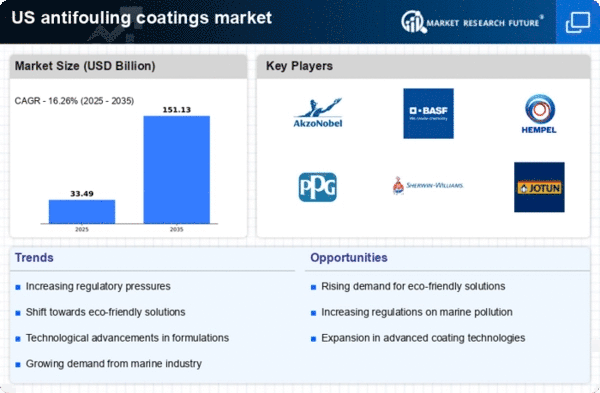
The antifouling coatings market is currently characterized by a competitive landscape that is both dynamic and multifaceted. Key growth drivers include increasing environmental regulations, the demand for sustainable solutions, and advancements in coating technologies. Major players such as PPG Industries (US), AkzoNobel (NL), and Sherwin-Williams (US) are strategically positioned to leverage these trends. PPG Industries (US) focuses on innovation and sustainability, emphasizing the development of eco-friendly products. AkzoNobel (NL) has been enhancing its operational focus on digital transformation and customer engagement, while Sherwin-Williams (US) is expanding its market presence through strategic acquisitions and partnerships. Collectively, these strategies shape a competitive environment that is increasingly oriented towards sustainability and technological advancement.In terms of business tactics, companies are localizing manufacturing to reduce lead times and optimize supply chains. The market structure appears moderately fragmented, with several key players holding substantial market shares. This fragmentation allows for a diverse range of products and innovations, although the influence of major companies remains significant in setting industry standards and trends.
In October PPG Industries (US) announced the launch of a new line of bio-based antifouling coatings designed to meet stringent environmental regulations. This strategic move not only aligns with the growing demand for sustainable products but also positions PPG as a leader in eco-friendly solutions within the market. The introduction of these coatings is likely to enhance PPG's competitive edge and appeal to environmentally conscious consumers.
In September AkzoNobel (NL) revealed its partnership with a leading technology firm to develop AI-driven solutions for optimizing coating applications. This collaboration is indicative of AkzoNobel's commitment to digital transformation and innovation. By integrating AI into its operations, the company aims to improve efficiency and reduce waste, which could significantly enhance its market position in the long term.
In August Sherwin-Williams (US) completed the acquisition of a regional coatings manufacturer, thereby expanding its product portfolio and market reach. This acquisition is strategically important as it allows Sherwin-Williams to tap into new customer segments and enhance its distribution capabilities. The move is expected to bolster the company's competitive stance in the antifouling coatings market.
As of November current trends in the antifouling coatings market include a strong emphasis on digitalization, sustainability, and the integration of advanced technologies such as AI. Strategic alliances are increasingly shaping the competitive landscape, enabling companies to pool resources and expertise. Looking ahead, competitive differentiation is likely to evolve from traditional price-based competition to a focus on innovation, technological advancements, and supply chain reliability. This shift underscores the importance of developing unique, sustainable solutions that meet the evolving needs of the market.