×
Request Free Sample ×

Kindly complete the form below to receive a free sample of this Report

* Please use a valid business email

Leading companies partner with us for data-driven Insights

clients tt-cursor
Hero Background

US Airline IoT Market

ID: MRFR/AD/16185-HCR
100 Pages
Garvit Vyas
February 2026

US Airline IoT Market

Share:
Download PDF ×

We do not share your information with anyone. However, we may send you emails based on your report interest from time to time. You may contact us at any time to opt-out.

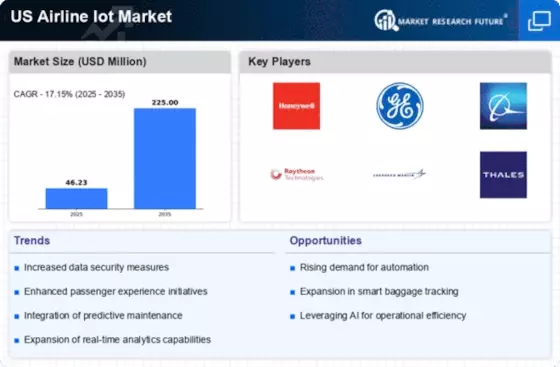
US Airline IoT Market Infographic
Purchase Options

US Airline IoT Market Summary

As per analysis, the US Airline IoT Market is projected to grow from USD 39.46 Million in 2024 to USD 46.94 Million by 2025, exhibiting a compound annual growth rate (CAGR) of 17.15% during the forecast period (2025 - 2035).

Key Market Trends & Highlights

The US Airline IoT market is poised for substantial growth driven by technological advancements and evolving customer expectations.

  • Fleet management remains the largest segment, focusing on enhancing operational efficiency through IoT integration.
  • Predictive maintenance is the fastest-growing segment, leveraging data analytics to preemptively address potential issues.
  • Data analytics continues to dominate the market, providing critical insights for decision-making and operational improvements.
  • Key market drivers include enhanced data analytics capabilities and sustainability initiatives, which are shaping the future of the industry.

Market Size & Forecast

2024 Market Size 39.46 (USD Million)
2035 Market Size 225.0 (USD Million)
CAGR (2025 - 2035) 17.15%

Major Players

Honeywell (US), General Electric (US), Boeing (US), Raytheon Technologies (US), Lockheed Martin (US), Thales Group (US), Cisco Systems (US), IBM (US), Siemens (US)

Our Impact
Enabled $4.3B Revenue Impact for Fortune 500 and Leading Multinationals
Partnering with 2000+ Global Organizations Each Year
30K+ Citations by Top-Tier Firms in the Industry

US Airline IoT Market Trends

The US Airline IoT Market is currently experiencing a transformative phase, driven by advancements in technology and the increasing demand for enhanced operational efficiency. Airlines are increasingly adopting Internet of Things (IoT) solutions to streamline processes, improve customer experiences, and optimize maintenance operations. The integration of IoT devices allows for real-time data collection and analysis, which can lead to more informed decision-making and proactive management of resources. This trend appears to be fueled by the need for airlines to remain competitive in a rapidly evolving industry, where customer expectations are continuously rising. Furthermore, regulatory bodies in the US are encouraging the adoption of innovative technologies to enhance safety and efficiency in air travel, which may further propel the growth of IoT applications within the sector. In addition to operational improvements, the US Airline IoT Market is also witnessing a shift towards personalized customer experiences. Airlines are leveraging IoT technologies to gather insights into passenger preferences and behaviors, enabling them to tailor services accordingly. This focus on customer-centric solutions seems to be a strategic response to the growing importance of passenger satisfaction in driving loyalty and repeat business. As the market evolves, it is likely that the integration of IoT will continue to play a pivotal role in shaping the future of air travel in the United States, fostering innovation and enhancing overall service delivery.

Enhanced Operational Efficiency

The US Airline IoT Market is increasingly focused on improving operational efficiency through the deployment of IoT technologies. Airlines are utilizing connected devices to monitor aircraft systems, track baggage, and manage fuel consumption. This integration allows for real-time data analysis, which can lead to reduced downtime and optimized resource allocation.

Personalized Customer Experiences

A notable trend within the US Airline IoT Market is the emphasis on creating personalized experiences for passengers. By leveraging IoT data, airlines can gain insights into customer preferences, enabling them to offer tailored services and enhance overall satisfaction. This approach is likely to foster customer loyalty and improve competitive positioning.

Regulatory Support for Innovation

The US government appears to be actively supporting the adoption of innovative technologies within the airline industry. Regulatory bodies are encouraging the implementation of IoT solutions to enhance safety and operational efficiency. This support may facilitate the growth of the US Airline IoT Market, as airlines seek to comply with evolving standards and leverage new technologies.

US Airline IoT Market Drivers

Sustainability Initiatives

Sustainability is becoming a critical focus within the US Airline IoT Market, as airlines strive to reduce their environmental impact. IoT technologies facilitate the monitoring and management of emissions, fuel consumption, and waste. For instance, airlines can use IoT sensors to track fuel efficiency in real-time, enabling them to make adjustments that minimize carbon footprints. Additionally, IoT solutions can optimize flight paths to reduce fuel burn, contributing to sustainability goals. The push for greener operations is not only driven by regulatory requirements but also by consumer demand for environmentally responsible travel options. Consequently, the integration of IoT technologies aimed at sustainability is expected to expand within the US Airline IoT Market.

Integration of Smart Technologies

The integration of smart technologies is a significant driver in the US Airline IoT Market. Airlines are increasingly adopting smart devices and systems to enhance operational efficiency and customer experience. For example, smart boarding systems that utilize IoT technology can streamline the boarding process, reducing delays and improving passenger flow. Additionally, in-flight IoT applications, such as connectivity solutions, allow passengers to access real-time information and entertainment options. The growing trend towards smart airports, equipped with IoT infrastructure, further supports this integration. As airlines continue to invest in smart technologies, the US Airline IoT Market is poised for substantial growth, driven by the demand for innovative solutions that enhance both operational performance and customer satisfaction.

Cost Reduction and Efficiency Gains

Cost reduction remains a pivotal driver in the US Airline IoT Market. By implementing IoT solutions, airlines can streamline operations and reduce expenses associated with fuel consumption, maintenance, and labor. For example, IoT-enabled fuel management systems can optimize fuel usage, potentially saving airlines millions annually. Additionally, real-time monitoring of aircraft systems allows for timely maintenance interventions, which can prevent costly repairs and extend the lifespan of aircraft components. According to industry estimates, IoT applications in the airline sector could lead to a 10-15 percent reduction in operational costs. This focus on efficiency and cost-effectiveness is likely to propel further investment in IoT technologies within the US Airline IoT Market.

Enhanced Data Analytics Capabilities

The US Airline IoT Market is increasingly driven by enhanced data analytics capabilities. Airlines are leveraging IoT technologies to collect vast amounts of data from various sources, including aircraft sensors, passenger devices, and operational systems. This data is analyzed to optimize flight operations, improve maintenance schedules, and enhance customer service. For instance, predictive maintenance powered by IoT data can reduce aircraft downtime by up to 30 percent, leading to significant cost savings. Furthermore, airlines can utilize data analytics to tailor services to individual passenger preferences, thereby increasing customer satisfaction. The integration of advanced analytics tools into the US Airline IoT Market is expected to grow, as airlines seek to harness data for competitive advantage.

Improved Safety and Security Measures

Safety and security are paramount in the US Airline IoT Market, driving the adoption of IoT technologies. Airlines are increasingly utilizing IoT devices to enhance security protocols, such as biometric screening and real-time baggage tracking. These technologies not only improve passenger safety but also streamline the boarding process, reducing wait times. Moreover, IoT sensors can monitor aircraft systems for anomalies, alerting maintenance teams to potential safety issues before they escalate. The implementation of these safety measures is supported by regulatory bodies, which emphasize the importance of technology in maintaining high safety standards. As a result, the US Airline IoT Market is likely to see continued growth in safety-focused IoT applications.


Market Segment Insights

By Application: Fleet Management (Largest) vs. Predictive Maintenance (Fastest-Growing)

In the US Airline IoT Market, the application segment in 2024 showcases Fleet Management as the largest area of focus. This segment accounts for a significant portion of the market share, reflecting airlines' ongoing investment in optimizing fleet operations and ensuring efficient use of resources. In contrast, segments like Predictive Maintenance are gaining momentum, indicating a shift towards advanced operational strategies that prioritize both cost-effectiveness and reliability in flight operations. The growth trends in this segment are being primarily driven by technological advancements and increasing demand for improved operational efficiencies. Airlines are leveraging IoT solutions to enhance passenger experiences and ensure compliance with stringent safety regulations. Moreover, the rising adoption of data analytics facilitates predictive maintenance efforts that not only minimize downtime but also foster a more proactive approach to aircraft management, thereby reshaping future strategies in the industry.

Fleet Management (Dominant) vs. Passenger Experience (Emerging)

Fleet Management remains the dominant application in the US Airline IoT Market due to its critical role in enhancing operational efficiencies and reducing costs. This segment focuses on real-time tracking of aircraft, optimizing flight routes, and improving maintenance schedules, ensuring that airlines can maximize their fleet's performance. Conversely, Passenger Experience is identified as an emerging segment, reflecting a growing emphasis on enhancing customer satisfaction through personalized services and connectivity options during flights. As airlines invest in IoT technologies, they are discovering new ways to engage passengers, offering seamless in-flight experiences with enhanced Wi-Fi connectivity and tailored services, indicating a shift towards more integrated and customer-focused strategies.

By Technology: Data Analytics (Largest) vs. Artificial Intelligence (Fastest-Growing)

The US Airline IoT Market is witnessing a diverse distribution of market share among its technological segment values. Data Analytics stands out as the largest contributor, leveraging passenger data and operational efficiencies to enhance services. Sensor Technology and Cloud Computing also hold notable shares, playing crucial roles in data collection and management. Meanwhile, Artificial Intelligence and Machine Learning are emerging as critical drivers, attracting significant investment and attention from airlines seeking to optimize their operations.

Technology: Data Analytics (Dominant) vs. Artificial Intelligence (Emerging)

Data Analytics is a dominant force in the US Airline IoT Market, facilitating insights that improve decision-making and operational efficiency. Its applications range from predictive maintenance to passenger experience enhancements. In contrast, Artificial Intelligence is emerging rapidly, offering innovative solutions that automate processes and enhance customer interactions. As airlines adapt to a digital-first approach, AI's capability to analyze vast datasets and generate actionable insights distinguishes it in the marketplace. Together, these technologies are transforming operational paradigms, with Data Analytics solidifying its foundational role while AI paves new avenues of innovation.

By End Use: Commercial Aviation (Largest) vs. Cargo Airlines (Fastest-Growing)

In the US Airline IoT Market, Commercial Aviation holds the largest share, dominating the market landscape due to the extensive adoption of IoT technologies for passenger services, safety, and operational efficiency. This segment accounts for a significant portion of the revenue, driven by major airlines implementing connected devices and systems to enhance customer experiences and streamline operations. On the other hand, the Cargo Airlines segment is observing rapid growth, becoming the fastest-growing segment within the market. The expansion of e-commerce and the need for efficient logistics solutions are propelling cargo airlines to invest more in IoT technologies, resulting in improved tracking, inventory management, and operational effectiveness. This heightened focus on modernization is reflecting positively in their growth trajectory.

Commercial Aviation (Dominant) vs. Cargo Airlines (Emerging)

The Commercial Aviation segment remains the dominant player in the US Airline IoT Market, characterized by its significant investment in technology to improve passenger satisfaction and operational performance. Airlines are increasingly leveraging IoT solutions for real-time data on aircraft performance and passenger preferences, thereby enhancing service quality and operational efficiency. In contrast, Cargo Airlines represent an emerging segment that is rapidly adopting IoT technologies to meet the demands of a growing e-commerce market. This segment focuses on inventory tracking, real-time shipment monitoring, and logistics optimization, allowing cargo airlines to reduce delays and increase transparency. The shift towards IoT in cargo operations is essential for maintaining competitiveness in a fast-paced delivery ecosystem.

Get more detailed insights about US Airline IoT Market

Key Players and Competitive Insights

The Airline IoT Market is currently characterized by a dynamic competitive landscape, driven by technological advancements and an increasing demand for operational efficiency. Key players such as Honeywell (US), Boeing (US), and Raytheon Technologies (US) are at the forefront, each adopting distinct strategies to enhance their market positioning. Honeywell (US) focuses on innovation through the development of advanced IoT solutions that optimize aircraft maintenance and operational performance. Boeing (US), on the other hand, emphasizes partnerships with tech firms to integrate cutting-edge technologies into their aircraft systems, thereby enhancing passenger experience and operational safety. Raytheon Technologies (US) is leveraging its expertise in aerospace and defense to create integrated IoT systems that improve real-time data analytics and predictive maintenance capabilities, collectively shaping a competitive environment that prioritizes technological integration and customer-centric solutions.

In terms of business tactics, companies are increasingly localizing manufacturing and optimizing supply chains to enhance responsiveness and reduce costs. The market structure appears moderately fragmented, with several key players exerting influence over various segments. This fragmentation allows for a diverse range of solutions, yet the collective impact of major companies like Honeywell (US) and Boeing (US) is significant, as they set industry standards and drive innovation.

In December 2025, Honeywell (US) announced a strategic partnership with a leading cloud service provider to enhance its IoT platform capabilities. This collaboration aims to leverage cloud computing to improve data analytics and operational efficiency for airlines, indicating a shift towards more integrated and scalable solutions. The strategic importance of this partnership lies in its potential to provide airlines with real-time insights, thereby enabling proactive decision-making and improved operational performance.

In November 2025, Boeing (US) unveiled a new suite of IoT-enabled services designed to enhance aircraft maintenance and reduce downtime. This initiative reflects Boeing's commitment to integrating advanced technologies into its operations, which could lead to significant cost savings for airlines. The introduction of these services is strategically important as it positions Boeing as a leader in the digital transformation of aviation, potentially reshaping maintenance practices across the industry.

In October 2025, Raytheon Technologies (US) launched a new IoT-based predictive maintenance solution aimed at improving aircraft reliability. This solution utilizes machine learning algorithms to analyze data from various aircraft systems, allowing for timely maintenance interventions. The strategic significance of this launch is profound, as it not only enhances operational efficiency but also aligns with the growing trend towards data-driven decision-making in aviation.

As of January 2026, the competitive trends in the Airline IoT Market are increasingly defined by digitalization, sustainability, and the integration of artificial intelligence (AI). Strategic alliances are becoming more prevalent, as companies recognize the need for collaborative approaches to tackle complex challenges. Looking ahead, competitive differentiation is likely to evolve from traditional price-based competition to a focus on innovation, technology, and supply chain reliability. This shift underscores the importance of developing unique value propositions that leverage advanced technologies to meet the evolving needs of the aviation sector.

Key Companies in the US Airline IoT Market include

Future Outlook

US Airline IoT Market Future Outlook

The US Airline IoT Market is projected to grow at a 17.15% CAGR from 2025 to 2035, driven by advancements in connectivity, operational efficiency, and customer experience enhancement.

New opportunities lie in:

  • Implementation of predictive maintenance analytics for aircraft systems.
  • Development of real-time passenger flow monitoring solutions.
  • Integration of IoT-enabled baggage tracking systems for improved efficiency.

By 2035, the market is expected to be robust, driven by innovative IoT applications and enhanced operational capabilities.

Market Segmentation

US Airline IoT Market End Use Outlook

  • Commercial Aviation
  • Cargo Airlines
  • Private Aviation
  • Government Aviation

US Airline IoT Market Technology Outlook

  • Sensor Technology
  • Data Analytics
  • Cloud Computing
  • Artificial Intelligence
  • Machine Learning

US Airline IoT Market Application Outlook

  • Fleet Management
  • Passenger Experience
  • Predictive Maintenance
  • Cargo Tracking
  • Safety Monitoring

Report Scope

MARKET SIZE 202439.46(USD Million)
MARKET SIZE 202546.94(USD Million)
MARKET SIZE 2035225.0(USD Million)
COMPOUND ANNUAL GROWTH RATE (CAGR)17.15% (2024 - 2035)
REPORT COVERAGERevenue Forecast, Competitive Landscape, Growth Factors, and Trends
BASE YEAR2024
Market Forecast Period2025 - 2035
Historical Data2019 - 2024
Market Forecast UnitsUSD Million
Key Companies ProfiledHoneywell (US), General Electric (US), Boeing (US), Raytheon Technologies (US), Lockheed Martin (US), Thales Group (US), Cisco Systems (US), IBM (US), Siemens (US)
Segments CoveredApplication, Technology, End Use
Key Market OpportunitiesIntegration of advanced data analytics for enhanced operational efficiency in the US Airline IoT Market.
Key Market DynamicsGrowing integration of Internet of Things technologies enhances operational efficiency and customer experience in the US Airline sector.
Countries CoveredUS
Leave a Comment

FAQs

What is the projected market valuation of the US Airline IoT Market by 2035?

The projected market valuation of the US Airline IoT Market is expected to reach 225.0 USD Million by 2035.

What was the market valuation of the US Airline IoT Market in 2024?

The overall market valuation of the US Airline IoT Market was 39.46 USD Million in 2024.

What is the expected CAGR for the US Airline IoT Market during the forecast period 2025 - 2035?

The expected CAGR for the US Airline IoT Market during the forecast period 2025 - 2035 is 17.15%.

Which companies are considered key players in the US Airline IoT Market?

Key players in the US Airline IoT Market include Honeywell, General Electric, Boeing, Raytheon Technologies, Lockheed Martin, Thales Group, Cisco Systems, IBM, and Siemens.

What are the main application segments of the US Airline IoT Market?

The main application segments include Fleet Management, Passenger Experience, Predictive Maintenance, Cargo Tracking, and Safety Monitoring.

How does the Passenger Experience segment perform in terms of valuation?

The Passenger Experience segment is valued between 10.0 and 60.0 USD Million.

What is the valuation range for the Predictive Maintenance segment?

The Predictive Maintenance segment has a valuation range of 12.0 to 70.0 USD Million.

What technologies are driving the US Airline IoT Market?

Driving technologies include Sensor Technology, Data Analytics, Cloud Computing, Artificial Intelligence, and Machine Learning.

What is the valuation range for the Machine Learning technology segment?

The Machine Learning technology segment is valued between 9.46 and 60.0 USD Million.

Which end-use segments are included in the US Airline IoT Market?

End-use segments include Commercial Aviation, Cargo Airlines, Private Aviation, and Government Aviation.

Download Free Sample

Kindly complete the form below to receive a free sample of this Report

Compare Licence

×
Features License Type
Single User Multiuser License Enterprise User
Price $4,950 $5,950 $7,250
Maximum User Access Limit 1 User Upto 10 Users Unrestricted Access Throughout the Organization
Free Customization
Direct Access to Analyst
Deliverable Format
Platform Access
Discount on Next Purchase 10% 15% 15%
Printable Versions