×
Request Free Sample ×

Kindly complete the form below to receive a free sample of this Report

* Please use a valid business email

Leading companies partner with us for data-driven Insights

clients tt-cursor
Hero Background

US Agricultural Tractor Machinery Market

ID: MRFR/AT/20068-HCR
128 Pages
Swapnil Palwe
February 2026

US Agricultural Tractor Machinery Market Research Report Information By Horse Power (Below 40 HP, 40-100 HP and Above 100 HP), By Tractor Type (Utility Tractors, Row Crop Tractors, Garden & Orchard Type Tractors and Other Tractor Types) – and United States Market Forecast Till 2035

Share:
Download PDF ×

We do not share your information with anyone. However, we may send you emails based on your report interest from time to time. You may contact us at any time to opt-out.

US Agricultural Tractor Machinery Market Infographic
Purchase Options

US Agricultural Tractor Machinery Market Summary

As per analysis, the US Agricultural Tractor Machinery Market is projected to grow from USD 15.66 Billion in 2025 to USD 19.34 Billion by 2035, exhibiting a compound annual growth rate (CAGR) of 2.15% during the forecast period (2025 - 2035).

Key Market Trends & Highlights

The US Agricultural Tractor Machinery Market is experiencing a transformative shift driven by technological advancements and sustainability efforts.

  • Technological advancements in machinery are reshaping operational efficiency in the agricultural sector.
  • The crop farming segment remains the largest, while the livestock farming segment is the fastest-growing in terms of machinery demand.
  • Internal combustion engines dominate the market, yet electric engines are emerging as the fastest-growing segment.
  • Key market drivers include technological innovations in precision agriculture and the growing demand for sustainable farming solutions.

Market Size & Forecast

2024 Market Size 15.3 (USD Billion)
2035 Market Size 19.34 (USD Billion)
CAGR (2025 - 2035) 2.15%

Major Players

Deere & Company (US), CNH Industrial (US), AGCO Corporation (US), Kubota Corporation (JP), Mahindra & Mahindra (IN), Tractor Supply Company (US), Buhler Industries (CA), SAME Deutz-Fahr (IT)

Our Impact
Enabled $4.3B Revenue Impact for Fortune 500 and Leading Multinationals
Partnering with 2000+ Global Organizations Each Year
30K+ Citations by Top-Tier Firms in the Industry

US Agricultural Tractor Machinery Market Trends

The US Agricultural Tractor Machinery Market is currently experiencing a dynamic phase characterized by evolving consumer preferences and technological advancements. As farmers increasingly seek efficiency and productivity, there is a noticeable shift towards the adoption of advanced machinery that integrates precision agriculture techniques. This trend appears to be driven by the need for sustainable practices, as well as the desire to optimize resource utilization. Furthermore, the market is witnessing a growing interest in electric and hybrid tractors, which may offer reduced emissions and lower operational costs. In addition to technological innovations, the US Agricultural Tractor Machinery Market is influenced by changing regulatory frameworks aimed at promoting environmentally friendly practices. These regulations could potentially encourage manufacturers to develop machinery that aligns with sustainability goals. Moreover, the increasing focus on food security and the need for enhanced agricultural output may further propel the demand for sophisticated tractor machinery. Overall, the market seems poised for growth, with various factors converging to shape its future trajectory.

Technological Advancements in Machinery

The US Agricultural Tractor Machinery Market is witnessing a surge in the adoption of advanced technologies, such as GPS and automation. These innovations enhance operational efficiency and precision in farming practices, allowing for better crop management and resource allocation.

Shift Towards Sustainable Practices

There is a growing emphasis on sustainability within the US Agricultural Tractor Machinery Market. Farmers are increasingly seeking equipment that minimizes environmental impact, leading to a rise in demand for electric and hybrid tractors that offer lower emissions and fuel consumption.

Regulatory Influences on Equipment Development

The evolving regulatory landscape in the United States is shaping the development of agricultural machinery. New policies aimed at promoting environmentally friendly practices are likely to drive manufacturers to innovate and produce equipment that meets these sustainability standards.

US Agricultural Tractor Machinery Market Drivers

Government Support and Subsidies

Government policies play a crucial role in shaping the US Agricultural Tractor Machinery Market. Various federal and state programs provide financial assistance and subsidies to farmers for purchasing advanced machinery. For instance, the USDA's Environmental Quality Incentives Program (EQIP) offers funding for equipment that promotes sustainable practices. This support encourages farmers to invest in modern tractors and machinery, thereby stimulating market growth. Recent data suggests that government incentives have led to a 20% increase in the adoption of new agricultural technologies among US farmers. As such, government support remains a vital driver influencing the dynamics of the US Agricultural Tractor Machinery Market.

Rising Labor Costs and Labor Shortages

The US Agricultural Tractor Machinery Market is significantly impacted by rising labor costs and labor shortages. As the agricultural sector faces challenges in securing sufficient labor, many farmers are turning to mechanization as a solution. The increasing costs associated with hiring seasonal labor have prompted a shift towards investing in advanced machinery that can perform tasks more efficiently. Recent reports indicate that labor costs have risen by approximately 10% over the past year, further incentivizing farmers to adopt tractors and machinery that reduce reliance on manual labor. This trend underscores the importance of mechanization in the US Agricultural Tractor Machinery Market.

Increased Focus on Crop Diversification

The US Agricultural Tractor Machinery Market is influenced by an increased focus on crop diversification among farmers. As agricultural practices evolve, farmers are seeking to cultivate a wider variety of crops to enhance resilience against market fluctuations and climate change. This shift necessitates the use of versatile agricultural machinery capable of handling different types of crops and farming techniques. Recent data indicates that farmers diversifying their crop portfolios have reported a 30% increase in overall profitability. Consequently, the demand for adaptable tractors and machinery that can support diverse agricultural practices is likely to drive growth in the US Agricultural Tractor Machinery Market.

Growing Demand for Sustainable Farming Solutions

The US Agricultural Tractor Machinery Market is witnessing a growing demand for sustainable farming solutions. As environmental concerns rise, farmers are increasingly adopting practices that reduce carbon footprints and enhance soil health. The market for eco-friendly tractors, including those powered by alternative fuels or electric engines, is projected to grow significantly. Recent statistics indicate that sales of electric tractors have surged by 15% in the last year alone. This shift towards sustainability not only aligns with consumer preferences but also meets regulatory requirements aimed at reducing greenhouse gas emissions. Consequently, the emphasis on sustainable practices is a pivotal driver in the US Agricultural Tractor Machinery Market.

Technological Innovations in Precision Agriculture

The US Agricultural Tractor Machinery Market is experiencing a notable shift towards precision agriculture, driven by advancements in technology. Innovations such as GPS-guided tractors and automated steering systems enhance operational efficiency and reduce labor costs. According to recent data, the adoption of precision farming technologies has increased by approximately 25% over the past five years. This trend not only optimizes resource use but also improves crop yields, making it a critical driver in the market. As farmers increasingly seek to maximize productivity while minimizing environmental impact, the integration of smart technologies into agricultural machinery is likely to continue shaping the landscape of the US Agricultural Tractor Machinery Market.

Market Segment Insights

By Application: Crop Farming (Largest) vs. Livestock Farming (Fastest-Growing)

In the US Agricultural Tractor Machinery Market, the distribution of market share among application segments indicates that crop farming holds the largest share, driven by the vast expanse of farmland dedicated to various crops. This segment benefits from a mature demand bolstered by the increasing need for efficient machinery to enhance productivity and reduce labor costs. Meanwhile, livestock farming is emerging as a critical growth area, supported by rising meat consumption and the need for improved farming technologies that enhance operational efficiency.

Crop Farming (Dominant) vs. Livestock Farming (Emerging)

Crop farming is a dominant force in the US Agricultural Tractor Machinery Market, characterized by a high volume of equipment tailored for diverse agricultural tasks, such as planting, harvesting, and soil preparation. This segment benefits from strong technological advancements that allow for precision farming, significantly enhancing yield. Conversely, livestock farming is emerging as a rapidly growing segment, where advancements in machinery are revolutionizing operations. The integration of automation and efficient feeding systems is aiding farmers in managing livestock more effectively, making it a focal point for future investments and innovations.

By Engine Type: Internal Combustion Engine (Largest) vs. Electric Engine (Fastest-Growing)

In the US Agricultural Tractor Machinery Market, the internal combustion engine remains the largest segment, maintaining a significant share due to its longstanding reliability and familiarity among farmers. This traditional engine type is favored for its power output and efficiency in various agricultural tasks, ensuring its continued dominance. Conversely, the electric engine segment, while still smaller, is witnessing rapid growth as sustainability trends gain momentum. Farmers are increasingly interested in electric tractors due to lower emissions and operational costs, driving a shift in purchasing preferences.

Internal Combustion Engine (Dominant) vs. Electric Engine (Emerging)

The internal combustion engine is the dominant force within the US Agricultural Tractor Machinery Market, celebrated for its robust power and operational efficiency. This engine type is widely recognized for its versatility in handling heavy loads and diverse terrains, making it the go-to choice for traditional farming practices. In contrast, the electric engine represents an emerging trend, appealing to a growing base of eco-conscious farmers. With advancements in battery technology and increased awareness of environmental impacts, electric engines are poised to reshape future market dynamics, offering lower running costs and a much quieter operation than their combustion counterparts.

By Power Output: 50 to 100 Horsepower (Largest) vs. 100 to 150 Horsepower (Fastest-Growing)

In the US Agricultural Tractor Machinery Market, the power output segment depicts a diverse distribution among various categories. The predominant segment is the 50 to 100 Horsepower category, which appeals to a broad range of farming operations due to its ample power and versatility. Following closely is the 100 to 150 Horsepower segment, which, while smaller in market share, is observing significant growth as modern farms increasingly adopt more powerful machinery for efficient crop and livestock management. Growth trends in the power output segment are driven by the evolving needs of agricultural producers who demand machinery that enhances productivity and efficiency. The increasing rise in commercial farming operations is contributing to the uptake of higher horsepower tractors, particularly in the 100 to 150 Horsepower range. This segment's growth is further supported by advancements in technology and fuel efficiency, making these tractors more attractive to the market.

Power Output: 50 to 100 Horsepower (Dominant) vs. 100 to 150 Horsepower (Emerging)

The 50 to 100 Horsepower category has established itself as a dominant player in the US Agricultural Tractor Machinery Market, primarily due to its flexibility and suitability for a wide range of farming tasks. It effectively meets the demands of mid-sized farms that seek a balance between power and handling. On the other hand, the 100 to 150 Horsepower segment is emerging, showing a rapid increase in adoption as larger commercial farms look for efficiency and more advanced features. This segment is increasingly favored for its ability to handle more demanding agricultural tasks, such as tilling and heavy lifting, thereby reinforcing its position as an essential choice in modern farming.

By Drive Type: Four-Wheel Drive (Largest) vs. Two-Wheel Drive (Emerging)

In the US Agricultural Tractor Machinery Market, the distribution of market share between Two-Wheel Drive and Four-Wheel Drive tractors demonstrates a clear preference for Four-Wheel Drive options. The versatility and enhanced traction offered by Four-Wheel Drive tractors make them highly favored among farmers, allowing for effective operations across varied terrains and conditions. Conversely, Two-Wheel Drive tractors, while still relevant, occupy a smaller share as they are primarily suited for flat and less challenging landscapes. As farming practices evolve, this differentiation highlights the growing reliance on technology-enhanced machinery, further shaping market dynamics. Growth trends indicate that the demand for Four-Wheel Drive tractors is on an upward trajectory, driven by advancements in agricultural technology and the increasing need for efficient farming solutions. The adoption of precision farming methods, coupled with the desire for higher productivity, has led to greater investments in Four-Wheel Drive tractors. Meanwhile, Two-Wheel Drive tractors may witness steady growth, particularly in niche markets where lower-cost options align with specific farming needs. As the agricultural landscape continues to change, the competition between these drive types will significantly influence the overall machinery market.

Four-Wheel Drive (Dominant) vs. Two-Wheel Drive (Emerging)

In the US Agricultural Tractor Machinery Market, Four-Wheel Drive tractors are recognized as the dominant segment due to their exceptional capability in handling challenging terrains and facilitating high-efficiency operations. Farmers favor these models for their versatility, especially in regions with diverse agricultural requirements. Meanwhile, Two-Wheel Drive tractors serve as an emerging choice, particularly for smaller farms and specific applications where cost-effectiveness matters. They are typically lighter and less expensive, appealing to budget-conscious farmers. While Four-Wheel Drive tractors represent the forefront of technology with advanced features and capabilities, Two-Wheel Drive models continue to carve out a niche by providing sufficient power and efficiency for less demanding tasks.

By Size: Utility Tractors (Largest) vs. Compact Tractors (Fastest-Growing)

In the US Agricultural Tractor Machinery Market, the segment distribution showcases Utility Tractors as the largest segment, dominating the market with their versatile applications across various agricultural tasks. Compact Tractors have also gained considerable attention, appealing to small-scale farmers and urban agriculturalists, thus securing a significant share of the market. Meanwhile, Row Crop and Specialty Tractors occupy niche segments, serving specific farming needs but contributing less to the overall market share compared to their counterparts. Growth trends indicate a robust rise in the demand for Compact Tractors as farmers seek more efficient, user-friendly machinery that can navigate smaller fields and urban settings. Utility Tractors continue to thrive, driven by their adaptability in various farming environments. Technological advancements and eco-friendly innovations are further propelling market growth, positioning these segments favorably for ongoing expansion.

Utility Tractors (Dominant) vs. Specialty Tractors (Emerging)

Utility Tractors represent the dominant force in the US Agricultural Tractor Machinery Market, characterized by their all-round capabilities to handle a wide range of farming activities from planting to harvesting. They are preferred for their robust design and enhanced efficiency, making them suitable for medium to large farms. In contrast, Specialty Tractors, though smaller in market share, are emerging steadily, tailored for specific agricultural operations such as vineyard management and orchard maintenance. These tractors often come equipped with precision technology to cater to specialized tasks, and as sustainable farming practices gain traction, the demand for Specialty Tractors is likely to rise, highlighting their growing significance in the agricultural landscape.

Get more detailed insights about US Agricultural Tractor Machinery Market

Regional Insights

North America : Market Leader in Agriculture

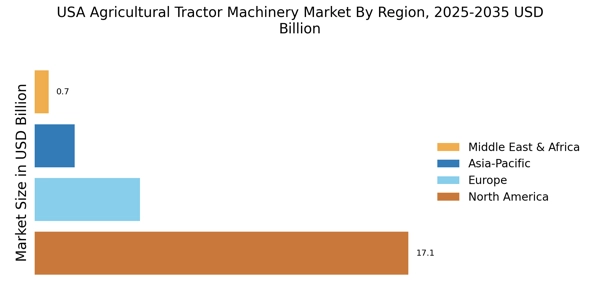
The North American agricultural tractor machinery market is primarily driven by technological advancements, increasing demand for efficient farming practices, and supportive government policies. The United States holds the largest market share at approximately 70%, followed by Canada at around 15%. Regulatory initiatives aimed at promoting sustainable farming practices further bolster market growth, encouraging the adoption of advanced machinery. In this region, the competitive landscape is characterized by major players such as Deere & Company, AGCO Corporation, and CNH Industrial. These companies are continuously innovating to meet the evolving needs of farmers, focusing on automation and precision agriculture. The presence of a robust supply chain and strong distribution networks enhances their market position, ensuring that they can effectively cater to the growing demand for agricultural machinery.

Europe : Innovation and Sustainability Focus

The European agricultural tractor machinery market is experiencing growth driven by a shift towards sustainable farming practices and technological innovation. The region is characterized by stringent regulations aimed at reducing carbon emissions and promoting eco-friendly machinery. Germany and France are the largest markets, collectively holding about 60% of the European market share, with increasing investments in precision agriculture technologies. Leading countries in this region are Germany, France, and the UK, where companies like SAME Deutz-Fahr and AGCO Corporation are prominent. The competitive landscape is marked by a focus on R&D, with manufacturers investing heavily in developing advanced machinery that meets regulatory standards. The presence of various agricultural cooperatives also supports the adoption of new technologies, enhancing market dynamics.

Asia-Pacific : Rapid Growth and Adoption

The Asia-Pacific agricultural tractor machinery market is witnessing rapid growth, driven by increasing agricultural productivity and the adoption of modern farming techniques. Countries like China and India are leading the market, accounting for approximately 50% of the regional share. Government initiatives aimed at enhancing food security and promoting mechanization are significant growth catalysts, encouraging farmers to invest in advanced machinery. China and India dominate the competitive landscape, with key players like Mahindra & Mahindra and Yanmar Holdings leading the charge. The market is characterized by a mix of local and international manufacturers, fostering competition and innovation. As the region continues to urbanize, the demand for efficient agricultural practices is expected to rise, further propelling market growth.

Middle East and Africa : Emerging Market Potential

The Middle East and Africa agricultural tractor machinery market is emerging, driven by increasing investments in agriculture and a growing focus on food security. Countries like South Africa and Kenya are at the forefront, collectively holding about 40% of the market share. The region's agricultural policies are increasingly supportive of mechanization, with governments encouraging the adoption of modern farming equipment to boost productivity. In this region, the competitive landscape is evolving, with both local and international players vying for market share. Companies like Buhler Industries are making significant inroads, while local manufacturers are also gaining traction. The presence of various agricultural initiatives and partnerships is fostering growth, making the region a potential hub for agricultural machinery innovation.

US Agricultural Tractor Machinery Market Regional Image

Key Players and Competitive Insights

The Agricultural Tractor Machinery Market is characterized by a competitive landscape that is increasingly shaped by innovation, sustainability, and technological advancements. Key players such as Deere & Company (US), CNH Industrial (US), and AGCO Corporation (US) are actively pursuing strategies that emphasize digital transformation and regional expansion. For instance, Deere & Company (US) has been focusing on integrating advanced technologies into its machinery, which not only enhances operational efficiency but also aligns with the growing demand for precision agriculture. Similarly, CNH Industrial (US) is leveraging partnerships to enhance its product offerings, thereby strengthening its market position. Collectively, these strategies contribute to a dynamic competitive environment where companies are not only vying for market share but also striving to lead in innovation and sustainability.

In terms of business tactics, companies are increasingly localizing manufacturing and optimizing supply chains to enhance responsiveness to market demands. The market structure appears moderately fragmented, with several key players exerting considerable influence. This fragmentation allows for a diverse range of products and services, catering to various segments of the agricultural sector. However, the collective actions of major companies are likely to shape the market's trajectory, as they seek to capitalize on emerging trends and consumer preferences.

In December 2025, AGCO Corporation (US) announced a strategic partnership with a leading technology firm to develop AI-driven solutions for agricultural machinery. This collaboration is poised to enhance AGCO's product offerings, enabling farmers to leverage data analytics for improved decision-making. The strategic importance of this partnership lies in its potential to position AGCO as a frontrunner in the integration of AI technologies within the agricultural sector, thereby addressing the increasing demand for smart farming solutions.

In November 2025, Kubota Corporation (JP) unveiled its latest line of electric tractors, marking a significant shift towards sustainable farming practices. This launch not only reflects Kubota's commitment to reducing carbon emissions but also aligns with the growing consumer preference for environmentally friendly machinery. The introduction of electric tractors is likely to enhance Kubota's competitive edge, as it caters to a market that is increasingly prioritizing sustainability.

In October 2025, CNH Industrial (US) expanded its manufacturing capabilities in the Midwest, focusing on the production of advanced agricultural equipment. This expansion is strategically significant as it allows CNH to better serve the North American market while optimizing its supply chain. By enhancing local production, CNH Industrial (US) is likely to improve its responsiveness to customer needs and reduce lead times, thereby strengthening its competitive position.

As of January 2026, the Agricultural Tractor Machinery Market is witnessing trends that emphasize digitalization, sustainability, and the integration of AI technologies. Strategic alliances are becoming increasingly pivotal in shaping the competitive landscape, as companies collaborate to enhance their technological capabilities. Looking ahead, it appears that competitive differentiation will evolve from traditional price-based competition to a focus on innovation, technology, and supply chain reliability. This shift suggests that companies that prioritize these aspects are likely to gain a competitive advantage in the rapidly changing market.


Key Companies in the US Agricultural Tractor Machinery Market include

Industry Developments

  • Q2 2025: US tractor sales continue to fall amid trade concerns In April 2025, U.S. tractor and combine sales continued to decline, with tractor sales down 13.3% year-over-year for the first four months of 2025, according to the Association of Equipment Manufacturers. The industry faces challenges from tariffs, high interest rates, and rising input costs.
  • Q2 2025: U.S. Sales of Agricultural Tractors and Combines Continue to Fall in May 2025 U.S. agricultural tractor sales dropped 11.9% and combine sales fell 20.9% in May 2025 compared to May 2024, as reported by the Association of Equipment Manufacturers. The decline is attributed to high interest rates, global trade uncertainty, and increased input prices.

Future Outlook

US Agricultural Tractor Machinery Market Future Outlook

The US Agricultural Tractor Machinery Market is projected to grow at a 2.15% CAGR from 2025 to 2035, driven by technological advancements, increasing automation, and sustainable farming practices.

New opportunities lie in:

  • Development of precision agriculture technologies for enhanced yield
  • Expansion into electric and hybrid tractor models
  • Integration of IoT solutions for real-time fleet management

By 2035, the market is expected to be robust, driven by innovation and sustainability.

Market Segmentation

US Agricultural Tractor Machinery Market Size Outlook

  • Compact Tractors
  • Utility Tractors
  • Row Crop Tractors
  • Specialty Tractors

US Agricultural Tractor Machinery Market Drive Type Outlook

  • Two-Wheel Drive
  • Four-Wheel Drive

US Agricultural Tractor Machinery Market Application Outlook

  • Crop Farming
  • Livestock Farming
  • Forestry
  • Horticulture

US Agricultural Tractor Machinery Market Engine Type Outlook

  • Internal Combustion Engine
  • Electric Engine
  • Hybrid Engine

US Agricultural Tractor Machinery Market Power Output Outlook

  • Less than 50 Horsepower
  • 50 to 100 Horsepower
  • 100 to 150 Horsepower
  • More than 150 Horsepower

Report Scope

MARKET SIZE 202415.3(USD Billion)
MARKET SIZE 202515.66(USD Billion)
MARKET SIZE 203519.34(USD Billion)
COMPOUND ANNUAL GROWTH RATE (CAGR)2.15% (2024 - 2035)
REPORT COVERAGERevenue Forecast, Competitive Landscape, Growth Factors, and Trends
BASE YEAR2024
Market Forecast Period2025 - 2035
Historical Data2019 - 2024
Market Forecast UnitsUSD Billion
Key Companies ProfiledDeere & Company (US), CNH Industrial (US), AGCO Corporation (US), Kubota Corporation (JP), Mahindra & Mahindra (IN), Tractor Supply Company (US), Buhler Industries (CA), SAME Deutz-Fahr (IT)
Segments CoveredApplication, Engine Type, Power Output, Drive Type, Size
Key Market OpportunitiesAdoption of precision agriculture technologies enhances efficiency in the US Agricultural Tractor Machinery Market.
Key Market DynamicsTechnological advancements drive efficiency and sustainability in the US Agricultural Tractor Machinery Market.
Countries CoveredUS
Leave a Comment

FAQs

What is the current valuation of the US Agricultural Tractor Machinery Market?

As of 2024, the market valuation was 15.3 USD Billion.

What is the projected market size for the US Agricultural Tractor Machinery Market by 2035?

The market is projected to reach 19.34 USD Billion by 2035.

What is the expected CAGR for the US Agricultural Tractor Machinery Market during the forecast period 2025 - 2035?

The expected CAGR for the market during the forecast period 2025 - 2035 is 2.15%.

Which companies are considered key players in the US Agricultural Tractor Machinery Market?

Key players include Deere & Company, CNH Industrial, AGCO Corporation, Kubota Corporation, Mahindra & Mahindra, Tractor Supply Company, Buhler Industries, and SAME Deutz-Fahr.

How does the market perform in terms of application segments?

In 2024, Crop Farming generated 6.0 USD Billion, Livestock Farming 4.2 USD Billion, Forestry 2.5 USD Billion, and Horticulture 6.0 USD Billion.

What are the different engine types in the US Agricultural Tractor Machinery Market?

The market segments by engine type include Internal Combustion Engine at 12.0 USD Billion, Electric Engine at 3.0 USD Billion, and Hybrid Engine at 4.34 USD Billion.

What is the distribution of power output in the market?

In 2024, power output segments included Less than 50 Horsepower at 3.1 USD Billion, 50 to 100 Horsepower at 4.8 USD Billion, 100 to 150 Horsepower at 4.2 USD Billion, and More than 150 Horsepower at 6.2 USD Billion.

What are the drive type segments in the US Agricultural Tractor Machinery Market?

The market segments by drive type include Two-Wheel Drive at 6.2 USD Billion and Four-Wheel Drive at 13.14 USD Billion.

What is the market size for different tractor sizes?

In 2024, Compact Tractors accounted for 3.73 USD Billion, Utility Tractors 5.63 USD Billion, Row Crop Tractors 6.14 USD Billion, and Specialty Tractors 3.84 USD Billion.

How does the market outlook appear for the US Agricultural Tractor Machinery Market?

The market outlook appears positive, with steady growth anticipated as it progresses towards the projected valuation of 19.34 USD Billion by 2035.

Download Free Sample

Kindly complete the form below to receive a free sample of this Report

Compare Licence

×
Features License Type
Single User Multiuser License Enterprise User
Price $4,950 $5,950 $7,250
Maximum User Access Limit 1 User Upto 10 Users Unrestricted Access Throughout the Organization
Free Customization
Direct Access to Analyst
Deliverable Format
Platform Access
Discount on Next Purchase 10% 15% 15%
Printable Versions