×
Request Free Sample ×

Kindly complete the form below to receive a free sample of this Report

* Please use a valid business email

Leading companies partner with us for data-driven Insights

clients tt-cursor
Hero Background

UK Smart Ticketing Market

ID: MRFR/ICT/61148-HCR
200 Pages
Aarti Dhapte
February 2026

UK Smart Ticketing Market Size, Share and Research Report: By Component (Hardware, Software, Card Reader, Cards and Microchips), By Application (Airlines, Buses, Sports & Entertainment, Railways and Metros, Others), By System (Smart Card, Open Payment System, Near-field Communication) and By Product (E-Ticket, Request Tracker, Ticket Machine, E-Toll, E-Kiosk, Smart Parking System, Others)-Forecast to 2035

Share:
Download PDF ×

We do not share your information with anyone. However, we may send you emails based on your report interest from time to time. You may contact us at any time to opt-out.

UK Smart Ticketing Market Infographic
Purchase Options

UK Smart Ticketing Market Summary

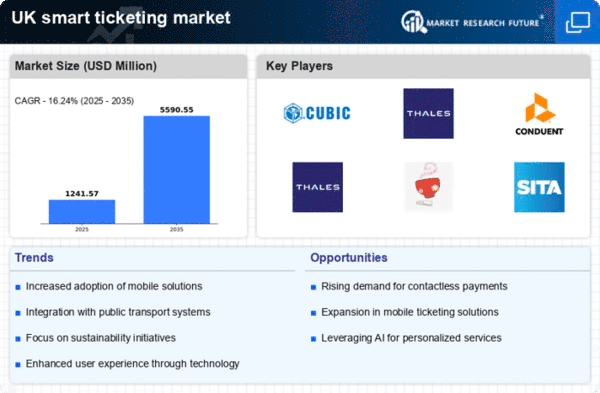
As per Market Research Future analysis, the UK smart ticketing market Size was estimated at 1068.11 USD Million in 2024. The UK smart ticketing market is projected to grow from 1241.57 USD Million in 2025 to 5590.55 USD Million by 2035, exhibiting a compound annual growth rate (CAGR) of 16.2% during the forecast period 2025 - 2035

Key Market Trends & Highlights

The UK smart ticketing market is experiencing robust growth driven by technological advancements and consumer preferences.

  • The integration of mobile technology is transforming the way consumers interact with ticketing systems, enhancing convenience and accessibility.
  • Sustainability initiatives are increasingly influencing smart ticketing solutions, aligning with broader environmental goals.
  • Enhanced data analytics capabilities are enabling operators to optimize services and improve user experiences in the market.
  • Key drivers such as growing urbanization and government initiatives are propelling the demand for integrated smart ticketing solutions across transport modes.

Market Size & Forecast

2024 Market Size 1068.11 (USD Million)
2035 Market Size 5590.55 (USD Million)
CAGR (2025 - 2035) 16.24%

Major Players

Cubic Corporation (US), Thales Group (FR), Conduent (US), Gemalto (NL), Masabi (GB), SITA (CH), Atos (FR), Kapsch TrafficCom (AT)

Our Impact
Enabled $4.3B Revenue Impact for Fortune 500 and Leading Multinationals
Partnering with 2000+ Global Organizations Each Year
30K+ Citations by Top-Tier Firms in the Industry

UK Smart Ticketing Market Trends

The smart ticketing market is currently experiencing a transformative phase, driven by advancements in technology and changing consumer preferences. The integration of mobile applications and contactless payment systems has revolutionized how users interact with transportation services. This shift not only enhances convenience but also promotes efficiency in fare collection and management. As urban areas continue to grow, the demand for seamless travel experiences is likely to increase, pushing stakeholders to adopt innovative solutions that cater to the evolving needs of commuters. Moreover, the emphasis on sustainability is becoming increasingly prominent within the smart ticketing market. Authorities are recognizing the importance of reducing carbon footprints and promoting eco-friendly practices. This trend is reflected in the development of systems that encourage the use of public transport over private vehicles. By implementing smart ticketing solutions, cities can potentially reduce congestion and improve air quality, aligning with broader environmental goals. As the market evolves, collaboration among technology providers, transport operators, and government entities will be crucial in shaping the future landscape of smart ticketing.

Integration of Mobile Technology

The rise of mobile technology is reshaping the smart ticketing market. Users are increasingly relying on smartphones for ticket purchases and travel planning. This trend indicates a shift towards more user-friendly interfaces and applications that streamline the travel experience.

Focus on Sustainability

Sustainability is becoming a central theme in the smart ticketing market. Authorities are prioritizing eco-friendly solutions that encourage public transport usage. This focus aligns with broader environmental initiatives aimed at reducing urban congestion and improving air quality.

Enhanced Data Analytics

Data analytics is playing a pivotal role in the smart ticketing market. Transport operators are leveraging data to understand user behavior and optimize services. This trend suggests a move towards more personalized travel experiences, enhancing customer satisfaction.

UK Smart Ticketing Market Drivers

Growing Urbanization

The increasing urbanization in the UK is a pivotal driver for the smart ticketing market. As more individuals migrate to urban areas, the demand for efficient public transport systems escalates. This trend necessitates the implementation of smart ticketing solutions that streamline access to various modes of transport. According to recent data, urban areas in the UK are projected to house over 85% of the population by 2030, which could lead to a surge in smart ticketing adoption. The smart ticketing market is likely to benefit from this demographic shift, as local governments and transport authorities seek to enhance user experience and operational efficiency. Furthermore, the integration of smart ticketing systems can alleviate congestion and improve overall transport management, making it a crucial component in urban planning and development.

Technological Advancements

Technological advancements are a crucial driver for the smart ticketing market, as innovations in mobile technology, data analytics, and payment systems continue to evolve. The proliferation of smartphones and contactless payment methods has transformed how consumers interact with transport services. In the UK, it is estimated that over 80% of adults own a smartphone, which facilitates the adoption of mobile ticketing solutions. The smart ticketing market is likely to benefit from these technological trends, as they enable more efficient ticketing processes and enhance user engagement. Furthermore, advancements in data analytics allow transport operators to gain insights into consumer behavior, leading to improved service offerings and operational efficiencies. As technology continues to advance, the smart ticketing market is expected to expand, driven by the need for innovative solutions that meet the demands of modern commuters.

Consumer Demand for Convenience

The evolving consumer preferences towards convenience and seamless travel experiences are propelling the smart ticketing market. As individuals increasingly seek hassle-free travel options, the demand for smart ticketing solutions that offer quick access and easy payment methods rises. Recent surveys indicate that approximately 70% of UK commuters prefer digital ticketing options over traditional paper tickets. This shift in consumer behavior is prompting transport operators to adopt smart ticketing systems that cater to these preferences. The smart ticketing market is thus positioned to thrive as it aligns with the growing expectation for user-friendly and efficient travel solutions. Moreover, the integration of mobile applications and contactless payment methods enhances the overall travel experience, making smart ticketing an attractive option for both consumers and transport providers.

Government Initiatives and Funding

Government initiatives aimed at modernizing transport infrastructure are significantly influencing the smart ticketing market. The UK government has allocated substantial funding to enhance public transport systems, with a focus on digital transformation. Recent reports indicate that over £500 million has been earmarked for smart transport projects, which include the development of smart ticketing solutions. These initiatives not only aim to improve user convenience but also to promote sustainable transport options. The smart ticketing market stands to gain from these investments, as they facilitate the deployment of advanced technologies that enhance ticketing processes. Additionally, government support fosters collaboration between public and private sectors, driving innovation and expanding the reach of smart ticketing solutions across various transport networks.

Focus on Integration Across Transport Modes

The emphasis on integrating various transport modes is a significant driver for the smart ticketing market. In the UK, there is a growing recognition of the need for seamless travel experiences that connect buses, trains, and other forms of transport. This integration is essential for enhancing the efficiency of public transport systems and improving user satisfaction. Recent initiatives have been launched to create unified ticketing systems that allow passengers to use a single ticket across multiple transport modes. The smart ticketing market is poised to benefit from this trend, as it encourages the development of interoperable ticketing solutions that simplify the travel process. By fostering collaboration among different transport operators, the smart ticketing market can enhance connectivity and accessibility, ultimately leading to a more integrated and user-friendly transport network.


Market Segment Insights

By Components: Hardware (Largest) vs. Software (Fastest-Growing)

In the UK smart ticketing market, the largest segment, Hardware, dominates due to its critical role in facilitating transactions and ensuring system reliability. Hardware components, including servers and network devices, comprise a significant proportion of market share, driven by the need for robust infrastructure to support increasing passenger numbers. Software, on the other hand, has emerged as the fastest-growing segment, as ticketing systems increasingly rely on sophisticated software solutions to enhance user experiences and streamline operations. The growth in the Software segment is largely propelled by advancements in technology and the rising adoption of digital wallets and mobile applications. This segment responds swiftly to consumer demand for convenience and ease of use, making it a focal point for innovation. Meanwhile, the Hardware segment continues to evolve by integrating new features to maintain compliance with modern regulatory requirements and customer expectations, thereby ensuring steady improvements in performance and reliability.

Hardware (Dominant) vs. Software (Emerging)

Hardware in the UK smart ticketing market serves as the foundational layer, facilitating smooth transaction processes and ensuring system dependability. It encompasses devices such as card readers, ticket vending machines, and networking equipment, which are essential for seamless integration with digital solutions. The current emphasis on enhancing system performance underscores Hardware's dominant role. Conversely, Software is emerging as a vital counterpart, offering advanced functionalities such as data analytics and user-friendly interfaces. With organizations increasingly investing in Software development to meet customer demands for digital solutions, this segment is rapidly evolving. The interplay between these segments indicates a balanced approach, with Hardware maintaining stability while Software paves the way for innovation.

By Application: Railways and Metros (Largest) vs. Buses (Fastest-Growing)

In the UK smart ticketing market, the application segment reveals that Railways and Metros hold the largest share, showcasing a robust adoption of smart ticketing systems among commuters. This segment capitalizes on the extensive rail network, allowing for seamless integration of digital ticketing, which enhances user experience and operational efficiency. Meanwhile, the Buses segment is emerging as a strong competitor, increasingly adopting smart ticketing to meet the rising demand for efficient urban transport solutions. Growth trends indicate a significant shift towards digitalization across all application segments. Factors driving this growth include increased smartphone penetration, the push for cashless transactions, and the growing importance of contactless travel solutions especially post-pandemic. Buses are rapidly evolving to meet consumer expectations for convenience and speed, making them the fastest-growing segment. Railways and Metros continue to innovate with technology, improving service delivery and gaining market confidence.

Railways and Metros (Dominant) vs. Buses (Emerging)

The Railways and Metros segment remains dominant within the UK smart ticketing market, characterized by a well-established infrastructure and widespread consumer acceptance of smart ticketing solutions. This segment benefits from significant government support, making continuous improvements in digital platforms. Conversely, the Buses segment is seen as emerging, reflecting a dynamic shift toward incorporating smart ticketing systems to attract more riders. As urban demand for public transportation rises, Buses are implementing these systems to streamline operations and provide enhanced customer experiences, paving the way for growth in this segment. Overall, the market landscape is evolving, with both segments displaying unique advantages and addressing consumer needs effectively.

By System: Smart Card (Largest) vs. Near-field Communication (Fastest-Growing)

In the UK smart ticketing market, the Smart Card segment holds the largest market share, primarily due to its widespread adoption and user familiarity. This segment is favored for its convenience and ease of use among commuters, leading to a solid foundation in public transportation. In contrast, the Open Payment System segment is also notable, though it has yet to achieve the same scale as Smart Cards. Near-field Communication (NFC) technology is rapidly gaining traction, enabled by its innovative approach to contactless payments, which are increasingly popular among tech-savvy consumers. Recent growth trends indicate a shift towards digital integration, contributing to the rise of NFC as the fastest-growing segment. This growth is driven by consumer demand for contactless solutions and the increasing adoption of smartphones. Urban development and smart city initiatives further propel these trends, leading transit authorities to adopt innovative ticketing solutions that enhance user experience while improving operational efficiency. The expanding infrastructure for mobile payments showcases a shift in consumer behavior, embracing modern technological advancements over traditional ticketing methods.

Smart Card (Dominant) vs. Near-field Communication (Emerging)

The Smart Card segment has established itself as a dominant player in the UK smart ticketing market. These cards are known for their reliability and ease of access, which appeals to a broad demographic, including both regular commuters and occasional travelers. They often integrate features such as stored value and multi-journey tickets, which enhance user convenience. Conversely, Near-field Communication technology represents an emerging trend that focuses on seamless transactions through mobile devices. This segment attracts a younger audience that favors the convenience of tap-and-go solutions, offering a flexible and user-friendly alternative to traditional smart cards. As cities become more digitized, both segments are likely to coexist, catering to varying consumer preferences.

By Product: E-Ticket (Largest) vs. Smart Parking System (Fastest-Growing)

The UK smart ticketing market showcases a diverse range of product offerings, with the E-Ticket segment holding the largest share among various technological advancements. Request Tracker and Ticket Machine follow closely, yet E-Toll, E-Kiosk, and Smart Parking System are experiencing growth, with Smart Parking System being noted as a particularly innovative offering. The rise of mobile solutions and fewer transaction barriers have contributed to E-Ticket's prominence, as users increasingly prefer digital methods for convenience. In terms of growth trends, the Smart Parking System is rapidly gaining traction, fostering increased demand for integrated mobility solutions. Key drivers include technological advancements, convenience offered by smart devices, and a push towards cashless transactions. E-Toll solutions are witnessing an upward trajectory due to the rising adoption of electronic payment systems in urban environments. These dynamics indicate a robust competitive landscape characterized by continual innovation and adaptation to consumer preferences.

E-Ticket (Dominant) vs. Smart Parking System (Emerging)

E-Ticket serves as the dominant segment in the UK smart ticketing market, primarily due to its widespread acceptance and ease of use. It allows users to purchase tickets via mobile applications or websites, aligning with the trend of digital consumer behaviors. In contrast, the Smart Parking System is emerging, capitalizing on the need for efficient urban traffic management. This system integrates technology to automate parking processes, providing users with real-time availability information and mobile payment options. Both segments highlight the critical shifts towards digital solutions, shaping consumer habits and influencing the broader market landscape.

Get more detailed insights about UK Smart Ticketing Market

Key Players and Competitive Insights

The smart ticketing market in the UK is characterized by a dynamic competitive landscape, driven by technological advancements and increasing demand for seamless travel experiences. Key players such as Cubic Corporation (US), Thales Group (FR), and Masabi (GB) are at the forefront, each adopting distinct strategies to enhance their market positioning. Cubic Corporation (US) focuses on innovation through the development of integrated transport solutions, while Thales Group (FR) emphasizes partnerships with local authorities to expand its digital ticketing capabilities. Masabi (GB) leverages its expertise in mobile ticketing to cater to the growing preference for contactless solutions, collectively shaping a competitive environment that prioritizes user experience and operational efficiency.The market structure appears moderately fragmented, with several players vying for market share through various business tactics. Localizing manufacturing and optimizing supply chains are common strategies employed by these companies to enhance responsiveness to market demands. The collective influence of these key players fosters a competitive atmosphere where innovation and customer-centric solutions are paramount, driving the evolution of smart ticketing systems across the UK.

In October Cubic Corporation (US) announced a strategic partnership with Transport for London (TfL) to enhance the integration of its ticketing systems with TfL's existing infrastructure. This collaboration is poised to streamline the user experience, allowing for more efficient fare collection and improved data analytics capabilities. Such initiatives not only bolster Cubic's market presence but also signify a trend towards collaborative approaches in the sector.

In September Thales Group (FR) unveiled its latest digital ticketing platform, which incorporates advanced AI algorithms to optimize fare pricing and enhance user engagement. This development reflects Thales's commitment to leveraging cutting-edge technology to meet evolving consumer expectations. The introduction of AI-driven solutions may potentially set a new standard for operational efficiency and customer satisfaction in the smart ticketing landscape.

In August Masabi (GB) launched a new mobile ticketing application that integrates real-time travel information and personalized offers for users. This initiative aims to enhance user engagement and loyalty, positioning Masabi as a leader in mobile ticketing solutions. The focus on user experience through innovative applications underscores the importance of digital transformation in maintaining competitive advantage.

As of November current trends in the smart ticketing market are heavily influenced by digitalization, sustainability, and the integration of AI technologies. Strategic alliances among key players are increasingly shaping the competitive landscape, fostering innovation and collaboration. The shift from price-based competition to a focus on technological advancement and supply chain reliability is evident, suggesting that future differentiation will hinge on the ability to deliver innovative, user-friendly solutions that align with sustainability goals.

Key Companies in the UK Smart Ticketing Market include

Industry Developments

In recent months, the UK Smart Ticketing Market has seen significant developments, particularly in the realm of technological integration and collaborations. Transport for London has continued to enhance its contactless ticketing systems, catering increasingly to the needs of commuters with streamlined functionalities and partnerships with companies like Cubic Transportation Systems and Gemalto. Furthermore, in May 2023, Thales announced the integration of advanced digital technologies to improve user experience in public transport ticketing, showcasing a commitment to innovation within the sector.

There has also been notable activity in mergers and acquisitions; for instance, in July 2022, Accenture acquired a transportation technology firm to bolster their Smart Ticketing solutions. Meanwhile, growth in the market valuation of these companies has been reflected in various projects aimed at expanding contactless payment options across the UK, increasingly encouraged by government initiatives pushing for modernization in transport systems.

Over the past two years, the focus on sustainability and user accessibility has also prompted companies like Atos and Scheidt and Bachmann to invest in more eco-friendly and user-friendly solutions, thereby enhancing the overall experience for commuters. These trends highlight a robust evolution in the UK Smart Ticketing Market ecosystem, positioning it for future advancements.

Future Outlook

UK Smart Ticketing Market Future Outlook

The Smart Ticketing Market is projected to grow at a 16.24% CAGR from 2025 to 2035, driven by technological advancements, increased urbanization, and demand for seamless travel experiences.

New opportunities lie in:

  • Integration of AI-driven analytics for personalized ticketing solutions.
  • Development of mobile wallet partnerships for enhanced payment options.
  • Expansion of contactless payment systems in public transport networks.

By 2035, the smart ticketing market is expected to achieve substantial growth and innovation.

Market Segmentation

UK Smart Ticketing Market System Outlook

  • Smart Card
  • Open Payment System
  • Near-field Communication

UK Smart Ticketing Market Product Outlook

  • E-Ticket
  • Request Tracker
  • Ticket Machine
  • E-Toll
  • E-Kiosk
  • Smart Parking System
  • Others

UK Smart Ticketing Market Components Outlook

  • Hardware
  • Software
  • Card Reader
  • Cards and Microchips

UK Smart Ticketing Market Application Outlook

  • Airlines
  • Buses
  • Sports & Entertainment
  • Railways and Metros
  • Others

Report Scope

MARKET SIZE 2024 1068.11(USD Million)
MARKET SIZE 2025 1241.57(USD Million)
MARKET SIZE 2035 5590.55(USD Million)
COMPOUND ANNUAL GROWTH RATE (CAGR) 16.24% (2025 - 2035)
REPORT COVERAGE Revenue Forecast, Competitive Landscape, Growth Factors, and Trends
BASE YEAR 2024
Market Forecast Period 2025 - 2035
Historical Data 2019 - 2024
Market Forecast Units USD Million
Key Companies Profiled Cubic Corporation (US), Thales Group (FR), Conduent (US), Gemalto (NL), Masabi (GB), SITA (CH), Atos (FR), Kapsch TrafficCom (AT)
Segments Covered Components, Application, System, Product
Key Market Opportunities Integration of mobile applications and contactless payments enhances user experience in the smart ticketing market.
Key Market Dynamics Technological advancements drive competitive dynamics in the smart ticketing market, enhancing user experience and operational efficiency.
Countries Covered UK
Leave a Comment

FAQs

What is the expected market size of the UK Smart Ticketing Market in 2024?

The UK Smart Ticketing Market is expected to be valued at 1.0 billion USD in 2024.

What will the market size of the UK Smart Ticketing Market be by 2035?

By 2035, the UK Smart Ticketing Market is projected to reach a value of 4.2 billion USD.

What is the expected CAGR for the UK Smart Ticketing Market from 2025 to 2035?

The expected CAGR for the UK Smart Ticketing Market from 2025 to 2035 is 13.935%.

Which key players dominate the UK Smart Ticketing Market?

Major players in the UK Smart Ticketing Market include Thales, Accenture, Transport for London, and Cubic Transportation Systems.

What is the projected market size for Hardware within the UK Smart Ticketing Market in 2035?

The Hardware component of the UK Smart Ticketing Market is expected to be valued at 1.05 billion USD by 2035.

How much revenue is expected from the Software component of the UK Smart Ticketing Market in 2024?

The Software component of the UK Smart Ticketing Market is projected to generate approximately 0.4 billion USD in revenue in 2024.

What will the market size for Card Readers in the UK Smart Ticketing Market be in 2035?

The market size for Card Readers in the UK Smart Ticketing Market is anticipated to reach 0.85 billion USD by 2035.

What growth is anticipated for Cards and Microchips in the UK Smart Ticketing Market by 2035?

The Cards and Microchips segment is expected to grow to a value of 0.6 billion USD by 2035.

What are the significant growth drivers for the UK Smart Ticketing Market?

Key growth drivers for the UK Smart Ticketing Market include advancements in technology and increased consumer demand for seamless travel experiences.

What challenges are currently facing the UK Smart Ticketing Market?

The UK Smart Ticketing Market faces challenges such as the need for interoperability between different transport systems and the integration of new technologies.

Download Free Sample

Kindly complete the form below to receive a free sample of this Report

Compare Licence

×
Features License Type
Single User Multiuser License Enterprise User
Price $4,950 $5,950 $7,250
Maximum User Access Limit 1 User Upto 10 Users Unrestricted Access Throughout the Organization
Free Customization
Direct Access to Analyst
Deliverable Format
Platform Access
Discount on Next Purchase 10% 15% 15%
Printable Versions