×
Request Free Sample ×

Kindly complete the form below to receive a free sample of this Report

* Please use a valid business email

Leading companies partner with us for data-driven Insights

clients tt-cursor
Hero Background

UK Prostate Cancer Treatment Market

ID: MRFR/MED/50962-HCR
200 Pages
Garvit Vyas
February 2026

UK Prostate Cancer Treatment Market Research Report: Size, Share, Trend Analysis By Treatment Type (Surgery, Radiation Therapy, Hormonal Therapy, Chemotherapy, Immunotherapy), By Administration Route (Oral, Injection, Intravenous, Topical), By End Userss (Hospitals, Clinics, Homecare, Research Institutions) and By Disease Stage (Localized, Locally Advanced, Metastatic) - Growth Outlook & Industry Forecast 2025 To 2035

Share:
Download PDF ×

We do not share your information with anyone. However, we may send you emails based on your report interest from time to time. You may contact us at any time to opt-out.

UK Prostate Cancer Treatment Market Infographic
Purchase Options

UK Prostate Cancer Treatment Market Summary

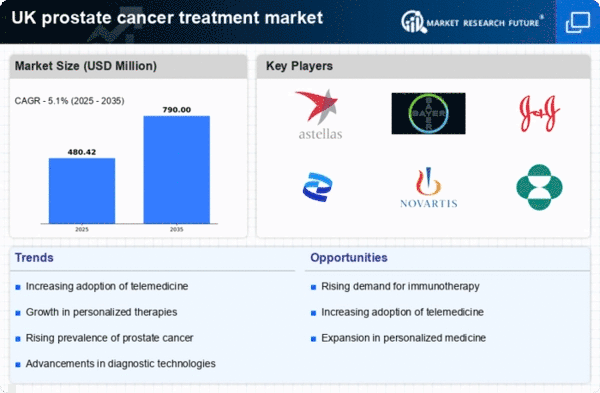
As per Market Research Future analysis, the UK prostate cancer treatment market size was estimated at 457.1 USD Million in 2024. The UK prostate cancer-treatment market is projected to grow from 480.42 USD Million in 2025 to 790.0 USD Million by 2035, exhibiting a compound annual growth rate (CAGR) of 5% during the forecast period 2025 - 2035

Key Market Trends & Highlights

The UK prostate cancer treatment market is experiencing a transformative shift towards innovative therapies and enhanced patient care.

  • The market is witnessing a rise in targeted therapies, which are becoming increasingly prevalent in treatment protocols.
  • Telemedicine is gaining traction, facilitating remote consultations and follow-ups for prostate cancer patients.
  • There is a growing emphasis on early detection strategies, which are crucial for improving patient outcomes.
  • Key market drivers include the growing aging population and advancements in medical technology, which are significantly influencing treatment approaches.

Market Size & Forecast

2024 Market Size 457.1 (USD Million)
2035 Market Size 790.0 (USD Million)
CAGR (2025 - 2035) 5.1%

Major Players

Astellas Pharma (JP), Bayer AG (DE), Johnson & Johnson (US), Pfizer Inc. (US), Novartis AG (CH), Merck & Co. (US), Sanofi (FR), Ipsen S.A. (FR), Eli Lilly and Company (US)

Our Impact
Enabled $4.3B Revenue Impact for Fortune 500 and Leading Multinationals
Partnering with 2000+ Global Organizations Each Year
30K+ Citations by Top-Tier Firms in the Industry

UK Prostate Cancer Treatment Market Trends

The prostate cancer-treatment market is currently experiencing notable shifts driven by advancements in medical technology and evolving patient needs. Innovative therapies, including targeted treatments and immunotherapies, are gaining traction, reflecting a broader trend towards personalized medicine. This shift appears to be influenced by a growing understanding of the genetic and molecular underpinnings of prostate cancer, which may lead to more effective treatment options tailored to individual patients. Furthermore, the increasing prevalence of prostate cancer in the UK is prompting healthcare providers to explore new strategies for early detection and intervention, potentially improving patient outcomes. In addition, the integration of digital health solutions into the prostate cancer-treatment market is becoming more pronounced. Telemedicine and mobile health applications are facilitating better patient engagement and monitoring, which could enhance adherence to treatment protocols. As healthcare systems adapt to these technological advancements, there is a potential for improved access to care, particularly for patients in remote areas. Overall, the landscape of the prostate cancer-treatment market is evolving, with a focus on innovation, patient-centered care, and the integration of technology into treatment pathways.

Rise of Targeted Therapies

The prostate cancer-treatment market is witnessing a significant rise in targeted therapies. These treatments focus on specific genetic mutations and molecular characteristics of tumors, potentially leading to more effective outcomes. As research progresses, the development of new agents that target these specific pathways is likely to expand, offering patients more personalized options.

Increased Use of Telemedicine

Telemedicine is becoming increasingly prevalent in the prostate cancer-treatment market. This trend allows patients to consult with healthcare providers remotely, improving access to care and facilitating ongoing management of their condition. The convenience of virtual consultations may enhance patient adherence to treatment plans and follow-up appointments.

Focus on Early Detection

There is a growing emphasis on early detection within the prostate cancer-treatment market. Enhanced screening methods and awareness campaigns are being implemented to identify prostate cancer at earlier stages. This proactive approach may lead to improved treatment outcomes and a reduction in advanced cases, ultimately benefiting patient survival rates.

UK Prostate Cancer Treatment Market Drivers

Rising Incidence Rates

The prostate cancer-treatment market is influenced by rising incidence rates of prostate cancer in the UK. Recent statistics indicate that prostate cancer cases have increased by approximately 10% over the last decade, making it the most common cancer among men. This trend is attributed to factors such as lifestyle changes and improved diagnostic capabilities. As more men are diagnosed, the demand for treatment options, including hormone therapy and chemotherapy, is expected to rise. This increase in incidence rates necessitates a robust healthcare response, thereby driving growth in the prostate cancer-treatment market.

Growing Aging Population

The prostate cancer-treatment market is experiencing growth due to the increasing aging population in the UK. As men age, the risk of developing prostate cancer rises significantly, with approximately 1 in 8 men diagnosed during their lifetime. This demographic shift is expected to drive demand for various treatment options, including surgery, radiation therapy, and hormone therapy. The Office for National Statistics indicates that the population aged 65 and over is projected to reach 23% by 2035, further intensifying the need for effective prostate cancer treatments. Consequently, healthcare providers are likely to allocate more resources to address this growing patient base, thereby enhancing the overall market landscape.

Increased Awareness and Education

There is a notable increase in awareness and education regarding prostate cancer, which is positively impacting the prostate cancer-treatment market. Campaigns aimed at educating the public about risk factors, symptoms, and the importance of early detection have gained momentum. Organizations such as Prostate Cancer UK have been instrumental in disseminating information, leading to a rise in screening rates. According to recent surveys, awareness of prostate cancer has increased by 30% over the past five years. This heightened awareness encourages men to seek medical advice sooner, resulting in earlier diagnosis and treatment, which ultimately drives market growth.

Advancements in Medical Technology

Technological advancements play a crucial role in shaping the prostate cancer-treatment market. Innovations such as robotic-assisted surgery, advanced imaging techniques, and targeted therapies have revolutionized treatment approaches. For instance, the introduction of MRI-guided biopsies has improved diagnostic accuracy, leading to earlier detection and better treatment outcomes. The UK government has invested heavily in healthcare technology, with funding exceeding £1 billion for research and development in cancer treatments. These advancements not only enhance patient care but also stimulate market growth by attracting investments and fostering collaborations between healthcare providers and technology firms.

Government Initiatives and Funding

Government initiatives and funding are pivotal in shaping the prostate cancer-treatment market. The UK government has committed substantial resources to cancer research and treatment, with an annual budget exceeding £600 million dedicated to cancer services. These initiatives aim to improve patient outcomes and access to innovative therapies. Additionally, the National Health Service (NHS) has implemented various programs to enhance screening and treatment options for prostate cancer. Such government support not only facilitates the development of new treatments but also ensures that patients receive timely and effective care, thereby bolstering the market.


Market Segment Insights

By Type: Surgery (Largest) vs. Immunotherapy (Fastest-Growing)

In the UK prostate cancer-treatment market, the segment values exhibit a diverse distribution. Surgery currently stands out as the largest segment, commanding significant market share due to its established efficacy and widespread acceptance among patients and healthcare providers. Following closely are Radiation Therapy and Hormonal Therapy, which maintain considerable shares and remain integral treatment options. Chemotherapy and Immunotherapy, although smaller in comparison, are critical to addressing advanced prostate cancer cases. Recent trends indicate a shift towards less invasive techniques, contributing to the growing dominance of Surgery as patients increasingly prefer options with shorter recovery times. Immunotherapy, recognized as the fastest-growing segment, is fueled by advancements in personalized medicine and increased clinical trials, making it a viable option for previously hard-to-treat cases. The integration of innovative technologies and an expanding pipeline of treatments are essential for sustaining growth across these segments.

Surgery: Dominant vs. Immunotherapy: Emerging

Surgery has consolidated its position as the dominant treatment modality, providing curative potential for localized prostate cancer with therapies such as radical prostatectomy. Its extensive history and clinical backing add to its appeal, further strengthened by patient satisfaction related to long-term outcomes. On the other hand, Immunotherapy represents an emerging treatment paradigm in the UK prostate cancer-treatment market, focusing on harnessing the body’s immune system to combat cancer cells. The introduction of checkpoint inhibitors and CAR T-cell therapies signals a transformative era, appealing especially to patients with advanced disease. As clinical evidence mounts and treatment protocols evolve, Immunotherapy's role is anticipated to expand, benefiting from heightened awareness and increased investment in research.

By Administration Route: Oral (Largest) vs. Injection (Fastest-Growing)

The market share distribution in the UK prostate cancer-treatment market showcases Oral as the largest segment, capturing significant attention due to its convenience and patient compliance. Following closely, Injection routes have seen rapid adoption, reflecting a shift towards injectable therapies that offer quicker action and ease of administration. Intravenous and Topical segments, while present, are comparatively smaller and cater to very specific patient needs and therapies. Growth trends in this segment indicate a robust increase for Injection methods, driven by advancements in formulation technologies and an increased emphasis on patient-centric therapies. Investments in research and development further enhance the effectiveness of injectable solutions, making them a preferred choice. In contrast, Oral treatments maintain steady growth but face competition from innovative alternatives, pushing manufacturers to improve formulations and delivery mechanisms.

Oral (Dominant) vs. Injection (Emerging)

Oral medications remain the dominant choice in the UK prostate cancer-treatment market, mainly due to their ease of use and the comfort they provide to patients. These formulations often see a high compliance rate, encouraging more frequent use in long-term treatment plans. Conversely, Injectable therapies are emerging rapidly, benefiting from technological innovations that allow for less frequent dosing and increased patient adherence. While Oral options are designed for daily or regular intake, Injection solutions present an attractive alternative for patients seeking effective treatment with fewer interventions. As patient preferences evolve, the competition between these two segments intensifies, compelling manufacturers to innovate continuously.

By End Users: Hospitals (Largest) vs. Clinics (Fastest-Growing)

In the UK prostate cancer-treatment market, the distribution of market share among end users reveals that hospitals remain the largest segment, capturing a substantial portion of treatment and care services for prostate cancer patients. Clinics, despite having a smaller share compared to hospitals, are witnessing an increase in patient preference and utilization, reflecting shifting trends towards outpatient services. Their role in enhancing accessibility to treatment options is becoming increasingly critical. The growth trends in this segment are being driven by several factors, including rising incidences of prostate cancer and advancements in treatment technologies. The increasing awareness of prostate health and early detection is also contributing to the growing demand for services offered by clinics, positioning them as the fastest-growing segment. Moreover, the shift towards homecare has created opportunities for further expansion in treatment customization and convenience for patients.

Hospitals (Dominant) vs. Clinics (Emerging)

In the UK prostate cancer-treatment market, hospitals serve as the dominant end-user segment. They provide comprehensive care, advanced treatment modalities, and multidisciplinary teams that enhance patient outcomes. Their established infrastructure and resources allow for complex surgeries and extensive treatment protocols, making them a preferred choice for patients with severe cases. Conversely, clinics are emerging as an alternative for patients seeking less invasive and more personalized treatment options. As healthcare dynamics evolve, clinics are gaining prominence due to their ability to offer specialized care with shorter wait times and a more focused approach, appealing to a growing patient base interested in outpatient services.

By Disease Stage: Localized (Largest) vs. Metastatic (Fastest-Growing)

In the UK prostate cancer-treatment market, the market share distribution among disease stages shows that the localized segment holds the largest share, predominantly due to higher detection rates through screening programs. In contrast, the locally advanced and metastatic stages hold smaller but significant shares, driven by the complexity and urgency of treatment needed as the disease progresses, which calls for more complex therapeutic approaches. Growth trends indicate a surge in the metastatic stage as new treatments and therapies emerge, focusing on precision medicine and targeted therapies that enhance patient outcomes. The increase in awareness and advancements in diagnostic technologies are also contributing to the identification of advanced stages, which is fostering growth in this segment, making it the fastest-growing in the market.

Localized (Dominant) vs. Metastatic (Emerging)

The localized segment remains dominant in the UK prostate cancer-treatment market as it represents a significant portion of diagnosed cases, benefitting from early detection and effective treatment options. This stage typically allows for various treatment modalities, including surgery, radiation, and active surveillance, leading to favorable outcomes. On the other hand, the metastatic stage is emerging rapidly due to the development of innovative therapies, specifically immunotherapy and hormone therapy, which are transforming patient management. This phase typically presents more complex treatment challenges, driving research and investment in this area. As advances continue, metastatic therapies are anticipated to capture a larger market share, reflecting the evolving treatment landscape.

Get more detailed insights about UK Prostate Cancer Treatment Market

Key Players and Competitive Insights

The prostate cancer-treatment market exhibits a dynamic competitive landscape, characterized by a blend of innovation and strategic partnerships among key players. Companies such as Astellas Pharma (JP), Bayer AG (DE), and Johnson & Johnson (US) are at the forefront, each adopting distinct strategies to enhance their market presence. Astellas Pharma (JP) focuses on expanding its portfolio through innovative therapies, while Bayer AG (DE) emphasizes strategic collaborations to bolster its research capabilities. Johnson & Johnson (US) appears to be leveraging its extensive distribution network to enhance accessibility to its treatments, thereby shaping a competitive environment that prioritizes both innovation and market reach.
The market structure is moderately fragmented, with several players vying for dominance. Key business tactics include localizing manufacturing to reduce costs and optimize supply chains, which is particularly relevant in the context of increasing demand for prostate cancer treatments. The collective influence of these major companies fosters a competitive atmosphere where agility and responsiveness to market needs are paramount.
In October 2025, Bayer AG (DE) announced a strategic partnership with a leading biotechnology firm to co-develop a novel prostate cancer therapy. This collaboration is significant as it not only enhances Bayer's research capabilities but also positions the company to potentially lead in the development of next-generation treatments. Such partnerships are indicative of a broader trend where companies seek to combine resources and expertise to accelerate innovation.
In September 2025, Astellas Pharma (JP) launched a new digital health initiative aimed at improving patient engagement and adherence to treatment protocols. This initiative underscores the growing importance of digital transformation in the healthcare sector, particularly in enhancing patient outcomes. By integrating technology into its treatment offerings, Astellas Pharma (JP) is likely to strengthen its competitive edge in a market that increasingly values patient-centric solutions.
In August 2025, Johnson & Johnson (US) expanded its prostate cancer treatment portfolio by acquiring a promising biotech startup specializing in immunotherapy. This acquisition not only diversifies Johnson & Johnson's offerings but also reflects a strategic shift towards harnessing advanced therapeutic modalities. The move is expected to enhance the company's position in the market, particularly as immunotherapy gains traction as a viable treatment option.
As of November 2025, current trends in the prostate cancer-treatment market are increasingly defined by digitalization, sustainability, and the integration of artificial intelligence (AI) in treatment development. Strategic alliances are becoming more prevalent, enabling companies to pool resources and expertise to drive innovation. Looking ahead, competitive differentiation is likely to evolve, with a shift from price-based competition to a focus on technological advancements and supply chain reliability. This transition suggests that companies that prioritize innovation and patient-centric approaches will be better positioned to thrive in an increasingly complex market.

Key Companies in the UK Prostate Cancer Treatment Market include

Industry Developments

Recent developments in the UK Prostate Cancer Treatment Market have showcased advancements from key companies such as Merck, Sanofi, and Bayer, particularly focusing on innovative therapies and clinical trials aimed at improving patient outcomes. In March 2023, AbbVie announced significant results from a research study that highlighted the efficacy of its treatment option, enhancing its position in the market. Acacia Pharma has also made strides in October 2022, obtaining regulatory approval for its prostate cancer medication, which addresses unmet medical needs.

The market is witnessing notable growth as investments in Research and Development by Pfizer, Bristol Myers Squibb, and AstraZeneca are leading to new therapeutic breakthroughs. Significant M&A activity was reported in September 2022, with Johnson and Johnson acquiring a promising biotech firm specializing in prostate cancer therapies, which is expected to reshape their portfolio. The UK government is actively supporting cancer research, providing funding that aids companies like Novartis and Ipsen to explore novel solutions.

The increased focus on patient-centric treatments is influencing market valuation and driving competition, establishing a robust environment for innovation within the prostate cancer treatment landscape in the UK.

Future Outlook

UK Prostate Cancer Treatment Market Future Outlook

The Prostate Cancer Treatment Market is projected to grow at a 5.1% CAGR from 2025 to 2035, driven by advancements in therapies, increasing awareness, and rising incidence rates.

New opportunities lie in:

  • Development of personalized medicine solutions for targeted therapies.
  • Expansion of telehealth services for remote patient monitoring.
  • Investment in AI-driven diagnostic tools to enhance early detection.

By 2035, the market is expected to achieve substantial growth, reflecting evolving treatment paradigms.

Market Segmentation

UK Prostate Cancer Treatment Market Type Outlook

  • Surgery
  • Radiation Therapy
  • Hormonal Therapy
  • Chemotherapy
  • Immunotherapy

UK Prostate Cancer Treatment Market End Users Outlook

  • Hospitals
  • Clinics
  • Homecare
  • Research Institutions

UK Prostate Cancer Treatment Market Disease Stage Outlook

  • Localized
  • Locally Advanced
  • Metastatic

UK Prostate Cancer Treatment Market Administration Route Outlook

  • Oral
  • Injection
  • Intravenous
  • Topical

Report Scope

MARKET SIZE 2024 457.1(USD Million)
MARKET SIZE 2025 480.42(USD Million)
MARKET SIZE 2035 790.0(USD Million)
COMPOUND ANNUAL GROWTH RATE (CAGR) 5.1% (2025 - 2035)
REPORT COVERAGE Revenue Forecast, Competitive Landscape, Growth Factors, and Trends
BASE YEAR 2024
Market Forecast Period 2025 - 2035
Historical Data 2019 - 2024
Market Forecast Units USD Million
Key Companies Profiled Astellas Pharma (JP), Bayer AG (DE), Johnson & Johnson (US), Pfizer Inc. (US), Novartis AG (CH), Merck & Co. (US), Sanofi (FR), Ipsen S.A. (FR), Eli Lilly and Company (US)
Segments Covered Type, Administration Route, End Users, Disease Stage
Key Market Opportunities Advancements in immunotherapy and personalized medicine enhance treatment options in the prostate cancer-treatment market.
Key Market Dynamics Rising demand for innovative therapies drives competition and regulatory scrutiny in the prostate cancer-treatment market.
Countries Covered UK
Leave a Comment

FAQs

What is the expected market size of the UK Prostate Cancer Treatment Market in 2024?

The UK Prostate Cancer Treatment Market is expected to be valued at 819.6 million USD in 2024.

What is the projected market size for the UK Prostate Cancer Treatment Market by 2035?

By 2035, the UK Prostate Cancer Treatment Market is anticipated to reach a value of 1560.0 million USD.

What is the Compound Annual Growth Rate (CAGR) for the UK Prostate Cancer Treatment Market from 2025 to 2035?

The market is projected to grow at a CAGR of 6.026 percent during the period from 2025 to 2035.

Which treatment type is expected to dominate the UK Prostate Cancer Treatment Market in 2024?

Surgery is expected to dominate the market with a valuation of 250.0 million USD in 2024.

What market size is projected for Radiation Therapy in the UK Prostate Cancer Treatment Market by 2035?

Radiation Therapy is projected to reach a market size of 420.0 million USD by 2035.

Who are the major players in the UK Prostate Cancer Treatment Market?

Major players in the market include Merck, Sanofi, Bayer, AbbVie, and Pfizer.

What is the expected market value for Hormonal Therapy in 2024?

Hormonal Therapy is expected to have a market value of 180.0 million USD in 2024.

How much is the UK Prostate Cancer Treatment Market for Chemotherapy forecasted to be in 2035?

The Chemotherapy market is forecasted to reach a value of 190.0 million USD by 2035.

What significant opportunity exists in the UK Prostate Cancer Treatment Market?

There is a notable opportunity in the growing demand for Immunotherapy, projected to be valued at 200.0 million USD by 2035.

How are current global factors affecting the growth of the UK Prostate Cancer Treatment Market?

Current global factors are causing fluctuations in the market but overall growth remains positive due to rising treatment needs.

Download Free Sample

Kindly complete the form below to receive a free sample of this Report

Compare Licence

×
Features License Type
Single User Multiuser License Enterprise User
Price $4,950 $5,950 $7,250
Maximum User Access Limit 1 User Upto 10 Users Unrestricted Access Throughout the Organization
Free Customization
Direct Access to Analyst
Deliverable Format
Platform Access
Discount on Next Purchase 10% 15% 15%
Printable Versions