×
Request Free Sample ×

Kindly complete the form below to receive a free sample of this Report

* Please use a valid business email

Leading companies partner with us for data-driven Insights

clients tt-cursor
Hero Background

UK Pathological Microscopes Market

ID: MRFR/HC/47746-HCR
200 Pages
Rahul Gotadki
February 2026

UK Pathological Microscopes Market Research Report By Type (Electron Microscope, Optical Microscope, Compound Microscope, Digital Microscope, Fluorescence Microscope, others), By Application (Bodily Fluids, Tissue Scanning, others) and By End User (Pathology and Diagnostic Laboratories, Hospitals & Clinics, Forensic Laboratories, others) -Forecast to 2035

Share:
Download PDF ×

We do not share your information with anyone. However, we may send you emails based on your report interest from time to time. You may contact us at any time to opt-out.

UK Pathological Microscopes Market Infographic
Purchase Options

UK Pathological Microscopes Market Summary

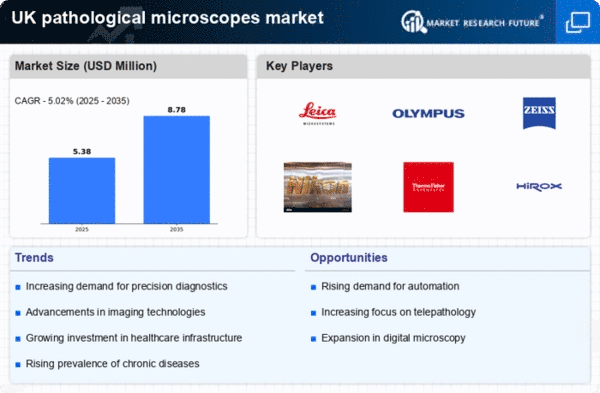
As per Market Research Future analysis, the UK pathological microscopes market size was estimated at 5.12 USD Million in 2024.. The UK pathological microscopes market is projected to grow from 5.38 USD Million in 2025 to 8.78 USD Million by 2035, exhibiting a compound annual growth rate (CAGR) of 5.0% during the forecast period 2025 - 2035

Key Market Trends & Highlights

The UK pathological microscopes market is experiencing robust growth driven by technological advancements and increasing healthcare demands.

  • Technological advancements in microscopy are enhancing diagnostic accuracy and efficiency in pathology labs.
  • The largest segment in the UK market is the digital pathology segment, which is rapidly gaining traction due to its integration with IT systems.
  • The fastest-growing segment is the automated microscopy segment, reflecting a shift towards efficiency and precision in diagnostics.
  • Rising demand for diagnostic services and investment in healthcare infrastructure are key drivers propelling market growth.

Market Size & Forecast

2024 Market Size 5.12 (USD Million)
2035 Market Size 8.78 (USD Million)
CAGR (2025 - 2035) 5.02%

Major Players

Leica Microsystems (DE), Olympus Corporation (JP), Carl Zeiss AG (DE), Nikon Corporation (JP), Thermo Fisher Scientific (US), Hirox Co., Ltd. (JP), Motic (CN), Bionomous (CH)

Our Impact
Enabled $4.3B Revenue Impact for Fortune 500 and Leading Multinationals
Partnering with 2000+ Global Organizations Each Year
30K+ Citations by Top-Tier Firms in the Industry

UK Pathological Microscopes Market Trends

the pathological microscopes market is currently experiencing significant changes, driven by advancements in technology and increasing demand for precise diagnostic tools. the integration of digital imaging and artificial intelligence into microscopy is enhancing the capabilities of these instruments. This allows for more accurate and efficient analysis of pathological specimens. This trend appears to be fostering a shift towards more automated processes, which could potentially reduce human error and improve diagnostic outcomes. Furthermore, the growing emphasis on personalized medicine is likely to propel the need for sophisticated microscopy solutions that can provide detailed insights into individual patient conditions. In addition, the regulatory landscape surrounding medical devices is becoming increasingly stringent, which may influence the development and distribution of pathological microscopes. Manufacturers are adapting to these changes by investing in research and development to ensure compliance while also meeting the evolving needs of healthcare providers. the market is poised for growth as healthcare institutions recognize the value of high-quality microscopy in enhancing patient care and treatment efficacy. As the demand for advanced diagnostic tools continues to rise, the pathological microscopes market is expected to expand, reflecting the ongoing commitment to improving healthcare outcomes.

Technological Advancements

The integration of cutting-edge technologies such as digital imaging and artificial intelligence is transforming the capabilities of pathological microscopes. These innovations enhance diagnostic accuracy and efficiency, allowing for more detailed analysis of specimens.

Regulatory Compliance

The evolving regulatory environment is prompting manufacturers to focus on compliance with stringent standards. This trend may lead to increased investment in research and development to ensure that products meet both safety and performance requirements.

Personalized Medicine

The rising focus on personalized medicine is driving demand for advanced microscopy solutions. Healthcare providers are seeking tools that can deliver precise insights into individual patient conditions, thereby improving treatment strategies.

UK Pathological Microscopes Market Drivers

Rising Demand for Diagnostic Services

The increasing prevalence of chronic diseases in the UK is driving the demand for diagnostic services, which in turn fuels the growth of the pathological microscopes market. As healthcare providers strive to enhance diagnostic accuracy, the need for advanced microscopy solutions becomes paramount. The market is projected to witness a compound annual growth rate (CAGR) of approximately 6.5% over the next five years, reflecting the growing reliance on precise diagnostic tools. Furthermore, the integration of digital pathology into routine diagnostics is likely to enhance workflow efficiency, thereby increasing the adoption of pathological microscopes. This trend indicates a shift towards more sophisticated diagnostic methodologies, which are essential for effective disease management and treatment planning in the UK healthcare landscape.

Investment in Healthcare Infrastructure

The UK government has been actively investing in healthcare infrastructure, which is expected to positively impact the pathological microscopes market. With initiatives aimed at modernizing hospitals and laboratories, there is a growing emphasis on acquiring advanced diagnostic equipment. This investment is likely to enhance the capabilities of healthcare facilities, enabling them to provide better diagnostic services. According to recent reports, the UK healthcare expenditure is projected to reach £200 billion by 2026, with a significant portion allocated to upgrading laboratory equipment. Such financial commitments suggest a robust market environment for pathological microscopes, as healthcare providers seek to improve patient outcomes through enhanced diagnostic accuracy and efficiency.

Growing Focus on Research and Development

emphasis on research and development (R&D) within the UK healthcare sector is a key driver for the pathological microscopes market. As academic institutions and private companies invest in innovative research, the demand for advanced microscopy techniques is likely to increase. The UK is home to numerous research facilities that require high-quality pathological microscopes for various applications, including cancer research and drug development. This focus on R&D is expected to propel the market forward, as new technologies and methodologies emerge. Furthermore, collaborations between universities and industry players may lead to the development of cutting-edge microscopy solutions, thereby enhancing the overall market landscape.

Technological Integration in Pathology Labs

the integration of technology in pathology laboratories is transforming operations, thereby influencing the pathological microscopes market. The adoption of digital pathology solutions, including telepathology and automated imaging systems, is becoming increasingly prevalent. These technologies enhance diagnostic accuracy and efficiency, allowing pathologists to analyze samples more effectively. As laboratories seek to streamline their processes, the demand for advanced pathological microscopes that can integrate with digital systems is likely to rise. This trend suggests a shift towards more automated and efficient workflows, which could redefine the standards of diagnostic practices in the UK.

Aging Population and Increased Healthcare Needs

the aging population in the UK is contributing to increased demand for healthcare services, which subsequently impacts the pathological microscopes market. As the population ages, the incidence of age-related diseases, such as cancer and cardiovascular conditions, is likely to rise. This demographic shift necessitates improved diagnostic capabilities, prompting healthcare providers to invest in advanced pathological microscopes. Projections indicate that by 2030, over 20% of the UK population will be aged 65 and above, further intensifying the need for effective diagnostic tools. Consequently, the market is expected to expand as healthcare systems adapt to meet the growing healthcare needs of an aging society.


Market Segment Insights

By Application: Optical Microscope (Largest) vs. Digital Microscope (Fastest-Growing)

In the UK pathological microscopes market, Optical Microscopes hold the largest market share due to their widespread application in educational and clinical settings. Their affordability and user-friendly features make them a preferred choice for many laboratories, thus solidifying their position at the forefront of the market. On the other hand, Digital Microscopes are rapidly gaining traction, accounting for a significant portion of the market due to advancements in imaging technology and the increasing need for digital records in laboratory environments. The growth trends in the application segment of the UK pathological microscopes market indicate a strong inclination towards more advanced technology. Digital Microscopes are particularly benefiting from the rise in telemedicine and remote diagnostics, which require high-quality imaging and data sharing capabilities. Additionally, the increasing research activities and funding in the healthcare sector are driving the demand for Electron and Fluorescence Microscopes, catering to specialized applications in pathology and life sciences.

Optical Microscope (Dominant) vs. Digital Microscope (Emerging)

Optical Microscopes are characterized by their ability to magnify specimens using visible light, making them ideal for routine examinations in pathology labs. They are widely recognized for their reliability and ease of use, which has contributed to their dominance in the market. Meanwhile, Digital Microscopes are emerging as a game-changer in the field, leveraging advanced image processing technologies that enable enhanced visualization and analysis. These devices often integrate software solutions that allow for seamless data management and sharing, aligning with current trends towards digitalization in laboratories. Both segments complement each other, wherein Optical Microscopes serve foundational roles, while Digital Microscopes cater to the evolving needs for integration and technological advancement.

By Type: Tissue Scanning (Largest) vs. Bodily Fluids (Fastest-Growing)

The market share distribution in the segment highlights Tissue Scanning as the largest contributor among the values, capturing a significant portion due to its advanced technology and extensive application in diagnostics. Bodily Fluids follows, showing strong demand driven by its utility in various medical tests and quick results. Others represent a niche segment, adding diversity but with a smaller impact on overall share. Growth trends indicate a robust expansion in the Bodily Fluids category, attributed to rising healthcare spending and the increasing prevalence of chronic diseases necessitating fluid analysis. Innovations in Tissue Scanning technologies are also propelling its growth, while the Others category sees sporadic advancements, relying on emerging applications in specialized diagnostics. Regulatory support for advanced diagnostic tools further encourages market expansion.

Tissue Scanning (Dominant) vs. Bodily Fluids (Emerging)

Tissue Scanning holds a dominant position in the market due to its crucial role in providing detailed cellular analysis and aiding in the diagnosis of numerous medical conditions. Its established technology ensures accuracy and reliability, making it a preferred choice among healthcare practitioners. Conversely, Bodily Fluids is emerging rapidly, capturing attention for its ease of sample collection and speed of diagnostic results. This segment is gaining traction, especially in the areas of point-of-care testing. The versatility of bodily fluid analyses, including blood, urine, and saliva tests, is making it a key focus for future innovations. Both segments cater to the evolving needs of the healthcare sector, emphasizing accuracy and efficiency.

By End-User: Clinics and Hospitals (Largest) vs. Forensic Laboratories (Fastest-Growing)

In the UK pathological microscopes market, the end-user distribution highlights clinics and hospitals as the largest segment, accounting for a significant portion of market demand. Diagnostic and pathology laboratories also represent a key market segment, serving essential functions in disease diagnostics and research. These segments collectively emphasize the importance of microscopy in accurate medical assessments and patient care, leading to a stable growth pattern in the overall market share. The growth trends in the end-user segments are strongly influenced by advancements in technology, increasing healthcare investments, and the growing demand for precise diagnostic tools. Forensic laboratories are identified as the fastest-growing segment, driven by the rising need for forensic investigations and the enhancement of crime scene analysis techniques. As healthcare evolves, clinics and hospitals continue to adopt innovative solutions, boosting efficiency and improving patient outcomes.

Clinics and Hospitals (Dominant) vs. Forensic Laboratories (Emerging)

Clinics and hospitals represent the dominant segment in the UK pathological microscopes market, due to their extensive use of advanced microscopy for diagnostic purposes and routine examinations. This segment benefits from the integration of cutting-edge technologies that improve diagnostic accuracy and workflow efficiency. Meanwhile, forensic laboratories are rapidly emerging, characterized by their unique requirements for high-resolution imaging and analysis in criminal investigations. The growing implementation of digital pathology within this segment enhances case resolution times and evidence quality, indicating a shift towards more specialized applications of microscopy. Both segments underscore the critical role of pathological microscopes in today's healthcare landscape, each contributing differently to market dynamics.

Get more detailed insights about UK Pathological Microscopes Market

Key Players and Competitive Insights

the pathological microscopes market is increasingly shaped by technological advancements and strategic collaborations. Key players such as Leica Microsystems (DE), Olympus Corporation (JP), and Thermo Fisher Scientific (US) are at the forefront, focusing on innovation and expanding their product portfolios. These companies are leveraging cutting-edge technologies, including digital imaging and AI integration, to enhance diagnostic capabilities and improve user experience. Their strategic positioning emphasizes not only product development but also partnerships that facilitate market penetration and customer engagement, thereby collectively shaping a dynamic competitive environment.In terms of business tactics, companies are increasingly localizing manufacturing to reduce costs and optimize supply chains. the market structure is moderately fragmented, with several players vying for market share. However, the influence of major companies is substantial, as they set industry standards and drive technological advancements. This competitive structure allows for a diverse range of products and services, catering to various customer needs while fostering innovation across the sector.

In October Olympus Corporation (JP) announced the launch of a new line of high-resolution digital microscopes aimed at enhancing research capabilities in pathology. This strategic move is significant as it not only reinforces Olympus's commitment to innovation but also positions the company to capture a larger share of the growing demand for advanced imaging solutions in the UK market. The introduction of these products is likely to attract research institutions and laboratories seeking state-of-the-art technology.

In September Thermo Fisher Scientific (US) expanded its collaboration with leading universities in the UK to develop next-generation microscopy solutions. This partnership is pivotal as it aligns with the company's strategy to integrate customer feedback into product development, ensuring that their offerings meet the evolving needs of the market. Such collaborations may enhance Thermo Fisher's reputation as a leader in the field and drive future sales growth.

In August Leica Microsystems (DE) unveiled a new AI-driven software platform designed to streamline the analysis of pathological samples. This innovation is particularly noteworthy as it reflects the growing trend towards digitalization in the industry. By incorporating AI, Leica aims to improve diagnostic accuracy and efficiency, which could significantly impact clinical workflows and patient outcomes.

As of November the competitive trends in the pathological microscopes market are increasingly defined by digitalization, sustainability, and the integration of AI technologies. Strategic alliances are becoming more prevalent, as companies recognize the value of collaboration in driving innovation and enhancing product offerings. Looking ahead, competitive differentiation is likely to evolve from traditional price-based competition to a focus on technological innovation, reliability in supply chains, and the ability to meet specific customer needs. This shift underscores the importance of adaptability and forward-thinking strategies in maintaining a competitive edge.

Key Companies in the UK Pathological Microscopes Market include

Industry Developments

Recent developments in the UK Pathological Microscopes Market are shaping a dynamic landscape, with significant players like Sakura Finetek, Leica Biosystems, Nikon Corporation, and Thermo Fisher Scientific actively innovating and expanding their offerings. In July 2022, Leica Biosystems launched a new line of digital pathology products enhancing diagnostic accuracy, while in April 2023, Olympus Corporation introduced advanced imaging technologies aimed at improving histopathology workflows. Current affairs reflect an increasing focus on integrated and digital solutions in pathology, aligning with the UK's National Health Service (NHS) investment in healthcare technology.

Merger and acquisition activities have also been notable; in August 2023, Thermo Fisher Scientific announced its acquisition of a competitive microscopy firm, expanding its portfolio and capabilities in diagnostic instrumentation. The market valuation for companies like Agilent Technologies and Bruker Corporation is experiencing growth as they enhance R&D efforts, contributing to the evolution of clinical applications. Noteworthy is the trend towards automation and digital pathology which has accelerated since the COVID-19 pandemic, with a marked shift in demand for high-quality microscopy solutions that could lead to efficiency improvements in diagnostic services.


Future Outlook

UK Pathological Microscopes Market Future Outlook

The Pathological Microscopes Market is projected to grow at 5.02% CAGR from 2025 to 2035, driven by technological advancements, increasing healthcare investments, and rising demand for diagnostic tools.

New opportunities lie in:

  • Development of AI-integrated imaging systems for enhanced diagnostics.
  • Expansion into telepathology services to reach remote healthcare facilities.
  • Partnerships with educational institutions for training programs on advanced microscopy techniques.

By 2035, the market is expected to achieve robust growth, positioning itself as a leader in diagnostic innovation.

Market Segmentation

UK Pathological Microscopes Market Type Outlook

  • Tissue Scanning
  • Bodily Fluids
  • Others

UK Pathological Microscopes Market End-User Outlook

  • Forensic laboratories
  • Clinics and Hospitals
  • Diagnostic and Pathology Laboratories
  • Others

UK Pathological Microscopes Market Application Outlook

  • Digital Microscope
  • Electron Microscope
  • Fluorescence Microscope
  • Optical Microscope
  • Others

Report Scope

MARKET SIZE 20245.12(USD Million)
MARKET SIZE 20255.38(USD Million)
MARKET SIZE 20358.78(USD Million)
COMPOUND ANNUAL GROWTH RATE (CAGR)5.02% (2025 - 2035)
REPORT COVERAGERevenue Forecast, Competitive Landscape, Growth Factors, and Trends
BASE YEAR2024
Market Forecast Period2025 - 2035
Historical Data2019 - 2024
Market Forecast UnitsUSD Million
Key Companies ProfiledLeica Microsystems (DE), Olympus Corporation (JP), Carl Zeiss AG (DE), Nikon Corporation (JP), Thermo Fisher Scientific (US), Hirox Co., Ltd. (JP), Motic (CN), Bionomous (CH)
Segments CoveredApplication, Type, End-User
Key Market OpportunitiesAdvancements in digital pathology enhance diagnostic accuracy in the pathological microscopes market.
Key Market DynamicsTechnological advancements drive innovation in the pathological microscopes market, enhancing diagnostic accuracy and efficiency.
Countries CoveredUK
Leave a Comment

FAQs

What is the projected market size of the UK Pathological Microscopes Market in 2024?

The UK Pathological Microscopes Market is expected to be valued at 5.0 USD Million in 2024.

How much is the UK Pathological Microscopes Market expected to grow by 2035?

By 2035, the market is anticipated to reach a value of 9.0 USD Million.

What is the expected compound annual growth rate (CAGR) for the UK Pathological Microscopes Market from 2025 to 2035?

The market is projected to grow at a CAGR of 5.489% during the forecast period from 2025 to 2035.

Which type of microscope is projected to have the highest value in 2035?

The Optical Microscope is projected to reach a market value of 2.7 USD Million in 2035.

Which company is a key player in the UK Pathological Microscopes Market?

Major players include renowned companies like Leica Biosystems, Nikon Corporation, and Thermo Fisher Scientific.

What is the expected market size for Electron Microscopes in 2024?

The Electron Microscope segment is expected to be valued at 0.8 USD Million in 2024.

What challenges may affect the growth of the UK Pathological Microscopes Market until 2035?

Market growth may face challenges such as technological advancements and regulation changes impacting equipment usage.

What is the market growth rate forecast for the Digital Microscope segment?

The Digital Microscope segment is expected to grow from 0.9 USD Million in 2024 to 1.6 USD Million in 2035.

How is the market for Fluorescence Microscopes expected to change by 2035?

The Fluorescence Microscope segment is projected to increase in value to 1.2 USD Million by 2035.

What opportunities exist for emerging trends in the UK Pathological Microscopes Market?

Emerging trends may include advancements in digital imaging and increasing demand for precise diagnostic tools.

Download Free Sample

Kindly complete the form below to receive a free sample of this Report

Compare Licence

×
Features License Type
Single User Multiuser License Enterprise User
Price $4,950 $5,950 $7,250
Maximum User Access Limit 1 User Upto 10 Users Unrestricted Access Throughout the Organization
Free Customization
Direct Access to Analyst
Deliverable Format
Platform Access
Discount on Next Purchase 10% 15% 15%
Printable Versions