×
Request Free Sample ×

Kindly complete the form below to receive a free sample of this Report

* Please use a valid business email

Leading companies partner with us for data-driven Insights

clients tt-cursor
Hero Background

UK Neurodiagnostics Market

ID: MRFR/MED/49617-HCR
200 Pages
Rahul Gotadki
February 2026

UK Neurodiagnostics Market Research Report: Size, Share, Trend Analysis By Product Type (Diagnostic Imaging Systems, Clinical Diagnostic Instruments, Reagents and Consumables), By Condition (Neurodegenerative Diseases, Stroke, Epilepsy, Headache Disorders, Sleep Disorders, Others) and By End Users (Hospitals and Surgical Centers, Diagnostic Laboratories and Imaging Centers, Neurology Centers, Ambulatory Care Centers, Research Laboratories and Academic Institutes) - Growth Outlook & Industry Forecast 2025 To 2035

Share:
Download PDF ×

We do not share your information with anyone. However, we may send you emails based on your report interest from time to time. You may contact us at any time to opt-out.

UK Neurodiagnostics Market Infographic
Purchase Options

UK Neurodiagnostics Market Summary

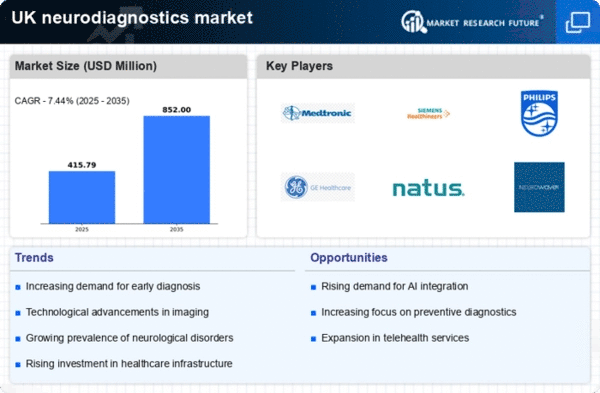
As per Market Research Future analysis, the UK neurodiagnostics market Size was estimated at 387.0 USD Million in 2024. The UK neurodiagnostics market is projected to grow from 415.79 USD Million in 2025 to 852.0 USD Million by 2035, exhibiting a compound annual growth rate (CAGR) of 7.4% during the forecast period 2025 - 2035

Key Market Trends & Highlights

The UK neurodiagnostics market is poised for growth driven by technological advancements and increasing demand for mental health services.

  • Technological advancements are enhancing diagnostic accuracy and efficiency in the neurodiagnostics market.
  • The largest segment in the UK neurodiagnostics market is the EEG segment, while the fastest-growing segment is the MRI segment.
  • There is a notable increase in demand for mental health services, reflecting a societal shift towards prioritizing neurological health.
  • Rising prevalence of neurological disorders and regulatory support for innovative diagnostics are key drivers propelling market growth.

Market Size & Forecast

2024 Market Size 387.0 (USD Million)
2035 Market Size 852.0 (USD Million)
CAGR (2025 - 2035) 7.44%

Major Players

Medtronic (US), Siemens Healthineers (DE), Philips (NL), GE Healthcare (US), Natus Medical (US), NeuroWave (US), Compumedics (AU), BrainScope (US)

Our Impact
Enabled $4.3B Revenue Impact for Fortune 500 and Leading Multinationals
Partnering with 2000+ Global Organizations Each Year
30K+ Citations by Top-Tier Firms in the Industry

UK Neurodiagnostics Market Trends

The neurodiagnostics market is currently experiencing notable advancements, driven by technological innovations and an increasing prevalence of neurological disorders. The integration of artificial intelligence and machine learning into diagnostic tools appears to enhance the accuracy and efficiency of neurodiagnostic procedures. Furthermore, the growing awareness of mental health issues among the population seems to be propelling demand for neurodiagnostic services, as individuals seek timely and effective diagnoses. This trend is likely to continue, as healthcare providers increasingly prioritize early detection and intervention strategies. In addition, the regulatory landscape surrounding neurodiagnostics is evolving, with government bodies emphasizing the importance of quality and safety in medical devices. This regulatory focus may lead to enhanced standards for neurodiagnostic equipment, fostering trust among healthcare professionals and patients alike. As the market matures, collaboration between technology firms and healthcare providers could facilitate the development of innovative solutions tailored to specific neurological conditions. Overall, the neurodiagnostics market is poised for growth, driven by technological advancements, increased awareness, and a supportive regulatory environment.

Technological Advancements

The neurodiagnostics market is witnessing rapid technological advancements, particularly in imaging and monitoring techniques. Innovations such as advanced MRI and EEG systems are enhancing diagnostic capabilities, allowing for more precise assessments of neurological conditions. These developments may lead to improved patient outcomes and more efficient healthcare delivery.

Increased Demand for Mental Health Services

There is a growing demand for neurodiagnostic services, particularly in the realm of mental health. As awareness of mental health issues rises, more individuals are seeking neurodiagnostic evaluations to understand their conditions better. This trend suggests a shift towards integrating neurodiagnostics into routine mental health assessments.

Regulatory Changes and Standards

The regulatory environment for neurodiagnostics is evolving, with an emphasis on safety and efficacy. Government agencies are likely to implement stricter guidelines for neurodiagnostic devices, which may enhance the quality of care provided. This focus on regulation could foster innovation while ensuring patient safety.

UK Neurodiagnostics Market Drivers

Technological Integration in Healthcare

The integration of advanced technologies into healthcare systems is significantly influencing the neurodiagnostics market. Innovations such as artificial intelligence (AI), machine learning, and telemedicine are enhancing diagnostic accuracy and efficiency. For instance, AI algorithms can analyze neuroimaging data with remarkable precision, potentially reducing diagnostic errors. The UK government has been investing in digital health initiatives, which may further accelerate the adoption of these technologies in neurodiagnostics. As healthcare providers increasingly embrace these advancements, the neurodiagnostics market is likely to witness substantial growth, driven by the demand for more sophisticated diagnostic tools.

Growing Awareness of Neurological Health

There is a notable increase in public awareness regarding neurological health issues in the UK, which is positively impacting the neurodiagnostics market. Campaigns aimed at educating the public about the signs and symptoms of neurological disorders are encouraging individuals to seek early diagnosis and treatment. This heightened awareness is likely to lead to an increase in diagnostic testing and consultations with healthcare professionals. As more people recognize the importance of addressing neurological health, the demand for neurodiagnostic services is expected to rise, thereby driving market growth. The neurodiagnostics market stands to gain from this trend as healthcare systems adapt to meet the needs of an informed public.

Rising Prevalence of Neurological Disorders

The increasing incidence of neurological disorders in the UK is a primary driver for the neurodiagnostics market. Conditions such as epilepsy, multiple sclerosis, and Alzheimer's disease are becoming more prevalent, necessitating advanced diagnostic tools. According to recent data, approximately 1 in 6 people in the UK are affected by neurological conditions, which translates to millions requiring effective diagnosis and management. This growing patient population is likely to stimulate demand for neurodiagnostic devices and services, thereby propelling market growth. The neurodiagnostics market is expected to expand as healthcare providers seek innovative solutions to address these challenges, ensuring timely and accurate diagnoses.

Regulatory Support for Innovative Diagnostics

Regulatory bodies in the UK are increasingly supportive of innovative diagnostic solutions, which is fostering growth in the neurodiagnostics market. Streamlined approval processes for new technologies and devices are encouraging manufacturers to bring their products to market more quickly. The Medicines and Healthcare products Regulatory Agency (MHRA) has been working to ensure that new neurodiagnostic tools meet safety and efficacy standards while facilitating innovation. This supportive regulatory environment is likely to attract investment and encourage the development of novel diagnostic solutions. As a result, the neurodiagnostics market may experience accelerated growth as new products become available to healthcare providers.

Increased Investment in Research and Development

Investment in research and development (R&D) within the neurodiagnostics market is on the rise, driven by both public and private sectors in the UK. This influx of funding is aimed at developing novel diagnostic tools and improving existing technologies. The UK government has allocated significant resources to neuroscience research, which may lead to breakthroughs in neurodiagnostic methods. Furthermore, collaborations between academic institutions and industry players are fostering innovation. As R&D efforts continue to expand, the neurodiagnostics market is expected to benefit from the introduction of cutting-edge technologies and methodologies, enhancing diagnostic capabilities.


Market Segment Insights

By Product Type: Diagnostic Imaging Systems (Largest) vs. Clinical Diagnostic Instruments (Fastest-Growing)

In the UK neurodiagnostics market, the product type segment is primarily dominated by Diagnostic Imaging Systems, which hold a significant market share relative to other categories. Following closely are Clinical Diagnostic Instruments and Reagents and Consumables, which cater to various diagnostic needs. The distribution reflects a robust infrastructure supporting imaging technologies, while the rising demand for precise and efficient clinical instruments plays a crucial role in overall market performance. Growth trends in the product type segment indicate a shift towards more advanced Diagnostic Imaging Systems, propelled by technological advancements such as AI integration and improved imaging techniques. Additionally, Clinical Diagnostic Instruments are witnessing faster growth due to an increasing focus on rapid diagnostics and personalized medicine. This expansion is further driven by the rise in neurological disorders, requiring innovative solutions for timely and accurate diagnosis.

Diagnostic Imaging Systems (Dominant) vs. Reagents and Consumables (Emerging)

Diagnostic Imaging Systems represent the dominant product type in the market, characterized by their critical role in accurate neurodiagnostics through enhanced imaging capabilities. These systems leverage advanced technologies to provide detailed insights into brain anomalies, thereby improving diagnostic accuracy and patient outcomes. Conversely, Reagents and Consumables, while considered an emerging segment, are essential for conducting various diagnostic tests, driving their demand. This growing segment is experiencing innovations in reagents tailored for neurological assessments, reflecting an overall trend towards precision in diagnostics. The differentiation in product types showcases a comprehensive approach to addressing the complexities of neurological disorders, with opportunities for both segments to thrive as the market evolves.

By Condition: Neurodegenerative Diseases (Largest) vs. Stroke (Fastest-Growing)

In the UK neurodiagnostics market, the distribution of market share among condition segments shows that neurodegenerative diseases hold the largest share, reflecting the increasing prevalence of conditions such as Alzheimer's and Parkinson's. Stroke, on the other hand, represents the fastest-growing segment, driven by rising awareness around stroke diagnosis and the need for advanced neurodiagnostic solutions to improve patient outcomes. Growth trends in this segment are primarily influenced by an aging population and advancements in medical technology. The demand for early and accurate neurodiagnostic tools is accelerating, especially for stroke, as it is critical for timely intervention. Increasing investments in healthcare infrastructure and innovative research are further propelling the market forward, making it a dynamic field ripe for expansion.

Neurodegenerative Diseases (Dominant) vs. Stroke (Emerging)

Neurodegenerative diseases, being the dominant segment, have solidified their position due to a higher patient base needing continuous monitoring and diagnostics. They encompass disorders that progressively deteriorate neural functions, demanding advanced neurodiagnostic solutions for effective management. Conversely, stroke as an emerging segment signifies a shift in focus due to its growing incidence rates and rising healthcare initiatives aimed at timely diagnosis and treatment. Both segments showcase distinct characteristics; while neurodegenerative diseases cater to long-term patient care, stroke diagnostics emphasize rapid assessment and intervention. As heart-related health issues continue to rise, the demand for innovative stroke diagnostics is likely to grow, complementing the established domain of neurodegenerative disease management.

By End User: Hospitals and Surgical Centers (Largest) vs. Neurology Centers (Fastest-Growing)

The market share distribution in the UK neurodiagnostics market showcases a significant presence of Hospitals and Surgical Centers, which dominate the landscape. These facilities account for a substantial portion of the market due to their integrated services and advanced technology that cater to a wide range of neurodiagnostic needs. In contrast, Neurology Centers, while maintaining a smaller share, are rapidly gaining ground, driven by an increasing focus on specialized neurology care and the rising incidence of neurological disorders. The growth trends within the neurodiagnostics market segment indicate that Hospitals and Surgical Centers will continue to lead, primarily fueled by an aging population and heightened awareness around early diagnosis of neurological conditions. Conversely, Neurology Centers are emerging as the fastest-growing segment, supported by technological advancements in neuroimaging and diagnostic testing. These centers are becoming critical in providing tailored treatment options, contributing to their swift expansion in the market.

Hospitals and Surgical Centers (Dominant) vs. Neurology Centers (Emerging)

Hospitals and Surgical Centers are characterized by their comprehensive approach to neurodiagnostics, offering a wide array of services including imaging, sleep studies, and neurological assessments. This segment benefits from robust funding and technological investments, allowing for efficient patient care pathways. On the other hand, Neurology Centers are emerging with a focused expertise in treating neurological disorders, utilizing cutting-edge technology like EEG and MRI. These centers are particularly attractive due to their patient-centric approach, fostering specialized care that addresses the complexities of neurological conditions. As awareness and demand for neurodiagnostic solutions rise, both segments are set to play pivotal roles in shaping the future of neurological healthcare.

Get more detailed insights about UK Neurodiagnostics Market

Key Players and Competitive Insights

The neurodiagnostics market in the UK is characterized by a dynamic competitive landscape, driven by technological advancements and an increasing demand for efficient diagnostic solutions. Key players such as Medtronic (US), Siemens Healthineers (DE), and Philips (NL) are at the forefront, each adopting distinct strategies to enhance their market presence. Medtronic (US) focuses on innovation through the development of advanced neurostimulation devices, while Siemens Healthineers (DE) emphasizes digital transformation, integrating AI into their diagnostic imaging solutions. Philips (NL) is strategically positioned towards partnerships with healthcare providers to expand its reach and improve patient outcomes, collectively shaping a competitive environment that prioritizes technological integration and patient-centric solutions.The business tactics employed by these companies include localizing manufacturing and optimizing supply chains to enhance operational efficiency. The market structure appears moderately fragmented, with several players vying for market share. However, the collective influence of major companies like GE Healthcare (US) and Natus Medical (US) suggests a trend towards consolidation, as these firms leverage their resources to gain competitive advantages in product offerings and service delivery.

In October Siemens Healthineers (DE) announced a strategic partnership with a leading UK healthcare provider to implement AI-driven diagnostic tools across multiple facilities. This collaboration is poised to enhance diagnostic accuracy and streamline workflows, reflecting a broader trend towards integrating advanced technologies in clinical settings. Such partnerships not only bolster Siemens' market position but also signify a shift towards collaborative approaches in healthcare delivery.

In September Medtronic (US) launched a new line of neurodiagnostic devices designed to improve the accuracy of epilepsy diagnosis. This product introduction is significant as it addresses a critical need in the market, potentially increasing Medtronic's share by appealing to healthcare providers seeking reliable diagnostic tools. The emphasis on innovation in product development underscores the company's commitment to enhancing patient care through advanced technology.

In August Philips (NL) expanded its portfolio by acquiring a UK-based startup specializing in neuroimaging software. This acquisition is indicative of Philips' strategy to bolster its technological capabilities and enhance its service offerings in the neurodiagnostics sector. By integrating innovative software solutions, Philips aims to provide comprehensive diagnostic tools that meet the evolving needs of healthcare professionals.

As of November the competitive trends in the neurodiagnostics market are increasingly defined by digitalization, sustainability, and the integration of AI technologies. Strategic alliances are becoming pivotal in shaping the landscape, as companies recognize the value of collaboration in driving innovation. Looking ahead, competitive differentiation is likely to evolve from traditional price-based competition towards a focus on technological advancements, reliability in supply chains, and the ability to deliver superior patient outcomes. This shift underscores the importance of innovation and strategic partnerships in navigating the complexities of the neurodiagnostics market.

Key Companies in the UK Neurodiagnostics Market include

Industry Developments

The UK Neurodiagnostics Market has seen significant developments recently, with companies like Medtronic and Philips expanding their product offerings to improve patient monitoring and diagnostic capabilities. In August 2023, Natus Medical launched a new EEG system aimed at enhancing the diagnostic process for neurological disorders, reflecting a trend towards advanced technology integration in neurodiagnostics.

Furthermore, Compumedics announced its continuous growth, reporting an increase in demand for its sleep and neurological diagnostics systems, paralleling the rising prevalence of neurological conditions in the UK. In the realm of mergers and acquisitions, MicroMedical was acquired by Omega Medical in September 2023, a strategic move aimed at consolidating capabilities in the diagnostic space, which underscores the trend of consolidation within the market.

The overall market valuation for Neurodiagnostics in the UK continues to grow, driven by an aging population and increased funding for healthcare technologies. Key stakeholders are focusing on innovation and collaboration to enhance research and development, resulting in more effective diagnostic tools to address neurological disorders, thereby impacting the healthcare landscape significantly in the UK. As a result, the market is poised for continued growth and transformation within this dynamic sector.

Future Outlook

UK Neurodiagnostics Market Future Outlook

The Neurodiagnostics Market is projected to grow at a 7.44% CAGR from 2025 to 2035, driven by technological advancements, increasing neurological disorders, and rising healthcare expenditure.

New opportunities lie in:

  • Development of portable neurodiagnostic devices for home use.
  • Integration of AI in neurodiagnostic imaging for enhanced accuracy.
  • Expansion of tele-neurodiagnostics services to reach remote populations.

By 2035, the neurodiagnostics market is expected to achieve substantial growth and innovation.

Market Segmentation

UK Neurodiagnostics Market End User Outlook

  • Hospitals and Surgical Centers
  • Diagnostic Laboratories and Imaging Centers
  • Neurology Centers
  • Ambulatory Care Centers
  • Research Laboratories and Academic Institutes

UK Neurodiagnostics Market Condition Outlook

  • Neurodegenerative Diseases
  • Stroke
  • Epilepsy
  • Headache Disorders
  • Sleep Disorders
  • Others

UK Neurodiagnostics Market Product Type Outlook

  • Diagnostic Imaging Systems
  • Clinical Diagnostic Instruments
  • Reagents and Consumables

Report Scope

MARKET SIZE 2024 387.0(USD Million)
MARKET SIZE 2025 415.79(USD Million)
MARKET SIZE 2035 852.0(USD Million)
COMPOUND ANNUAL GROWTH RATE (CAGR) 7.44% (2025 - 2035)
REPORT COVERAGE Revenue Forecast, Competitive Landscape, Growth Factors, and Trends
BASE YEAR 2024
Market Forecast Period 2025 - 2035
Historical Data 2019 - 2024
Market Forecast Units USD Million
Key Companies Profiled Medtronic (US), Siemens Healthineers (DE), Philips (NL), GE Healthcare (US), Natus Medical (US), NeuroWave (US), Compumedics (AU), BrainScope (US)
Segments Covered Product Type, Condition, End User
Key Market Opportunities Integration of artificial intelligence in neurodiagnostics enhances accuracy and efficiency in patient assessments.
Key Market Dynamics Technological advancements drive innovation in neurodiagnostics, enhancing diagnostic accuracy and patient outcomes in the UK.
Countries Covered UK
Leave a Comment

FAQs

What is the expected market size of the UK Neurodiagnostics Market in 2024?

The UK Neurodiagnostics Market is expected to be valued at 322.5 million USD in 2024.

What is the projected market value of the UK Neurodiagnostics Market by 2035?

By 2035, the UK Neurodiagnostics Market is projected to reach a value of 838.5 million USD.

What is the expected CAGR for the UK Neurodiagnostics Market from 2025 to 2035?

The expected CAGR for the UK Neurodiagnostics Market from 2025 to 2035 is 9.075 percent.

Which product type is expected to dominate the UK Neurodiagnostics Market by 2035?

The Diagnostic Imaging Systems segment is expected to dominate the UK Neurodiagnostics Market with a value of 300 million USD by 2035.

What will the market size for Clinical Diagnostic Instruments be in 2035?

The market size for Clinical Diagnostic Instruments is anticipated to be 230 million USD by 2035.

How much are Reagents and Consumables projected to contribute to the market by 2035?

Reagents and Consumables are projected to contribute 308.5 million USD to the market by 2035.

Who are some of the key players in the UK Neurodiagnostics Market?

Key players in the UK Neurodiagnostics Market include Neuropace, Natus Medical, Compumedics, and Medtronic.

What are the key applications driving the growth of the UK Neurodiagnostics Market?

Key applications driving growth include diagnostic imaging and clinical diagnostics for neurological disorders.

What challenges does the UK Neurodiagnostics Market currently face?

Challenges include regulatory hurdles and the integration of advanced technologies into existing systems.

What opportunities exist for growth in the UK Neurodiagnostics Market?

Opportunities for growth include increasing demand for advanced neurodiagnostic technologies and expanding patient populations.

Download Free Sample

Kindly complete the form below to receive a free sample of this Report

Compare Licence

×
Features License Type
Single User Multiuser License Enterprise User
Price $4,950 $5,950 $7,250
Maximum User Access Limit 1 User Upto 10 Users Unrestricted Access Throughout the Organization
Free Customization
Direct Access to Analyst
Deliverable Format
Platform Access
Discount on Next Purchase 10% 15% 15%
Printable Versions