×
Request Free Sample ×

Kindly complete the form below to receive a free sample of this Report

* Please use a valid business email

Leading companies partner with us for data-driven Insights

clients tt-cursor
Hero Background

UK MRSA Drugs Market

ID: MRFR/Pharma/51029-HCR
200 Pages
Rahul Gotadki
February 2026

UK MRSA Drugs Market Research Report: Size, Share, Trend Analysis By Drug Class (Lipopeptides, Oxazolidinones, Cephalosporin, Tetracycline, Folate Antagonist, Other Drug Classes), By Route of Administration (Oral Administration, Parenteral Administration) and By Distribution Channel (Retail Pharmacies, Hospital Pharmacies, Online Pharmacies) - Growth Outlook & Industry Forecast 2025 To 2035

Share:
Download PDF ×

We do not share your information with anyone. However, we may send you emails based on your report interest from time to time. You may contact us at any time to opt-out.

UK MRSA Drugs Market Infographic
Purchase Options

UK MRSA Drugs Market Summary

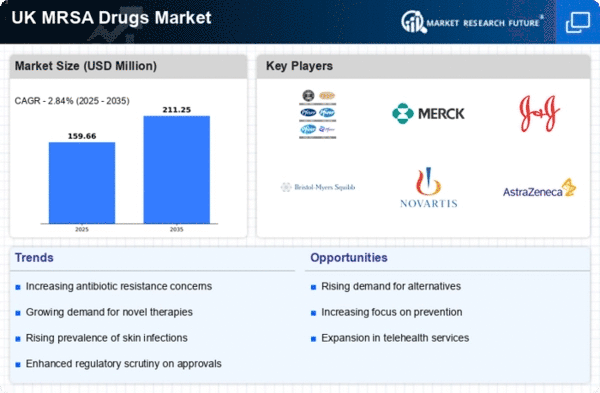
As per Market Research Future analysis, the UK MRSA Drugs Market Size was estimated at 155.25 $ Million in 2024. The UK mrsa drugs market is projected to grow from 159.66 $ Million in 2025 to 211.25 $ Million by 2035, exhibiting a compound annual growth rate (CAGR) of 2.8% during the forecast period 2025 - 2035

Key Market Trends & Highlights

The UK MRSA drugs market is experiencing a positive trajectory driven by innovation and increased awareness.

  • The largest segment in the UK MRSA drugs market is the antibiotic segment, which continues to dominate due to ongoing advancements in treatment options.
  • The fastest-growing segment is the topical MRSA treatment segment, reflecting a shift towards localized treatment strategies.
  • Rising research and development efforts are fostering innovation in MRSA drug formulations and delivery methods.
  • The increasing incidence of MRSA infections and government initiatives and funding are key drivers propelling market growth.

Market Size & Forecast

2024 Market Size 155.25 (USD Million)
2035 Market Size 211.25 (USD Million)
CAGR (2025 - 2035) 2.84%

Major Players

Pfizer Inc (US), Merck & Co Inc (US), Johnson & Johnson (US), Bristol-Myers Squibb Company (US), Novartis AG (CH), AstraZeneca PLC (GB), Gilead Sciences Inc (US), AbbVie Inc (US)

Our Impact
Enabled $4.3B Revenue Impact for Fortune 500 and Leading Multinationals
Partnering with 2000+ Global Organizations Each Year
30K+ Citations by Top-Tier Firms in the Industry

UK MRSA Drugs Market Trends

The mrsa drugs market is currently experiencing notable shifts driven by various factors, including advancements in pharmaceutical research and the increasing prevalence of antibiotic-resistant infections. The rise in awareness regarding the dangers posed by Methicillin-resistant Staphylococcus aureus (MRSA) has prompted healthcare providers to seek more effective treatment options. Consequently, there is a growing emphasis on developing novel antibiotics and alternative therapies that can combat resistant strains. This trend is further supported by government initiatives aimed at enhancing research funding and promoting collaboration between public and private sectors. Moreover, the regulatory landscape is evolving, with agencies focusing on expediting the approval process for new drugs targeting MRSA. This acceleration is crucial, as it allows for quicker access to innovative treatments that can address the urgent need for effective solutions. Additionally, the increasing burden of healthcare costs associated with MRSA infections is driving stakeholders to invest in preventive measures and treatment strategies. As a result, the market is likely to witness a surge in demand for both existing and emerging therapies, reflecting a proactive approach to managing this public health challenge.

Rising Research and Development Efforts

There is a marked increase in research and development activities aimed at discovering new antibiotics and alternative therapies for MRSA. This trend is fueled by the urgent need to address antibiotic resistance, prompting pharmaceutical companies and research institutions to collaborate on innovative solutions.

Regulatory Support for New Treatments

Regulatory bodies are enhancing their support for the approval of new MRSA drugs. This includes streamlining the approval process, which is essential for bringing effective treatments to market more rapidly, thereby addressing the pressing healthcare needs.

Growing Awareness and Preventive Strategies

Awareness campaigns regarding MRSA and its implications are gaining traction. This heightened awareness is leading to increased investment in preventive strategies, including education and infection control measures, which are crucial for reducing the incidence of MRSA infections.

UK MRSA Drugs Market Drivers

Rising Healthcare Expenditure

The rising healthcare expenditure in the UK is a significant driver for the mrsa drugs market. As the government allocates more funds towards healthcare services, there is a corresponding increase in the budget for infectious disease management, including MRSA treatment. The NHS has reported a growing financial commitment to addressing antibiotic resistance, which includes funding for research and the procurement of effective MRSA drugs. This trend suggests that healthcare providers are prioritizing the development and availability of new treatment options to combat MRSA infections. Furthermore, the increasing burden of healthcare costs associated with MRSA infections, such as extended hospital stays and additional treatments, reinforces the need for effective drug solutions. Consequently, the mrsa drugs market is likely to experience growth as healthcare expenditure continues to rise.

Government Initiatives and Funding

Government initiatives and funding play a pivotal role in shaping the mrsa drugs market. The UK government has implemented various programs aimed at combating antibiotic resistance, including the UK Five Year Antimicrobial Resistance Strategy. This strategy emphasizes the importance of research and development in the field of antibiotics, providing financial support to projects focused on MRSA treatment. Additionally, public health campaigns aimed at raising awareness about antibiotic stewardship are likely to drive demand for effective MRSA drugs. The allocation of resources towards the development of new therapies not only enhances the treatment landscape but also encourages collaboration between public and private sectors. As a result, the mrsa drugs market is expected to benefit from increased investment and innovation, ultimately leading to improved patient outcomes.

Advancements in Antibiotic Development

Recent advancements in antibiotic development are significantly influencing the mrsa drugs market. The emergence of novel antibiotics and alternative therapies, such as bacteriophage therapy, presents new opportunities for treating MRSA infections. Research institutions and pharmaceutical companies in the UK are increasingly focusing on developing drugs that target resistant strains of bacteria. The UK government has also initiated funding programs aimed at fostering innovation in antibiotic research, which could lead to the introduction of breakthrough therapies. As the healthcare landscape evolves, the integration of advanced technologies in drug development processes is expected to enhance the efficacy of MRSA treatments. This focus on innovation not only addresses the urgent need for effective therapies but also positions the mrsa drugs market for substantial growth in the coming years.

Increasing Incidence of MRSA Infections

The rising incidence of MRSA infections in the UK is a critical driver for the MRSA Drugs Market. Reports indicate that MRSA infections have been steadily increasing, with a notable rise in cases reported in hospitals and community settings. This trend necessitates the development and availability of effective treatment options, thereby propelling the demand for MRSA drugs. The National Health Service (NHS) has highlighted the need for enhanced surveillance and management strategies to combat these infections. As healthcare providers seek to address this growing challenge, investments in the mrsa drugs market are likely to increase, fostering innovation and the introduction of new therapies. Furthermore, the economic burden associated with MRSA infections, estimated to cost the NHS millions annually, underscores the urgency for effective drug solutions, thereby stimulating market growth.

Collaboration Between Public and Private Sectors

Collaboration between public and private sectors is emerging as a crucial driver for the mrsa drugs market. Partnerships between government agencies, research institutions, and pharmaceutical companies are fostering innovation in the development of MRSA treatments. These collaborations often result in shared resources, expertise, and funding, which can accelerate the research and development process. The UK government has been actively promoting such partnerships to enhance the effectiveness of antibiotic development initiatives. By leveraging the strengths of both sectors, the mrsa drugs market can benefit from a more robust pipeline of new therapies. This collaborative approach not only addresses the urgent need for effective MRSA drugs but also enhances the overall healthcare landscape, potentially leading to improved patient outcomes and reduced healthcare costs.


Market Segment Insights

By Drug Class: Lipopeptides (Largest) vs. Oxazolidinones (Fastest-Growing)

In the UK mrsa drugs market, the distribution of market share among various drug classes reveals Lipopeptides as the largest segment, demonstrating a significant foothold due to its effectiveness against resistant strains. Oxazolidinones follow closely, gaining traction for their innovative mechanism of action, making them a preferred choice among healthcare professionals. Other classes like Cephalosporins, Tetracycline, and Folate Antagonists contribute to the market but with comparatively smaller shares. Growth trends in the UK mrsa drugs market indicate a robust expansion for Oxazolidinones, driven by increasing resistance to traditional antibiotics and the rising demand for advanced treatment options. Lipopeptides maintain their lead due to ongoing clinical support and established efficacy in severe infections. The overall shift towards targeted therapies is further enhancing the appeal of Emerging drug classes, promising a dynamic competitive landscape.

Lipopeptides (Dominant) vs. Oxazolidinones (Emerging)

Lipopeptides stand as the dominant class in the UK mrsa drugs market, recognized for their strong efficacy against multidrug-resistant strains of MRSA. Their unique mechanism of action allows them to disrupt bacterial cell membranes, making them highly effective in severe infections. The clinical trust in Lipopeptides is fortified by numerous successful treatment outcomes. Conversely, Oxazolidinones are emerging rapidly due to their novel approach to combating bacterial resistance, especially in gram-positive organisms. Their ability to inhibit protein synthesis provides a critical alternative for patients with limited treatment options. The increasing adoption of Oxazolidinones reflects a shift in prescribing practices, emphasizing the need for innovative solutions in antibiotic therapy.

By Route of Administration: Oral Administration (Largest) vs. Parenteral Administration (Fastest-Growing)

In the UK mrsa drugs market, the predominant route of administration is Oral Administration, which commands the largest market share due to its ease of use and patient compliance. Parenteral Administration, on the other hand, is witnessing rapid growth as advancements in drug formulation and administration techniques make it more appealing for both healthcare providers and patients alike. The rise of biologics and complex regimens has further boosted interest in injectable therapies, contributing to its expanding share. The growth trends in this segment are primarily driven by the increasing prevalence of MRSA infections and the demand for effective treatment options. Additionally, the shift toward outpatient care and self-administration of medications is propelling the use of Parenteral Administration options. Increased investment in research and development for newer drug delivery systems also fosters competition and innovation within the market, enhancing both routes of administration's attractiveness.

Oral Administration (Dominant) vs. Parenteral Administration (Emerging)

Oral Administration remains the dominant route in the UK mrsa drugs market, characterized by its convenience and higher acceptance among patients. This method is often preferred due to its non-invasive nature, allowing for easier medication adherence. On the other hand, Parenteral Administration is considered an emerging method, gaining traction due to the development of advanced delivery systems that cater to more severe MRSA cases. The increasing complexity of MRSA treatments, including biologics, highlights the need for effective parenteral options, which are becoming critical As healthcare moves towards more sophisticated and targeted therapies.

By Distribution Channel: Hospital Pharmacies (Largest) vs. Online Pharmacies (Fastest-Growing)

In the UK mrsa drugs market, Hospital Pharmacies hold the largest share among distribution channels, primarily due to their integral role in providing medicines within healthcare settings. Retail Pharmacies follow, serving local communities and providing quick access to medications. Online Pharmacies, although currently smaller in market share, are rapidly gaining traction as more consumers turn to digital channels for convenience and accessibility. The growth in this channel is particularly notable among younger demographics who prefer online shopping. Growth trends in the UK mrsa drugs market indicate a shift towards Online Pharmacies, driven by technological advancements and changing consumer behaviors. Factors such as increased smartphone usage and a growing preference for home delivery services are contributing to this trend. Meanwhile, Hospital Pharmacies continue to thrive due to their essential function in hospitals, ensuring patients receive timely treatments. Retail Pharmacies will need to innovate to compete with the growing e-pharmacy sector, which is becoming an essential part of healthcare delivery.

Hospital Pharmacies (Dominant) vs. Online Pharmacies (Emerging)

Hospital Pharmacies remain the dominant distribution channel in the UK mrsa drugs market, serving as the primary source of medications for hospitalized patients. They are characterized by their close integration with healthcare providers, ensuring that patients receive necessary treatments promptly. On the other hand, Online Pharmacies are emerging as a significant player in the market, capitalizing on the trend of digital shopping. They offer convenience and privacy, appealing particularly to consumers wary of visiting physical locations. The shift toward online procurement of medications reflects changing consumer preferences and an increasing reliance on technology for health management, positioning Online Pharmacies for substantial growth in the coming years.

Get more detailed insights about UK MRSA Drugs Market

Key Players and Competitive Insights

The MRSA drugs market exhibits a competitive landscape characterized by a blend of innovation, strategic partnerships, and a focus on addressing the growing threat of antibiotic resistance. Key players such as Pfizer Inc (US), Merck & Co Inc (US), and AstraZeneca PLC (GB) are actively engaged in developing novel therapies and enhancing their market presence. Pfizer Inc (US) has positioned itself as a leader in antibiotic research, emphasizing the development of next-generation antibiotics that target resistant strains. Meanwhile, Merck & Co Inc (US) has focused on strategic collaborations with biotech firms to accelerate the discovery of new MRSA treatments, thereby enhancing its portfolio and market reach. AstraZeneca PLC (GB) is also investing in digital health initiatives to improve patient outcomes and streamline drug delivery systems, reflecting a broader trend towards integrating technology in healthcare solutions.The business tactics employed by these companies include localizing manufacturing to reduce costs and optimize supply chains, which is particularly crucial in the context of fluctuating global trade dynamics. The market structure appears moderately fragmented, with several players vying for market share, yet the influence of major companies remains substantial. This competitive environment is shaped by the collective efforts of these key players, who are not only innovating but also adapting to the evolving regulatory landscape and patient needs.

In October Pfizer Inc (US) announced a partnership with a leading genomics company to develop a targeted therapy for MRSA infections. This collaboration is expected to leverage advanced genomic technologies to identify specific bacterial targets, potentially leading to more effective treatment options. The strategic importance of this move lies in its potential to position Pfizer at the forefront of precision medicine in the antibiotic space, addressing the urgent need for tailored therapies against resistant infections.

In September Merck & Co Inc (US) launched a new clinical trial for a novel MRSA antibiotic, which is designed to combat strains resistant to existing treatments. This initiative underscores Merck's commitment to addressing the critical challenge of antibiotic resistance. The trial's success could significantly enhance Merck's competitive edge, providing a much-needed solution in a market that is increasingly focused on innovative therapies.

In August AstraZeneca PLC (GB) expanded its research capabilities by establishing a new facility dedicated to antibiotic research in the UK. This strategic investment aims to bolster its R&D efforts in combating resistant infections. The establishment of this facility is indicative of AstraZeneca's long-term commitment to addressing public health challenges and reflects a broader trend of increasing investment in antibiotic research.

As of November the competitive trends in the MRSA drugs market are increasingly defined by digitalization, sustainability, and the integration of artificial intelligence in drug development processes. Strategic alliances are becoming more prevalent, as companies recognize the value of collaboration in accelerating innovation. Looking ahead, the competitive differentiation in this market is likely to evolve from traditional price-based competition towards a focus on technological advancements, innovative therapies, and reliable supply chains. This shift may ultimately enhance patient care and outcomes in the fight against MRSA.

Key Companies in the UK MRSA Drugs Market include

Industry Developments

In the UK MRSA Drugs Market, recent developments have drawn considerable attention, particularly with companies such as GlaxoSmithKline, Merck, and Pfizer focusing on enhanced drug formulations and antibiotic stewardship programs amid rising MRSA infection rates. In August 2023, Pfizer announced advancements in their MRSA treatment pipeline, indicating promising outcomes in clinical trials. Johnson and Johnson's subsidiary has also recently boosted its efforts in the UK by issuing a new antibiotic aimed at resistant strains of Staphylococcus aureus, a key player in MRSA infections.

In terms of acquisitions, Bristol-Myers Squibb completed its acquisition of Celgene in January 2023, enhancing its antibiotic capabilities and expanding its portfolio in antibiotic resistance. Another significant trend includes AstraZeneca's push into bacteriophage therapy, a novel approach gaining traction in the UK to combat MRSA. The overall market valuation for MRSA-related drugs in the UK is steadily growing, influenced by both innovation in treatments and increased funding from the National Health Service aimed at tackling antimicrobial resistance. This growth is imperative as the NHS and UK Health Security Agency continue to advocate for stronger measures against antibiotic-resistant infections.

Future Outlook

UK MRSA Drugs Market Future Outlook

The MRSA Drugs Market is projected to grow at a 2.84% CAGR from 2025 to 2035, driven by rising infection rates, increased awareness, and advancements in drug development.

New opportunities lie in:

  • Development of targeted therapies for resistant strains
  • Expansion of telehealth services for remote consultations
  • Investment in rapid diagnostic testing technologies

By 2035, the MRSA drugs market is expected to achieve a robust position, reflecting sustained growth and innovation.

Market Segmentation

UK MRSA Drugs Market Drug Class Outlook

  • Lipopeptides
  • Oxazolidinones
  • Cephalosporin
  • Tetracycline
  • Folate Antagonist
  • Other Drug Classes

UK MRSA Drugs Market Distribution Channel Outlook

  • Hospital Pharmacies
  • Retail Pharmacies
  • Online Pharmacies

UK MRSA Drugs Market Route of Administration Outlook

  • Oral Administration
  • Parenteral Administration

Report Scope

MARKET SIZE 2024 155.25(USD Million)
MARKET SIZE 2025 159.66(USD Million)
MARKET SIZE 2035 211.25(USD Million)
COMPOUND ANNUAL GROWTH RATE (CAGR) 2.84% (2025 - 2035)
REPORT COVERAGE Revenue Forecast, Competitive Landscape, Growth Factors, and Trends
BASE YEAR 2024
Market Forecast Period 2025 - 2035
Historical Data 2019 - 2024
Market Forecast Units USD Million
Key Companies Profiled Pfizer Inc (US), Merck & Co Inc (US), Johnson & Johnson (US), Bristol-Myers Squibb Company (US), Novartis AG (CH), AstraZeneca PLC (GB), Gilead Sciences Inc (US), AbbVie Inc (US)
Segments Covered Drug Class, Route of Administration, Distribution Channel
Key Market Opportunities Emerging antibiotic resistance drives demand for innovative therapies in the mrsa drugs market.
Key Market Dynamics Rising antibiotic resistance drives demand for innovative MRSA drugs amid evolving regulatory frameworks in the UK.
Countries Covered UK
Leave a Comment

FAQs

What is the expected market size of the UK MRSA Drugs Market in 2024?

The UK MRSA Drugs Market is expected to be valued at 172.5 million USD in 2024.

What will the UK MRSA Drugs Market be valued at by 2035?

By 2035, the UK MRSA Drugs Market is projected to reach a value of 187.5 million USD.

What is the expected CAGR for the UK MRSA Drugs Market from 2025 to 2035?

The expected CAGR for the UK MRSA Drugs Market from 2025 to 2035 is 0.761%.

Which drug class is projected to have the highest market value in 2024?

In 2024, the Cephalosporin drug class is projected to have the highest market value at 40.0 million USD.

What will be the market value of the Lipopeptides drug class in 2035?

The market value of the Lipopeptides drug class is expected to be 37.5 million USD in 2035.

Who are the major players in the UK MRSA Drugs Market?

Major players in the UK MRSA Drugs Market include GlaxoSmithKline, Pfizer, Merck, and Roche.

How is the market growth rate for Tetracycline expected to change from 2024 to 2035?

The market value for the Tetracycline drug class is expected to grow from 25.0 million USD in 2024 to 27.5 million USD by 2035.

What challenges does the UK MRSA Drugs Market face currently?

The UK MRSA Drugs Market faces challenges such as increasing antibiotic resistance and regulatory hurdles.

What is the expected market value for Oxazolidinones in 2025?

The expected market value for Oxazolidinones in 2025 is projected to be around 30.0 million USD.

How does the Folate Antagonist drug class perform in terms of market size from 2024 to 2035?

The Folate Antagonist drug class is projected to grow from 42.5 million USD in 2024 to 47.5 million USD in 2035.

Download Free Sample

Kindly complete the form below to receive a free sample of this Report

Compare Licence

×
Features License Type
Single User Multiuser License Enterprise User
Price $4,950 $5,950 $7,250
Maximum User Access Limit 1 User Upto 10 Users Unrestricted Access Throughout the Organization
Free Customization
Direct Access to Analyst
Deliverable Format
Platform Access
Discount on Next Purchase 10% 15% 15%
Printable Versions