×
Request Free Sample ×

Kindly complete the form below to receive a free sample of this Report

* Please use a valid business email

Leading companies partner with us for data-driven Insights

clients tt-cursor
Hero Background

UK Ischemic Stroke Surgery Market

ID: MRFR/HC/48442-HCR
200 Pages
Rahul Gotadki
February 2026

UK Ischemic Stroke Surgery Market Research Report By Type of Surgery (Thrombectomy, Revascularization Surgery, Carotid Endarterectomy, Angioplasty), By Product Type (Catheter, Aspiration System, Guidewire, Microcatheter, Others) and By End User (Hospitals and Clinics, Ambulatory Surgical Centers, Others) - Growth & Industry Forecast 2025 To 2035

Share:
Download PDF ×

We do not share your information with anyone. However, we may send you emails based on your report interest from time to time. You may contact us at any time to opt-out.

UK Ischemic Stroke Surgery Market Infographic
Purchase Options

UK Ischemic Stroke Surgery Market Summary

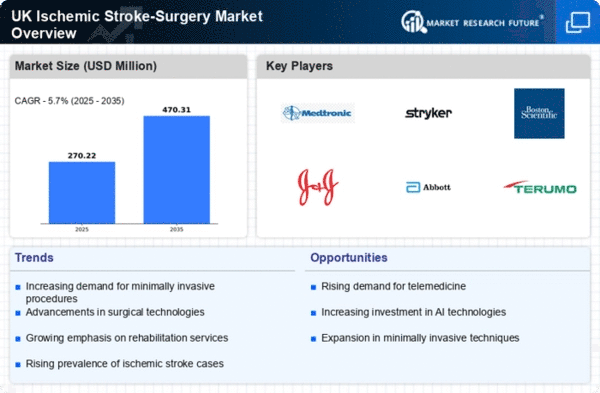
As per Market Research Future analysis, the UK ischemic stroke-surgery market Size was estimated at 255.65 USD Million in 2024. The UK ischemic stroke-surgery market is projected to grow from 270.22 USD Million in 2025 to 470.31 USD Million by 2035, exhibiting a compound annual growth rate (CAGR) of 5% during the forecast period 2025 - 2035

Key Market Trends & Highlights

The UK ischemic stroke-surgery market is experiencing a shift towards advanced surgical techniques and early intervention strategies.

  • Minimally invasive techniques are gaining traction, enhancing patient recovery times and outcomes.
  • The focus on early intervention is becoming increasingly critical in reducing long-term disability associated with ischemic strokes.
  • Investment in research and development is driving innovation in surgical procedures, particularly in the largest segment of acute ischemic stroke treatment.
  • Rising incidence of ischemic stroke and technological advancements in surgical procedures are key drivers propelling market growth.

Market Size & Forecast

2024 Market Size 255.65 (USD Million)
2035 Market Size 470.31 (USD Million)
CAGR (2025 - 2035) 5.7%

Major Players

Medtronic (US), Stryker (US), Boston Scientific (US), Johnson & Johnson (US), Abbott Laboratories (US), Terumo Corporation (JP), B. Braun Melsungen AG (DE), Penumbra (US)

Our Impact
Enabled $4.3B Revenue Impact for Fortune 500 and Leading Multinationals
Partnering with 2000+ Global Organizations Each Year
30K+ Citations by Top-Tier Firms in the Industry

UK Ischemic Stroke Surgery Market Trends

The ischemic stroke-surgery market is currently experiencing notable developments, driven by advancements in medical technology and an increasing understanding of stroke management. The integration of minimally invasive techniques is becoming more prevalent, as these methods tend to reduce recovery times and improve patient outcomes. Furthermore, the emphasis on early intervention and timely surgical procedures is gaining traction, as healthcare providers recognize the critical nature of addressing ischemic strokes promptly. This shift in focus is likely to enhance the overall efficacy of treatments available in the market. In addition, the growing prevalence of risk factors associated with ischemic strokes, such as hypertension and diabetes, is prompting healthcare systems to adapt and innovate. The ischemic stroke-surgery market appears to be responding to these challenges by investing in research and development, aiming to create more effective surgical solutions. Collaboration between healthcare professionals and technology developers is fostering an environment conducive to innovation, which may lead to improved surgical techniques and better patient care. As the landscape evolves, stakeholders in the market are likely to prioritize patient-centered approaches, ensuring that treatments are tailored to individual needs and conditions.

Minimally Invasive Techniques

The trend towards minimally invasive surgical procedures is gaining momentum within the ischemic stroke-surgery market. These techniques are associated with reduced recovery times and lower complication rates, making them increasingly attractive to both patients and healthcare providers. As technology advances, the adoption of these methods is expected to rise, potentially transforming surgical practices.

Focus on Early Intervention

There is a growing emphasis on early intervention in the ischemic stroke-surgery market. Timely surgical procedures are critical for improving patient outcomes, and healthcare systems are prioritizing rapid response protocols. This trend indicates a shift towards proactive management of ischemic strokes, which may enhance the overall effectiveness of treatments.

Investment in Research and Development

Investment in research and development is becoming a key trend in the ischemic stroke-surgery market. As the prevalence of risk factors for ischemic strokes increases, stakeholders are focusing on creating innovative surgical solutions. This trend suggests a commitment to improving patient care through advanced techniques and technologies.

UK Ischemic Stroke Surgery Market Drivers

Rising Healthcare Expenditure

The rising healthcare expenditure in the UK is a significant driver for the ischemic stroke-surgery market. As the government and private sectors allocate more funds towards healthcare, there is an increased focus on advanced surgical treatments for ischemic stroke. Recent reports indicate that healthcare spending in the UK is projected to grow by approximately 4% annually, which may lead to enhanced resources for surgical interventions. This financial commitment allows for the procurement of cutting-edge surgical equipment and the implementation of innovative treatment protocols. Consequently, the growth in healthcare expenditure is expected to positively impact the ischemic stroke-surgery market, facilitating better patient care and outcomes.

Growing Awareness and Education

There is a notable increase in public awareness and education regarding stroke symptoms and the importance of timely intervention. Campaigns aimed at educating the population about the signs of ischemic stroke have led to earlier presentations to healthcare facilities, which is critical for successful surgical outcomes. This heightened awareness is likely to result in more patients seeking surgical options, thereby driving demand in the ischemic stroke-surgery market. Furthermore, healthcare professionals are increasingly trained to recognize stroke symptoms, which contributes to improved patient management and outcomes, further supporting market growth.

Government Initiatives and Funding

Government initiatives aimed at improving stroke care are significantly influencing the ischemic stroke-surgery market. The UK government has implemented various programs to enhance stroke prevention, treatment, and rehabilitation. For instance, the NHS has allocated substantial funding to improve stroke services, which includes investments in surgical facilities and training for healthcare professionals. This financial support is crucial, as it enables hospitals to adopt new technologies and expand their surgical capabilities. Consequently, the increased funding and focus on stroke care are likely to stimulate growth in the ischemic stroke-surgery market, ensuring that patients receive timely and effective treatment.

Rising Incidence of Ischemic Stroke

The increasing incidence of ischemic stroke in the UK is a primary driver for the ischemic stroke-surgery market. Recent statistics indicate that approximately 100,000 individuals experience a stroke annually in the UK, with ischemic strokes accounting for around 85% of these cases. This growing patient population necessitates advanced surgical interventions, thereby propelling market demand. Furthermore, the aging population, which is more susceptible to stroke, is projected to rise significantly, leading to an increased burden on healthcare systems. As a result, healthcare providers are likely to invest more in surgical solutions to manage this condition effectively, thereby enhancing the overall growth of the ischemic stroke-surgery market.

Technological Advancements in Surgical Procedures

Technological innovations in surgical techniques and equipment are transforming the ischemic stroke-surgery market. The introduction of advanced imaging technologies, such as MRI and CT scans, allows for more accurate diagnosis and treatment planning. Additionally, the development of robotic-assisted surgical systems enhances precision and reduces recovery times for patients. According to recent data, the adoption of these technologies has led to improved patient outcomes, with a reported reduction in complication rates by up to 30%. As these technologies become more accessible, they are expected to drive further growth in the ischemic stroke-surgery market, as healthcare providers seek to offer the best possible care.


Market Segment Insights

By Type of Surgery: Thrombectomy (Largest) vs. Revascularization Surgery (Fastest-Growing)

In the UK ischemic stroke-surgery market, Thrombectomy holds the largest share among various surgical types, owing to its effectiveness in acute ischemic stroke treatment. With a growing recognition of its benefits, it continues to dominate the market and is often the first line of treatment for eligible patients. Revascularization Surgery, while currently smaller in market share, is emerging rapidly as a crucial option, driven by advances in technology and increasing procedural capabilities among healthcare providers. The growth trends in this segment are substantially influenced by ongoing innovations and increasing awareness about treatment options. Thrombectomy is supported by a robust body of clinical evidence that bolsters its adoption, while Revascularization Surgery is gaining momentum through newer techniques that minimize recovery time. This dynamic interplay is crucial in shaping the future of surgical interventions for ischemic strokes.

Thrombectomy (Dominant) vs. Revascularization Surgery (Emerging)

Thrombectomy remains the dominant procedure in the UK ischemic stroke-surgery market, renowned for its ability to restore blood flow effectively and promptly in acute scenarios. Its establishment as a standard of care highlights its critical role in improving patient outcomes. Conversely, Revascularization Surgery is positioned as an emerging technique, focusing on broader treatment applications and enhanced patient recovery experiences. As healthcare facilities increasingly adopt comprehensive stroke care strategies, Revascularization Surgery's relevance grows, particularly for patients not amenable to Thrombectomy. This evolving landscape showcases an ongoing shift where both procedures find their niches, significantly impacting overall treatment paradigms.

By Product Type: Catheter (Largest) vs. Aspiration System (Fastest-Growing)

The UK ischemic stroke-surgery market has a diverse range of product types, with catheters holding the largest market share. This segment is favored for its versatility and effectiveness in various surgical procedures. Aspiration systems, while currently smaller in market share, are rapidly gaining traction due to their advanced capabilities in efficiently removing thrombus and their role in enhancing patient outcomes. Growth in this segment is driven by the increasing incidence of ischemic strokes and advancements in medical technology. The focus on minimally invasive procedures is also propelling the demand for specialized tools like aspiration systems. Continuous innovations, coupled with the need for greater efficiency in stroke treatment, position these products favorably for future growth in the market.

Catheter (Dominant) vs. Aspiration System (Emerging)

Catheters are widely recognized as the dominant product in the UK ischemic stroke-surgery market, primarily due to their established reliability and adaptability in various surgical contexts. Their ability to facilitate effective intervention makes them a staple in stroke management protocols. On the other hand, aspiration systems are emerging as a critical player, showcasing rapid growth driven by their innovative designs that cater to the specific needs of ischemic stroke intervention. These systems enhance procedural efficiency and overall patient safety, making them increasingly appealing to healthcare providers. The contrasting positions of these product types reflect a market dynamic where traditional solutions coexist with innovative approaches aimed at improving clinical outcomes.

By End User: Hospitals & Clinics (Largest) vs. Ambulatory Surgical Centers (Fastest-Growing)

In the UK ischemic stroke-surgery market, the segment of Hospitals & Clinics commands the largest market share, driven by their comprehensive facilities and specialized workforce. The preference for these establishments is further supported by the ability to provide immediate and extensive care, which is crucial for stroke treatment. On the other hand, Ambulatory Surgical Centers are gaining traction due to their cost-effectiveness and efficiency in handling specific surgical procedures. Their share is increasingly becoming significant against the traditional settings, reflecting a shift in patient preferences. Growth trends in this segment indicate a notable shift towards outpatient care, particularly in Ambulatory Surgical Centers, where advancements in surgical techniques and recovery protocols reduce the need for extended hospital stays. Factors like rising healthcare costs, a focus on patient convenience, and technological innovations in minimally invasive procedures are driving this change. As patients seek quicker recovery times with lower costs, the demand for these centers is poised to grow, establishing them as vital players in the market.

Hospitals & Clinics (Dominant) vs. Ambulatory Surgical Centers (Emerging)

Hospitals & Clinics represent the dominant force in the UK ischemic stroke-surgery market, owing to their extensive resources, experienced staff, and ability to manage critical care scenarios. These facilities are equipped with cutting-edge technology and have the capacity to provide comprehensive treatment packages, including rehabilitation and follow-up care. In contrast, Ambulatory Surgical Centers, while emerging, are rapidly adopting innovative practices that allow for faster surgical procedures with reduced recovery times. These centers cater to less severe cases and capitalize on the demand for outpatient services. As they expand their offerings and improve patient satisfaction, these centers are increasingly viewed as a viable alternative to traditional hospitals, driving their growth in the ischemic stroke-surgery market.

Get more detailed insights about UK Ischemic Stroke Surgery Market

Key Players and Competitive Insights

The ischemic stroke-surgery market is characterized by a competitive landscape that is increasingly shaped by innovation, strategic partnerships, and regional expansions. Key players such as Medtronic (US), Stryker (US), and Boston Scientific (US) are at the forefront, leveraging their technological advancements to enhance surgical outcomes. Medtronic (US) focuses on developing minimally invasive solutions, while Stryker (US) emphasizes robotic-assisted surgery, indicating a trend towards precision and efficiency in surgical procedures. Boston Scientific (US) appears to be investing heavily in digital health technologies, which may enhance patient monitoring and post-operative care, thereby influencing the overall competitive dynamics in the market.The market structure is moderately fragmented, with several players vying for market share through localized manufacturing and optimized supply chains. This fragmentation allows for a diverse range of products and services, catering to various patient needs and preferences. Companies are increasingly localizing their manufacturing processes to reduce costs and improve supply chain reliability, which is crucial in maintaining competitive advantage. The collective influence of these key players fosters a dynamic environment where innovation and operational efficiency are paramount.

In October Medtronic (US) announced the launch of a new line of neurovascular devices designed to improve outcomes in ischemic stroke patients. This strategic move is significant as it not only expands Medtronic's product portfolio but also reinforces its commitment to innovation in neurovascular care. The introduction of these devices is likely to enhance procedural efficiency and patient safety, positioning Medtronic favorably against its competitors.

In September Stryker (US) entered into a partnership with a leading AI technology firm to integrate artificial intelligence into its surgical robotics systems. This collaboration is poised to revolutionize surgical precision and decision-making, potentially leading to better patient outcomes. By harnessing AI, Stryker aims to differentiate itself in a competitive market that increasingly values technological integration.

In August Boston Scientific (US) expanded its digital health platform to include remote monitoring capabilities for stroke patients. This strategic enhancement is indicative of a broader trend towards digitalization in healthcare, allowing for continuous patient engagement and improved post-operative care. Such initiatives may not only improve patient satisfaction but also reduce hospital readmission rates, thereby influencing market dynamics.

As of November the competitive trends in the ischemic stroke-surgery market are increasingly defined by digitalization, sustainability, and the integration of AI technologies. Strategic alliances are becoming more prevalent, as companies recognize the need to collaborate to enhance their technological capabilities. The shift from price-based competition to a focus on innovation, technology, and supply chain reliability is evident, suggesting that future competitive differentiation will hinge on the ability to deliver advanced, patient-centered solutions.

Key Companies in the UK Ischemic Stroke Surgery Market include

Industry Developments

The UK Ischemic Stroke Surgery Market has seen noteworthy developments recently, particularly with technological advancements and competitive dynamics. Medtronic and Boston Scientific have made strides with new surgical devices that enhance the precision of ischemic stroke interventions, gaining attention from healthcare professionals across the nation.

Companies like NeuroZone and Nico Corp are expanding their offerings, focusing on minimally invasive techniques that promote faster recovery times. There have been mergers and acquisitions such as Cerenovus acquiring assets from Stryker in September 2022, reflecting a strategic move to strengthen market position and enhance operational efficiencies.

The market has also experienced growth, with an increased valuation for companies like Abbott Laboratories and Penumbra, attributed to rising incidences of ischemic strokes and an aging population. This surge in demand is likely to drive further innovations and investments in the coming months.

The UK government continues to prioritize stroke care, aligning with initiatives to boost healthcare funding, which will further support the development of the ischemic stroke surgery landscape in the UK, fostering collaboration among leading companies like Terumo and Veryan to improve surgical outcomes for patients.

Future Outlook

UK Ischemic Stroke Surgery Market Future Outlook

The Ischemic Stroke Surgery Market is projected to grow at a 5.7% CAGR from 2025 to 2035, driven by technological advancements, increasing patient awareness, and enhanced healthcare infrastructure.

New opportunities lie in:

  • Development of AI-driven surgical planning software
  • Expansion of telemedicine platforms for pre- and post-operative care
  • Investment in minimally invasive surgical techniques and training programs

By 2035, the market is expected to achieve substantial growth, reflecting advancements in surgical techniques and patient care.

Market Segmentation

UK Ischemic Stroke Surgery Market End User Outlook

  • Hospitals & Clinics
  • Ambulatory Surgical Centers
  • Others

UK Ischemic Stroke Surgery Market Product Type Outlook

  • Catheter
  • Aspiration System
  • Guidewire
  • Microcatheter
  • Others

UK Ischemic Stroke Surgery Market Type of Surgery Outlook

  • Thrombectomy
  • Revascularization Surgery
  • Carotid Endarterectomy
  • Angioplasty
  • Others

Report Scope

MARKET SIZE 2024 255.65(USD Million)
MARKET SIZE 2025 270.22(USD Million)
MARKET SIZE 2035 470.31(USD Million)
COMPOUND ANNUAL GROWTH RATE (CAGR) 5.7% (2025 - 2035)
REPORT COVERAGE Revenue Forecast, Competitive Landscape, Growth Factors, and Trends
BASE YEAR 2024
Market Forecast Period 2025 - 2035
Historical Data 2019 - 2024
Market Forecast Units USD Million
Key Companies Profiled Medtronic (US), Stryker (US), Boston Scientific (US), Johnson & Johnson (US), Abbott Laboratories (US), Terumo Corporation (JP), B. Braun Melsungen AG (DE), Penumbra (US)
Segments Covered Type of Surgery, Product Type, End User
Key Market Opportunities Advancements in minimally invasive techniques enhance patient outcomes in the ischemic stroke-surgery market.
Key Market Dynamics Technological advancements and regulatory changes drive innovation in ischemic stroke surgical procedures and treatment options.
Countries Covered UK
Leave a Comment

FAQs

What is the expected market size of the UK Ischemic Stroke Surgery Market in 2024?

The UK Ischemic Stroke Surgery Market is expected to be valued at 255.0 USD Million in 2024.

What is the projected market size of the UK Ischemic Stroke Surgery Market by 2035?

By 2035, the UK Ischemic Stroke Surgery Market is projected to reach a value of 512.0 USD Million.

What is the expected compound annual growth rate (CAGR) for the UK Ischemic Stroke Surgery Market from 2025 to 2035?

The anticipated CAGR for the UK Ischemic Stroke Surgery Market from 2025 to 2035 is 6.542%.

Which type of surgery is expected to have the highest market value in 2024 within the UK Ischemic Stroke Surgery Market?

Thrombectomy is expected to have the highest market value at 85.0 USD Million in 2024.

What is the market value of Revascularization Surgery in the UK Ischemic Stroke Surgery Market for 2024?

Revascularization Surgery is valued at 65.0 USD Million in 2024.

What is the market value for Carotid Endarterectomy in 2035?

The market value for Carotid Endarterectomy is projected to be 120.0 USD Million by 2035.

Who are the key players in the UK Ischemic Stroke Surgery Market?

Major players in the UK Ischemic Stroke Surgery Market include Medtronic, Boston Scientific, and Johnson and Johnson.

What opportunities are driving the growth of the UK Ischemic Stroke Surgery Market?

Growing technological advancements in stroke treatment and increasing patient population are driving growth opportunities.

What challenges are currently facing the UK Ischemic Stroke Surgery Market?

Challenges include high operational costs and stringent regulatory frameworks affecting market growth.

How does the market growth rate compare across different types of surgeries in the UK Ischemic Stroke Surgery Market?

Thrombectomy and Revascularization Surgery show significant growth rates, with both expected to increase substantially by 2035.

Download Free Sample

Kindly complete the form below to receive a free sample of this Report

Compare Licence

×
Features License Type
Single User Multiuser License Enterprise User
Price $4,950 $5,950 $7,250
Maximum User Access Limit 1 User Upto 10 Users Unrestricted Access Throughout the Organization
Free Customization
Direct Access to Analyst
Deliverable Format
Platform Access
Discount on Next Purchase 10% 15% 15%
Printable Versions