×
Request Free Sample ×

Kindly complete the form below to receive a free sample of this Report

* Please use a valid business email

Leading companies partner with us for data-driven Insights

clients tt-cursor
Hero Background

UK Industrial Automation Services Market

ID: MRFR/ICT/62418-HCR
200 Pages
Aarti Dhapte
February 2026

UK Industrial Automation Services Market Size, Share and Trends Analysis Report By Solution (Programmable Logic Controller, Supervisory Control & Data Acquisition, Distributed Control System, Manufacturing Execution System, Product Lifecycle Management, Functional Safety, Plant Asset Management), By Services (Consulting Services, System Integration, Professional Service, Technical Training, Others) and By Application (Aerospace & Defense, Transportation & Logistics, Automotive)- Forecast to 2035

Share:
Download PDF ×

We do not share your information with anyone. However, we may send you emails based on your report interest from time to time. You may contact us at any time to opt-out.

UK Industrial Automation Services Market Infographic
Purchase Options

UK Industrial Automation Services Market Summary

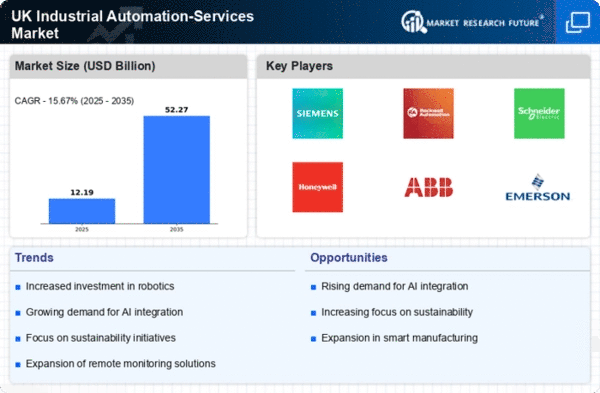
As per Market Research Future analysis, the UK industrial automation-services market Size was estimated at 10.54 USD Billion in 2024. The UK industrial automation-services market is projected to grow from 12.19 USD Billion in 2025 to 52.27 USD Billion by 2035, exhibiting a compound annual growth rate (CAGR) of 15.6% during the forecast period 2025 - 2035

Key Market Trends & Highlights

The UK industrial automation-services market is experiencing robust growth driven by technological advancements and a focus on sustainability.

  • The largest segment in the UK industrial automation-services market is the manufacturing sector, which continues to dominate due to its extensive automation needs.
  • The fastest-growing segment is the logistics and warehousing sector, reflecting the increasing demand for automation in supply chain operations.
  • There is a notable trend towards the adoption of AI and machine learning technologies, enhancing operational efficiency and decision-making processes.
  • Key market drivers include rising labour costs and the need for regulatory compliance, which are pushing companies towards automation solutions.

Market Size & Forecast

2024 Market Size 10.54 (USD Billion)
2035 Market Size 52.27 (USD Billion)
CAGR (2025 - 2035) 15.67%

Major Players

Siemens (DE), Rockwell Automation (US), Schneider Electric (FR), Honeywell (US), ABB (CH), Emerson Electric (US), Mitsubishi Electric (JP), Bosch Rexroth (DE), Yokogawa Electric (JP)

Our Impact
Enabled $4.3B Revenue Impact for Fortune 500 and Leading Multinationals
Partnering with 2000+ Global Organizations Each Year
30K+ Citations by Top-Tier Firms in the Industry

UK Industrial Automation Services Market Trends

The industrial automation-services market is currently undergoing a transformative phase driven by technological advancements and a growing demand for efficiency across various sectors. Automation solutions are being integrated into manufacturing processes, logistics, and supply chain management, leading to enhanced productivity and reduced operational costs. The emphasis on smart manufacturing and Industry 4.0 principles is reshaping how businesses operate, with a focus on data-driven decision-making and real-time monitoring. As organizations seek to remain competitive, the adoption of automation technologies is becoming a strategic priority, fostering innovation and growth within the market. Moreover, the push towards sustainability is influencing the industrial automation-services market. Companies are increasingly recognizing the importance of reducing their carbon footprint and optimizing resource usage. Automation technologies are facilitating this transition by enabling more efficient energy management and waste reduction practices. The integration of artificial intelligence and machine learning into automation systems is also enhancing predictive maintenance capabilities, thereby minimizing downtime and extending equipment lifespan. As the market evolves, it appears poised for continued expansion, with a strong emphasis on technological integration and sustainable practices.

Increased Adoption of AI and Machine Learning

The integration of artificial intelligence and machine learning into automation services is increasingly common. These technologies enhance operational efficiency by enabling predictive analytics and real-time decision-making. Businesses are leveraging AI to optimize processes, reduce errors, and improve overall productivity.

Focus on Sustainability and Energy Efficiency

Sustainability is emerging as a key driver in the industrial automation-services market. Companies are prioritizing energy-efficient solutions to minimize environmental impact. Automation technologies are facilitating better resource management, leading to reduced waste and lower energy consumption.

Growth of Remote Monitoring and Control Solutions

The demand for remote monitoring and control solutions is on the rise. Businesses are increasingly adopting these technologies to enhance operational oversight and ensure safety. Remote capabilities allow for real-time data access, enabling quicker responses to issues and improved management of resources.

UK Industrial Automation Services Market Drivers

Rising Labour Costs

In the UK, rising labour costs are compelling businesses to explore automation solutions. The industrial automation-services market is likely to benefit from this trend, as companies aim to mitigate expenses associated with hiring and training personnel. With labour costs increasing by approximately 5% annually, many firms are turning to automation to maintain profitability. By investing in automation services, businesses can streamline processes and reduce reliance on manual labour, which not only cuts costs but also enhances operational efficiency. This shift towards automation is expected to accelerate as companies seek to remain competitive in a challenging economic landscape.

Demand for Customization and Flexibility

The industrial automation-services market is increasingly driven by the demand for customization and flexibility in production processes. UK manufacturers are seeking tailored automation solutions that can adapt to changing market needs and consumer preferences. This trend is particularly evident in sectors such as food and beverage, where production lines must be agile to accommodate varying product specifications. As a result, automation service providers are focusing on developing modular and scalable solutions that can be easily modified. This shift towards customization is expected to propel growth in the industrial automation-services market, as businesses prioritize flexibility to remain competitive.

Technological Advancements in Automation

The industrial automation-services market is experiencing a surge in technological advancements, particularly in robotics and IoT. These innovations enhance operational efficiency and reduce human error, which is crucial for maintaining competitiveness. In the UK, the integration of advanced robotics is projected to increase productivity by up to 30% in manufacturing sectors. Furthermore, the adoption of IoT devices allows for real-time data collection and analysis, enabling companies to make informed decisions swiftly. This trend is likely to drive investment in automation services, as businesses seek to modernize their operations and leverage these technologies to improve their bottom line.

Increased Focus on Operational Efficiency

The industrial automation-services market is seeing an increased emphasis on operational efficiency among UK businesses. Companies are striving to optimize their processes to reduce waste and improve productivity. This trend is reflected in the growing adoption of automation technologies, which can streamline operations and enhance output. For example, businesses that implement automation solutions can achieve efficiency gains of up to 25%, leading to significant cost savings. As competition intensifies, firms are likely to invest more in automation services to maintain their market position and drive growth, making operational efficiency a key driver in the industry.

Regulatory Compliance and Safety Standards

The industrial automation-services market is significantly influenced by stringent regulatory compliance and safety standards in the UK. Companies are increasingly required to adhere to regulations that ensure workplace safety and environmental protection. As a result, there is a growing demand for automation services that can help businesses meet these requirements efficiently. For instance, automation solutions can facilitate compliance with health and safety regulations by minimizing human exposure to hazardous environments. This trend is likely to drive investment in automation technologies, as firms seek to avoid penalties and enhance their reputation by demonstrating commitment to safety and compliance.


Market Segment Insights

By Solution: Programmable Logic Controller (PLC) (Largest) vs. Manufacturing Execution System (MES) (Fastest-Growing)

In the UK industrial automation-services market, the market share among the solution segments reveals that Programmable Logic Controllers (PLC) hold a dominant position, significantly outpacing other solutions. This is attributed to their critical role in automation processes, enabling efficient and flexible manufacturing operations. Following PLCs, Manufacturing Execution Systems (MES) are showcasing rapid growth, driven by the increasing need for real-time data integration and process optimization across manufacturing environments. The growth trends within this segment are largely influenced by advancements in industrial IoT and the push for digital transformation in manufacturing. As companies strive for greater efficiency and agility, the adoption of MES is accelerating, particularly in sectors that prioritize data-driven decision-making. Additionally, the ongoing evolution of PLC technologies, with enhanced capabilities and integration with other digital solutions, further boosts their market presence, illustrating a robust competitive landscape in the automation space.

PLC (Dominant) vs. MES (Emerging)

The Programmable Logic Controller (PLC) segment is characterized by its extensive application in various manufacturing sectors, providing essential functionalities for the mechanization of production lines. PLCs are regarded as the backbone of industrial automation, known for their reliability and flexibility in controlling complex machinery and processes. Their ability to integrate with various systems makes them indispensable in achieving operational efficiency. In contrast, the Manufacturing Execution System (MES) is an emerging segment that focuses on optimizing production processes through real-time data analysis and control. MES solutions bridge the gap between enterprise resource planning and plant floor operations, allowing manufacturers to enhance productivity and track performance efficiently. The increasing emphasis on smart manufacturing and data-driven operations positions MES as a critical player in the overall automation landscape, aligning with the need for innovation in manufacturing practices.

By Services: Consulting Services (Largest) vs. System Integration (Fastest-Growing)

The UK industrial automation-services market is characterized by a diverse range of services, with Consulting Services commanding the largest share. System Integration follows closely, emerging as a significant player due to increasing demand for cohesive technology solutions. Other segments, including Professional Services and Technical Training, also contribute to the overall landscape, but their shares are relatively smaller compared to the dominant Consulting and System Integration categories. Growth in the UK industrial automation-services market is driven by advancements in technology, including AI and IoT, leading to increased demand for integrated solutions. Companies seek more efficient operations, prompting a rise in consulting and system integration services. Technical training is also gaining traction as businesses recognize the need for skilled workforce development to keep pace with rapid technological advancements.

Consulting Services (Dominant) vs. Professional Service (Emerging)

Consulting Services play a dominant role in the UK's industrial automation-services market, offering strategic guidance and expertise that help organizations optimize their operational efficiency. This segment is characterized by tailored services that address specific client needs, making it essential for businesses aiming to leverage cutting-edge technologies effectively. In contrast, Professional Services are emerging rapidly as companies acknowledge the necessity of specialized support in implementing automation solutions. These services often include project management, installation, and support, fulfilling a critical gap as industries transition towards more automated processes. Both segments are vital; however, Consulting Services consistently lead due to their strategic importance, while Professional Services are positioned for significant growth as the market evolves.

By Application: Automotive (Largest) vs. Aerospace & Defense (Fastest-Growing)

The market share distribution among the application segments in the UK industrial automation-services market highlights that the Automotive sector holds the largest share, driven by the increasing demand for automation in manufacturing and assembly processes. Following closely is the Transportation & Logistics segment, which benefits from advancements in supply chain technologies. The Aerospace & Defense segment, while smaller in market share, is experiencing substantial growth due to rising investments in defense technologies and automation solutions. Growth trends are being propelled by the integration of advanced technologies in various sectors. The Automotive segment continues to innovate with electric vehicles and autonomous systems, fostering the need for sophisticated automation services. Meanwhile, the Aerospace & Defense sector is witnessing a surge in demand for automation technologies as manufacturers seek to enhance operational efficiency and compliance with regulatory standards, marking it as the fastest-growing segment in this landscape.

Automotive: Dominant vs. Aerospace & Defense: Emerging

The Automotive segment stands as a dominant force in the UK industrial automation-services market, characterized by its extensive adoption of robotics and automation in manufacturing to improve efficiency and reduce production costs. This segment is driven by the shift towards electric vehicles and smart manufacturing, solidifying its strong market position. In contrast, the Aerospace & Defense segment is emerging as a vital area of growth, focusing on advanced automation technologies to meet stringent regulatory requirements and enhance production capabilities. Despite its smaller market share, the Aerospace & Defense segment is rapidly evolving, with increased investments and innovations set to drive its expansion in the coming years.

Get more detailed insights about UK Industrial Automation Services Market

Key Players and Competitive Insights

The industrial automation-services market in the UK is characterized by a dynamic competitive landscape, driven by technological advancements and increasing demand for efficiency across various sectors. Key players such as Siemens (DE), Rockwell Automation (US), and Schneider Electric (FR) are at the forefront, each adopting distinct strategies to enhance their market positioning. Siemens (DE) emphasizes innovation through its digital twin technology, which allows for real-time simulations and optimizations in manufacturing processes. Meanwhile, Rockwell Automation (US) focuses on strategic partnerships, particularly in the realm of AI and IoT, to bolster its service offerings and expand its customer base. Schneider Electric (FR) is actively pursuing sustainability initiatives, integrating energy management solutions that align with global environmental goals, thereby appealing to a growing segment of eco-conscious clients.The business tactics employed by these companies reflect a concerted effort to localize manufacturing and optimize supply chains, which are crucial in a moderately fragmented market. This competitive structure allows for a diverse range of services and solutions, enabling companies to cater to specific regional needs while maintaining operational efficiency. The collective influence of these key players shapes the market dynamics, fostering an environment where innovation and customer-centric approaches are paramount.

In September Siemens (DE) announced the launch of its new cloud-based platform designed to enhance operational efficiency for manufacturers. This strategic move is significant as it positions Siemens as a leader in the digital transformation of industrial processes, allowing clients to leverage data analytics for improved decision-making. The platform's capabilities are expected to streamline operations and reduce downtime, thereby enhancing productivity across various sectors.

In October Rockwell Automation (US) entered into a partnership with a leading AI firm to develop advanced predictive maintenance solutions. This collaboration is pivotal, as it not only strengthens Rockwell's technological capabilities but also addresses the growing demand for smart manufacturing solutions. By integrating AI into its service offerings, Rockwell aims to provide clients with tools that can anticipate equipment failures, thus minimizing operational disruptions and enhancing overall efficiency.

In August Schneider Electric (FR) unveiled its new sustainability initiative aimed at reducing carbon emissions in industrial operations by 30% by 2030. This initiative underscores Schneider's commitment to sustainability and positions the company as a frontrunner in the green technology space. By aligning its services with environmental goals, Schneider Electric is likely to attract a broader client base that prioritizes sustainable practices in their operations.

As of November the competitive trends in the industrial automation-services market are increasingly defined by digitalization, sustainability, and the integration of AI technologies. Strategic alliances are becoming more prevalent, as companies recognize the need to collaborate in order to innovate and meet evolving customer demands. Looking ahead, it appears that competitive differentiation will shift from traditional price-based competition to a focus on innovation, technological advancements, and supply chain reliability. This evolution suggests that companies that prioritize these aspects will likely gain a competitive edge in the rapidly changing landscape.

Key Companies in the UK Industrial Automation Services Market include

Industry Developments

Siemens announced in March 2024 the establishment of a new £100 million digital engineering facility in Wiltshire, UK. The facility is intended to replace the existing rail infrastructure factory in Chippenham with a research and development center, which is anticipated to be operational by 2026.This facility is a testament to Siemens' dedication to enhancing the UK's R&D presence and digital manufacturing capabilities. Mitsubishi Electric emphasized in July 2025 that its autonomous systems are assisting UK manufacturers in bridging the skills divide in automation technology.

This development underscores the critical role that Mitsubishi's automation solutions are playing in addressing workforce challenges and promoting adoption across UK manufacturing. In August 2025, Make UK (in collaboration with Sage) issued a report that cautioned that the UK is behind in the adoption of industrial robotics and AI. The report cited a mere 112 industrial robots per 10,000 workers, which is half the EU average.

The report also urged for immediate, SME-focused funding and training services.This call-to-action is indicative of the increasing apprehension regarding the automation density in the United Kingdom and the necessity of accessible innovation support for lesser manufacturers.

Future Outlook

UK Industrial Automation Services Market Future Outlook

The Industrial Automation Services Market is projected to grow at a 15.67% CAGR from 2025 to 2035, driven by technological advancements, increased efficiency demands, and sustainability initiatives.

New opportunities lie in:

  • Integration of AI-driven predictive maintenance solutions
  • Development of customized automation software for SMEs
  • Expansion of remote monitoring and control services for industrial operations

By 2035, the market is expected to achieve substantial growth, reflecting evolving industrial needs.

Market Segmentation

UK Industrial Automation Services Market Services Outlook

  • Consulting Services
  • System Integration
  • Professional Service
  • Technical Training
  • Others

UK Industrial Automation Services Market Solution Outlook

  • Programmable Logic Controller (PLC)
  • Supervisory Control & Data Acquisition (SCADA)
  • Distributed Control System
  • Manufacturing Execution System (MES)
  • Product Lifecycle Management (PLM)
  • Functional Safety
  • Plant Asset Management (PAM)

UK Industrial Automation Services Market Application Outlook

  • Aerospace & Defense
  • Transportation & Logistics
  • Automotive
  • Energy & Power Systems
  • Mining & Metals

Report Scope

MARKET SIZE 2024 10.54(USD Billion)
MARKET SIZE 2025 12.19(USD Billion)
MARKET SIZE 2035 52.27(USD Billion)
COMPOUND ANNUAL GROWTH RATE (CAGR) 15.67% (2025 - 2035)
REPORT COVERAGE Revenue Forecast, Competitive Landscape, Growth Factors, and Trends
BASE YEAR 2024
Market Forecast Period 2025 - 2035
Historical Data 2019 - 2024
Market Forecast Units USD Billion
Key Companies Profiled Siemens (DE), Rockwell Automation (US), Schneider Electric (FR), Honeywell (US), ABB (CH), Emerson Electric (US), Mitsubishi Electric (JP), Bosch Rexroth (DE), Yokogawa Electric (JP)
Segments Covered Solution, Services, Application
Key Market Opportunities Integration of artificial intelligence in industrial automation-services enhances efficiency and reduces operational costs.
Key Market Dynamics Growing demand for automation services driven by technological advancements and regulatory compliance in the UK manufacturing sector.
Countries Covered UK
Leave a Comment

FAQs

What is the expected market size of the UK Industrial Automation Services Market in 2024?

The UK Industrial Automation Services Market is expected to be valued at 9.5 USD Billion in 2024.

What is the projected market size for the UK Industrial Automation Services Market by 2035?

By 2035, the UK Industrial Automation Services Market is projected to reach a value of 20.5 USD Billion.

What is the expected compound annual growth rate (CAGR) for the UK Industrial Automation Services Market from 2025 to 2035?

The market is anticipated to grow at a CAGR of 7.242% from 2025 to 2035.

Which segment is valued at 2.1 USD Billion for Programmable Logic Controllers in 2024?

The Programmable Logic Controller segment is valued at 2.1 USD Billion in 2024.

What will be the value of the Supervisory Control & Data Acquisition segment by 2035?

By 2035, the Supervisory Control & Data Acquisition segment is expected to be valued at 5.0 USD Billion.

Who are the key players in the UK Industrial Automation Services Market?

Key players in the market include Mitsubishi Electric, Siemens, Rockwell Automation, and Honeywell, among others.

Which solution segment is projected to grow significantly between 2024 and 2035?

The Distributed Control System segment, valued at 2.0 USD Billion in 2024, is expected to see considerable growth by 2035.

What is the market size estimate for Product Lifecycle Management in 2024?

The Product Lifecycle Management segment is estimated to be valued at 1.3 USD Billion in 2024.

How does the Manufacturing Execution System market size compare between 2024 and 2035?

The Manufacturing Execution System segment is valued at 1.8 USD Billion in 2024 and expected to reach 3.8 USD Billion by 2035.

What are the growth drivers for the UK Industrial Automation Services Market?

Key growth drivers include technological advancements and increased demand for operational efficiency in manufacturing.

Download Free Sample

Kindly complete the form below to receive a free sample of this Report

Compare Licence

×
Features License Type
Single User Multiuser License Enterprise User
Price $4,950 $5,950 $7,250
Maximum User Access Limit 1 User Upto 10 Users Unrestricted Access Throughout the Organization
Free Customization
Direct Access to Analyst
Deliverable Format
Platform Access
Discount on Next Purchase 10% 15% 15%
Printable Versions