×
Request Free Sample ×

Kindly complete the form below to receive a free sample of this Report

* Please use a valid business email

Leading companies partner with us for data-driven Insights

clients tt-cursor
Hero Background

UK Fill Finish Manufacturing Market

ID: MRFR/HC/48320-HCR
200 Pages
Rahul Gotadki
February 2026

UK Fill Finish Manufacturing Market Research Report By Application (Vaccine Filling, Parenteral Drug Filling, Biopharmaceuticals Filling, Diagnostic Product Filling), By Product Type (Pre-filled Syringes, Vials, Cartridges, Ampoules), By Equipment Type (Filling Machines, Capping Machines, Labeling Machines, Inspection Machines) and By End User (Pharmaceutical Companies, Contract Manufacturing Organizations, Biotechnology Companies) -Forecast to 2035

Share:
Download PDF ×

We do not share your information with anyone. However, we may send you emails based on your report interest from time to time. You may contact us at any time to opt-out.

UK Fill Finish Manufacturing Market Infographic
Purchase Options

UK Fill Finish Manufacturing Market Summary

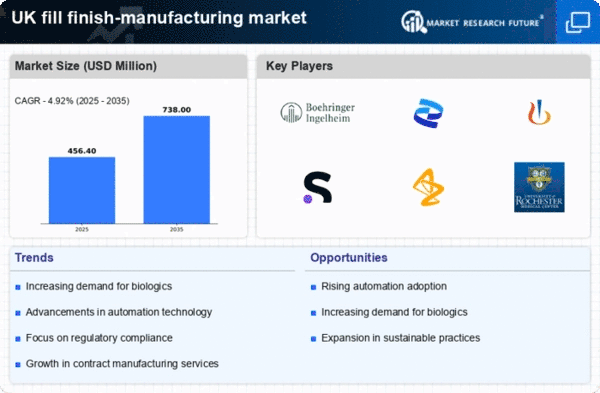
As per Market Research Future analysis, the UK Fill Finish Manufacturing Market size was estimated at 435.0 USD Million in 2024. The Fill Finish-manufacturing market is projected to grow from 456.4 USD Million in 2025 to 738.0 USD Million by 2035, exhibiting a compound annual growth rate (CAGR) of 4.9% during the forecast period 2025 - 2035

Key Market Trends & Highlights

The UK The UK fill finish-manufacturing market is experiencing a transformative shift. This shift is driven by technological advancements and sustainability efforts.

  • Automation and technology integration are reshaping operational efficiencies in the fill finish-manufacturing sector.
  • Sustainability initiatives are becoming increasingly critical as companies strive to reduce their environmental footprint.
  • Regulatory compliance and quality assurance remain paramount, influencing manufacturing practices and operational standards.
  • The rising demand for biopharmaceuticals and technological advancements in manufacturing are key drivers propelling market growth.

Market Size & Forecast

2024 Market Size 435.0 (USD Million)
2035 Market Size 738.0 (USD Million)
CAGR (2025 - 2035) 4.92%

Major Players

Boehringer Ingelheim (DE), Pfizer (US), Novartis (CH), Sanofi (FR), AstraZeneca (GB), Roche (CH), Merck KGaA (DE), GSK (GB), Baxter International (US)

Our Impact
Enabled $4.3B Revenue Impact for Fortune 500 and Leading Multinationals
Partnering with 2000+ Global Organizations Each Year
30K+ Citations by Top-Tier Firms in the Industry

UK Fill Finish Manufacturing Market Trends

The market is currently experiencing a transformative phase, driven by advancements in technology and increasing demand for high-quality pharmaceutical products. The emphasis on safety and efficacy has led to a surge in the adoption of automated systems, which enhance precision and reduce human error during the filling and finishing processes. Regulatory bodies are also tightening their standards, compelling manufacturers to invest in state-of-the-art facilities and equipment. This shift not only improves product integrity but also aligns with the growing trend towards sustainability in manufacturing practices. Moreover, the market is witnessing a notable increase in the production of biologics and biosimilars, which require specialized fill finish-manufacturing techniques. As the healthcare landscape evolves, there is a rising need for flexible manufacturing solutions that can accommodate varying batch sizes and product types. This adaptability is crucial for meeting the diverse needs of the pharmaceutical sector, particularly in the context of personalized medicine. Ongoing collaboration between industry stakeholders and regulatory agencies is likely to foster innovation and ensure compliance. This will ultimately benefit the UK Fill Finish Manufacturing Market in the long run.

Automation and Technology Integration

The integration of automation in the fill finish-manufacturing market is reshaping operational efficiency. Automated systems enhance accuracy and minimize contamination risks, which are critical in pharmaceutical production. This trend reflects a broader industry movement towards digitization, where data analytics and real-time monitoring play pivotal roles in optimizing processes.

Sustainability Initiatives

Sustainability is becoming a focal point within the fill finish-manufacturing market. Manufacturers are increasingly adopting eco-friendly practices, such as reducing waste and utilizing recyclable materials. This shift not only addresses environmental concerns but also aligns with consumer preferences for sustainable products.

Regulatory Compliance and Quality Assurance

The landscape of regulatory compliance is evolving, with stricter guidelines impacting the fill finish-manufacturing market. Companies are prioritizing quality assurance measures to meet these regulations, which enhances product safety and efficacy. This trend underscores the importance of maintaining high standards in manufacturing processes.

UK Fill Finish Manufacturing Market Drivers

Rising Demand for Biopharmaceuticals

The increasing demand for biopharmaceuticals is a pivotal driver in the fill finish-manufacturing market. As the UK healthcare sector continues to evolve, the need for advanced therapies, particularly biologics, is surging. This trend is reflected in the projected growth of the biopharmaceutical market, which is expected to reach £30 billion by 2025. Consequently, fill finish-manufacturing facilities are under pressure to scale up production capabilities to meet this demand. The complexity of biologics necessitates specialized fill finish processes, which can enhance the operational requirements of manufacturing plants. This growing market segment is likely to stimulate investments in state-of-the-art technologies and facilities, thereby propelling the fill finish-manufacturing market forward.

Technological Advancements in Manufacturing

Technological advancements are significantly influencing the fill finish-manufacturing market. Innovations such as automated filling systems, advanced inspection technologies, and real-time monitoring systems are becoming increasingly prevalent. These technologies not only enhance efficiency but also improve product quality and safety. For instance, the integration of artificial intelligence in manufacturing processes can lead to a reduction in human error, which is crucial in the production of sensitive pharmaceutical products. The UK government has been supportive of such technological initiatives, providing funding and resources to encourage innovation in the sector. As a result, the fill finish-manufacturing market is likely to experience a transformation that aligns with modern manufacturing practices.

Increased Focus on Patient-Centric Solutions

The shift towards patient-centric solutions is reshaping the fill finish-manufacturing market. Pharmaceutical companies are increasingly prioritizing the needs and preferences of patients, which influences product design and delivery methods. This trend is evident in the rise of personalized medicine, where treatments are tailored to individual patient profiles. The fill finish-manufacturing market must adapt to these changes by developing flexible manufacturing processes that can accommodate smaller batch sizes and diverse product formats. This adaptability is essential for meeting the unique requirements of patient-centric therapies, which may include specialized packaging and delivery systems. As the market evolves, companies that can effectively respond to these demands are likely to gain a competitive edge.

Regulatory Landscape and Compliance Challenges

The regulatory landscape presents both challenges and opportunities for the fill finish-manufacturing market. In the UK, stringent regulations govern the production of pharmaceutical products, necessitating compliance with quality standards and safety protocols. This regulatory environment drives manufacturers to invest in robust quality assurance systems and processes. While compliance can be resource-intensive, it also fosters innovation as companies seek to develop more efficient manufacturing practices that meet regulatory requirements. The ongoing evolution of regulations, particularly concerning biologics and advanced therapies, may compel the fill finish-manufacturing market to adapt continuously. Companies that proactively address these challenges are likely to enhance their market position and ensure long-term sustainability.

Expansion of Contract Manufacturing Organizations (CMOs)

The expansion of Contract Manufacturing Organizations (CMOs) is a notable driver in the fill finish-manufacturing market. As pharmaceutical companies seek to optimize their operations and reduce costs, they increasingly turn to CMOs for specialized manufacturing services. This trend is particularly pronounced in the UK, where the number of CMOs has been steadily increasing. By outsourcing fill finish processes, companies can focus on core competencies while leveraging the expertise of CMOs. This shift not only enhances operational efficiency but also allows for greater flexibility in production capacity. The fill finish-manufacturing market is likely to benefit from this trend, as CMOs continue to play a crucial role in meeting the growing demands of the pharmaceutical industry.


Market Segment Insights

By Application: Vaccine Filling (Largest) vs. Parenteral Drug Filling (Fastest-Growing)

In the UK fill finish-manufacturing market, the application segment is notably diverse, with Vaccine Filling leading the market share due to the increasing demand for immunization and health security measures. Parenteral Drug Filling follows closely, driven by the rise in chronic diseases requiring injectable medications. Both segments exhibit significant growth, but Vaccine Filling takes precedence as the dominant force as public health initiatives bolster its demand. The growth trends in this segment are influenced by technological advancements and the overall expansion of biopharmaceuticals. Vaccine Filling is supported by governmental investments and rising health concerns, while Parenteral Drug Filling is experiencing rapid growth due to the need for innovative therapies and medications. This sector is projected to grow as the emphasis on patient-specific treatments and personalized medicine continues to rise.

Vaccine Filling (Dominant) vs. Parenteral Drug Filling (Emerging)

Vaccine Filling stands as the dominant application within the market, characterized by robust support from health initiatives and widespread public demands for vaccination, making it a critical aspect of healthcare. This segment has established a reputation for reliability and quality, ensuring that vaccines are efficiently and safely processed. In contrast, Parenteral Drug Filling is an emerging sector that is rapidly gaining traction. It is characterized by a shift towards innovative drug formulations and delivery systems designed to enhance patient compliance. This segment caters to a diverse range of therapeutic areas, thus attracting significant interest from pharmaceutical companies aiming to expand their product offerings. Together, these segments reflect a dynamic balance between established practices and emerging therapeutic needs.

By Product Type: Pre-filled Syringes (Largest) vs. Cartridges (Fastest-Growing)

The UK fill finish-manufacturing market is predominantly led by pre-filled syringes, which capture the largest market share due to their increasing adoption in various therapeutic areas, including vaccines and biologics. Vials and ampoules also hold significant positions; however, they are gradually being overshadowed by the convenience offered by pre-filled syringes and the innovative designs of cartridges. The demand for easy-to-use and efficient drug delivery systems is steering the market dynamics toward these segments. Growth trends in the UK fill finish-manufacturing market indicate a robust increase in the adoption of cartridges as they emerge as the fastest-growing segment. Factors driving this growth include the rising focus on self-administered medications, especially in chronic disease management, and advancements in cartridge technology that enhance functionality and user-friendliness. Moreover, the expansion of biopharmaceuticals and personalized medicine is anticipated to contribute significantly to the growing demand for innovative packaging solutions.

Pre-filled Syringes (Dominant) vs. Ampoules (Emerging)

Pre-filled syringes stand out as the dominant product type in the UK fill finish-manufacturing market, attributed to their ease of use and effectiveness in minimizing medication errors. This segment is highly favored by healthcare providers and patients alike for administering vaccinations and biologic therapies. On the other hand, ampoules are emerging as a viable alternative, particularly in the sterile filling of sensitive drugs and diagnostics. While they offer excellent protection against contamination, their traditional usage is being challenged by the growing preference for more modern delivery systems. As the market evolves, the competition between these two segments is expected to intensify, with manufacturers continuously innovating to meet regulatory standards and customer demands.

By Equipment Type: Filling Machines (Largest) vs. Labeling Machines (Fastest-Growing)

In the UK fill finish-manufacturing market, the market share distribution among equipment types highlights Filling Machines as the dominant segment, boasting significant utilization across various sectors. Following closely are Capping Machines, Inspection Machines, and Labeling Machines, with the latter positioned as a critical player thanks to its role in meeting compliance and branding needs. The competition among these segments underscores the importance of efficiency and reliability in production lines. Growth trends reveal that while Filling Machines maintain a steady share, Labeling Machines are experiencing rapid expansion, driven by increasing regulatory requirements and consumer demands for traceability and attractive packaging. Innovations in technology and automation further propel this segment, making it not just essential, but also a focal point for investment in the UK fill finish-manufacturing market.

Filling Machines (Dominant) vs. Labeling Machines (Emerging)

Filling Machines are critical for ensuring precise and efficient filling processes, maintaining dominance in the market due to their established reliability and effectiveness in a variety of applications, including liquid, powder, and viscous products. As manufacturers seek to enhance throughput and minimize waste, these machines are increasingly tailored to integrate with automated systems. Meanwhile, Labeling Machines are emerging at a rapid pace, influenced by the need for compliance with stringent regulations and growing consumer preferences for transparency in product labeling. Their adaptability to various container shapes and sizes, alongside advances in digital printing technology, places them in a strong position for future growth, attracting attention from both established companies and new entrants looking to capitalize on market opportunities.

By End User: Pharmaceutical Companies (Largest) vs. Contract Manufacturing Organizations (Fastest-Growing)

Pharmaceutical Companies dominate the UK fill finish-manufacturing market, holding a significant share due to their consistent demand for high-quality manufacturing processes. This segment benefits from a well-established infrastructure and regulatory framework that supports large-scale production. Contract Manufacturing Organizations, while not as large in market share, serve crucial roles in flexibility and adaptability, catering to various clients with specialized needs. In recent years, growth in the Contract Manufacturing Organizations segment has surged, driven by an increasing trend towards outsourcing by pharmaceutical firms and the rise of biotechnology companies. These trends are supported by technological advancements and a favorable regulatory environment that facilitate faster production processes and cost efficiencies, allowing this segment to expand rapidly in the competitive landscape.

Pharmaceutical Companies (Dominant) vs. Biotechnology Companies (Emerging)

Pharmaceutical Companies are the cornerstone of the UK fill finish-manufacturing market, characterized by their substantial investments in R&D and robust supply chains. They engage in extensive clinical trials, which require meticulous fill finish processes to ensure product integrity. Meanwhile, Biotechnology Companies are emerging as key players, leveraging innovative biopharmaceutical technologies and emphasizing personalized medicine. They often operate on smaller scales but exhibit rapid growth potential, particularly in niche markets. The contrast between the established practices of Pharmaceutical Companies and the agility of Biotechnology Companies represents a dynamic shift in the market, propelling advancements in fill finish capabilities.

Get more detailed insights about UK Fill Finish Manufacturing Market

Key Players and Competitive Insights

The fill finish-manufacturing market is currently characterized by a dynamic competitive landscape, driven by increasing demand for biologics and the need for advanced manufacturing capabilities. Key players such as Boehringer Ingelheim (DE), Pfizer (US), and AstraZeneca (GB) are strategically positioning themselves through innovation and regional expansion. Boehringer Ingelheim (DE) has focused on enhancing its capabilities in biologics, while Pfizer (US) emphasizes digital transformation to streamline operations. AstraZeneca (GB) is actively pursuing partnerships to bolster its manufacturing footprint, collectively shaping a competitive environment that prioritizes efficiency and technological advancement.In terms of business tactics, companies are increasingly localizing manufacturing to reduce lead times and optimize supply chains. The market appears moderately fragmented, with several key players exerting influence over their respective segments. This structure allows for a diverse range of strategies, as companies leverage their strengths to capture market share and respond to evolving customer needs.

In October Pfizer (US) announced a significant investment in a new fill finish facility in the UK, aimed at increasing its capacity for sterile injectable products. This strategic move is likely to enhance Pfizer's operational efficiency and responsiveness to market demands, positioning the company favorably against competitors. The investment underscores the importance of local manufacturing capabilities in meeting the growing demand for high-quality pharmaceuticals.

In September AstraZeneca (GB) entered into a collaboration with a leading technology firm to integrate AI-driven solutions into its fill finish processes. This partnership is expected to optimize production efficiency and reduce costs, reflecting a broader trend towards digitalization in the industry. By leveraging AI, AstraZeneca (GB) aims to enhance its competitive edge and improve product quality, which is increasingly critical in the current market landscape.

In August Boehringer Ingelheim (DE) expanded its partnership with a prominent biotech company to co-develop a new biologic product. This collaboration not only strengthens Boehringer Ingelheim's product pipeline but also highlights the growing trend of strategic alliances in the fill finish-manufacturing market. Such partnerships are essential for sharing resources and expertise, ultimately driving innovation and improving market positioning.

As of November the competitive trends in the fill finish-manufacturing market are increasingly defined by digitalization, sustainability, and the integration of advanced technologies. Strategic alliances are playing a crucial role in shaping the landscape, enabling companies to pool resources and enhance their capabilities. Looking ahead, competitive differentiation is likely to evolve from traditional price-based competition towards a focus on innovation, technological advancements, and supply chain reliability, as companies strive to meet the demands of a rapidly changing market.

Key Companies in the UK Fill Finish Manufacturing Market include

Industry Developments

The UK Fill Finish Manufacturing Market has experienced notable developments recently. In October 2023, Cipla Ltd announced enhancements to its fill-finish manufacturing capabilities, aiming for an increase in production efficiency and higher output for biologics. Similarly, Lonza Group has invested significantly in state-of-the-art technology for its facilities in the UK to meet the growing demand for personalized medicines. Vetter Pharma has also expanded its operations in the region, reflecting a broader trend in boosting capacity. In September 2023, a merger was finalized between Recipharm and a subsidiary of Bristol-Myers Squibb, enhancing Recipharm's capabilities in pharmaceutical contract manufacturing.

Baxter International is ramping up its production to meet the increasing demand for injectable medications amid market growth. Meanwhile, Boehringer Ingelheim reported the successful implementation of advanced automated systems in its UK facilities, further solidifying its position in the market. Over the last two to three years, significant strides have been made in strengthening regulatory compliance and sterilization methods, improving overall market confidence. The UK's proactive approach to addressing pharmaceutical supply chain challenges has also influenced investment decisions, ultimately leading to a more robust Fill Finish Manufacturing sector.

Future Outlook

UK Fill Finish Manufacturing Market Future Outlook

The Fill finish Manufacturing Market is projected to grow at a 4.92% CAGR from 2025 to 2035, driven by technological advancements and increasing demand for biopharmaceuticals.

New opportunities lie in:

  • Investment in automated filling lines to enhance efficiency and reduce costs.
  • Development of sustainable packaging solutions to meet regulatory demands.
  • Expansion of contract manufacturing services to cater to diverse client needs.

By 2035, the market is expected to achieve robust growth, driven by innovation and strategic partnerships.

Market Segmentation

UK Fill Finish Manufacturing Market End User Outlook

  • Pharmaceutical Companies
  • Contract Manufacturing Organizations
  • Biotechnology Companies

UK Fill Finish Manufacturing Market Application Outlook

  • Vaccine Filling
  • Parenteral Drug Filling
  • Biopharmaceuticals Filling
  • Diagnostic Product Filling

UK Fill Finish Manufacturing Market Product Type Outlook

  • Pre-filled Syringes
  • Vials
  • Cartridges
  • Ampoules

UK Fill Finish Manufacturing Market Equipment Type Outlook

  • Filling Machines
  • Capping Machines
  • Labeling Machines
  • Inspection Machines

Report Scope

MARKET SIZE 2024 435.0(USD Million)
MARKET SIZE 2025 456.4(USD Million)
MARKET SIZE 2035 738.0(USD Million)
COMPOUND ANNUAL GROWTH RATE (CAGR) 4.92% (2025 - 2035)
REPORT COVERAGE Revenue Forecast, Competitive Landscape, Growth Factors, and Trends
BASE YEAR 2024
Market Forecast Period 2025 - 2035
Historical Data 2019 - 2024
Market Forecast Units USD Million
Key Companies Profiled Boehringer Ingelheim (DE), Pfizer (US), Novartis (CH), Sanofi (FR), AstraZeneca (GB), Roche (CH), Merck KGaA (DE), GSK (GB), Baxter International (US)
Segments Covered Application, Product Type, Equipment Type, End User
Key Market Opportunities Adoption of advanced automation technologies enhances efficiency in the fill finish-manufacturing market.
Key Market Dynamics Technological advancements drive efficiency and compliance in the fill finish-manufacturing market, reshaping competitive dynamics.
Countries Covered UK
Leave a Comment

FAQs

What is the expected market size of the UK Fill Finish Manufacturing Market in 2024?

The UK Fill Finish Manufacturing Market is expected to be valued at 271.88 million USD in 2024.

What is the projected market value of the UK Fill Finish Manufacturing Market by 2035?

By 2035, the overall market is projected to reach a value of 351.25 million USD.

What is the expected compound annual growth rate (CAGR) for the UK Fill Finish Manufacturing Market from 2025 to 2035?

The market is expected to grow at a CAGR of 2.356 percent during the period from 2025 to 2035.

Which application segment in the UK Fill Finish Manufacturing Market is valued highest in 2024?

In 2024, the Vaccine Filling segment is the highest valued application, estimated at 90.0 million USD.

How much is the Parenteral Drug Filling segment expected to be valued in 2035?

The Parenteral Drug Filling segment is expected to be valued at 90.0 million USD by 2035.

What is the valuation of the Biopharmaceuticals Filling segment in 2024?

The Biopharmaceuticals Filling segment is anticipated to be valued at 60.0 million USD in 2024.

Who are the major key players in the UK Fill Finish Manufacturing Market?

Some major players include Bristol-Myers Squibb, Pfizer Inc, and Amgen Inc among others.

What growth opportunities exist within the UK Fill Finish Manufacturing Market?

There are significant opportunities due to increasing demand in Vaccine Filling and Biopharmaceuticals Filling applications.

What could be a challenge for the growth of the UK Fill Finish Manufacturing Market?

Potential challenges include regulatory hurdles and the need for advanced technological solutions.

How is the Diagnostic Product Filling segment expected to grow by 2035?

The Diagnostic Product Filling segment is forecasted to grow to a valuation of 71.25 million USD by 2035.

Download Free Sample

Kindly complete the form below to receive a free sample of this Report

Compare Licence

×
Features License Type
Single User Multiuser License Enterprise User
Price $4,950 $5,950 $7,250
Maximum User Access Limit 1 User Upto 10 Users Unrestricted Access Throughout the Organization
Free Customization
Direct Access to Analyst
Deliverable Format
Platform Access
Discount on Next Purchase 10% 15% 15%
Printable Versions