×
Request Free Sample ×

Kindly complete the form below to receive a free sample of this Report

* Please use a valid business email

Leading companies partner with us for data-driven Insights

clients tt-cursor
Hero Background

UK Esophageal Squamous Cell Carcinoma Market

ID: MRFR/LS/51657-HCR
200 Pages
Rahul Gotadki
February 2026

UK Esophageal Squamous Cell Carcinoma Market Research Report By End User (Hospital, Specialty Centers, Others) - Growth & Industry Forecast 2025 To 2035

Share:
Download PDF ×

We do not share your information with anyone. However, we may send you emails based on your report interest from time to time. You may contact us at any time to opt-out.

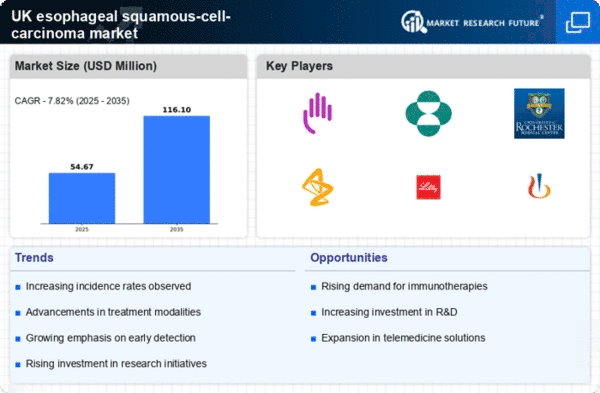
UK Esophageal Squamous Cell Carcinoma Market Infographic
Purchase Options

UK Esophageal Squamous Cell Carcinoma Market Summary

As per Market Research Future analysis, the UK esophageal squamous-cell-carcinoma market size was estimated at 50.7 USD Million in 2024. The UK esophageal squamous-cell-carcinoma market is projected to grow from 54.67 USD Million in 2025 to 116.1 USD Million by 2035, exhibiting a compound annual growth rate (CAGR) of 7.8% during the forecast period 2025 - 2035

Key Market Trends & Highlights

The UK esophageal squamous-cell-carcinoma market is experiencing notable advancements driven by innovative treatment approaches and increasing awareness.

  • Advancements in diagnostic techniques are enhancing early detection and improving patient outcomes.
  • The emergence of targeted therapies is transforming treatment paradigms and offering new hope for patients.
  • Multidisciplinary care approaches are becoming more prevalent, fostering collaboration among healthcare professionals.
  • Increasing incidence rates and advancements in treatment modalities are key drivers propelling market growth.

Market Size & Forecast

2024 Market Size 50.7 (USD Million)
2035 Market Size 116.1 (USD Million)
CAGR (2025 - 2035) 7.82%

Major Players

Bristol-Myers Squibb (US), Merck & Co (US), Roche (CH), AstraZeneca (GB), Eli Lilly and Company (US), Novartis (CH), Pfizer (US), Amgen (US), Boehringer Ingelheim (DE)

Our Impact
Enabled $4.3B Revenue Impact for Fortune 500 and Leading Multinationals
Partnering with 2000+ Global Organizations Each Year
30K+ Citations by Top-Tier Firms in the Industry

UK Esophageal Squamous Cell Carcinoma Market Trends

The esophageal squamous-cell-carcinoma market is currently experiencing notable developments, driven by advancements in diagnostic techniques and treatment modalities. Enhanced awareness regarding the disease has led to increased screening and early detection, which is crucial for improving patient outcomes. The integration of innovative therapies, including targeted treatments and immunotherapy, appears to be reshaping the therapeutic landscape. Furthermore, ongoing research initiatives and clinical trials are likely to contribute to the evolution of treatment protocols, potentially leading to more effective management strategies for patients. In addition, the role of multidisciplinary care teams is becoming increasingly prominent in the esophageal squamous-cell-carcinoma market. These teams, comprising oncologists, surgeons, radiologists, and nutritionists, collaborate to provide comprehensive care tailored to individual patient needs. This holistic approach may enhance treatment efficacy and improve quality of life for patients. As the market continues to evolve, the focus on personalized medicine and patient-centered care is expected to gain traction, reflecting a shift towards more tailored therapeutic options. Overall, the esophageal squamous-cell-carcinoma market is poised for growth, driven by innovation and a commitment to improving patient outcomes.

Advancements in Diagnostic Techniques

Recent improvements in diagnostic methods are transforming the esophageal squamous-cell-carcinoma market. Techniques such as endoscopic ultrasound and advanced imaging modalities are facilitating earlier detection, which is critical for effective treatment. Enhanced diagnostic accuracy may lead to better patient stratification and tailored therapeutic approaches.

Emergence of Targeted Therapies

The introduction of targeted therapies is reshaping treatment options within the esophageal squamous-cell-carcinoma market. These therapies focus on specific molecular targets associated with cancer progression, potentially improving treatment efficacy and minimizing side effects. This trend indicates a shift towards more personalized treatment regimens.

Multidisciplinary Care Approaches

The adoption of multidisciplinary care teams is gaining momentum in the esophageal squamous-cell-carcinoma market. By integrating various specialties, these teams aim to provide comprehensive treatment plans that address the complex needs of patients. This collaborative approach may enhance overall treatment outcomes and patient satisfaction.

UK Esophageal Squamous Cell Carcinoma Market Drivers

Increasing Incidence Rates

The rising incidence rates of esophageal squamous-cell-carcinoma in the UK are a primary driver for the market. Recent statistics indicate that the age-standardized incidence rate has increased, with approximately 8,000 new cases diagnosed annually. This trend is likely influenced by lifestyle factors such as smoking and alcohol consumption, which are prevalent in the UK. As awareness of the disease grows, healthcare providers are expected to enhance screening and diagnostic efforts, thereby increasing demand for treatment options. The esophageal squamous-cell-carcinoma market is poised to expand as more patients seek intervention, leading to a greater need for innovative therapies and supportive care. This increase in incidence not only highlights the urgency for effective treatment solutions but also underscores the importance of ongoing research and development in the field.

Rising Awareness and Education

Rising awareness and education regarding esophageal squamous-cell-carcinoma are pivotal in driving the market forward. Public health campaigns and initiatives aimed at educating the population about risk factors and early symptoms are gaining momentum in the UK. This increased awareness is likely to lead to earlier diagnosis and treatment, which can significantly improve patient outcomes. Healthcare professionals are also receiving enhanced training on recognizing the disease, further contributing to timely interventions. As a result, the esophageal squamous-cell-carcinoma market is expected to benefit from a surge in demand for diagnostic and therapeutic services. The emphasis on education not only empowers patients but also fosters a more proactive approach to managing this aggressive cancer type.

Emergence of Personalized Medicine

The emergence of personalized medicine is transforming the landscape of the esophageal squamous-cell-carcinoma market. Tailoring treatment plans based on individual genetic profiles and tumor characteristics is becoming increasingly feasible, thanks to advancements in genomic testing. This approach allows for more effective targeting of therapies, potentially leading to better patient outcomes. In the UK, the integration of personalized medicine into clinical practice is gaining traction, with healthcare providers recognizing its potential to optimize treatment efficacy. As more patients receive tailored therapies, the esophageal squamous-cell-carcinoma market is likely to expand, driven by the demand for innovative solutions that address the unique needs of each patient. This shift towards personalized care represents a significant evolution in the management of this challenging cancer type.

Government Initiatives and Funding

Government initiatives and funding play a crucial role in shaping the esophageal squamous-cell-carcinoma market. The UK government has been actively investing in cancer research and treatment programs, with a focus on improving healthcare infrastructure and access to innovative therapies. Recent funding allocations have aimed to enhance early detection and treatment capabilities, which are essential for improving survival rates. This financial support is likely to stimulate growth in the market, as it encourages the development of new treatment options and technologies. Additionally, collaborations between public health organizations and private sectors are expected to foster innovation in the esophageal squamous-cell-carcinoma market, ultimately benefiting patients through improved care pathways.

Advancements in Treatment Modalities

The esophageal squamous-cell-carcinoma market is significantly influenced by advancements in treatment modalities. Recent developments in surgical techniques, radiotherapy, and chemotherapy have improved patient outcomes and survival rates. For instance, minimally invasive surgical approaches have gained traction, allowing for quicker recovery times and reduced hospital stays. Furthermore, the introduction of novel chemotherapeutic agents has expanded the therapeutic arsenal available to oncologists. In the UK, the market for these treatments is projected to grow, with an estimated value reaching £1 billion by 2027. This growth is driven by the increasing adoption of these advanced therapies, which are becoming standard practice in managing esophageal squamous-cell-carcinoma. As clinical trials continue to yield promising results, the market is likely to see further innovations that could enhance treatment efficacy.


Market Segment Insights

By Diagnosis: Endoscopy (Largest) vs. CT Scan (Fastest-Growing)

In the UK esophageal squamous-cell-carcinoma market, Endoscopy holds the largest share among the diagnosis segment values, demonstrating its established importance in early detection and diagnosis. Following closely, CT Scans are emerging as a critical tool, particularly in staging and assessing the cancer's spread, which contributes to their increasing uptake in clinical settings. Other modalities such as Esophagram and PET scans, while utilized, occupy smaller niches due to their specific application and time requirements. Growth trends in this diagnosis segment are influenced by technological advancements and increasing awareness of esophageal squamous-cell carcinoma. The rise in incidences of the disease is propelling demand for effective diagnostic tools. As healthcare providers continue to adopt innovative imaging technologies, CT Scan is gaining traction due to its speed and accuracy, indicating a shift in preference towards rapid diagnostic solutions.

Endoscopy (Dominant) vs. CT Scan (Emerging)

Endoscopy remains the dominant method for diagnosing esophageal squamous-cell carcinoma in the UK, known for its direct visualization capabilities and ability to obtain biopsy samples. This method allows for immediate assessment, which is crucial for timely intervention. In contrast, CT Scan is rapidly emerging, providing a non-invasive alternative that offers comprehensive imaging of the body's internal structures. Its ability to evaluate tumor size, shape, and delineation from surrounding tissues makes it invaluable in staging cancer. While Endoscopy is the gold standard, the increasing reliance on CT Scan reflects a trend towards hybrid diagnostic approaches that combine traditional methods with innovative imaging technologies, enhancing overall diagnostic accuracy.

By Treatment: Surgery (Largest) vs. Immunotherapy (Fastest-Growing)

In the UK esophageal squamous-cell-carcinoma market, treatment methods are primarily categorized into surgery, chemotherapy, radiotherapy, immunotherapy, and others. Currently, surgery holds the largest share of the treatment segment, reflecting its critical role in addressing advanced cases. Chemotherapy remains a significant part of the treatment blend, delivering necessary systemic therapy. Meanwhile, emerging modalities like immunotherapy are carving out their space rapidly, responding to the demand for innovative treatment solutions. Growth trends indicate a pronounced shift towards immunotherapy, driven by breakthroughs in targeted therapies and a better understanding of tumor biology. This method's ability to enhance patient outcomes significantly positions it as a vital component of future treatment protocols. Additionally, factors like increasing awareness about treatment options and patient-centric approaches contribute to the rapid adoption of various therapeutic strategies.

Surgery: Dominant vs. Immunotherapy: Emerging

Surgery, often the first line of treatment in cases of localized esophageal squamous-cell carcinoma, boasts a dominant position in the treatment landscape. It is essential for tumor resection and is associated with higher survival rates. Conversely, immunotherapy is an emerging modality that is gaining traction due to its innovative mechanisms that empower the immune system against cancer cells. The rapid development of immunotherapeutic agents has positioned this approach as a promising alternative, particularly for patients with recurrent disease, marking a significant shift in treatment paradigms. The interplay between these two modalities illustrates a dynamic landscape where traditional methods coexist and integrate with novel therapies to enhance patient care.

By End User: Hospitals (Largest) vs. Specialty Centres (Fastest-Growing)

In the UK esophageal squamous-cell-carcinoma market, the distribution among end users reveals that hospitals hold the largest market share due to their extensive resources and capabilities in treating complex cases. Specialty centres, while smaller in share, are rapidly gaining ground as they focus exclusively on esophageal treatments, attracting more patients with personalized care options. Growth trends indicate an increasing adoption of advanced treatment protocols in specialty centres, driven by rising awareness and the push for specialized care. This shift is complemented by technological advancements that enhance treatment efficacy. Furthermore, collaborations between hospitals and specialty centres are expected to improve overall patient outcomes, thereby boosting the market for both segments.

Hospitals: Dominant vs. Specialty Centres: Emerging

Hospitals serve as the dominant end-user segment in the UK esophageal squamous-cell-carcinoma market, characterized by their comprehensive treatment facilities and access to a wide range of clinical resources. They are primarily equipped to handle higher patient volumes and complex cases, thus maintaining a significant advantage. On the other hand, specialty centres represent the emerging segment, focusing on niche markets with tailored therapies and dedicated patient support. The growth of specialty centres is fueled by their ability to provide innovative treatment options, fostering patient loyalty and enhancing outcomes. As healthcare evolves, both segments are likely to coexist, with hospitals leading in volume while specialty centres carve out a growing share due to their specialized offerings.

Get more detailed insights about UK Esophageal Squamous Cell Carcinoma Market

Key Players and Competitive Insights

The esophageal squamous-cell-carcinoma market is characterized by a competitive landscape that is increasingly shaped by innovation, strategic partnerships, and a focus on patient-centric solutions. Key players such as Bristol-Myers Squibb (US), Merck & Co (US), and Roche (CH) are at the forefront, leveraging their extensive research capabilities and established market presence to drive growth. Bristol-Myers Squibb (US) emphasizes immunotherapy advancements, while Merck & Co (US) focuses on expanding its oncology portfolio through strategic acquisitions. Roche (CH) is enhancing its diagnostic capabilities, which complements its therapeutic offerings, thereby creating a synergistic approach to treatment. Collectively, these strategies foster a dynamic environment where innovation and collaboration are paramount.In terms of business tactics, companies are increasingly localizing manufacturing and optimizing supply chains to enhance efficiency and responsiveness to market demands. The competitive structure of the market appears moderately fragmented, with several players vying for market share. However, the influence of major companies is substantial, as they set the pace for innovation and establish benchmarks for quality and efficacy in treatment options.

In October Merck & Co (US) announced a strategic partnership with a leading biotechnology firm to co-develop a novel therapeutic agent targeting esophageal squamous-cell-carcinoma. This collaboration is expected to accelerate the development timeline and enhance the therapeutic landscape, potentially leading to improved patient outcomes. The strategic importance of this partnership lies in its ability to leverage combined expertise and resources, thereby positioning Merck & Co (US) as a leader in innovative treatment solutions.

In September Roche (CH) launched a new diagnostic tool aimed at early detection of esophageal squamous-cell-carcinoma, which is anticipated to significantly improve patient prognosis through earlier intervention. This move underscores Roche's commitment to integrating diagnostics with therapeutics, thereby enhancing its competitive edge. The introduction of this tool may also facilitate better treatment personalization, aligning with current trends towards precision medicine.

In November Bristol-Myers Squibb (US) revealed a new clinical trial focusing on a combination therapy for esophageal squamous-cell-carcinoma, which is expected to provide insights into more effective treatment regimens. This initiative reflects the company's ongoing commitment to research and development, aiming to address unmet medical needs in the oncology space. The potential outcomes of this trial could redefine treatment protocols and further solidify Bristol-Myers Squibb's position in the market.

As of November current competitive trends indicate a strong shift towards digitalization, sustainability, and the integration of artificial intelligence in drug development and patient management. Strategic alliances are increasingly shaping the landscape, allowing companies to pool resources and expertise to tackle complex challenges. Looking ahead, competitive differentiation is likely to evolve from traditional price-based competition to a focus on innovation, technological advancements, and supply chain reliability, which will be crucial for sustaining market leadership.

Key Companies in the UK Esophageal Squamous Cell Carcinoma Market include

Industry Developments

In recent months, the UK Esophageal Squamous Cell Carcinoma Market has witnessed notable developments, particularly in the realms of drug availability and clinical advancements. GlaxoSmithKline has recently focused its efforts on expanding immuno-oncology therapies, targeting esophageal cancers specifically, while Teva Pharmaceutical Industries continues to enhance its generic offerings in cancer treatment. 

Additionally, Amgen has made strides in biomarker-driven therapies, aiming to personalize treatment regimens. The market has seen a growth surge, attributed to increasing awareness of esophageal cancers, which has driven patient enrollment in clinical trials across leading institutions. Major happenings over the past few years include AstraZeneca's collaboration with Eloxx Pharmaceuticals in May 2021, focusing on unique therapeutic approaches. 

Pricing pressures and regulatory scrutiny remain critical, influencing market dynamics significantly. In terms of mergers and acquisitions, Roche and Genentech have been reported to strengthen their pipeline portfolios, paving the way for innovative treatments tailored to the UK demographic's specific needs. The growth in market valuation has accentuated the focus on Research and Development among these leading entities, as they strive to deliver effective solutions and improve patient outcomes in the UK.

Future Outlook

UK Esophageal Squamous Cell Carcinoma Market Future Outlook

The Esophageal Squamous Cell Carcinoma Market is projected to grow at a 7.82% CAGR from 2025 to 2035, driven by advancements in treatment options and increasing awareness.

New opportunities lie in:

  • Development of targeted immunotherapy treatments for enhanced patient outcomes.
  • Expansion of telemedicine services for remote patient monitoring and consultations.
  • Investment in AI-driven diagnostic tools to improve early detection rates.

By 2035, the market is expected to achieve substantial growth, driven by innovative therapies and improved patient care strategies.

Market Segmentation

UK Esophageal Squamous Cell Carcinoma Market End User Outlook

  • Hospitals
  • Specialty Centres
  • Others

UK Esophageal Squamous Cell Carcinoma Market Diagnosis Outlook

  • Endoscopy
  • CT Scan
  • Esophagram
  • Positron Emission Tomography (PET)
  • Others

UK Esophageal Squamous Cell Carcinoma Market Treatment Outlook

  • Surgery
  • Chemotherapy
  • Radiotherapy
  • Immunotherapy
  • Others

Report Scope

MARKET SIZE 2024 50.7(USD Million)
MARKET SIZE 2025 54.67(USD Million)
MARKET SIZE 2035 116.1(USD Million)
COMPOUND ANNUAL GROWTH RATE (CAGR) 7.82% (2025 - 2035)
REPORT COVERAGE Revenue Forecast, Competitive Landscape, Growth Factors, and Trends
BASE YEAR 2024
Market Forecast Period 2025 - 2035
Historical Data 2019 - 2024
Market Forecast Units USD Million
Key Companies Profiled Bristol-Myers Squibb (US), Merck & Co (US), Roche (CH), AstraZeneca (GB), Eli Lilly and Company (US), Novartis (CH), Pfizer (US), Amgen (US), Boehringer Ingelheim (DE)
Segments Covered Diagnosis, Treatment, End User
Key Market Opportunities Advancements in targeted therapies and immunotherapies enhance treatment options in the esophageal squamous-cell-carcinoma market.
Key Market Dynamics Rising demand for targeted therapies in esophageal squamous-cell-carcinoma drives innovation and competitive dynamics in the market.
Countries Covered UK
Leave a Comment

FAQs

What is the expected market size of the UK Esophageal Squamous Cell Carcinoma Market in 2024?

The expected market size of the UK Esophageal Squamous Cell Carcinoma Market in 2024 is valued at 50.62 USD Million.

What is the projected market valuation of the UK Esophageal Squamous Cell Carcinoma Market by 2035?

By 2035, the market is expected to be valued at 155.87 USD Million.

What is the expected CAGR for the UK Esophageal Squamous Cell Carcinoma Market from 2025 to 2035?

The expected CAGR for the UK Esophageal Squamous Cell Carcinoma Market from 2025 to 2035 is 10.764%.

Which segment is expected to dominate the UK Esophageal Squamous Cell Carcinoma Market by 2035?

The Hospital segment is projected to dominate the market with a valuation of 62.1 USD Million by 2035.

What are the 2024 market values for the Specialty Centers segment in the UK Esophageal Squamous Cell Carcinoma Market?

The Specialty Centers segment is valued at 15.3 USD Million in 2024.

What are the expected market values for the 'Others' segment in the UK Esophageal Squamous Cell Carcinoma Market by 2035?

The 'Others' segment is expected to reach a valuation of 48.27 USD Million by 2035.

Who are the key players in the UK Esophageal Squamous Cell Carcinoma Market?

Major players in the market include GlaxoSmithKline, Teva Pharmaceutical Industries, Amgen, and Pfizer among others.

What is the expected market value for the Hospital segment in the UK Esophageal Squamous Cell Carcinoma Market in 2024?

The Hospital segment is expected to be valued at 20.25 USD Million in 2024.

What are the expected growth opportunities in the UK Esophageal Squamous Cell Carcinoma Market?

The market presents growth opportunities due to advancements in treatment options and increasing patient awareness.

How does the current market scenario affect the UK Esophageal Squamous Cell Carcinoma Market?

The ongoing advancements in medical technology are positively impacting growth in the UK Esophageal Squamous Cell Carcinoma Market.

Download Free Sample

Kindly complete the form below to receive a free sample of this Report

Compare Licence

×
Features License Type
Single User Multiuser License Enterprise User
Price $4,950 $5,950 $7,250
Maximum User Access Limit 1 User Upto 10 Users Unrestricted Access Throughout the Organization
Free Customization
Direct Access to Analyst
Deliverable Format
Platform Access
Discount on Next Purchase 10% 15% 15%
Printable Versions