×
Request Free Sample ×

Kindly complete the form below to receive a free sample of this Report

* Please use a valid business email

Leading companies partner with us for data-driven Insights

clients tt-cursor
Hero Background

UK Drug Repurposing Market

ID: MRFR/Pharma/50631-HCR
200 Pages
Rahul Gotadki
February 2026

UK Drug Repurposing Market Research Report: Size, Share, Trend Analysis By Typess (Disease-centric, Target-centric, Drug-centric), By Therapeutic Area (Same Therapeutic Area, Different Therapeutic Area) and By Drug Molecules (Biologics, Small Molecule) - Growth Outlook & Industry Forecast 2025 To 2035

Share:
Download PDF ×

We do not share your information with anyone. However, we may send you emails based on your report interest from time to time. You may contact us at any time to opt-out.

UK Drug Repurposing Market Infographic
Purchase Options

UK Drug Repurposing Market Summary

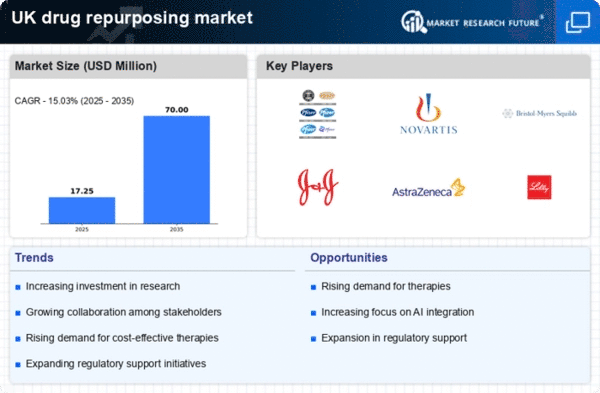
As per Market Research Future analysis, the UK drug repurposing market size was estimated at 15.0 USD Million in 2024. The UK drug repurposing market is projected to grow from 17.25 USD Million in 2025 to 70.0 USD Million by 2035, exhibiting a compound annual growth rate (CAGR) of 15.0% during the forecast period 2025 - 2035

Key Market Trends & Highlights

The UK The UK drug repurposing market is poised for growth, driven by collaboration and technological advancements.

  • Increased collaboration between academia and industry is shaping the landscape of drug repurposing.
  • Regulatory support is enhancing the approval process for repurposed drugs, fostering innovation.
  • Technological advancements in data analytics are streamlining the identification of new therapeutic uses for existing drugs.
  • Rising healthcare costs and increased patient demand for innovative therapies are key drivers propelling market expansion.

Market Size & Forecast

2024 Market Size 15.0 (USD Million)
2035 Market Size 70.0 (USD Million)
CAGR (2025 - 2035) 15.03%

Major Players

Pfizer Inc (US), Novartis AG (CH), Bristol-Myers Squibb Company (US), Johnson & Johnson (US), AstraZeneca PLC (GB), Eli Lilly and Company (US), Gilead Sciences Inc (US), Amgen Inc (US)

Our Impact
Enabled $4.3B Revenue Impact for Fortune 500 and Leading Multinationals
Partnering with 2000+ Global Organizations Each Year
30K+ Citations by Top-Tier Firms in the Industry

UK Drug Repurposing Market Trends

The drug repurposing market is currently experiencing notable growth, driven by the increasing need for cost-effective therapeutic solutions. This approach allows existing medications to be utilized for new indications, thereby reducing the time and resources typically required for drug development. The UK has been at the forefront of this trend, with various initiatives aimed at fostering innovation in pharmaceutical research. Regulatory bodies are actively encouraging the exploration of off-label uses for established drugs, which may lead to quicker patient access to effective treatments. Furthermore, collaborations between academic institutions and pharmaceutical companies are becoming more prevalent, enhancing the potential for successful repurposing efforts. In addition, the drug repurposing market is benefiting from advancements in technology, particularly in data analytics and artificial intelligence. These tools facilitate the identification of potential new uses for existing drugs, streamlining the research process. The UK government has recognized the importance of this sector, providing funding and support for projects that aim to repurpose drugs for various diseases. As the market evolves, it appears that the focus will increasingly shift towards personalized medicine, where tailored treatments based on individual patient profiles may become the norm. This shift could further enhance the efficacy of repurposed drugs, making them a vital component of future healthcare strategies.

Increased Collaboration

There is a growing trend of partnerships between academic institutions and pharmaceutical companies, aimed at enhancing drug repurposing efforts. These collaborations leverage shared expertise and resources, potentially leading to innovative therapeutic solutions.

Regulatory Support

Regulatory bodies in the UK are increasingly promoting the exploration of off-label drug uses. This support may expedite the approval process for repurposed medications, facilitating quicker access for patients.

Technological Advancements

The integration of advanced technologies, such as artificial intelligence and data analytics, is transforming the drug repurposing market. These innovations assist in identifying new therapeutic applications for existing drugs, streamlining research and development.

UK Drug Repurposing Market Drivers

Rising Healthcare Costs

The escalating costs associated with healthcare in the UK are driving interest in the drug repurposing market. As the National Health Service (NHS) faces budget constraints, there is a pressing need for cost-effective treatment options. Drug repurposing offers a viable solution, as it can significantly reduce the time and financial investment required for drug development. By utilizing existing drugs for new therapeutic indications, the drug repurposing market can potentially lower the average cost of bringing a new treatment to market, which can exceed £1 billion. This financial incentive is likely to encourage pharmaceutical companies and healthcare providers to explore repurposed drugs as a means to alleviate the burden of rising healthcare expenses.

Advancements in Data Analytics

The emergence of advanced data analytics tools is transforming the drug repurposing market in the UK. These tools enable researchers to analyze vast datasets, identifying potential new uses for existing drugs more efficiently. By leveraging machine learning and artificial intelligence, researchers can uncover novel therapeutic applications that may have previously gone unnoticed. This technological advancement is likely to enhance the drug repurposing process, making it more efficient and cost-effective. As a result, the drug repurposing market may experience accelerated growth, as companies harness these innovations to bring repurposed drugs to market more rapidly.

Supportive Regulatory Environment

The regulatory landscape in the UK is becoming increasingly supportive of drug repurposing initiatives. Regulatory bodies, such as the Medicines and Healthcare products Regulatory Agency (MHRA), are recognizing the value of repurposed drugs in addressing public health challenges. This supportive environment is likely to facilitate faster approval processes and streamlined pathways for repurposed drugs, thereby enhancing their market viability. The drug repurposing market benefits from this trend, as it can lead to quicker access to innovative therapies for patients. The potential for reduced regulatory hurdles may encourage more companies to invest in drug repurposing projects, further driving market expansion.

Collaboration Between Academia and Industry

There is a notable trend of collaboration between academic institutions and the pharmaceutical industry in the UK, particularly in the drug repurposing market. These partnerships are fostering innovation and facilitating the sharing of knowledge and resources. Academic researchers often possess valuable insights into drug mechanisms and potential new applications, while industry partners bring expertise in drug development and commercialization. This synergy is likely to enhance the drug repurposing process, leading to the identification of new therapeutic uses for existing drugs. As these collaborations continue to grow, the drug repurposing market may benefit from increased investment and a more robust pipeline of repurposed therapies.

Increased Patient Demand for Innovative Therapies

There is a growing demand among patients in the UK for innovative therapies that can address unmet medical needs. The drug repurposing market is well-positioned to meet this demand, as it allows for the rapid introduction of new treatment options based on existing medications. Patients are increasingly seeking alternatives to traditional therapies, particularly for chronic and complex conditions. This shift in patient expectations is likely to drive investment in the drug repurposing market, as healthcare providers and pharmaceutical companies aim to deliver effective solutions that resonate with patient needs. Improved patient outcomes through repurposed drugs may further stimulate market growth.

Market Segment Insights

By Type: Disease-centric (Largest) vs. Target-centric (Fastest-Growing)

In the UK drug repurposing market, the distribution among segment values reveals Disease-centric approaches dominating the landscape. This segment capitalizes on existing drug effectiveness for various diseases, leveraging historical data and clinical experiences. Following closely, the Target-centric approach is gaining traction, focusing on specific biological targets which fosters innovative treatments and broader therapeutic applications. Simultaneously, the Drug-centric segment remains relevant, although it holds a minor share compared to the other two.

Disease-centric: Dominant vs. Target-centric: Emerging

The Disease-centric segment has established itself as the dominant player in the UK drug repurposing market, primarily due to its established methodology and familiarity within the pharmaceutical community. This approach allows for quicker identification of potential uses for existing drugs, emphasizing patient-centric strategies and optimizing resource allocation. Conversely, the Target-centric segment is emerging as a pivotal player by emphasizing precision medicine and simultaneous targeting of multiple pathways. This robust innovation provides an adaptive and flexible framework to meet evolving healthcare challenges, potentially reshaping treatment paradigms across a spectrum of diseases.

By Therapeutic Area: Same Therapeutic Area (Largest) vs. Different Therapeutic Area (Fastest-Growing)

In the UK drug repurposing market, there is a clear preference for the Same Therapeutic Area, which has carved out the largest share. This preference is due to its familiarity and established protocols in clinical applications. This segment benefits from existing market dynamics and regulatory frameworks that promote further exploration of therapies within the same therapeutic background, driving significant utilization among healthcare professionals. Conversely, the Different Therapeutic Area segment is recognized as the fastest-growing, fueled by innovative research and a push towards solving unmet medical needs. The increasing collaboration among biopharmaceutical companies and academic institutions in exploring new uses for existing drugs is driving this growth. Factors such as the need for cost-effective treatments and the leveraging of advanced technologies are enhancing the potential of this segment.

Therapeutic Area: Same vs. Different (Dominant vs. Emerging)

The Same Therapeutic Area segment stands out as the dominant player in the UK drug repurposing market, benefiting from its leverage of existing therapeutic knowledge to repurpose drugs effectively. This segment typically involves minimal risk and provides a quicker path to market acceptance as practitioners are accustomed to these therapies. On the other hand, the Different Therapeutic Area segment is emerging rapidly, with increasing attention from researchers looking to repurpose drugs for new indications. This shift is primarily driven by the increasing demand for personalized medicine and the rising costs of drug development, prompting a reevaluation of existing treatments for novel applications.

By Drug Molecules: Biologics (Largest) vs. Small Molecule (Fastest-Growing)

In the UK drug repurposing market, the distribution of market share between biologics and small molecules is distinct. Biologics hold the largest share owing to their complexity and efficacy in treating various diseases, driving significant interest from researchers and pharmaceutical companies. Conversely, small molecules are gaining traction and represent a growing segment of the market as advancements in synthetic biology and medicinal chemistry enhance their development and application. The growth trends in this segment are influenced by several factors, including increasing availability of clinical data supporting repurposing initiatives and advancements in biopharmaceutical technologies. The shift towards personalized medicine and the need for innovative therapeutic solutions are also propelling both biologics and small molecules as vital components for addressing unmet medical needs. The emphasis on cost-effectiveness and rapid deployment in drug development further accentuates the importance of small molecules in the market.

Biologics (Dominant) vs. Small Molecule (Emerging)

Biologics dominate the UK drug repurposing market due to their ability to target specific biological pathways, making them effective for complex diseases with significant therapeutic potential. Their sophisticated manufacturing processes and high efficacy rates have led to substantial investment in research and development. In contrast, small molecules are emerging as crucial players in this landscape, characterized by lower production costs and quicker development timelines. Their versatility in drug formulation allows for innovative applications and adaptation to various therapeutic areas. As regulators and healthcare providers increasingly favor drugs that combine efficacy with cost-effectiveness, small molecules are positioned to carve out a more significant market share, complementing the established dominance of biologics.

Get more detailed insights about UK Drug Repurposing Market

Key Players and Competitive Insights

The drug repurposing market in the UK is characterized by a dynamic competitive landscape, driven by the need for cost-effective therapeutic solutions and accelerated drug development timelines. Major players such as AstraZeneca PLC (GB), Pfizer Inc (US), and Novartis AG (CH) are strategically positioned to leverage their extensive research capabilities and established market presence. AstraZeneca PLC (GB) focuses on innovative partnerships and collaborations, particularly in oncology and respiratory diseases, which enhances its portfolio through repurposed drugs. Pfizer Inc (US) emphasizes digital transformation and data analytics to streamline its drug repurposing efforts, while Novartis AG (CH) is actively pursuing mergers and acquisitions to bolster its pipeline with repurposed therapies, thereby shaping a competitive environment that prioritizes innovation and strategic alliances.The market structure appears moderately fragmented, with a blend of large pharmaceutical companies and smaller biotech firms. Key players are adopting various business tactics, such as localizing manufacturing and optimizing supply chains, to enhance operational efficiency and reduce costs. This collective influence of major companies fosters a competitive atmosphere where agility and responsiveness to market demands are crucial for success.

In October AstraZeneca PLC (GB) announced a collaboration with a leading academic institution to explore the repurposing of existing drugs for the treatment of rare genetic disorders. This strategic move not only diversifies AstraZeneca's therapeutic offerings but also underscores its commitment to addressing unmet medical needs through innovative research. The partnership is expected to accelerate the development timeline for new indications, thereby enhancing AstraZeneca's competitive edge in the market.

In September Pfizer Inc (US) launched a new initiative aimed at utilizing artificial intelligence (AI) to identify potential candidates for drug repurposing. This initiative is significant as it positions Pfizer at the forefront of technological integration in drug development, potentially leading to faster identification of viable therapies. The use of AI could streamline the repurposing process, allowing Pfizer to respond more swiftly to emerging health challenges and market opportunities.

In August Novartis AG (CH) completed the acquisition of a biotech firm specializing in drug repurposing technologies. This acquisition is pivotal as it enhances Novartis's capabilities in identifying and developing new uses for existing drugs, thereby expanding its therapeutic portfolio. The integration of advanced technologies from the acquired firm is likely to bolster Novartis's competitive positioning in the market, enabling it to deliver innovative solutions more efficiently.

As of November current trends in the drug repurposing market are increasingly defined by digitalization, sustainability, and the integration of AI technologies. Strategic alliances among key players are shaping the landscape, fostering collaboration that enhances research capabilities and accelerates drug development. Looking ahead, competitive differentiation is expected to evolve, with a shift from price-based competition to a focus on innovation, technological advancements, and supply chain reliability. This transition may redefine how companies approach drug repurposing, emphasizing the importance of agility and responsiveness in a rapidly changing market.

Key Companies in the UK Drug Repurposing Market include

Industry Developments

Recent developments in the UK Drug Repurposing Market have seen significant activity, particularly among major pharmaceutical companies such as AstraZeneca, Roche, and GlaxoSmithKline. In September 2023, AstraZeneca announced a collaboration with a UK-based biotechnology firm to explore new applications for existing drugs in treating rare diseases, demonstrating a growing interest in the repurposing approach within the sector.

Additionally, Roche has ramped up its Research and Development investments focused on leveraging existing therapies for new indications, aiming to address unmet medical needs in oncology.Merger and acquisition trends have also shaped the landscape, with Merck acquiring a smaller biotech firm in August 2023 to enhance its repurposing pipeline. 

The growth in market valuation for companies like Pfizer and Johnson and Johnson, particularly in the context of their ongoing research into leveraging existing drugs for conditions like Alzheimer’s and COVID-19, signals a robust interest and potential profitability in the repurposing strategy. Over the past two years, various pharmaceutical companies, including Amgen and Bristol Myers Squibb, have consistently explored drug repurposing, resulting in clinical trials and partnerships that continuously reshape the UK drug market landscape.

Future Outlook

UK Drug Repurposing Market Future Outlook

The Drug Repurposing Market is projected to grow at a 15.03% CAGR from 2025 to 2035, driven by technological advancements, regulatory support, and increasing healthcare costs.

New opportunities lie in:

  • Development of AI-driven drug screening platforms
  • Partnerships with biotech firms for clinical trials
  • Expansion into personalized medicine applications

By 2035, the market is expected to achieve substantial growth and innovation.

Market Segmentation

UK Drug Repurposing Market Type Outlook

  • Disease-centric
  • Target-centric
  • Drug-centric

UK Drug Repurposing Market Drug Molecules Outlook

  • Biologics
  • Small Molecule

UK Drug Repurposing Market Therapeutic Area Outlook

  • Same Therapeutic Area
  • Different Therapeutic Area

Report Scope

MARKET SIZE 202415.0(USD Million)
MARKET SIZE 202517.25(USD Million)
MARKET SIZE 203570.0(USD Million)
COMPOUND ANNUAL GROWTH RATE (CAGR)15.03% (2025 - 2035)
REPORT COVERAGERevenue Forecast, Competitive Landscape, Growth Factors, and Trends
BASE YEAR2024
Market Forecast Period2025 - 2035
Historical Data2019 - 2024
Market Forecast UnitsUSD Million
Key Companies ProfiledPfizer Inc (US), Novartis AG (CH), Bristol-Myers Squibb Company (US), Johnson & Johnson (US), AstraZeneca PLC (GB), Eli Lilly and Company (US), Gilead Sciences Inc (US), Amgen Inc (US)
Segments CoveredType, Therapeutic Area, Drug Molecules
Key Market OpportunitiesEmerging technologies enhance drug repurposing efficiency, addressing unmet medical needs and regulatory challenges.
Key Market DynamicsGrowing emphasis on regulatory compliance drives innovation in the drug repurposing market, enhancing competitive dynamics.
Countries CoveredUK
Leave a Comment

FAQs

What is the expected market size of the UK Drug Repurposing Market in 2024?

The UK Drug Repurposing Market is expected to be valued at 12.68 million USD in 2024.

What will the UK Drug Repurposing Market be valued at in 2035?

By 2035, the market is anticipated to reach a value of 53.34 million USD.

What is the projected compound annual growth rate (CAGR) for the UK Drug Repurposing Market from 2025 to 2035?

The expected CAGR for this market from 2025 to 2035 is 13.955 percent.

Which types of drug repurposing will contribute significantly to the market by 2035?

By 2035, the Disease-centric type is projected to be valued at 19.2 million USD and the Target-centric type at 16.5 million USD.

Who are the key players operating in the UK Drug Repurposing Market?

Major players in the market include AstraZeneca, Roche, Merck, Amgen, and Johnson & Johnson, among others.

What challenges and opportunities exist in the UK Drug Repurposing Market?

The market presents opportunities through innovation in drug development while facing challenges such as regulatory hurdles and competition.

How is the UK Drug Repurposing Market expected to grow in specific segments by 2035?

The Drug-centric segment is projected to grow to 17.6 million USD by 2035, demonstrating significant potential.

What factors are driving the growth of the UK Drug Repurposing Market?

Factors driving growth include the need for cost-effective treatments and increased research on existing drugs for new indications.

What is the market outlook for the UK Drug Repurposing Market amid current global conditions?

The market outlook remains positive as demand for innovative therapeutic solutions continues to rise despite global challenges.

Which market segment is anticipated to have the largest share by 2035?

The Disease-centric segment is expected to command the largest share by achieving a value of 19.2 million USD by 2035.

Download Free Sample

Kindly complete the form below to receive a free sample of this Report

Compare Licence

×
Features License Type
Single User Multiuser License Enterprise User
Price $4,950 $5,950 $7,250
Maximum User Access Limit 1 User Upto 10 Users Unrestricted Access Throughout the Organization
Free Customization
Direct Access to Analyst
Deliverable Format
Platform Access
Discount on Next Purchase 10% 15% 15%
Printable Versions