×
Request Free Sample ×

Kindly complete the form below to receive a free sample of this Report

* Please use a valid business email

Leading companies partner with us for data-driven Insights

clients tt-cursor
Hero Background

UK Data Governance Market

ID: MRFR/ICT/58248-HCR
200 Pages
Aarti Dhapte
February 2026

UK Data Governance Market Research Report By Solution (Data Quality Management, Data Catalogs, Data Security, Master Data Management, Data Integration), By Deployment Type (On-Premises, Cloud-Based, Hybrid), By Industry Vertical (Banking, Financial Services, Insurance, Healthcare, Retail, Information Technology, Telecommunications) and By Organization Size (Small Enterprises, Medium Enterprises, Large Enterprises) - Forecast to 2035

Share:
Download PDF ×

We do not share your information with anyone. However, we may send you emails based on your report interest from time to time. You may contact us at any time to opt-out.

UK Data Governance Market Infographic
Purchase Options

UK Data Governance Market Summary

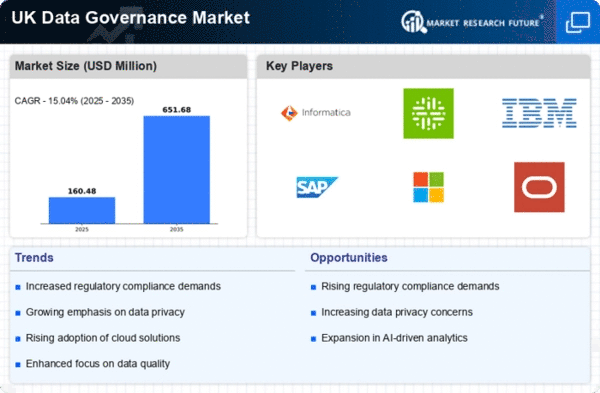
As per analysis, the UK data governance market Size was estimated at 139.5 USD Million in 2024. The UK data governance market is projected to grow from 160.48 USD Million in 2025 to 651.68 USD Million by 2035, exhibiting a compound annual growth rate (CAGR) of 15.0% during the forecast period 2025 - 2035

Key Market Trends & Highlights

The UK The UK data governance market is experiencing robust growth. This growth is driven by regulatory compliance and technological advancements.

  • Regulatory compliance remains a primary focus for organizations in the UK data governance market.
  • Automation and AI integration are increasingly being adopted to enhance data management processes.
  • The demand for high-quality data is driving investments in data governance solutions across various sectors.
  • Rising data privacy concerns and increased regulatory scrutiny are key drivers propelling market growth.

Market Size & Forecast

2024 Market Size 139.5 (USD Million)
2035 Market Size 651.68 (USD Million)
CAGR (2025 - 2035) 15.04%

Major Players

Informatica (US), Collibra (BE), IBM (US), SAP (DE), Microsoft (US), Oracle (US), Alation (US), Talend (FR), DataRobot (US)

Our Impact
Enabled $4.3B Revenue Impact for Fortune 500 and Leading Multinationals
Partnering with 2000+ Global Organizations Each Year
30K+ Citations by Top-Tier Firms in the Industry

UK Data Governance Market Trends

The data governance market is currently experiencing a transformative phase. This transformation is driven by the increasing need for organizations to manage their data assets effectively. As businesses generate vast amounts of data, the importance of establishing robust governance frameworks becomes evident. This market is characterized by a growing emphasis on compliance with regulations, such as the General Data Protection Regulation (GDPR), which mandates strict data handling practices. Organizations are investing in technologies and solutions that enhance data quality, security, and accessibility, thereby fostering a culture of accountability and transparency. Furthermore, the rise of data-driven decision-making is propelling the demand for comprehensive governance strategies that align with business objectives. In addition, the data governance market is witnessing a shift towards automation and artificial intelligence. These technologies are being integrated into governance processes to streamline operations and reduce human error. As organizations seek to optimize their data management practices, the adoption of advanced analytics tools is becoming increasingly prevalent. This trend not only improves efficiency but also enables organizations to derive actionable insights from their data. Overall, the data governance market is poised for continued growth as businesses recognize the critical role of effective data management in achieving strategic goals.

Regulatory Compliance

Regulatory compliance emphasis is intensifying within the data governance market. Organizations are compelled to adhere to stringent regulations, which necessitate the implementation of comprehensive governance frameworks. This trend is particularly pronounced in sectors such as finance and healthcare, where data protection is paramount. Companies are increasingly investing in solutions that ensure compliance, thereby mitigating risks associated with data breaches and legal penalties.

Automation and AI Integration

Automation and artificial intelligence integration into data governance practices is gaining traction. Organizations are leveraging these technologies to enhance efficiency and accuracy in data management processes. By automating routine tasks, businesses can focus on strategic initiatives while minimizing the potential for human error. This trend is likely to reshape the landscape of data governance, making it more agile and responsive.

Focus on Data Quality

There is a growing recognition of the importance of data quality within the data governance market. Organizations are prioritizing initiatives that enhance the accuracy, consistency, and reliability of their data assets. This focus on quality is driven by the need for informed decision-making and effective risk management. As a result, businesses are adopting frameworks and tools that facilitate continuous monitoring and improvement of data quality.

UK Data Governance Market Drivers

Rising Data Privacy Concerns

The increasing awareness of data privacy issues among consumers and businesses is driving the data governance market. In the UK, recent surveys indicate that over 70% of individuals express concerns regarding how their personal data is managed. This heightened sensitivity compels organisations to adopt robust data governance frameworks to ensure compliance with regulations such as the Data Protection Act. As a result, the data governance market is experiencing growth, with estimates suggesting a potential increase of 15% annually. Companies are investing in solutions that enhance transparency and accountability in data handling, thereby fostering trust with their customers. This trend indicates a shift towards prioritising data privacy, which is likely to shape the future landscape of the data governance market in the UK.

Increased Regulatory Scrutiny

The data governance market is significantly influenced by the growing regulatory scrutiny faced by organisations in the UK. Regulatory bodies are intensifying their focus on data management practices, leading to stricter compliance requirements. For instance, the Information Commissioner's Office (ICO) has ramped up enforcement actions, resulting in fines exceeding £20 million for non-compliance. This environment compels businesses to invest in comprehensive data governance strategies to mitigate risks associated with regulatory breaches. The market is projected to expand as organisations seek to implement solutions that not only comply with existing regulations but also anticipate future legislative changes. Consequently, the data governance market is likely to see a surge in demand for compliance-oriented tools and services.

Growing Demand for Data Analytics

The surge in data analytics adoption across various sectors is propelling the data governance market. As organisations in the UK increasingly rely on data-driven decision-making, the need for effective data governance becomes paramount. A recent report indicates that 65% of UK businesses are prioritising data analytics initiatives, which necessitate robust governance frameworks to ensure data integrity and quality. This trend suggests that organisations are recognising the value of data as a strategic asset, leading to investments in governance solutions that facilitate accurate analytics. The data governance market is expected to grow as companies seek to align their data management practices with their analytical objectives, thereby enhancing overall business performance.

Emergence of Cloud-Based Solutions

The shift towards cloud-based solutions is reshaping the data governance market in the UK. As organisations migrate their data to cloud environments, the complexities of data management increase, necessitating effective governance strategies. Cloud service providers are offering tools that integrate data governance capabilities, which are becoming essential for businesses to maintain control over their data assets. This trend is reflected in the market, with cloud-based data governance solutions projected to account for over 40% of the total market share by 2026. The flexibility and scalability of cloud solutions are appealing to organisations, prompting them to invest in governance frameworks that can adapt to evolving data landscapes. This evolution indicates a significant transformation in how data governance is approached in the UK.

Focus on Data Lifecycle Management

Data lifecycle management emphasis is becoming a critical driver for the data governance market. Organisations in the UK are increasingly recognising the importance of managing data throughout its lifecycle, from creation to deletion. This focus is driven by the need to optimise data usage, reduce storage costs, and ensure compliance with data retention policies. As a result, businesses are investing in governance solutions that provide visibility and control over data assets at every stage. The data governance market is likely to benefit from this trend, with projections indicating a growth rate of approximately 12% annually as organisations seek to implement effective lifecycle management practices. This shift underscores the evolving nature of data governance in the context of comprehensive data management strategies.


Market Segment Insights

By Solution: Data Quality Management (Largest) vs. Data Catalogs (Fastest-Growing)

In the UK data governance market, Data Quality Management holds the largest market share, reflecting its critical role in ensuring accurate and reliable data for organizations. Meanwhile, Data Catalogs are emerging rapidly, catering to the increasing demand for robust data asset management solutions. As businesses recognize the importance of effective data governance, the distribution among these solutions shows a distinct trend toward prioritizing data quality while embracing innovative cataloging tools. Key growth trends are being driven by the rising emphasis on compliance and regulatory requirements in data management. Companies are investing heavily in data governance strategies, enabling them to enhance data quality, security, and integration across various platforms. The increasing complexity of data environments is also pushing organizations toward adopting Data Catalogs as they seek efficient ways to manage, discover, and utilize their data assets, further fueling growth in this sector.

Data Quality Management (Dominant) vs. Data Integration (Emerging)

Data Quality Management stands as the dominant solution in the landscape of the UK data governance market, reflecting its indispensable role in maintaining data integrity and reliability across organizations. This segment is focused on identifying and rectifying data inaccuracies, ensuring that businesses can trust their data for decision-making. In contrast, Data Integration is gaining traction as an emerging solution, driven by the need for seamless connectivity among disparate data sources. As organizations increasingly adopt cloud-based solutions, the demand for Data Integration tools is surging, enabling them to unify data streams efficiently. The interplay between these solutions showcases a comprehensive approach to data governance, where quality and integration collectively enhance overall data utility.

By Deployment Type: Cloud-Based (Largest) vs. Hybrid (Fastest-Growing)

In the UK data governance market, deployment types are vital to understanding organizational needs. Currently, cloud-based solutions dominate the landscape, capturing a substantial share of the market. This strong preference is driven by their flexibility, scalability, and cost-effectiveness, making them the go-to choice for many enterprises. Conversely, on-premises solutions account for a smaller segment, reflecting a shift toward modernized approaches that favor remote accessibility and reduced infrastructure maintenance. The shift toward hybrid deployments is notable in recent trends, indicating a growing desire for integrated solutions that combine cloud benefits with the security of on-premises systems. Factors such as the rising emphasis on data security regulations, coupled with the increasing adoption of cloud technologies, are driving this transition. Organizations are seeking to balance control and convenience by implementing hybrid solutions, thus fostering significant growth in this segment.

Cloud-Based (Dominant) vs. Hybrid (Emerging)

Cloud-based deployment stands as the dominant choice in the UK data governance market, reflecting a robust demand for agile and scalable solutions. Organizations appreciate the ease of integration, reduced costs, and enhanced collaboration offered by cloud technologies. On the other hand, hybrid deployment is emerging as a compelling option for businesses looking to merge the benefits of cloud flexibility with the reliability of on-premises systems. As data governance demands evolve, hybrid solutions are gaining traction, driven by the need for security and compliance, which aligns well with modern business strategies. This dual approach enables organizations to customize their data governance frameworks, tailoring them to specific operational needs while accommodating growth and regulatory requirements.

By Industry Vertical: Banking (Largest) vs. Healthcare (Fastest-Growing)

In the UK data governance market, the distribution of market share among industry verticals presents a clear hierarchy. Banking holds the largest share as organizations in this sector prioritize compliance and data integrity, making significant investments in data governance solutions. Meanwhile, the Financial Services and Telecommunications segments follow, driven by regulatory demands and data-driven decision-making. Retail and Insurance sectors are also contributing notable shares, albeit smaller compared to Banking. Growth trends in the UK data governance market indicate a significant uptick in the Healthcare sector, which is now recognized as the fastest-growing segment. Increased regulatory scrutiny and the demand for secure patient data management are primary drivers for this growth. Additionally, advancements in technology and a rising focus on data analytics across all sectors are pushing organizations to adopt robust data governance frameworks, ensuring data accuracy and security, which increasingly becomes a competitive differentiator in the market.

Banking: Financial Services (Dominant) vs. Healthcare (Emerging)

The Banking sector stands out as the dominant player in the UK data governance market, characterized by stringent regulatory requirements and an unwavering focus on safeguarding sensitive financial data. Banks are investing heavily in advanced data governance solutions to maintain compliance and minimize risks associated with data breaches. Conversely, the Healthcare sector, while currently emerging, shows remarkable growth potential due to increasing regulations such as GDPR and heightened awareness regarding data privacy. Healthcare organizations are now prioritizing data governance as a core component of their operational strategy, seeking to enhance patient trust and streamline data management processes. This contrast between the two segments showcases the dynamic landscape of the UK data governance market, where evolving regulatory frameworks are shaping organizational priorities.

By Organization Size: Medium Enterprises (Largest) vs. Small Enterprises (Fastest-Growing)

The UK data governance market is primarily dominated by medium enterprises, which hold a significant market share due to their intricate data management needs and compliance requirements. Medium enterprises typically have the resources to invest in comprehensive data governance solutions, making them essential players in the overall market landscape. In contrast, small enterprises are witnessing rapid growth as they increasingly recognize the value of data governance in enhancing operational efficiency and regulatory compliance. Growth trends show that small enterprises are the fastest-growing segment as they adopt data governance frameworks to better manage their data and mitigate risks associated with data breaches. This growth is driven by the increasing prevalence of data privacy regulations and the need for improved data quality. As these businesses scale, their demand for advanced data governance solutions will likely continue, leading to an even larger overall market share in the coming years.

Medium Enterprises: Dominant vs. Small Enterprises: Emerging

Medium enterprises in the UK data governance market are characterized by their ability to allocate substantial budgets for data governance tools and initiatives, allowing for effective data quality management and regulatory compliance. These companies often have specialized teams dedicated to managing data governance, which enhances their capability to navigate complex data landscapes. On the other hand, small enterprises, while currently emerging, are quickly adapting to the changing market dynamics. They tend to be agile and innovative, embracing technology solutions that help them establish robust data governance practices. As more small enterprises recognize the need for effective data governance, their market position will continue to strengthen, paving the way for increased competition with larger organizations.

Get more detailed insights about UK Data Governance Market

Key Players and Competitive Insights

The data governance market is currently characterized by a dynamic competitive landscape, driven by the increasing need for organizations to manage data effectively and comply with regulatory requirements. Key players such as Informatica (US), IBM (US), and Microsoft (US) are at the forefront, leveraging their technological prowess to enhance data management capabilities. These companies are focusing on innovation and strategic partnerships to solidify their market positions. For instance, Informatica (US) emphasizes cloud-based solutions, while IBM (US) integrates AI into its offerings, indicating a collective shift towards advanced technological solutions that shape the competitive environment.The market structure appears moderately fragmented, with several players vying for dominance. Key business tactics include localizing services to meet regional demands and optimizing supply chains to enhance efficiency. This competitive structure allows for a diverse range of solutions, catering to various organizational needs. The influence of major players is significant, as their strategies often set industry standards and drive innovation across the sector.

In October Microsoft (US) announced a strategic partnership with a leading UK-based data analytics firm to enhance its data governance solutions. This collaboration aims to integrate advanced analytics capabilities into Microsoft's existing offerings, thereby providing clients with more robust data management tools. The strategic importance of this partnership lies in its potential to expand Microsoft's market reach and enhance its competitive edge in the UK.

In September IBM (US) launched a new suite of AI-driven data governance tools designed to streamline compliance processes for organizations. This initiative reflects IBM's commitment to integrating cutting-edge technology into its data governance framework. The launch is strategically significant as it positions IBM as a leader in AI-enhanced data solutions, appealing to organizations seeking to navigate complex regulatory landscapes.

In August Informatica (US) unveiled a comprehensive data governance platform that incorporates machine learning capabilities. This platform aims to automate data quality assessments and improve data lineage tracking. The strategic relevance of this development is profound, as it not only enhances Informatica's product offerings but also addresses the growing demand for automated solutions in data governance, thereby reinforcing its competitive position.

As of November current trends in the data governance market include a pronounced focus on digitalization, sustainability, and the integration of AI technologies. Strategic alliances are increasingly shaping the competitive landscape, enabling companies to pool resources and expertise. Looking ahead, it is likely that competitive differentiation will evolve, with a shift from price-based competition to a focus on innovation, technological advancement, and supply chain reliability. This transition underscores the importance of agility and responsiveness in a rapidly changing market.

Key Companies in the UK Data Governance Market include

Industry Developments

Recent developments in the UK Data Governance Market indicate a significant acceleration in the adoption of data governance solutions as organizations increasingly prioritize data integrity and compliance with regulations such as the UK General Data Protection Regulation (GDPR). In September 2023, Alation and IBM announced a strategic partnership aimed at enhancing data catalog capabilities, which is expected to strengthen their positions in the UK market. Additionally, Informatica revealed its plans to expand data governance offerings to assist UK companies in streamlining data management processes and achieving compliance effectively.

According to industry sources, the market valuation for data governance is projected to grow considerably, with a notable increase in investments from firms like Microsoft and SAP towards cloud-based data governance solutions. 

In July 2022, the UK government launched a strategy to foster data-driven technologies, further fueling demand for robust data governance strategies. Furthermore, Talend and OneTrust have also expanded their operations in the UK, reinforcing the growing competitive landscape as organizations strive to maximize the value of their data while adhering to regulatory requirements. The momentum in this sector presents unique opportunities for key players to innovate and enhance their service offerings.

Future Outlook

UK Data Governance Market Future Outlook

The data governance market is projected to grow at a 15.04% CAGR from 2025 to 2035. This growth is driven by regulatory compliance, data quality management, and increasing data volumes.

New opportunities lie in:

  • Development of AI-driven data classification tools
  • Expansion of cloud-based data governance solutions
  • Implementation of automated compliance monitoring systems

By 2035, the data governance market is expected to be robust, driven by innovation and strategic investments.

Market Segmentation

UK Data Governance Market Solution Outlook

  • Data Quality Management
  • Data Catalogs
  • Data Security
  • Master Data Management
  • Data Integration

UK Data Governance Market Deployment Type Outlook

  • On-Premises
  • Cloud-Based
  • Hybrid

UK Data Governance Market Industry Vertical Outlook

  • Banking
  • Financial Services
  • Insurance
  • Healthcare
  • Retail
  • Information Technology
  • Telecommunications

UK Data Governance Market Organization Size Outlook

  • Small Enterprises
  • Medium Enterprises
  • Large Enterprises

Report Scope

MARKET SIZE 2024 139.5(USD Million)
MARKET SIZE 2025 160.48(USD Million)
MARKET SIZE 2035 651.68(USD Million)
COMPOUND ANNUAL GROWTH RATE (CAGR) 15.04% (2025 - 2035)
REPORT COVERAGE Revenue Forecast, Competitive Landscape, Growth Factors, and Trends
BASE YEAR 2024
Market Forecast Period 2025 - 2035
Historical Data 2019 - 2024
Market Forecast Units USD Million
Key Companies Profiled Informatica (US), Collibra (BE), IBM (US), SAP (DE), Microsoft (US), Oracle (US), Alation (US), Talend (FR), DataRobot (US)
Segments Covered Solution, Deployment Type, Industry Vertical, Organization Size
Key Market Opportunities Increasing regulatory compliance demands drive growth in the data governance market.
Key Market Dynamics Growing regulatory scrutiny drives demand for robust data governance frameworks in the UK market.
Countries Covered UK
Leave a Comment

FAQs

What is the expected market size of the UK Data Governance Market in 2024?

The UK Data Governance Market is expected to be valued at 141.0 million USD in 2024.

What will be the market size of the UK Data Governance Market by 2035?

By 2035, the UK Data Governance Market is projected to grow to 706.0 million USD.

What is the expected CAGR for the UK Data Governance Market from 2025 to 2035?

The expected CAGR for the UK Data Governance Market from 2025 to 2035 is 15.771%.

Which solution segment in the UK Data Governance Market is projected to grow the most from 2024 to 2035?

The Data Quality Management segment is expected to grow from 30.0 million USD in 2024 to 150.0 million USD by 2035.

What is the forecasted market value of the Data Security segment in 2035?

The Data Security segment is projected to be valued at 175.0 million USD in 2035.

Who are the key players in the UK Data Governance Market?

Major players in the UK's Data Governance Market include SAP, Alation, Informatica, Varonis, and Microsoft.

What is the anticipated market size for Data Integration by 2035?

The Data Integration segment is expected to reach 131.0 million USD in market size by 2035.

How much will the Data Catalogs segment be worth in 2035?

The Data Catalogs segment is anticipated to be valued at 125.0 million USD in 2035.

What challenges might the UK Data Governance Market face in the coming years?

The UK Data Governance Market may face challenges related to regulatory compliance and data privacy issues.

What is a key emerging trend in the UK Data Governance Market?

An important emerging trend is the increasing emphasis on data security and privacy regulations in data governance.

Download Free Sample

Kindly complete the form below to receive a free sample of this Report

Compare Licence

×
Features License Type
Single User Multiuser License Enterprise User
Price $4,950 $5,950 $7,250
Maximum User Access Limit 1 User Upto 10 Users Unrestricted Access Throughout the Organization
Free Customization
Direct Access to Analyst
Deliverable Format
Platform Access
Discount on Next Purchase 10% 15% 15%
Printable Versions