×
Request Free Sample ×

Kindly complete the form below to receive a free sample of this Report

* Please use a valid business email

Leading companies partner with us for data-driven Insights

clients tt-cursor
Hero Background

UK Custom Antibody Market

ID: MRFR/HC/51846-HCR
200 Pages
Rahul Gotadki
February 2026

UK Custom Antibody Market Research Report By Service (Antibody Development, Antibody Production & Purification, Antibody Fragmentation & Labelling), By Source (Mice, Others), By Research Area (Oncology, Neurobiology, Infectious Diseases, Immunology, Others), By Type (Monoclonal Antibodies, Polyclonal Antibodies, Recombinant Antibody, Other Custom Antibodies) and By End Users (Hospitals & Clinics, Academic & Research Institute, Contact Research Organization, Biotechnology Companies, Others) - Growth & Industry Forecast 2025 To 2035

Share:
Download PDF ×

We do not share your information with anyone. However, we may send you emails based on your report interest from time to time. You may contact us at any time to opt-out.

UK Custom Antibody Market Infographic
Purchase Options

UK Custom Antibody Market Summary

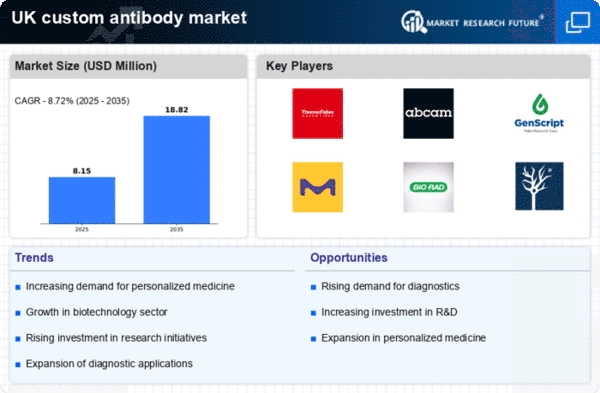
As per Market Research Future analysis, the UK custom antibody market Size was estimated at 7.5 USD Million in 2024. The UK custom antibody market is projected to grow from 8.15 USD Million in 2025 to 18.82 USD Million by 2035, exhibiting a compound annual growth rate (CAGR) of 8.7% during the forecast period 2025 - 2035

Key Market Trends & Highlights

The UK custom antibody market is experiencing robust growth driven by technological advancements and increasing demand for personalized medicine.

  • The largest segment in the UK custom antibody market is therapeutic antibodies, while the fastest-growing segment is diagnostic antibodies.
  • Technological innovations in antibody production are enhancing efficiency and specificity, thereby attracting more investments.
  • There is a notable increase in collaboration between academia and industry, fostering innovation and accelerating product development.
  • Key market drivers include growing investment in biopharmaceuticals and rising prevalence of chronic diseases, which are propelling market expansion.

Market Size & Forecast

2024 Market Size 7.5 (USD Million)
2035 Market Size 18.82 (USD Million)
CAGR (2025 - 2035) 8.72%

Major Players

Thermo Fisher Scientific (US), Abcam (GB), GenScript (CN), Merck KGaA (DE), Bio-Rad Laboratories (US), Cell Signaling Technology (US), Santa Cruz Biotechnology (US), R&D Systems (US), Sigma-Aldrich (US)

Our Impact
Enabled $4.3B Revenue Impact for Fortune 500 and Leading Multinationals
Partnering with 2000+ Global Organizations Each Year
30K+ Citations by Top-Tier Firms in the Industry

UK Custom Antibody Market Trends

The custom antibody market is currently experiencing notable growth, driven by advancements in biotechnology and increasing demand for personalized medicine. The rise in research activities, particularly in the fields of immunology and oncology, has led to a greater need for custom antibodies tailored to specific applications. This trend is further supported by the growing number of academic and research institutions focusing on antibody development, which appears to enhance collaboration between academia and industry. Additionally, the increasing prevalence of chronic diseases necessitates the development of innovative therapeutic solutions, thereby propelling the custom antibody market forward. Moreover, the regulatory landscape in the UK is evolving, with agencies emphasizing the importance of quality and safety in antibody production. This shift may lead to stricter guidelines, which could impact the operational dynamics of companies within the custom antibody market. As organizations strive to comply with these regulations, there is a potential for increased investment in quality assurance processes and technologies. Furthermore, the integration of artificial intelligence and machine learning in antibody design and production processes is likely to streamline operations and improve efficiency, indicating a promising future for the custom antibody market.

Rising Demand for Personalized Medicine

The custom antibody market is witnessing a surge in demand for personalized medicine solutions. This trend is largely driven by advancements in genomics and proteomics, which enable the development of tailored therapies. As healthcare shifts towards more individualized treatment approaches, the need for specific antibodies that target unique biomarkers is becoming increasingly critical.

Technological Innovations in Antibody Production

Innovations in biotechnology are transforming the landscape of antibody production. Techniques such as phage display and hybridoma technology are being refined, leading to more efficient and cost-effective methods for generating custom antibodies. These advancements not only enhance the quality of antibodies but also reduce the time required for their development.

Increased Collaboration Between Academia and Industry

There is a growing trend of collaboration between academic institutions and industry players in the custom antibody market. This partnership fosters knowledge exchange and accelerates the development of novel antibodies. Such collaborations are likely to enhance research capabilities and drive innovation, ultimately benefiting the market as a whole.

UK Custom Antibody Market Drivers

Advancements in Antibody Engineering

Technological advancements in antibody engineering are playing a pivotal role in shaping the custom antibody market. Innovations such as phage display technology and CRISPR gene editing are enabling the development of highly specific and effective antibodies. In the UK, research institutions and biotech companies are increasingly adopting these technologies, which may lead to the creation of next-generation custom antibodies. The custom antibody market is likely to benefit from these advancements, as they enhance the efficiency and precision of antibody production. As a result, the market may witness an influx of novel products that cater to diverse therapeutic needs, further driving growth.

Rising Prevalence of Chronic Diseases

The custom antibody market is significantly influenced by the rising prevalence of chronic diseases in the UK. Conditions such as cancer, autoimmune disorders, and infectious diseases are becoming more common, necessitating the development of targeted therapies. The demand for custom antibodies, which can be tailored to address specific disease mechanisms, is likely to increase as healthcare providers seek more effective treatment options. According to recent statistics, chronic diseases account for approximately 70% of all deaths in the UK, highlighting the urgent need for innovative solutions. This trend is expected to drive growth in the custom antibody market, as pharmaceutical companies focus on developing specialized antibodies to meet the needs of patients.

Growing Investment in Biopharmaceuticals

The custom antibody market is experiencing a surge in investment, particularly within the biopharmaceutical sector. In the UK, biopharmaceuticals are projected to reach a market value of £30 billion by 2025, driven by the increasing need for innovative therapies. This investment is likely to enhance research and development capabilities, leading to the creation of more tailored antibodies. As companies allocate more resources towards biopharmaceuticals, the demand for custom antibodies is expected to rise, facilitating advancements in drug development and therapeutic applications. The custom antibody market is thus positioned to benefit from this influx of capital, which may result in improved production techniques and expanded product offerings.

Regulatory Support for Advanced Therapies

The regulatory landscape in the UK is becoming increasingly supportive of advanced therapies, including those utilizing custom antibodies. Recent initiatives by the Medicines and Healthcare products Regulatory Agency (MHRA) aim to streamline the approval process for innovative treatments. This regulatory support is crucial for the custom antibody market, as it encourages companies to invest in the development of novel therapies. The potential for faster market access may lead to an increase in the number of custom antibodies being developed and commercialized. Consequently, the custom antibody market stands to gain from a more favorable regulatory environment, which could enhance the overall growth trajectory of the sector.

Increased Focus on Research and Development

The custom antibody market is witnessing an increased focus on research and development (R&D) activities, particularly within the UK. With the government and private sector investing heavily in R&D, there is a growing emphasis on developing innovative therapeutic solutions. This trend is reflected in the substantial funding allocated to life sciences research, which reached £1.5 billion in 2025. As a result, the custom antibody market is likely to see a rise in the number of research initiatives aimed at discovering new applications for custom antibodies. This heightened focus on R&D may lead to breakthroughs that not only enhance the efficacy of existing therapies but also pave the way for novel treatment modalities.


Market Segment Insights

By Service: Antibody Development (Largest) vs. Antibody Production & Purification (Fastest-Growing)

In the UK custom antibody market, Antibody Development holds the largest share among service segments, with a significant portion of sales stemming from this category. It serves as the backbone for many research initiatives, driven by advancements in technology and increasing demand for tailored antibody solutions across various sectors. Conversely, Antibody Production & Purification is rapidly gaining traction, reflecting a growing need for scalable production methodologies that enhance efficiency and effectiveness in the market. The growth trajectory of these segments is largely influenced by the increasing investment in biopharmaceutical research and development, coupled with innovative applications in diagnostics and therapeutics. The expansion in personalized medicine has also created a surge in demand for custom antibodies, facilitating the growth of production and purification services. Additionally, collaborations between biotech firms and academic institutions are fostering advancements in these areas, further propelling market growth.

Antibody Development (Dominant) vs. Antibody Fragmentation & Labelling (Emerging)

Antibody Development is a dominant force within the UK custom antibody market, catering to diverse applications including drug development, therapeutic research, and diagnostic tools. It is characterized by a highly skilled workforce and advanced technologies ensuring the efficacy and specificity of antibodies. In contrast, Antibody Fragmentation & Labelling, though emerging, is gaining relevance as it enhances the functionality of antibodies in various assays and therapeutic applications. This segment focuses on innovations that improve detection sensitivity and enable real-time tracking of antibody interactions. As the market shifts towards complex biological assays, the demand for these services is expected to grow, positioning fragmentation and labeling as essential components in the antibody development pipeline.

By Source: Mice (Largest) vs. Others (Fastest-Growing)

The UK custom antibody market's source segment is primarily dominated by Mice, accounting for a significant share of the total market distribution. This dominance is attributed to the high efficacy and reliability of murine models in producing antibodies that meet diverse research requirements. Others also contribute to the market, but to a lesser extent, reflecting a growing interest in alternative sources and methods for antibody production, which are beginning to gain traction among researchers. In terms of growth trends, the Mice segment remains the largest due to its established methodologies and well-documented outcomes in antibody generation. However, Others is noted as the fastest-growing segment, as advancements in technologies such as phage display and recombinant capabilities are making alternative sources more viable. This shift is driven by the demand for more specific and varied antibodies, which traditional methods may struggle to meet.

Mice (Dominant) vs. Others (Emerging)

Mice represent the dominant source within the UK custom antibody market, favored for their extensive historical usage and proven capabilities in generating a wide array of antibodies. This segment benefits from well-understood immunological responses and a robust infrastructure for antibody production. In contrast, the Others segment is emerging, comprising various alternative sources such as rabbits, goats, and novel biotechnological methods. These alternatives are gaining popularity due to their potential for producing antibodies with unique specificities and properties, catering to niche requirements in research and clinical applications. The evolution of this segment is creating a diverse landscape in antibody sourcing, encouraging innovation and adaptability in research methodologies.

By Research Area: Oncology (Largest) vs. Neurobiology (Fastest-Growing)

The UK custom antibody market is witnessing significant market share distribution among different research areas. Oncology holds the largest share, driven by the increasing prevalence of cancer and the rising investments in cancer research. Neurobiology, while trailing in overall share, is rapidly gaining traction due to growing interest in neurological disorders and substantial funding from both public and private sectors. This competitive landscape is increasingly characterized by diversification in research focus. Growth trends indicate a robust inclination towards Oncology, as advancements in cancer therapies fuel market expansion. Meanwhile, Neurobiology is emerging as a hotspot for research and development as neurological conditions gain more attention from researchers and pharmaceutical companies. The influx of funding and innovative collaborations are critical drivers propelling both segments forward, suggesting a dynamic shift in research priorities within the market.

Oncology (Dominant) vs. Neurobiology (Emerging)

Oncology stands as the dominant segment within the UK custom antibody market, characterized by a well-established framework for research and extensive applications in therapeutic development. This segment benefits from a rich pipeline of monoclonal antibodies and an array of collaborations between academic institutions and biotech firms. On the other hand, Neurobiology, while currently emerging, is gaining momentum with a focus on neurodegenerative diseases and mental health conditions. The future of this segment is bright as advancements in antibody specificity and targeted delivery systems enhance research capabilities. The investment landscape also favors Neurobiology, providing a platform for innovative therapeutic strategies and cutting-edge research approaches that can potentially redefine treatment paradigms.

By Type: Monoclonal Antibodies (Largest) vs. Polyclonal Antibodies (Fastest-Growing)

In the UK custom antibody market, Monoclonal Antibodies dominate, commanding a significant market share due to their high specificity and efficacy in various therapeutic applications. Polyclonal Antibodies follow, catering to a range of needs, including diagnostic uses, although they hold a smaller share. The remaining segments, including Recombinant Antibody and Other Custom Antibodies, contribute to a diversified landscape but remain less prominent compared to the leading segments. Growth trends indicate that while Monoclonal Antibodies retain their stronghold, Polyclonal Antibodies are emerging as the fastest-growing segment driven by increasing demand in research and diagnostics. This growth is fueled by advancements in technology, a greater understanding of immune responses, and the push for more flexible and versatile antibody solutions across various applications in the biomedical field.

Monoclonal Antibodies (Dominant) vs. Polyclonal Antibodies (Emerging)

Monoclonal Antibodies are recognized for their unparalleled specificity, making them the go-to choice for targeted therapies, especially in oncology and immunology. Their established performance in clinical settings underscores their dominant position in the UK custom antibody market. In contrast, Polyclonal Antibodies are valued for their broad reactivity and versatility, making them particularly popular in diagnostic applications. As researchers and clinicians seek adaptable solutions for various immune system challenges, Polyclonal Antibodies find an emerging niche, benefiting from innovations that enhance their production and effectiveness. This dynamic between the segments illustrates an evolving landscape where both types play critical roles in advancing healthcare solutions.

By End Users: Biotechnology Companies (Largest) vs. Contract Research Organizations (Fastest-Growing)

The market share distribution in the UK custom antibody market among end users reveals that biotechnology companies hold the largest segment, benefiting from strong demand for customized solutions in therapeutic applications. Following closely are hospitals and clinics, which increasingly rely on tailored antibodies for diagnostics and treatment. Academic and research institutes also play a pivotal role, but they capture a smaller share compared to industry-centric end users. Growth trends indicate that the contract research organizations segment is the fastest-growing within the market, reflecting an increasing trend where biopharmaceutical companies outsource antibody development to specialized firms. This trend is driven by the need for efficiency, cost-effectiveness, and access to advanced technologies, leading to an accelerated adoption of custom antibody services across various applications.

Biotechnology Companies (Dominant) vs. Contract Research Organizations (Emerging)

Biotechnology companies dominate the UK custom antibody market due to their extensive involvement in therapeutic antibody development and innovation. These companies often invest heavily in R&D to create cutting-edge therapeutic solutions that address complex diseases. In contrast, contract research organizations represent an emerging segment, providing critical support services in antibody development by offering specialized expertise and faster turnaround times. This growing trend highlights the shift towards outsourcing in the biotech field, as companies seek to leverage the capabilities of CROs to enhance their product development processes, thus facilitating quicker access to market and innovative therapies.

Get more detailed insights about UK Custom Antibody Market

Key Players and Competitive Insights

The custom antibody market is currently characterized by a dynamic competitive landscape, driven by innovation, strategic partnerships, and a focus on customer-centric solutions. Key players such as Thermo Fisher Scientific (US), Abcam (GB), and GenScript (CN) are at the forefront, each employing distinct strategies to enhance their market positioning. Thermo Fisher Scientific (US) emphasizes innovation through continuous investment in R&D, aiming to expand its product portfolio and improve service delivery. Abcam (GB) focuses on strategic partnerships and collaborations to enhance its product offerings and market reach, while GenScript (CN) is leveraging its manufacturing capabilities to provide cost-effective solutions, thereby appealing to a broader customer base. Collectively, these strategies contribute to a competitive environment that is increasingly focused on technological advancement and customer engagement.In terms of business tactics, companies are increasingly localizing manufacturing and optimizing supply chains to enhance efficiency and responsiveness to market demands. The market structure appears moderately fragmented, with several key players exerting influence while also allowing for niche companies to thrive. This fragmentation fosters a competitive atmosphere where innovation and customer service are paramount, as companies strive to differentiate themselves in a crowded marketplace.

In October Thermo Fisher Scientific (US) announced the launch of a new line of custom antibodies designed for specific research applications, which is expected to enhance its competitive edge by addressing the unique needs of researchers. This strategic move not only reinforces Thermo Fisher's commitment to innovation but also positions the company to capture a larger share of the market by offering tailored solutions that meet evolving customer demands.

In September Abcam (GB) entered into a strategic partnership with a leading biotechnology firm to co-develop next-generation antibody products. This collaboration is likely to accelerate product development timelines and expand Abcam's portfolio, thereby enhancing its competitive positioning in the market. Such partnerships are indicative of a broader trend where companies seek to leverage complementary strengths to drive innovation and market growth.

In August GenScript (CN) expanded its manufacturing capabilities by investing in a new facility in the UK, aimed at increasing production capacity for custom antibodies. This expansion is significant as it not only enhances GenScript's operational efficiency but also positions the company to better serve its European customer base, reflecting a strategic focus on regional growth and supply chain optimization.

As of November the custom antibody market is witnessing trends such as digitalization, sustainability, and the integration of AI technologies, which are reshaping competitive dynamics. Strategic alliances are becoming increasingly important, as companies recognize the value of collaboration in driving innovation and enhancing product offerings. Looking ahead, competitive differentiation is likely to evolve from traditional price-based competition to a focus on technological innovation, reliability in supply chains, and the ability to provide customized solutions that meet specific customer needs.

Key Companies in the UK Custom Antibody Market include

Industry Developments

The UK Custom Antibody Market is witnessing significant developments with notable growth in market valuation, driven primarily by increased demand for personalized medicine and advanced research applications. Companies like Abcam and Thermo Fisher Scientific have strengthened their positions by enhancing product offerings and expanding services to cater to the growing biotechnology sector. 

Recently, in September 2023, LifeSpan BioSciences announced a collaboration with HuaAn Biotechnology to develop innovative antibody solutions targeting emerging diseases. Additionally, BioRad Laboratories reported a notable increase in revenue, reflecting strong market performance and the broader trend of investment in life sciences.In terms of mergers and acquisitions, there have been no recent announcements regarding major deals involving the key players such as Creative Biolabs or SigmaAldrich within the last few months. 

However, the market has seen dynamic shifts over the past few years, particularly following the collaborations and technology licensing agreements that various companies entered into, aimed at enhancing their research capabilities. These developments highlight a competitive landscape where companies are actively seeking to innovate and expand their reach in the custom antibody sector.

Future Outlook

UK Custom Antibody Market Future Outlook

The Custom Antibody Market is projected to grow at an 8.72% CAGR from 2025 to 2035, driven by advancements in biotechnology, increasing research funding, and rising demand for personalized medicine.

New opportunities lie in:

  • Development of high-throughput antibody screening platforms
  • Expansion into emerging markets with tailored antibody solutions
  • Partnerships with biotech firms for co-development of novel therapeutics

By 2035, the market is expected to achieve substantial growth, positioning itself as a leader in biopharmaceutical innovations.

Market Segmentation

UK Custom Antibody Market Type Outlook

  • Monoclonal Antibodies
  • Polyclonal Antibodies
  • Recombinant Antibody
  • Other Custom Antibodies

UK Custom Antibody Market Source Outlook

  • Mice
  • Others

UK Custom Antibody Market Service Outlook

  • Antibody Development
  • Antibody Production & Purification
  • Antibody Fragmentation & Labelling

UK Custom Antibody Market End Users Outlook

  • Biotechnology Companies
  • Hospital & Clinics
  • Academic & Research Institutes
  • Contract Research Organizations
  • Others

UK Custom Antibody Market Research Area Outlook

  • Oncology
  • Neurobiology
  • Infectious Diseases
  • Immunology
  • Others

Report Scope

MARKET SIZE 2024 7.5(USD Million)
MARKET SIZE 2025 8.15(USD Million)
MARKET SIZE 2035 18.82(USD Million)
COMPOUND ANNUAL GROWTH RATE (CAGR) 8.72% (2025 - 2035)
REPORT COVERAGE Revenue Forecast, Competitive Landscape, Growth Factors, and Trends
BASE YEAR 2024
Market Forecast Period 2025 - 2035
Historical Data 2019 - 2024
Market Forecast Units USD Million
Key Companies Profiled Thermo Fisher Scientific (US), Abcam (GB), GenScript (CN), Merck KGaA (DE), Bio-Rad Laboratories (US), Cell Signaling Technology (US), Santa Cruz Biotechnology (US), R&D Systems (US), Sigma-Aldrich (US)
Segments Covered Service, Source, Research Area, Type, End Users
Key Market Opportunities Growing demand for personalized medicine drives innovation in the custom antibody market.
Key Market Dynamics Rising demand for personalized medicine drives innovation and competition in the custom antibody market.
Countries Covered UK
Leave a Comment

FAQs

What is the projected market size of the UK Custom Antibody Market in 2024?

The UK Custom Antibody Market is expected to be valued at 7.5 million USD in 2024.

What is the expected market size of the UK Custom Antibody Market by 2035?

The market is anticipated to reach 20.67 million USD by 2035.

What is the compound annual growth rate (CAGR) of the UK Custom Antibody Market from 2025 to 2035?

The market is expected to grow at a CAGR of 9.657% from 2025 to 2035.

Which service segment will dominate the UK Custom Antibody Market in 2024?

The Antibody Development segment is projected to be valued at 3.0 million USD in 2024.

What will be the market value for Antibody Production & Purification in 2035?

By 2035, the Antibody Production & Purification segment is expected to reach 6.84 million USD.

What is the expected market size for Antibody Fragmentation & Labelling in 2024?

Antibody Fragmentation & Labelling is anticipated to be valued at 2.0 million USD in 2024.

Who are the key players in the UK Custom Antibody Market?

Major players include LifeSpan BioSciences, Abcam, and Thermo Fisher Scientific among others.

Which regions are contributing to the growth of the UK Custom Antibody Market?

The UK Custom Antibody Market is primarily driven by demand from various research institutions and biotechnology companies within the UK.

What challenges does the UK Custom Antibody Market face?

Challenges include potential regulatory hurdles and competition from alternative technologies in the market.

What opportunities exist in the UK Custom Antibody Market for growth?

Opportunities arise from advancements in antibody technology and increasing investments in biopharmaceutical R&D.

Download Free Sample

Kindly complete the form below to receive a free sample of this Report

Compare Licence

×
Features License Type
Single User Multiuser License Enterprise User
Price $4,950 $5,950 $7,250
Maximum User Access Limit 1 User Upto 10 Users Unrestricted Access Throughout the Organization
Free Customization
Direct Access to Analyst
Deliverable Format
Platform Access
Discount on Next Purchase 10% 15% 15%
Printable Versions