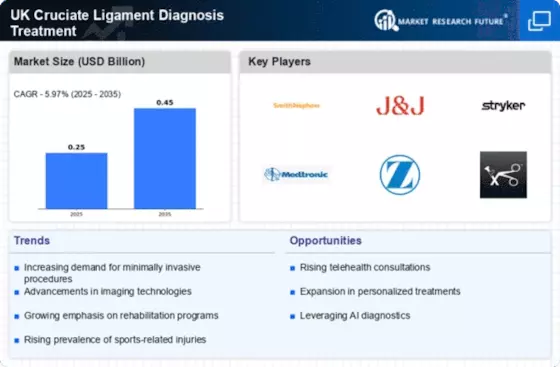
Increased Awareness and Education
In the UK, there is a growing awareness and education surrounding cruciate ligament injuries, which is positively impacting the Diagnosis Treatment Industry. Public health campaigns and educational programs aimed at athletes, coaches, and healthcare professionals are fostering a better understanding of injury prevention and the importance of early diagnosis. This heightened awareness is likely to lead to an increase in individuals seeking medical attention for knee injuries, thereby driving demand for specialized diagnostic and treatment services. Additionally, healthcare providers are increasingly focusing on educating patients about their treatment options, which may enhance patient engagement and adherence to rehabilitation protocols. As a result, the UK Cruciate Ligament Diagnosis Industry is poised for growth as more individuals recognize the importance of timely intervention and effective management of cruciate ligament injuries.
Government Initiatives and Funding
Government initiatives and funding play a pivotal role in shaping the UK Cruciate Ligament Diagnosis Industry. The UK government has been actively investing in healthcare infrastructure, particularly in sports medicine and rehabilitation services. Recent policies aimed at improving access to specialized care for sports injuries have led to the establishment of dedicated clinics and treatment centers across the country. Furthermore, funding for research into innovative treatment methods and rehabilitation techniques is on the rise, which may enhance the overall quality of care available to patients. These initiatives not only improve patient outcomes but also stimulate growth within the UK Cruciate Ligament Diagnosis Treatment Industry by attracting skilled professionals and fostering collaboration between healthcare providers and research institutions.
Rising Incidence of Sports Injuries
The UK Cruciate Ligament Diagnosis Industry is experiencing growth due to the increasing incidence of sports-related injuries. With a significant rise in participation in sports and physical activities, particularly among younger populations, the demand for effective diagnosis and treatment of cruciate ligament injuries is escalating. According to recent statistics, approximately 1 in 3 sports injuries involves the knee, with cruciate ligament injuries being particularly prevalent. This trend is likely to continue as more individuals engage in high-impact sports, necessitating advancements in diagnostic techniques and treatment options. The UK healthcare system is responding to this demand by investing in specialized clinics and rehabilitation programs, thereby enhancing the overall landscape of the UK Cruciate Ligament Diagnosis Treatment Industry.
Growing Demand for Personalized Medicine
The trend towards personalized medicine is increasingly influencing the UK Cruciate Ligament Diagnosis Industry. Patients are seeking tailored treatment plans that consider their unique physiological characteristics, activity levels, and recovery goals. This shift is prompting healthcare providers to adopt more individualized approaches to diagnosis and treatment, including the use of genetic testing and biomarker analysis to inform clinical decisions. As a result, rehabilitation protocols are becoming more customized, potentially leading to improved recovery outcomes. The growing emphasis on personalized care is likely to drive innovation within the UK Cruciate Ligament Diagnosis Treatment Industry, as providers strive to meet the evolving expectations of patients and enhance the overall effectiveness of treatment strategies.
Technological Advancements in Treatment Options
The UK Cruciate Ligament Diagnosis Industry is significantly influenced by technological advancements in treatment options. Innovations such as minimally invasive surgical techniques, improved arthroscopic procedures, and regenerative medicine are transforming the way cruciate ligament injuries are treated. For instance, the introduction of biologic therapies, including platelet-rich plasma (PRP) injections, has shown promising results in enhancing recovery times and improving outcomes for patients. Furthermore, the integration of advanced imaging technologies, such as MRI and 3D imaging, allows for more accurate diagnosis and tailored treatment plans. As these technologies continue to evolve, they are expected to play a crucial role in shaping the future of the UK Cruciate Ligament Diagnosis Treatment Industry, potentially leading to better patient outcomes and reduced recovery times.