×
Request Free Sample ×

Kindly complete the form below to receive a free sample of this Report

* Please use a valid business email

Leading companies partner with us for data-driven Insights

clients tt-cursor
Hero Background

UK 5G mm Wave Technology Market

ID: MRFR/ICT/56749-HCR
200 Pages
Aarti Dhapte
February 2026

UK 5G mm Wave Technology Market Size, Share and Trends Analysis Report By Application (Telecommunications, Automotive, Healthcare, Smart Cities, Consumer Electronics), By End Use (Residential, Commercial, Industrial), By Component (Antennas, Transceivers, Amplifiers, Filters) and By Frequency Band (Millimeter Wave Frequency, Sub-6 GHz Frequency)- Forecast to 2035

Share:
Download PDF ×

We do not share your information with anyone. However, we may send you emails based on your report interest from time to time. You may contact us at any time to opt-out.

UK 5G mm Wave Technology Market Infographic
Purchase Options

UK 5G mm Wave Technology Market Summary

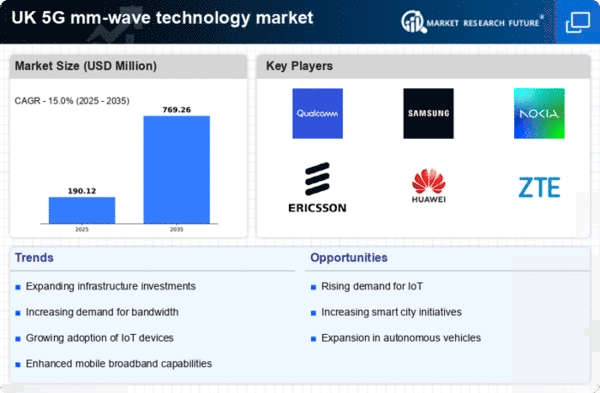
As per Market Research Future analysis, the UK 5G mm Wave Technology Market size was estimated at 165.32 USD Million in 2024. The 5G Mm-wave-technology market is projected to grow from 190.12 USD Million in 2025 to 769.26 USD Million by 2035, exhibiting a compound annual growth rate (CAGR) of 15% during the forecast period 2025 - 2035

Key Market Trends & Highlights

The UK 5G mm-wave technology market is poised for substantial growth driven by infrastructure investments and technological advancements.

  • The market is witnessing increased infrastructure investment to support the deployment of 5G mm-wave technology.
  • Expansion of IoT applications is driving demand for high-speed connectivity across various sectors.
  • Regulatory support for innovation is fostering a conducive environment for market growth and development.
  • Rising demand for high-speed connectivity and advancements in telecommunications infrastructure are key drivers propelling the market forward.

Market Size & Forecast

2024 Market Size 165.32 (USD Million)
2035 Market Size 769.26 (USD Million)
CAGR (2025 - 2035) 15.0%

Major Players

Qualcomm (US), Samsung (KR), Nokia (FI), Ericsson (SE), Huawei (CN), ZTE (CN), Intel (US), Broadcom (US), Cisco (US)

Our Impact
Enabled $4.3B Revenue Impact for Fortune 500 and Leading Multinationals
Partnering with 2000+ Global Organizations Each Year
30K+ Citations by Top-Tier Firms in the Industry

UK 5G mm Wave Technology Market Trends

The UK 5G mm Wave Technology Market is currently experiencing a transformative phase, driven by advancements in telecommunications infrastructure and increasing demand for high-speed connectivity. As the UK continues to enhance its digital landscape, the deployment of mm-wave technology is becoming more prevalent, facilitating faster data transmission and improved network efficiency. This technology is particularly beneficial for urban areas, where high user density necessitates robust connectivity solutions. The integration of mm-wave technology into existing networks is expected to bolster the overall performance of mobile services, catering to the growing appetite for data-intensive applications such as streaming, gaming, and IoT devices. Moreover, regulatory support and investment in research and development are likely to further propel the 5g mm-wave-technology market. The UK government has been actively promoting initiatives aimed at fostering innovation in telecommunications, which may lead to enhanced collaboration between public and private sectors. As a result, the market is poised for substantial growth, with stakeholders exploring new business models and applications that leverage the unique capabilities of mm-wave technology. This evolution not only signifies a shift in how connectivity is perceived but also highlights the potential for economic growth and technological advancement within the region.

Increased Infrastructure Investment

Investment in telecommunications infrastructure is on the rise, as stakeholders recognize the necessity of robust networks to support the demands of modern connectivity. This trend is likely to enhance the deployment of 5g mm-wave technology, ensuring that urban areas can accommodate the increasing number of connected devices.

Expansion of IoT Applications

The proliferation of Internet of Things (IoT) devices is expected to drive the demand for 5g mm-wave technology. As more devices become interconnected, the need for high-speed, low-latency communication will likely increase, positioning mm-wave technology as a critical enabler for various applications.

Regulatory Support for Innovation

Regulatory frameworks are evolving to support the adoption of advanced telecommunications technologies. This trend suggests that the UK government is committed to fostering an environment conducive to innovation, which may facilitate the growth of the 5g mm-wave-technology market.

UK 5G mm Wave Technology Market Drivers

Growth of Smart Cities Initiatives

The development of smart cities in the UK is a pivotal driver for the 5g mm-wave-technology market. As urban areas evolve to incorporate advanced technologies, the need for reliable and high-speed connectivity becomes paramount. The UK government has launched several initiatives aimed at creating smart cities, which are expected to require extensive 5g mm-wave infrastructure. This transition is anticipated to generate a market opportunity worth over £10 billion by 2030. The integration of 5g mm-wave technology into smart city projects will facilitate efficient traffic management, enhanced public safety, and improved energy management, thereby reinforcing the market's growth trajectory.

Emergence of Edge Computing Solutions

The emergence of edge computing solutions is significantly impacting the 5g mm-wave-technology market. By processing data closer to the source, edge computing reduces latency and enhances the performance of applications that rely on real-time data. In the UK, the edge computing market is expected to grow at a CAGR of 25% over the next five years, indicating a strong alignment with the capabilities of 5g mm-wave technology. This synergy is likely to drive the adoption of 5g mm-wave solutions across various sectors, including manufacturing, healthcare, and transportation, as businesses seek to optimize their operations and improve service delivery.

Rising Demand for High-Speed Connectivity

The 5g mm-wave-technology market is experiencing a surge in demand for high-speed connectivity, driven by the increasing reliance on digital services across various sectors. Businesses and consumers alike are seeking faster internet speeds to support activities such as streaming, online gaming, and remote work. In the UK, the demand for high-speed internet is projected to grow by approximately 30% over the next five years, indicating a robust market potential for 5g mm-wave technology. This demand is further fueled by the proliferation of smart devices and the need for seamless connectivity, which positions the 5g mm-wave-technology market as a critical enabler of the digital economy.

Advancements in Telecommunications Infrastructure

The 5g mm-wave-technology market is significantly influenced by advancements in telecommunications infrastructure. The UK government has committed to investing £1.5 billion in enhancing digital infrastructure, which includes the deployment of 5g networks. This investment aims to improve connectivity in urban and rural areas, thereby expanding the reach of high-speed internet services. As telecommunications companies upgrade their infrastructure to support 5g mm-wave technology, the market is likely to witness accelerated growth. Enhanced infrastructure not only facilitates faster data transmission but also supports the increasing number of connected devices, thereby driving the demand for 5g mm-wave technology.

Increased Adoption of Augmented and Virtual Reality

The 5g mm-wave-technology market is poised for growth due to the rising adoption of augmented reality (AR) and virtual reality (VR) applications. These technologies demand high bandwidth and low latency, characteristics that are inherent to 5g mm-wave technology. In the UK, the AR and VR market is projected to reach £1.2 billion by 2026, creating a substantial demand for the underlying 5g mm-wave infrastructure. As industries such as gaming, education, and healthcare increasingly leverage AR and VR, the need for robust connectivity solutions will likely propel the 5g mm-wave-technology market forward, making it a key player in the digital transformation landscape.


Market Segment Insights

By Application: Telecommunications (Largest) vs. Automotive (Fastest-Growing)

The UK 5g mm-wave-technology market showcases a diverse application landscape. Telecommunications remains the largest segment, commanding a significant share due to the increasing demand for high-speed connectivity and data services. Automotive follows closely, leveraging mm-wave technology for enhanced vehicle communication systems and autonomous driving capabilities. Through consistent innovation, these two sectors are expected to lead the market. Looking further, automotive applications are experiencing rapid growth, driven by advancements in autonomous technology and vehicle-to-everything (V2X) communication. The demand for smart cities is also on the rise, with mm-wave technology facilitating efficient traffic management and energy use. Meanwhile, healthcare and consumer electronics are emerging segments as the push for telehealth services and connected devices increases. The landscape is ever-evolving with new drivers for these applications.

Telecommunications: Dominant vs. Automotive: Emerging

Telecommunications plays a dominant role in the UK 5g mm-wave-technology market, focusing on delivering high-speed internet and seamless connectivity. Service providers are heavily investing in infrastructure to support the growing demand for mobile data. On the other hand, the automotive sector is characterized as an emerging segment, rapidly adopting 5g mm-wave technology to enable features like remote diagnostics and improved infotainment systems. The integration of advanced communication protocols within vehicles promotes both safety and efficiency. As these segments evolve, synergies between telecommunications and automotive will likely deepen, enhancing overall user experiences in the market.

By End Use: Residential (Largest) vs. Industrial (Fastest-Growing)

In the UK 5g mm-wave-technology market, the distribution of market share among end use segments reveals that residential applications dominate significantly due to the growing demand for high-speed internet and smart home technologies. Following closely behind is the commercial sector, which leverages 5g mm-wave technology for enhanced connectivity in businesses. The industrial segment, while smaller in share, is rapidly increasing its footprint as industries seek to implement advanced automation and IoT solutions. The growth trends in this segment are driven by the increasing adoption of high-speed internet in residential areas, complemented by the rise of smart appliances and streaming services. Additionally, the commercial and industrial sectors are benefiting from technological advancements, which encourage businesses to invest in digital transformation initiatives. The drive for faster and more reliable connectivity is propelling these segments forward, with emerging applications in automation and smart manufacturing gaining traction.

Residential (Dominant) vs. Industrial (Emerging)

The residential segment in the UK 5g mm-wave-technology market is characterized by its substantial user base that favors high-speed internet for personal and professional use. This segment is positioned as the dominant force, largely driven by increasing consumer expectations for seamless connectivity and entertainment services. Conversely, the industrial segment represents an emerging market with potential for significant growth as industries adopt 5g mm-wave technology for automation and smart factory solutions. Industries are investing in this technology to enhance operational efficiencies and connectivity on the manufacturing floor. The differences between these segments highlight a clear divide, with residential enjoying immediate demand while industrial lays the groundwork for future innovations.

By Component: Antennas (Largest) vs. Transceivers (Fastest-Growing)

In the UK 5g mm-wave-technology market, the distribution of market share among the component segment values reveals that antennas hold the largest share due to their critical role in signal transmission and reception. Antennas are essential for effective network coverage and performance, resulting in their dominance within this sector. In contrast, although transceivers represent a smaller portion of the market currently, their rapid adoption suggests a growing importance driven by advancements in digital communication technologies. Growth trends in this segment are significantly influenced by the increasing demand for high-speed connectivity and the expansion of 5g networks. The need for enhanced data rates and reliable service has propelled the development and implementation of sophisticated components like amplifiers and filters, which support the existing infrastructure. Furthermore, the push towards smart cities and the Internet of Things (IoT) has fostered innovation in transceiver technologies, making them an emerging focal point in this rapidly evolving market.

Antennas (Dominant) vs. Transceivers (Emerging)

Antennas serve as the backbone of the communication landscape, as they facilitate seamless connectivity and maintain the integrity of the signal across various frequencies. Their dominant position in the market is attributed to the significant investments made in R&D to improve antenna designs, ensuring compatibility with the latest 5g specifications. On the other hand, transceivers are emerging to be invaluable due to their dual functionality of transmitting and receiving signals. As the market evolves, innovations in transceiver technology are aimed at enhancing performance and reliability, making them a critical component for future-proofing network infrastructure.

By Frequency Band: Millimeter Wave Frequency (Largest) vs. Sub-6 GHz Frequency (Fastest-Growing)

In the UK 5g mm-wave-technology market, the distribution of market share reveals that the Millimeter Wave Frequency segment leads significantly, holding a dominant position due to its capacity for high data transfer speeds and low latency. Conversely, the Sub-6 GHz Frequency segment, while smaller, is gaining traction among consumers seeking broader coverage and cost-effective solutions, making the market landscape highly competitive. Looking ahead, growth trends in this segment are fueled by increasing demand for faster internet connectivity and the expansion of smart devices. The Millimeter Wave Frequency continues to be favored for urban areas with high data requirements, while the Sub-6 GHz Frequency is emerging in suburban and rural regions, where extensive coverage is essential. This dual focus on speed and coverage will shape the technology landscape in the coming years.

Frequency: Millimeter Wave (Dominant) vs. Sub-6 GHz (Emerging)

The Millimeter Wave Frequency segment is characterized by its high capacity for data transmission, making it the dominant force in the UK 5g mm-wave-technology market. This frequency band is particularly well-suited for densely populated urban environments where a significant volume of users demand rapid data access. In contrast, the Sub-6 GHz Frequency segment is emerging as a vital player, particularly in areas where coverage and cost-effectiveness are prioritized. While it may not match the speed of its Millimeter Wave counterpart, it offers more extensive reach, accommodating broader audiences and various applications, thus providing a balanced approach to 5G deployment across different geographic and demographic terrains.

Get more detailed insights about UK 5G mm Wave Technology Market

Key Players and Competitive Insights

The 5g mm-wave-technology market is currently characterized by intense competition and rapid technological advancements. Key growth drivers include the increasing demand for high-speed connectivity, the proliferation of IoT devices, and the ongoing digital transformation across various sectors. Major players such as Qualcomm (US), Samsung (KR), and Nokia (FI) are strategically positioned to leverage their technological expertise and extensive portfolios. Qualcomm (US) focuses on innovation in chipsets and software solutions, while Samsung (KR) emphasizes its capabilities in network infrastructure and consumer electronics. Nokia (FI) is enhancing its operational focus on private networks and cloud solutions, collectively shaping a competitive environment that is increasingly reliant on technological differentiation and strategic partnerships.
In terms of business tactics, companies are localizing manufacturing and optimizing supply chains to enhance efficiency and reduce costs. The market structure appears moderately fragmented, with several key players exerting significant influence. This fragmentation allows for a diverse range of offerings, yet the collective strength of these companies fosters a competitive landscape where innovation and strategic collaborations are paramount.
In October 2025, Qualcomm (US) announced a partnership with a leading UK telecommunications provider to enhance 5g mm-wave deployment across urban areas. This collaboration is expected to accelerate the rollout of high-speed networks, thereby improving connectivity for consumers and businesses alike. The strategic importance of this partnership lies in Qualcomm's ability to leverage its advanced chipset technology, which could potentially set new benchmarks for network performance in the region.
In September 2025, Samsung (KR) unveiled its latest 5g mm-wave base station technology, designed to support higher data rates and lower latency. This technological advancement is crucial as it aligns with the growing demand for enhanced mobile broadband services. By investing in cutting-edge infrastructure, Samsung positions itself as a leader in the market, likely enhancing its competitive edge against rivals.
In August 2025, Nokia (FI) secured a contract with a major UK city to deploy a smart city initiative utilizing 5g mm-wave technology. This initiative aims to integrate various urban services, such as traffic management and public safety, into a cohesive digital framework. The strategic significance of this project underscores Nokia's commitment to driving digital transformation in urban environments, potentially establishing it as a key player in the smart city sector.
As of November 2025, current competitive trends indicate a strong focus on digitalization, sustainability, and AI integration within the 5g mm-wave-technology market. Strategic alliances are increasingly shaping the landscape, as companies recognize the value of collaboration in driving innovation. Looking ahead, competitive differentiation is likely to evolve, shifting from price-based competition to a focus on technological innovation, supply chain reliability, and the ability to deliver tailored solutions that meet the diverse needs of customers.

Key Companies in the UK 5G mm Wave Technology Market include

Industry Developments

Qualcomm is actively collaborating with Vodafone to enhance network capabilities, while Cisco has been pushing its secure networks to support 5G deployments. Intel has launched new processors optimized for 5G solutions, and ZTE is focusing on expanding its infrastructure offerings in the UK. In March 2023, Sky Group announced its partnership with BT Group to co-develop 5G services. 

Vodafone's ongoing initiative to increase mmWave spectrum availability is set to bolster user experiences across urban areas.During the last two years, significant growth in investment has been noted, especially with companies like Ericsson and Samsung increasing their presence through R&D efforts. The market valuation for 5G mmWave technology continues to rise, driven by increasing consumer demand for high-speed internet and enhanced connectivity solutions in various sectors, such as smart cities and autonomous systems.


Future Outlook

UK 5G mm Wave Technology Market Future Outlook

The 5G mm-wave-technology market is projected to grow at a 15.0% CAGR from 2025 to 2035, driven by increased demand for high-speed connectivity and IoT applications.

New opportunities lie in:

  • Development of advanced mm-wave antennas for urban environments.
  • Integration of mm-wave technology in autonomous vehicle systems.
  • Expansion of mm-wave infrastructure in smart city projects.

By 2035, the market is expected to achieve substantial growth, positioning itself as a leader in connectivity solutions.

Market Segmentation

UK 5G mm Wave Technology Market End Use Outlook

  • Residential
  • Commercial
  • Industrial

UK 5G mm Wave Technology Market Component Outlook

  • Antennas
  • Transceivers
  • Amplifiers
  • Filters

UK 5G mm Wave Technology Market Application Outlook

  • Telecommunications
  • Automotive
  • Healthcare
  • Smart Cities
  • Consumer Electronics

UK 5G mm Wave Technology Market Frequency Band Outlook

  • Millimeter Wave Frequency
  • Sub-6 GHz Frequency

Report Scope

MARKET SIZE 2024 165.32(USD Million)
MARKET SIZE 2025 190.12(USD Million)
MARKET SIZE 2035 769.26(USD Million)
COMPOUND ANNUAL GROWTH RATE (CAGR) 15.0% (2025 - 2035)
REPORT COVERAGE Revenue Forecast, Competitive Landscape, Growth Factors, and Trends
BASE YEAR 2024
Market Forecast Period 2025 - 2035
Historical Data 2019 - 2024
Market Forecast Units USD Million
Key Companies Profiled Qualcomm (US), Samsung (KR), Nokia (FI), Ericsson (SE), Huawei (CN), ZTE (CN), Intel (US), Broadcom (US), Cisco (US)
Segments Covered Application, End Use, Component, Frequency Band
Key Market Opportunities Expansion of smart city initiatives driving demand for 5g mm-wave-technology market solutions.
Key Market Dynamics Intensifying competition drives innovation and regulatory adaptations in the 5G mm-wave technology market.
Countries Covered UK
Leave a Comment

FAQs

What is the projected market size of the UK 5G mmWave Technology Market in 2024?

The UK 5G mmWave Technology Market is expected to be valued at 528.5 million USD in 2024.

What will be the market value of the UK 5G mmWave Technology Market by 2035?

By 2035, the market is projected to reach a value of 2660.0 million USD.

What is the expected compound annual growth rate (CAGR) for the UK 5G mmWave Technology Market from 2025 to 2035?

The market is expected to grow at a CAGR of 15.825% from 2025 to 2035.

Which application segment is anticipated to have the largest market share in 2035?

The Telecommunications application segment is estimated to hold the largest share with a value of 1300.0 million USD in 2035.

What is the anticipated market value for the Automotive application segment in 2035?

The Automotive application segment is projected to reach 400.0 million USD by 2035.

Who are the major players in the UK 5G mmWave Technology Market?

Key players include Qualcomm, Cisco, Intel, ZTE, Vodafone, and Nokia among others.

What is the projected market size for the Healthcare application segment in 2024?

The Healthcare application segment is expected to be valued at 50.0 million USD in 2024.

How much is the Smart Cities application segment expected to be valued in 2035?

The Smart Cities application segment is projected to reach 400.0 million USD in 2035.

What growth opportunities exist in the UK 5G mmWave Technology Market?

The market presents opportunities particularly in Telecommunications, Consumer Electronics, and Smart Cities applications.

What are the challenges facing the UK 5G mmWave Technology Market?

Challenges include regulatory hurdles and infrastructure investment requirements to support rapid growth.

Download Free Sample

Kindly complete the form below to receive a free sample of this Report

Compare Licence

×
Features License Type
Single User Multiuser License Enterprise User
Price $4,950 $5,950 $7,250
Maximum User Access Limit 1 User Upto 10 Users Unrestricted Access Throughout the Organization
Free Customization
Direct Access to Analyst
Deliverable Format
Platform Access
Discount on Next Purchase 10% 15% 15%
Printable Versions