×
Request Free Sample ×

Kindly complete the form below to receive a free sample of this Report

* Please use a valid business email

Leading companies partner with us for data-driven Insights

clients tt-cursor
Hero Background
English
Chinese
French
Japanese
Korean
German
Spanish

Toulene Market Share

ID: MRFR/CnM/4126-HCR
137 Pages
Anshula Mandaokar
October 2025

Global Toluene Market Research Report Information By Grade (Commercial, Nitration, And Toulene Diisocyantes), By Application (Intermediates, Fuel Additives, Foam, Polymer Production, Solvents, And Others) And Region- Forecast Till 2035

Share:
Download PDF ×

We do not share your information with anyone. However, we may send you emails based on your report interest from time to time. You may contact us at any time to opt-out.

Toulene Market Infographic
×
Toulene Market Infographic Full View
Purchase Options

Market Share

Toulene Market Share Analysis

Additionally, because of various reasons, many companies competing within this industry are encouraged to strive for higher market shares. For example, one of the most common strategies is differentiation where a firm ensures that its products have unique qualities or features that no other company has so far come up with. This can be characterized by high purity levels, adherence to stringent environmental regulations or provision of innovative packaging solutions. Consequently, such firms concentrate on those consumers who are known to look for certain characteristics of this particular substance thereby facilitating development of enduring customer loyalty. Another option firms have within the Toluene sector includes cost leadership strategy; a situation where an organization becomes a ‘low-cost producer’ in that particular line of business. This entails minimizing production costs through process optimization and strategic positioning across supply chains in order to enjoy economies of scale thereby reducing overall expenses incurred in manufacturing that product line. In order to do this effectively, these businesses must set more competitive prices thus taking significant proportions of the market share along the entire value chain right from average clients who buy in large quantities to ordinary people interested in price only. Cost leadership comes into play particularly when customers seek affordable and cheap deals especially among price sensitive markets.

The toluene market is as well influenced by how responsive a company is in terms of changing market dynamics. This includes following industry trends, monitoring competition and changing strategy quickly when customers or regulations shift. Thus, companies with agility and flexibility are more likely to move through obstacles, manage emerging threats as well as opportunities hence either retaining their market shares, or even increasing them amidst intense competition within the toluene industry.

There are many strategies used by various companies within the Toluene Market targeting different methods of positioning themselves regarding market share. To gain competitive advantage, differentiation, low cost leadership, collaboration, innovation among others are employed by businesses operating in this fast changing environment. These strategies work best where a company understands the market conditions deeply meets client’s requirements and undergoes necessary alterations for any environmental changes.


Author
Anshula Mandaokar
Team Lead - Research

Anshula Mandaokar holds an academic degree in Chemical Engineering and has been contributing to the field for more than 5 years. She has expertise in Market Research and Business Consulting and serves as a Team Lead for a reputed Market Research firm under the Chemicals and Materials domain spectrum. She has worked on multiple projects, generating explicit results in a quick turnaround time. Her understanding of data interpretation justifies her role as a leader.

Leave a Comment

FAQs

What is the forecast period of Toulene Market research report?

The forecast period for Toulene Market research report is 2025-2035.

Which region will lead the global Toulene Market?

Global Toulene Market is dominated by APAC region.

Who are the key players in the Toulene Market?

Exxon Mobil Corporation (U.S.), Covestro AG (Germany), BP p.l.c. (U.K), China Petroleum & Chemical Corporation (China), BASF SE (Germany), Royal Dutch Shell plc (the Netherlands), Formosa Chemicals & Fibre Corporation (Taiwan), Indian Oil Corporation Ltd (India), The Dow Chemical Company (U.S), TOTAL S.A. (France)

Market Summary

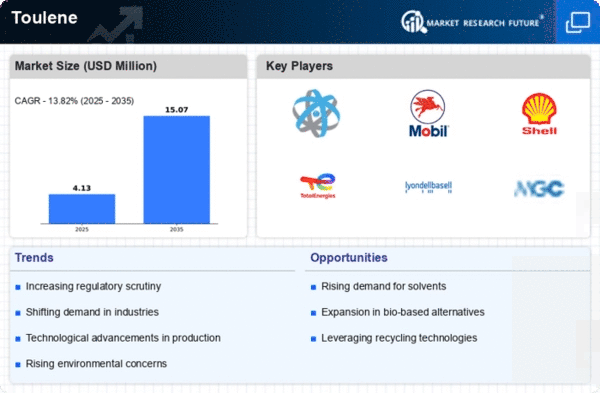
As per MRFR analysis, the Market Size was estimated at 3.63 USD Million in 2024. The Toulene industry is projected to grow from 4.13 in 2025 to 15.07 by 2035, exhibiting a compound annual growth rate (CAGR) of 13.82 during the forecast period 2025 - 2035.

Key Market Trends & Highlights

The Toluene Market is currently experiencing a dynamic shift driven by sustainability and technological advancements.

  • North America remains the largest market for toluene, primarily due to its extensive chemical manufacturing base.
  • Asia-Pacific is identified as the fastest-growing region, fueled by increasing industrialization and urbanization.
  • The solvent segment dominates the market, while the fuel additive segment is witnessing rapid growth due to evolving consumer preferences.
  • Rising demand in paints and coatings, along with technological innovations in production, are key drivers propelling market expansion.

Market Size & Forecast

2024 Market Size 3.63 (USD Million)
2035 Market Size 15.07 (USD Million)
CAGR (2025 - 2035) 13.82%
Largest Regional Market Share in 2024 North America

Major Players

Benzene International (US), ExxonMobil Chemical (US), Shell Chemicals (GB), TotalEnergies (FR), LyondellBasell Industries (US), Mitsubishi Gas Chemical (JP), SABIC (SA), Eastman Chemical Company (US), Formosa Plastics Corporation (TW)

Market Trends

The Market is currently experiencing a dynamic phase characterized by evolving demand patterns and shifting regulatory landscapes. The compound, primarily utilized as an industrial solvent and in the production of various chemicals, is witnessing increased interest from sectors such as automotive and pharmaceuticals. This heightened focus is likely driven by the compound's versatility and effectiveness in numerous applications. Furthermore, the market appears to be influenced by environmental considerations, prompting manufacturers to explore sustainable alternatives and practices. As a result, the industry is adapting to these changes, which may lead to innovations in production processes and product formulations. In addition, The Toulene is shaped by geopolitical factors and trade dynamics. Supply chain disruptions and fluctuating raw material costs could potentially impact availability and pricing strategies. Companies are likely to invest in research and development to enhance efficiency and reduce environmental footprints. Overall, the Toulene Market seems poised for transformation, with stakeholders navigating challenges while seeking opportunities for growth and sustainability.

Sustainability Initiatives

The Toulene Market is increasingly influenced by sustainability initiatives, as companies strive to reduce their environmental impact. This trend may lead to the development of greener production methods and alternative solvents that align with regulatory requirements and consumer preferences.

Technological Advancements

Technological advancements are playing a crucial role in the evolution of the Toulene Market. Innovations in extraction and processing techniques could enhance efficiency and reduce costs, thereby attracting new players and expanding market reach.

Regulatory Changes

Regulatory changes are shaping the operational landscape of the Toulene Market. Stricter environmental regulations may compel manufacturers to adapt their practices, potentially leading to a shift towards more sustainable and compliant production methods.

Toulene Market Market Drivers

Emerging Markets and Urbanization

The Global Toluene Market Industry is poised for growth due to urbanization and industrialization in emerging markets. As countries develop, the demand for toluene in various applications, including adhesives, paints, and fuels, is expected to rise. Urbanization drives infrastructure development, which in turn increases the consumption of toluene-based products. This trend is particularly evident in regions such as Asia-Pacific, where rapid economic growth is anticipated to bolster the market. The increasing population and urban centers are likely to create a favorable environment for the Global Toluene Market Industry to thrive.

Rising Demand in Automotive Sector

The Global Toluene Market Industry experiences a robust demand surge from the automotive sector, primarily due to its application in producing high-octane gasoline and various chemical intermediates. As automotive manufacturers increasingly focus on enhancing fuel efficiency and reducing emissions, toluene's role becomes increasingly pivotal. The industry's growth is reflected in the projected market value, which is expected to reach 235.94 USD Billion in 2024. This trend indicates a significant reliance on toluene as a key component in fuel formulations, thereby driving the overall growth of the Global Toluene Market Industry.

Expansion of Chemical Manufacturing

The Global Toluene Market Industry is significantly influenced by the expansion of the chemical manufacturing sector. Toluene serves as a vital solvent and intermediate in producing various chemicals, including benzene and xylene. The increasing production capacities in emerging economies contribute to this growth, as manufacturers seek to meet the rising global demand for chemical products. By 2035, the market is anticipated to reach 541.32 USD Billion, suggesting a strong correlation between chemical manufacturing expansion and toluene consumption. This dynamic underscores the importance of toluene in sustaining the chemical industry's growth trajectory.

Growth in Paints and Coatings Industry

The Global Toluene Market Industry benefits from the growth in the paints and coatings sector, where toluene is utilized as a solvent and thinner. The increasing demand for high-performance coatings in construction and automotive applications propels the market forward. As environmental regulations evolve, manufacturers are adapting to produce low-VOC formulations, which may further enhance toluene's appeal due to its effective solvent properties. This sector's expansion is likely to contribute to the overall market growth, aligning with the projected CAGR of 7.84% from 2025 to 2035, indicating a sustained interest in toluene within the coatings industry.

Technological Advancements in Production

Technological advancements in toluene production processes are shaping the Global Toluene Market Industry. Innovations in extraction and refining techniques enhance efficiency and reduce costs, making toluene more accessible for various applications. These advancements may lead to increased production capacities, allowing manufacturers to meet the growing demand across sectors. As the industry adapts to new technologies, the potential for improved sustainability practices emerges, aligning with global efforts to reduce environmental impacts. This evolution in production technology could play a crucial role in sustaining the market's growth in the coming years.

Market Segment Insights

By Application: Solvent (Largest) vs. Fuel Additive (Fastest-Growing)

In the Toulene Market, the application segment is diversified, with solvents dominating the market share due to their extensive use in industrial and consumer products. Solvents account for a significant portion of the overall application, driven by their versatility in formulations for paints, coatings, and various chemical processes. Following solvents, fuel additives are gaining traction as they enhance fuel performance and comply with stringent regulatory standards, albeit at a smaller share. The growth trends in the application segment indicate a robust demand for solvents amidst a rising emphasis on sustainable solutions, as industries seek eco-friendly alternatives. Fuel additives are experiencing rapid growth due to the increasing focus on efficient fuel usage and decreasing emissions, driven by legislative efforts to improve air quality and energy efficiency in transportation and industrial applications.

Solvent (Dominant) vs. Fuel Additive (Emerging)

The solvent segment is characterized by its dominance in the Toulene Market due to its extensive application in various industries, including paints, coatings, and adhesives. Solvents play a crucial role in enhancing product performance and ensuring optimal application processes. Meanwhile, fuel additives represent an emerging segment that is rapidly gaining importance as they improve the efficiency and cleanliness of fuel combustion in vehicles and machinery. The rise of regulations aimed at reducing pollutants boosts the demand for high-quality fuel additives, making them essential in modern fuel formulations.

By End Use: Automotive (Largest) vs. Pharmaceuticals (Fastest-Growing)

The Toulene Market exhibits a diverse range of end use segments, with the automotive industry being the largest consumer, primarily due to its essential role in the production of fuels and solvents. Following closely, the pharmaceutical sector also contributes significantly to market dynamics, leveraging toluene for various applications such as drug formulation and synthesis. Other notable segments include chemical manufacturing, cosmetics, and food processing, each playing a meaningful part in end use distribution.

Automotive (Dominant) vs. Pharmaceuticals (Emerging)

The automotive sector stands out as the dominant end use segment in the Toulene Market, relying heavily on toluene for its integral role in fuel production, solvents, and coatings. This segment benefits from a strong demand driven by the expanding automotive industry and the constant innovation in vehicle technologies. On the other hand, the pharmaceutical sector is considered the emerging segment, as it experiences rapid growth due to increasing investments in drug development and research. Toluene's solvent properties make it invaluable in pharmaceutical formulations, positioning it as a critical ingredient in drug manufacturing. Both segments are expected to evolve in response to industry trends and regulatory changes, with an emphasis on sustainability and safety.

By Distribution Channel: Direct Sales (Largest) vs. Online Sales (Fastest-Growing)

In the Toluene Market, the distribution channel segment is characterized by a diverse array of sales methods. Direct sales remain the largest channel, comprising a significant portion of overall distribution. This traditional sales method benefits from direct interaction with customers and facilitates immediate service delivery. Following closely are retail and wholesale channels, which also contribute noticeably to market penetration, albeit at a smaller scale compared to direct sales. Online sales have gained traction, marking a transformative shift within the industry as companies leverage digital platforms to reach broader audiences.

Direct Sales (Dominant) vs. Online Sales (Emerging)

Direct sales have established themselves as the dominant force in the Toluene Market, largely due to established relationships between manufacturers and end-users, enabling personalized service and tailored solutions. This channel thrives on its ability to offer immediate technical assistance and service, which is crucial for industrial applications. On the other hand, online sales are emerging rapidly, fueled by technological advancements and shifts towards e-commerce. This channel provides convenience and accessibility, attracting a new demographic of customers who prefer online transactions and the ability to compare products easily, thus diversifying the consumer base in the Toluene Market.

By Form: Liquid (Largest) vs. Solid (Fastest-Growing)

In the Toulene Market, the form segment displays an interesting distribution with liquid form leading as the largest share contributor. With its widespread applications in solvents and chemical manufacturing, liquid toluene is preferred across various industries. In contrast, solid toluene is gaining ground, becoming the fastest-growing segment in recent years, driven by innovative applications in electronics and adhesives.

Liquid (Dominant) vs. Solid (Emerging)

The liquid form of toluene remains dominant due to its versatility and broad utilization in industrial applications such as paint thinners and chemical intermediates. Its physical properties make it a preferred choice for formulations needing high solubility and low volatility. On the other hand, the solid form is emerging as a significant player in niche markets, particularly in advanced materials and coatings. Solid toluene’s ability to enhance performance characteristics in products is drawing increasing interest from manufacturers looking to develop more efficient and sustainable solutions. This dynamic opens up avenues for growth, leading to heightened competition and innovation within the market.

By Purity Level: Industrial Grade (Largest) vs. Reagent Grade (Fastest-Growing)

In the Toulene Market, the distribution of purity levels is characterized predominantly by Industrial Grade, which holds the largest share due to its extensive use in the manufacturing and industrial sectors. This segment is favored for its cost-effectiveness and suitability for various applications, making it highly sought after. Conversely, Laboratory Grade and Reagent Grade are smaller segments but are witnessing increased interest driven by the growing emphasis on quality and accuracy in laboratory settings. The demand for specialized and high-purity solvents is pushing the Reagent Grade to become a significant player as industries trend towards higher standards of purity.

Industrial Grade (Dominant) vs. Laboratory Grade (Emerging)

Industrial Grade toluene is widely utilized in diverse applications ranging from paint thinners to adhesives, largely due to its effectiveness and affordability. This segment is known for its ability to meet basic solvent requirements in various industrial processes. On the other hand, Laboratory Grade toluene is emerging in specialized settings such as laboratories where high purity and consistent quality are essential. It caters to sectors like pharmaceuticals and chemicals which demand superior quality standards. As regulatory frameworks become more stringent, the shift towards Laboratory Grade products is expected to accelerate, enhancing its market presence significantly. The balance between these segments reflects the evolving needs of various industries regarding compliance and quality assurance.

Get more detailed insights about Toulene Market Research Report- Forecast to 2035

Regional Insights

Key Players and Competitive Insights

The Toulene Market is characterized by a competitive landscape that is increasingly shaped by innovation, sustainability, and strategic partnerships. Key players such as ExxonMobil Chemical (US), TotalEnergies (FR), and LyondellBasell Industries (US) are actively pursuing strategies that emphasize technological advancements and operational efficiencies. ExxonMobil Chemical (US) has focused on enhancing its production capabilities through digital transformation initiatives, which aim to optimize supply chain processes and reduce operational costs. Meanwhile, TotalEnergies (FR) is positioning itself as a leader in sustainable practices, investing in bio-based alternatives to traditional petrochemicals, thereby appealing to environmentally conscious consumers. LyondellBasell Industries (US) has also been proactive in expanding its product portfolio, particularly in high-demand applications, which collectively shapes a competitive environment that is both dynamic and responsive to market needs.The business tactics employed by these companies reflect a concerted effort to localize manufacturing and optimize supply chains. The market structure appears moderately fragmented, with several key players exerting influence over pricing and availability. This fragmentation allows for a diverse range of products and innovations, yet it also necessitates that companies remain agile in their operations to maintain competitive advantages.

In November ExxonMobil Chemical (US) announced a significant investment in a new digital platform aimed at enhancing its operational efficiency. This strategic move is expected to streamline production processes and improve real-time decision-making capabilities, thereby positioning the company to respond more effectively to market fluctuations. The integration of advanced analytics into their operations could potentially lead to cost reductions and increased profitability.

In October TotalEnergies (FR) unveiled a new initiative focused on the development of sustainable toluene production methods. This initiative is part of a broader strategy to reduce carbon emissions and align with global sustainability goals. By investing in innovative technologies, TotalEnergies is likely to enhance its competitive edge while meeting the growing demand for eco-friendly products.

In September LyondellBasell Industries (US) entered into a strategic partnership with a leading technology firm to develop advanced recycling technologies for toluene. This collaboration aims to create a circular economy for petrochemicals, which could significantly reduce waste and improve resource efficiency. The partnership underscores LyondellBasell's commitment to sustainability and innovation, positioning it favorably in a market that increasingly values environmental responsibility.

As of December the competitive trends within the Toulene Market are heavily influenced by digitalization, sustainability, and the integration of artificial intelligence. Strategic alliances are becoming more prevalent, as companies recognize the need to collaborate in order to drive innovation and enhance supply chain reliability. The shift from price-based competition to a focus on technological advancements and sustainable practices is likely to define the future landscape of the market. Companies that can effectively differentiate themselves through innovation and operational excellence will be better positioned to thrive in this evolving environment.

Key Companies in the Toulene Market include

Industry Developments

Future Outlook

Toulene Market Future Outlook

The Toulene Market is projected to grow at a 13.82% CAGR from 2025 to 2035, driven by increasing demand in automotive and chemical industries.

New opportunities lie in:

  • Expansion into bio-based toluene production methods.
  • Development of advanced storage solutions for hazardous materials.
  • Strategic partnerships with automotive manufacturers for tailored formulations.

By 2035, the Toulene Market is expected to achieve robust growth, solidifying its position in key industrial sectors.

Market Segmentation

Toulene Market Form Outlook

  • Liquid
  • Solid
  • Gas

Toulene Market End Use Outlook

  • Automotive
  • Pharmaceutical
  • Chemical Manufacturing
  • Cosmetics
  • Food Processing

Toulene Market Application Outlook

  • Solvent
  • Fuel Additive
  • Chemical Intermediate
  • Paint Thinner
  • Adhesive

Toulene Market Purity Level Outlook

  • Industrial Grade
  • Laboratory Grade
  • Reagent Grade

Toulene Market Distribution Channel Outlook

  • Direct Sales
  • Online Sales
  • Retail Sales
  • Wholesale

Report Scope

MARKET SIZE 20243.63(USD Million)
MARKET SIZE 20254.13(USD Million)
MARKET SIZE 203515.07(USD Million)
COMPOUND ANNUAL GROWTH RATE (CAGR)13.82% (2025 - 2035)
REPORT COVERAGERevenue Forecast, Competitive Landscape, Growth Factors, and Trends
BASE YEAR2024
Market Forecast Period2025 - 2035
Historical Data2019 - 2024
Market Forecast UnitsUSD Million
Key Companies ProfiledBenzene International (US), ExxonMobil Chemical (US), Shell Chemicals (GB), TotalEnergies (FR), LyondellBasell Industries (US), Mitsubishi Gas Chemical (JP), SABIC (SA), Eastman Chemical Company (US), Formosa Plastics Corporation (TW)
Segments CoveredApplication, End Use, Distribution Channel, Form, Purity Level
Key Market OpportunitiesGrowing demand for eco-friendly solvents presents opportunities in the Toulene Market.
Key Market DynamicsRising demand for toluene in chemical manufacturing drives competitive dynamics and influences supply chain strategies.
Countries CoveredNorth America, Europe, APAC, South America, MEA

FAQs

What is the forecast period of Toulene Market research report?

The forecast period for Toulene Market research report is 2025-2035.

Which region will lead the global Toulene Market?

Global Toulene Market is dominated by APAC region.

Who are the key players in the Toulene Market?

Exxon Mobil Corporation (U.S.), Covestro AG (Germany), BP p.l.c. (U.K), China Petroleum & Chemical Corporation (China), BASF SE (Germany), Royal Dutch Shell plc (the Netherlands), Formosa Chemicals & Fibre Corporation (Taiwan), Indian Oil Corporation Ltd (India), The Dow Chemical Company (U.S), TOTAL S.A. (France)

  1. SECTION I: EXECUTIVE SUMMARY AND KEY HIGHLIGHTS
    1. | 1.1 EXECUTIVE SUMMARY
    2. | 1.1.1 Market Overview
    3. | 1.1.2 Key Findings
    4. | 1.1.3 Market Segmentation
    5. | 1.1.4 Competitive Landscape
    6. | 1.1.5 Challenges and Opportunities
    7. | 1.1.6 Future Outlook
  2. SECTION II: SCOPING, METHODOLOGY AND MARKET STRUCTURE
    1. | 2.1 MARKET INTRODUCTION
    2. | 2.1.1 Definition
    3. | 2.1.2 Scope of the study
    4. |-- 2.1.2.1 Research Objective
    5. |-- 2.1.2.2 Assumption
    6. |-- 2.1.2.3 Limitations
    7. | 2.2 RESEARCH METHODOLOGY
    8. | 2.2.1 Overview
    9. | 2.2.2 Data Mining
    10. | 2.2.3 Secondary Research
    11. | 2.2.4 Primary Research
    12. |-- 2.2.4.1 Primary Interviews and Information Gathering Process
    13. |-- 2.2.4.2 Breakdown of Primary Respondents
    14. | 2.2.5 Forecasting Model
    15. | 2.2.6 Market Size Estimation
    16. |-- 2.2.6.1 Bottom-Up Approach
    17. |-- 2.2.6.2 Top-Down Approach
    18. | 2.2.7 Data Triangulation
    19. | 2.2.8 Validation
  3. SECTION III: QUALITATIVE ANALYSIS
    1. | 3.1 MARKET DYNAMICS
    2. | 3.1.1 Overview
    3. | 3.1.2 Drivers
    4. | 3.1.3 Restraints
    5. | 3.1.4 Opportunities
    6. | 3.2 MARKET FACTOR ANALYSIS
    7. | 3.2.1 Value chain Analysis
    8. | 3.2.2 Porter's Five Forces Analysis
    9. |-- 3.2.2.1 Bargaining Power of Suppliers
    10. |-- 3.2.2.2 Bargaining Power of Buyers
    11. |-- 3.2.2.3 Threat of New Entrants
    12. |-- 3.2.2.4 Threat of Substitutes
    13. |-- 3.2.2.5 Intensity of Rivalry
    14. | 3.2.3 COVID-19 Impact Analysis
    15. |-- 3.2.3.1 Market Impact Analysis
    16. |-- 3.2.3.2 Regional Impact
    17. |-- 3.2.3.3 Opportunity and Threat Analysis
  4. SECTION IV: QUANTITATIVE ANALYSIS
    1. | 4.1 Chemicals and Materials, BY Application (USD Million)
    2. | 4.1.1 Solvent
    3. | 4.1.2 Fuel Additive
    4. | 4.1.3 Chemical Intermediate
    5. | 4.1.4 Paint Thinner
    6. | 4.1.5 Adhesive
    7. | 4.2 Chemicals and Materials, BY End Use (USD Million)
    8. | 4.2.1 Automotive
    9. | 4.2.2 Pharmaceutical
    10. | 4.2.3 Chemical Manufacturing
    11. | 4.2.4 Cosmetics
    12. | 4.2.5 Food Processing
    13. | 4.3 Chemicals and Materials, BY Distribution Channel (USD Million)
    14. | 4.3.1 Direct Sales
    15. | 4.3.2 Online Sales
    16. | 4.3.3 Retail Sales
    17. | 4.3.4 Wholesale
    18. | 4.4 Chemicals and Materials, BY Form (USD Million)
    19. | 4.4.1 Liquid
    20. | 4.4.2 Solid
    21. | 4.4.3 Gas
    22. | 4.5 Chemicals and Materials, BY Purity Level (USD Million)
    23. | 4.5.1 Industrial Grade
    24. | 4.5.2 Laboratory Grade
    25. | 4.5.3 Reagent Grade
    26. | 4.6 Chemicals and Materials, BY Region (USD Million)
    27. | 4.6.1 North America
    28. |-- 4.6.1.1 US
    29. |-- 4.6.1.2 Canada
    30. | 4.6.2 Europe
    31. |-- 4.6.2.1 Germany
    32. |-- 4.6.2.2 UK
    33. |-- 4.6.2.3 France
    34. |-- 4.6.2.4 Russia
    35. |-- 4.6.2.5 Italy
    36. |-- 4.6.2.6 Spain
    37. |-- 4.6.2.7 Rest of Europe
    38. | 4.6.3 APAC
    39. |-- 4.6.3.1 China
    40. |-- 4.6.3.2 India
    41. |-- 4.6.3.3 Japan
    42. |-- 4.6.3.4 South Korea
    43. |-- 4.6.3.5 Malaysia
    44. |-- 4.6.3.6 Thailand
    45. |-- 4.6.3.7 Indonesia
    46. |-- 4.6.3.8 Rest of APAC
    47. | 4.6.4 South America
    48. |-- 4.6.4.1 Brazil
    49. |-- 4.6.4.2 Mexico
    50. |-- 4.6.4.3 Argentina
    51. |-- 4.6.4.4 Rest of South America
    52. | 4.6.5 MEA
    53. |-- 4.6.5.1 GCC Countries
    54. |-- 4.6.5.2 South Africa
    55. |-- 4.6.5.3 Rest of MEA
  5. SECTION V: COMPETITIVE ANALYSIS
    1. | 5.1 Competitive Landscape
    2. | 5.1.1 Overview
    3. | 5.1.2 Competitive Analysis
    4. | 5.1.3 Market share Analysis
    5. | 5.1.4 Major Growth Strategy in the Chemicals and Materials
    6. | 5.1.5 Competitive Benchmarking
    7. | 5.1.6 Leading Players in Terms of Number of Developments in the Chemicals and Materials
    8. | 5.1.7 Key developments and growth strategies
    9. |-- 5.1.7.1 New Product Launch/Service Deployment
    10. |-- 5.1.7.2 Merger & Acquisitions
    11. |-- 5.1.7.3 Joint Ventures
    12. | 5.1.8 Major Players Financial Matrix
    13. |-- 5.1.8.1 Sales and Operating Income
    14. |-- 5.1.8.2 Major Players R&D Expenditure. 2023
    15. | 5.2 Company Profiles
    16. | 5.2.1 Benzene International (US)
    17. |-- 5.2.1.1 Financial Overview
    18. |-- 5.2.1.2 Products Offered
    19. |-- 5.2.1.3 Key Developments
    20. |-- 5.2.1.4 SWOT Analysis
    21. |-- 5.2.1.5 Key Strategies
    22. | 5.2.2 ExxonMobil Chemical (US)
    23. |-- 5.2.2.1 Financial Overview
    24. |-- 5.2.2.2 Products Offered
    25. |-- 5.2.2.3 Key Developments
    26. |-- 5.2.2.4 SWOT Analysis
    27. |-- 5.2.2.5 Key Strategies
    28. | 5.2.3 Shell Chemicals (GB)
    29. |-- 5.2.3.1 Financial Overview
    30. |-- 5.2.3.2 Products Offered
    31. |-- 5.2.3.3 Key Developments
    32. |-- 5.2.3.4 SWOT Analysis
    33. |-- 5.2.3.5 Key Strategies
    34. | 5.2.4 TotalEnergies (FR)
    35. |-- 5.2.4.1 Financial Overview
    36. |-- 5.2.4.2 Products Offered
    37. |-- 5.2.4.3 Key Developments
    38. |-- 5.2.4.4 SWOT Analysis
    39. |-- 5.2.4.5 Key Strategies
    40. | 5.2.5 LyondellBasell Industries (US)
    41. |-- 5.2.5.1 Financial Overview
    42. |-- 5.2.5.2 Products Offered
    43. |-- 5.2.5.3 Key Developments
    44. |-- 5.2.5.4 SWOT Analysis
    45. |-- 5.2.5.5 Key Strategies
    46. | 5.2.6 Mitsubishi Gas Chemical (JP)
    47. |-- 5.2.6.1 Financial Overview
    48. |-- 5.2.6.2 Products Offered
    49. |-- 5.2.6.3 Key Developments
    50. |-- 5.2.6.4 SWOT Analysis
    51. |-- 5.2.6.5 Key Strategies
    52. | 5.2.7 SABIC (SA)
    53. |-- 5.2.7.1 Financial Overview
    54. |-- 5.2.7.2 Products Offered
    55. |-- 5.2.7.3 Key Developments
    56. |-- 5.2.7.4 SWOT Analysis
    57. |-- 5.2.7.5 Key Strategies
    58. | 5.2.8 Eastman Chemical Company (US)
    59. |-- 5.2.8.1 Financial Overview
    60. |-- 5.2.8.2 Products Offered
    61. |-- 5.2.8.3 Key Developments
    62. |-- 5.2.8.4 SWOT Analysis
    63. |-- 5.2.8.5 Key Strategies
    64. | 5.2.9 Formosa Plastics Corporation (TW)
    65. |-- 5.2.9.1 Financial Overview
    66. |-- 5.2.9.2 Products Offered
    67. |-- 5.2.9.3 Key Developments
    68. |-- 5.2.9.4 SWOT Analysis
    69. |-- 5.2.9.5 Key Strategies
    70. | 5.3 Appendix
    71. | 5.3.1 References
    72. | 5.3.2 Related Reports

Chemicals and Materials Market Segmentation

Chemicals and Materials By Application (USD Million, 2025-2035)

  • Solvent
  • Fuel Additive
  • Chemical Intermediate
  • Paint Thinner
  • Adhesive

Chemicals and Materials By End Use (USD Million, 2025-2035)

  • Automotive
  • Pharmaceutical
  • Chemical Manufacturing
  • Cosmetics
  • Food Processing

Chemicals and Materials By Distribution Channel (USD Million, 2025-2035)

  • Direct Sales
  • Online Sales
  • Retail Sales
  • Wholesale

Chemicals and Materials By Form (USD Million, 2025-2035)

  • Liquid
  • Solid
  • Gas

Chemicals and Materials By Purity Level (USD Million, 2025-2035)

  • Industrial Grade
  • Laboratory Grade
  • Reagent Grade
Infographic

Free Sample Request

Kindly complete the form below to receive a free sample of this Report

Get Free Sample

Customer Strories

Compare Licence

×
Features License Type
Single User Multiuser License Enterprise User
Price $4,950 $5,950 $7,250
Maximum User Access Limit 1 User Upto 10 Users Unrestricted Access Throughout the Organization
Free Customization
Direct Access to Analyst
Deliverable Format
Platform Access
Discount on Next Purchase 10% 15% 15%
Printable Versions