
×
Hero Background
English
Chinese
French
Japanese
Korean
German
Spanish

Talent Management Software Market Share

ID: MRFR/ICT/2641-CR
110 Pages
Ankit Gupta
October 2022

Talent Management Software Market Research Report Information By Component (Solutions, Services), Deployment (On Premise, Cloud), Organization Size (SMEs and Large Enterprises) and Vertical – Global Forecast 2034

Share:
Download PDF ×

We do not share your information with anyone. However, we may send you emails based on your report interest from time to time. You may contact us at any time to opt-out.

Talent Management Software Market Infographic
Purchase Options

Market Share

Talent Management Software Market Share Analysis

Market vendors try to capture the most by heavily investing in the Talent Management software market to deal with the threat of other competitors and play their role. Companies often try to produce distinct characteristics and operations. This is the breakthrough recipe they tried to adapt against competition. Suppliers are working to increase their quality and services above the primary levels by bringing technology-related solutions such as artificial intelligence within their machines.

Companies which focuses on the recent technological advancements can meet current demands and fulfill future needs in a better way. One more important way for business to excel is being offering competitive prices. To attract different categories of organizations, they modify the cost structure for their specific customers. Many vendors choose this kind of model to provide their services, and businesses use this service according to their budget. Another way that organizations can opt for tiered pricing plans, to fulfill their specific requirements. By keeping different prices for the same product, companies can target various types of customers ranging from small start-ups to large organizations. For the positioning of market share to be done some level of strategic partnerships and collaborations must occur between the business and other institutions.

Companies can improve their current offering by making allies in the industrial sector and other technology service providers. Integration of talent management software with other HR solutions like payroll or workforce analytics can be a way to attract the customers. Partnerships help vendors to increase the variety of their products and allows them to provide a better user experience. Expanding the business geographically is a very important strategy for local businesses. By including new regions and making their base firm in the already expanded markets, vendors strive to expand their market share.

This can be done by making changes in the software so it meets the specific language requirements, and changing the settings to comply by regional standards. Companies can fulfill the needs of different regions and gain customer's trust if they have a strong hold in those places. Making sure to tailor the client experience and building a strong relationship will ensure that market shares are increased. If a customer is happy with the provided services, he will be more likely to suggest it to others and use it for long-term.


Author
Ankit Gupta
Senior Research Analyst

Ankit Gupta is an analyst in market research industry in ICT and SEMI industry. With post-graduation in "Telecom and Marketing Management" and graduation in "Electronics and Telecommunication" vertical he is well versed with recent development in ICT industry as a whole. Having worked on more than 150+ reports including consultation for fortune 500 companies such as Microsoft and Rio Tinto in identifying solutions with respect to business problems his opinions are inclined towards mixture of technical and managerial aspects.

Leave a Comment

FAQs

How much is the talent management software market?

The global market size of talent management software was valued at USD 7.85 Billion in 2024.

What is the global growth rate of the talent management software market?

The global market is predicted to grow at a CAGR of 16.26% during the forecast period, 2025 -2034.

Which region held the major market share in the talent management software market?

North America had the major share of the global market

Who are the leading market players in the talent management software market?

The key players in the market are Lumesse Ltd. (U.K.), SAP SE, Cornerstone OnDemand (U.S.), and Saba Software (U.S.).

Which component led the talent management software market?

The solution category dominated the market in 2024.

Which deployment had the largest market share in the talent management software market?

The cloud-based software had the largest share of the global market.

Market Summary

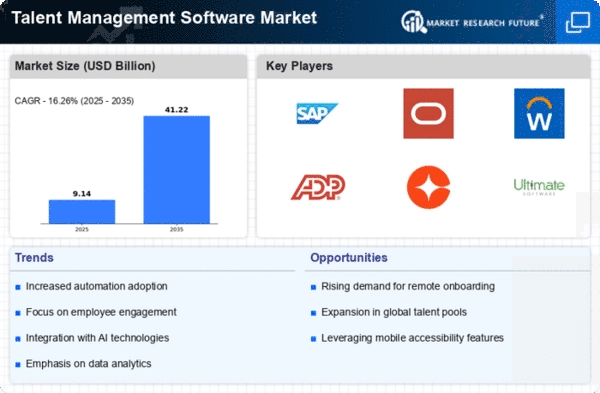
As per MRFR analysis, the Talent Management Software Market Size was estimated at 7.86 USD Billion in 2024. The Talent Management Software industry is projected to grow from 9.14 USD Billion in 2025 to 41.22 USD Billion by 2035, exhibiting a compound annual growth rate (CAGR) of 16.26 during the forecast period 2025 - 2035.

Key Market Trends & Highlights

The Talent Management Software Market is experiencing robust growth driven by technological advancements and evolving workforce needs.

  • The integration of Artificial Intelligence is transforming Talent Management Software, enhancing efficiency and personalization.
  • North America remains the largest market, while the Asia-Pacific region is emerging as the fastest-growing area for talent management solutions.
  • Performance Management continues to dominate the market, whereas Learning and Development is witnessing the fastest growth in demand.
  • The increased focus on skills development and upskilling, alongside the demand for remote work solutions, are key drivers propelling market expansion.

Market Size & Forecast

2024 Market Size 7.86 (USD Billion)
2035 Market Size 41.22 (USD Billion)
CAGR (2025 - 2035) 16.26%
Largest Regional Market Share in 2024 North America

Major Players

<p>SAP (DE), Oracle (US), Workday (US), ADP (US), Cornerstone OnDemand (US), Ultimate Software (US), Ceridian (CA), Saba Software (US), Talentsoft (FR)</p>

Market Trends

The Talent Management Software Market is currently experiencing a transformative phase, driven by the increasing need for organizations to enhance employee engagement and optimize workforce performance. Companies are increasingly recognizing the value of integrating technology into their human resource processes, which facilitates better talent acquisition, development, and retention strategies. This shift is largely influenced by the growing emphasis on data-driven decision-making, enabling organizations to leverage analytics for improved insights into employee performance and potential. As a result, the market is witnessing a surge in demand for innovative solutions that streamline various HR functions, from recruitment to performance management. Moreover, the Talent Management Software Market is characterized by a diverse range of offerings, catering to organizations of all sizes and industries. The rise of cloud-based solutions has further accelerated this trend, providing businesses with scalable and flexible options that can be tailored to their specific needs. Additionally, the focus on user experience and mobile accessibility is becoming increasingly paramount, as organizations seek to engage their workforce in a more interactive and intuitive manner. This evolving landscape suggests that the Talent Management Software Market will continue to expand, driven by technological advancements and the ongoing quest for enhanced organizational effectiveness.

Integration of Artificial Intelligence

The incorporation of artificial intelligence into talent management software is becoming more prevalent. This trend suggests that organizations are leveraging AI to automate routine tasks, enhance candidate screening processes, and provide personalized learning experiences for employees. By utilizing AI, companies may improve efficiency and make more informed decisions regarding talent development.

Emphasis on Employee Experience

There is a growing focus on enhancing the employee experience within the Talent Management Software Market. Organizations appear to be prioritizing tools that foster engagement, collaboration, and feedback. This trend indicates a shift towards creating a more supportive work environment, which could lead to higher retention rates and improved overall performance.

Data-Driven Decision Making

The reliance on data analytics for talent management is increasingly significant. Organizations are utilizing data to inform their HR strategies, from recruitment to performance evaluation. This trend suggests that companies are recognizing the importance of evidence-based approaches, which may lead to more effective talent management practices.

Talent Management Software Market Market Drivers

Market Growth Projections

The Global Talent Management Software Market Industry is poised for substantial growth, with projections indicating a market size of 7.24 USD Billion in 2024 and an anticipated increase to 41.2 USD Billion by 2035. This growth trajectory suggests a compound annual growth rate of 17.13% from 2025 to 2035. The increasing adoption of technology in human resource management, coupled with the need for effective talent acquisition and retention strategies, drives this expansion. As organizations recognize the value of investing in talent management solutions, the market is likely to witness significant advancements and innovations in the coming years.

Regulatory Compliance and Data Security

As organizations navigate complex regulatory environments, the importance of compliance and data security in the Global Talent Management Software Market Industry cannot be overstated. Companies are increasingly required to adhere to various labor laws and data protection regulations, necessitating robust talent management solutions that ensure compliance. Software that integrates compliance features helps organizations mitigate risks associated with non-compliance. The focus on data security is paramount, especially with the rise of cyber threats. As businesses prioritize safeguarding sensitive employee information, the demand for secure and compliant talent management software is likely to grow, shaping the future of the Global Talent Management Software Market Industry.

Increased Demand for Remote Work Solutions

The Global Talent Management Software Market Industry experiences heightened demand for solutions that facilitate remote work. As organizations adapt to flexible work arrangements, talent management software becomes essential for managing employee performance, engagement, and development remotely. This shift is reflected in the projected market growth, with the industry expected to reach 7.24 USD Billion in 2024. Companies are increasingly investing in these technologies to ensure seamless collaboration and communication among remote teams, thus enhancing productivity and employee satisfaction. The emphasis on remote work capabilities is likely to drive innovation and expansion within the Global Talent Management Software Market Industry.

Focus on Employee Development and Retention

In the Global Talent Management Software Market Industry, there is a growing emphasis on employee development and retention strategies. Organizations recognize that investing in their workforce leads to improved performance and reduced turnover rates. Talent management software provides tools for personalized learning and career development, enabling companies to nurture their talent effectively. This trend is underscored by the anticipated growth of the market, which is projected to expand to 41.2 USD Billion by 2035. As businesses strive to create a culture of continuous learning, the demand for robust talent management solutions is likely to increase, further propelling the Global Talent Management Software Market Industry.

Globalization and Diverse Workforce Management

Globalization has led to increasingly diverse workforces, presenting both challenges and opportunities for organizations. The Global Talent Management Software Market Industry is responding to this trend by offering solutions that cater to the needs of a multicultural workforce. Talent management software enables companies to manage global talent pools, ensuring compliance with local regulations and cultural nuances. This adaptability is crucial as businesses expand their operations internationally. The growing need for effective workforce management across borders is likely to drive the demand for specialized talent management solutions, further influencing the trajectory of the Global Talent Management Software Market Industry.

Integration of Artificial Intelligence and Automation

The integration of artificial intelligence and automation technologies is transforming the Global Talent Management Software Market Industry. AI-driven analytics enable organizations to make data-informed decisions regarding talent acquisition, performance management, and employee engagement. Automation streamlines administrative tasks, allowing HR professionals to focus on strategic initiatives. This technological advancement is expected to contribute to a compound annual growth rate of 17.13% from 2025 to 2035. As companies seek to enhance efficiency and effectiveness in their talent management processes, the adoption of AI and automation tools is likely to surge, shaping the future landscape of the Global Talent Management Software Market Industry.

Market Segment Insights

By Application: Performance Management (Largest) vs. Learning and Development (Fastest-Growing)

<p>In the Talent Management Software Market, the application segment is prominently led by Performance Management, exhibiting the largest market share. This category encapsulates tools and systems designed to assess and enhance employee performance in alignment with organizational goals. Following closely behind are Learning and Development systems, which have been gaining significant traction, focusing on continuous employee education and skills enhancement to keep pace with industry innovations. Both segments play a crucial role, yet their distinct focus areas cater to different organizational needs and priorities. As businesses increasingly emphasize employee engagement and growth, the market distribution between these applications is likely to evolve, impacting investment strategies and software developments.</p>

<p>Performance Management (Dominant) vs. Learning and Development (Emerging)</p>

<p>The Performance Management segment remains dominant within the Talent Management Software landscape, characterized by robust tools that facilitate goal setting, feedback, and performance reviews. This category is crucial for organizations seeking to optimize workforce productivity and ensure alignment with strategic objectives. In contrast, Learning and Development is emerging rapidly, fueled by a growing recognition of the importance of upskilling and ongoing professional development. This segment includes training modules, e-learning platforms, and personalized learning paths tailored to individual employees. As competition intensifies and job roles evolve, organizations increasingly turn to Learning and Development solutions to retain talent and enhance employee capabilities, marking this segment as a vital area for future growth.</p>

By Deployment Type: Cloud-Based (Largest) vs. On-Premises (Fastest-Growing)

<p>The Talent Management Software Market is significantly influenced by the deployment type, with cloud-based solutions holding the largest share. Organizations increasingly favor cloud-based software due to its flexibility, scalability, and lower upfront costs, making it the preferred choice for many businesses. On-premises solutions, although traditionally popular, are witnessing a decline as companies shift towards cloud offerings. However, they still maintain a loyal customer base that prioritizes control over data security and compliance. Hybrid solutions also play a role, combining the benefits of both deployment types.</p>

<p>Cloud-Based (Dominant) vs. On-Premises (Emerging)</p>

<p>Cloud-based talent management software is leading the charge in the market, with its popularity rooted in ease of access and continuous updates. Organizations appreciate the reduced IT overhead and the ability to integrate seamlessly with other cloud applications, promoting collaboration and efficiency. On-premises solutions, while characterized by their robust security and data sovereignty features, are becoming less requested among new clients as many companies prioritize agility in their operations. The emerging hybrid model is capturing interest by offering a balance, providing the flexibility of the cloud with the security elements of on-premises installations, appealing to companies with specific regulatory requirements.</p>

By End User: Large Enterprises (Largest) vs. Medium Enterprises (Fastest-Growing)

<p>In the Talent Management Software Market, the distribution of market share among end users reveals a significant dominance of large enterprises, which constitute a major portion of the market. These organizations leverage sophisticated talent management systems to enhance their recruitment, onboarding, and employee development processes, driving overall effectiveness. On the other hand, medium enterprises are steadily growing in their adoption of these technologies, reflecting an increasing recognition of the strategic importance of talent management in achieving business objectives.</p>

<p>Large Enterprises: Dominant vs. Medium Enterprises: Emerging</p>

<p>Large enterprises are characterized by their comprehensive talent management systems that integrate various HR functions, including recruitment, performance management, and employee engagement. Their substantial resources allow them to invest in advanced technologies, ensuring they remain competitive and efficient. In contrast, medium enterprises are emerging as key players in this market due to their adaptability and focus on scaling operations. They are increasingly investing in talent management software to streamline processes and enhance workforce management, positioning themselves as agile competitors. The growing availability of affordable and user-friendly solutions makes it easier for medium-sized companies to improve their HR capabilities, further driving their market presence.</p>

By Functionality: Talent Acquisition (Largest) vs. Employee Engagement (Fastest-Growing)

<p>In the Talent Management Software Market, Talent Acquisition holds the largest market share, demonstrating its pivotal role in the recruitment and onboarding processes within organizations. As businesses increasingly recognize the importance of attracting top talent, this segment has established itself as the cornerstone of talent management solutions. On the other hand, Employee Engagement is emerging as a significant player, rapidly gaining traction as organizations seek to enhance employee satisfaction and retention through innovative engagement strategies and tools. The growth trends in this segment are largely driven by the increasing demand for effective talent strategies that align with organizational goals. As more companies invest in holistic talent management solutions, the Workforce Planning and Learning Management segments are also gaining momentum. Enhanced technology, such as AI-driven analytics and cloud-based platforms, further supports the optimization of employee performance and development, thereby enriching the overall employee experience and contributing to business success.</p>

<p>Talent Acquisition: Dominant vs. Employee Engagement: Emerging</p>

<p>Talent Acquisition stands as the dominant force in the Talent Management Software market, primarily due to its critical influence on securing the best candidates for organizations. This segment is characterized by its comprehensive features that streamline recruitment processes, enhance candidate experiences, and facilitate effective onboarding. In contrast, Employee Engagement, while an emerging area, is rapidly evolving as organizations recognize its importance in maintaining a motivated workforce. This segment focuses on tools that foster employee satisfaction and commitment, providing mechanisms for feedback, recognition, and development. Both segments, although distinct, contribute significantly to the overarching goals of enhancing talent quality and organizational performance, making them essential components of modern talent management strategies.</p>

By Industry: Information Technology (Largest) vs. Healthcare (Fastest-Growing)

<p>The Talent Management Software Market displays a significant distribution of market share across various industries. The Information Technology sector holds the largest portion of the market, due to the sector's inherent reliance on technology and the need for efficient talent acquisition, development, and retention strategies. Healthcare follows closely, appealing especially to organizations looking to refine their hiring processes and enhance employee management. Manufacturing and Retail also contribute to the market, but their share is comparatively smaller due to differing priorities in talent management.</p>

<p>Information Technology: Dominant vs. Healthcare: Emerging</p>

<p>Information Technology remains the dominant force in the Talent Management Software Market, leveraging advanced technologies like AI and analytics to enhance talent acquisition and employee engagement. Companies in this sector prioritize agile solutions that cater to a highly competitive workforce, thus driving innovation. Conversely, the Healthcare sector represents an emerging market within talent management, emphasizing the need for specialized skills in recruitment and retention to address industry challenges. Companies are increasingly adopting technology-driven solutions to enhance compliance, streamline onboarding, and improve overall workforce efficiency, illustrating a growing trend toward digital transformation.</p>

Get more detailed insights about Talent Management Software Market Research Report- Forecast to 2035

Regional Insights

North America : Market Leader in Talent Management

North America continues to lead the Talent Management Software market, holding a significant share of 4.0B in 2025. The region's growth is driven by increasing demand for advanced HR solutions, regulatory support for workforce management, and a focus on employee engagement. Companies are investing heavily in technology to streamline operations and enhance productivity, making it a hotbed for innovation in talent management. The competitive landscape is robust, with key players like SAP, Oracle, and Workday dominating the market. The U.S. is the largest contributor, supported by a strong tech ecosystem and a high adoption rate of cloud-based solutions. Canadian firms like Ceridian are also making strides, ensuring a diverse range of offerings. This competitive environment fosters continuous improvement and innovation, solidifying North America's position as a leader in talent management solutions.

Europe : Emerging Market with Growth Potential

Europe's Talent Management Software market is valued at 2.5B in 2025, reflecting a growing recognition of the importance of effective talent management. The region is experiencing a shift towards digital transformation, driven by regulatory frameworks that encourage workforce development and skills enhancement. Companies are increasingly adopting software solutions to comply with labor laws and improve employee satisfaction, contributing to market growth. Leading countries like Germany, France, and the UK are at the forefront of this evolution, with a mix of established players and innovative startups. Companies such as Talentsoft and SAP are enhancing their offerings to meet local demands. The competitive landscape is characterized by a focus on customization and integration, allowing businesses to tailor solutions to their specific needs. This adaptability is crucial for maintaining a competitive edge in the evolving market.

Asia-Pacific : Rapid Growth in Emerging Markets

The Asia-Pacific region is witnessing a rapid expansion in the Talent Management Software market, projected to reach 1.8B by 2025. This growth is fueled by increasing investments in technology and a rising awareness of the importance of talent management in driving business success. Countries like China and India are leading the charge, with a growing number of organizations adopting software solutions to enhance their HR capabilities and streamline operations. The competitive landscape is diverse, with both The Talent Management Software share. Companies such as Workday and ADP are establishing a strong presence, while regional firms are innovating to cater to local needs. The focus on mobile and cloud-based solutions is particularly pronounced, as businesses seek to leverage technology for greater flexibility and efficiency in managing their workforce. This dynamic environment positions Asia-Pacific as a key player in the global talent management landscape.

Middle East and Africa : Emerging Opportunities in Talent Management

The Middle East and Africa (MEA) region is gradually emerging in the Talent Management Software market, currently valued at 0.56B in 2025. The growth is driven by increasing investments in human capital and a focus on aligning workforce capabilities with business objectives. Governments are implementing policies to enhance workforce skills, which is catalyzing the adoption of talent management solutions across various sectors. Countries like South Africa and the UAE are leading the way, with a growing number of organizations recognizing the value of effective talent management. The competitive landscape is evolving, with both international and local players entering the market. Companies are focusing on providing tailored solutions that address the unique challenges faced by businesses in the region, ensuring that the MEA market is poised for significant growth in the coming years.

Key Players and Competitive Insights

The Talent Management Software Market is currently characterized by a dynamic competitive landscape, driven by the increasing demand for efficient workforce management solutions and the integration of advanced technologies. Major players such as SAP (DE), Oracle (US), and Workday (US) are strategically positioned to leverage innovation and digital transformation to enhance their offerings. SAP (DE) focuses on integrating AI capabilities into its software, thereby improving user experience and operational efficiency. Oracle (US) emphasizes cloud-based solutions, which allow for greater scalability and flexibility, while Workday (US) is known for its user-friendly interface and strong analytics capabilities, positioning itself as a leader in data-driven decision-making. Collectively, these strategies contribute to a competitive environment that is increasingly centered around technological advancement and customer-centric solutions.

In terms of business tactics, companies are increasingly localizing their operations to better serve regional markets, optimizing supply chains to enhance efficiency, and investing in partnerships to expand their reach. The market appears moderately fragmented, with a mix of established players and emerging startups vying for market share. The collective influence of key players is significant, as they set industry standards and drive innovation, which in turn shapes customer expectations and competitive dynamics.

In November 2025, SAP (DE) announced a strategic partnership with a leading AI firm to enhance its talent management solutions. This collaboration aims to integrate advanced machine learning algorithms into SAP's software, enabling more personalized employee development plans. The strategic importance of this move lies in SAP's commitment to staying at the forefront of technological innovation, which is crucial for maintaining competitive advantage in a rapidly evolving market.

In October 2025, Oracle (US) launched a new cloud-based talent management platform that incorporates predictive analytics to forecast workforce trends. This initiative is significant as it allows organizations to proactively manage talent needs, thereby reducing turnover and improving employee satisfaction. Oracle's focus on predictive capabilities reflects a broader trend in the market towards data-driven decision-making, which is becoming increasingly essential for effective talent management.

In September 2025, Workday (US) expanded its global footprint by entering into a strategic alliance with a prominent HR consultancy in Asia. This partnership is expected to enhance Workday's market presence in the region and provide localized solutions tailored to specific cultural and regulatory needs. The strategic importance of this expansion underscores the growing recognition of the need for localized talent management solutions in diverse markets, which can significantly impact customer engagement and satisfaction.

As of December 2025, current competitive trends in the Talent Management Software Market are heavily influenced by digitalization, sustainability, and the integration of AI technologies. Strategic alliances are increasingly shaping the landscape, allowing companies to pool resources and expertise to deliver more comprehensive solutions. Looking ahead, competitive differentiation is likely to evolve from traditional price-based competition to a focus on innovation, technology integration, and supply chain reliability. This shift suggests that companies that prioritize these aspects will be better positioned to meet the evolving demands of the market.

Key Companies in the Talent Management Software Market market include

Industry Developments

  • Q2 2024: Workday Announces New AI-Powered Talent Optimization Capabilities Workday launched new AI-driven features in its talent management suite, including skills intelligence and personalized career recommendations, aimed at helping organizations better match employees to internal opportunities and close skills gaps.
  • Q2 2024: Cornerstone OnDemand Acquires Talespin to Expand Immersive Learning in Talent Management Cornerstone OnDemand announced the acquisition of Talespin, a provider of VR-based learning solutions, to enhance its talent management platform with immersive training and upskilling capabilities.
  • Q2 2024: SAP Appoints New Head of SuccessFactors to Drive Cloud Talent Management Growth SAP named a new global head for its SuccessFactors division, signaling a renewed focus on cloud-based talent management solutions and AI integration.
  • Q3 2024: Beamery Raises $50 Million Series D to Expand AI Talent Lifecycle Platform Beamery, a talent management software provider, secured $50 million in Series D funding to accelerate development of its AI-powered talent lifecycle management platform and expand into new markets.
  • Q3 2024: Oracle Launches Next-Gen Oracle Fusion Cloud Talent Management Oracle introduced a major update to its Fusion Cloud Talent Management suite, featuring advanced analytics and generative AI tools for workforce planning and employee engagement.
  • Q3 2024: UK Government Awards Talent Management Software Market Contract to SAP The UK government selected SAP SuccessFactors for a multi-year contract to modernize talent management and HR processes across several public sector agencies.
  • Q4 2024: LinkedIn Unveils New AI-Powered Talent Insights Platform LinkedIn launched a new AI-driven talent insights platform designed to help enterprises identify workforce trends, skills gaps, and optimize talent acquisition strategies.
  • Q4 2024: UKG Announces Partnership with Google Cloud to Enhance Talent Management Offerings UKG (Ultimate Kronos Group) entered a strategic partnership with Google Cloud to integrate advanced AI and machine learning capabilities into its talent management software.
  • Q1 2025: iCIMS Acquires Altru Labs to Bolster Employee Engagement Solutions iCIMS, a leading talent management software provider, acquired Altru Labs, a video-based employee engagement platform, to strengthen its suite of talent experience solutions.
  • Q1 2025: Ceridian Launches Dayforce Talent Intelligence for Predictive Workforce Planning Ceridian introduced Dayforce Talent Intelligence, a new module leveraging AI to provide predictive analytics for workforce planning and talent optimization.
  • Q2 2025: ADP Debuts AI-Driven Talent Marketplace for Internal Mobility ADP launched a new AI-powered talent marketplace within its talent management suite, enabling organizations to match employees to internal job opportunities and projects based on skills and career aspirations.
  • Q2 2025: Eightfold AI Secures $120 Million in Funding to Expand Global Talent Intelligence Platform Eightfold AI, a talent management software company, raised $120 million in a new funding round to accelerate global expansion and further develop its AI-driven talent intelligence platform.

Future Outlook

Talent Management Software Market Future Outlook

<p>The Talent Management Software Market is projected to grow at a 16.26% CAGR from 2024 to 2035, driven by technological advancements, increasing workforce mobility, and the demand for enhanced employee engagement.</p>

New opportunities lie in:

  • <p>Integration of AI-driven analytics for personalized employee development plans.</p>
  • <p>Expansion into emerging markets with localized talent management solutions.</p>
  • <p>Development of mobile-first platforms to enhance user accessibility and engagement.</p>

<p>By 2035, the Talent Management Software Market is expected to be robust, reflecting substantial growth and innovation.</p>

Market Segmentation

Talent Management Software Market End User Outlook

  • Small Enterprises
  • Medium Enterprises
  • Large Enterprises

Talent Management Software Market Industry Outlook

  • Information Technology
  • Healthcare
  • Manufacturing
  • Retail

Talent Management Software Market Application Outlook

  • Recruitment
  • Performance Management
  • Learning and Development
  • Succession Planning
  • Compensation Management

Talent Management Software Market Functionality Outlook

  • Talent Acquisition
  • Employee Engagement
  • Workforce Planning
  • Learning Management

Talent Management Software Market Deployment Type Outlook

  • Cloud-Based
  • On-Premises
  • Hybrid

Report Scope

MARKET SIZE 20247.86(USD Billion)
MARKET SIZE 20259.14(USD Billion)
MARKET SIZE 203541.22(USD Billion)
COMPOUND ANNUAL GROWTH RATE (CAGR)16.26% (2024 - 2035)
REPORT COVERAGERevenue Forecast, Competitive Landscape, Growth Factors, and Trends
BASE YEAR2024
Market Forecast Period2025 - 2035
Historical Data2019 - 2024
Market Forecast UnitsUSD Billion
Key Companies ProfiledSAP (DE), Oracle (US), Workday (US), ADP (US), Cornerstone OnDemand (US), Ultimate Software (US), Ceridian (CA), Saba Software (US), Talentsoft (FR)
Segments CoveredApplication, Deployment Type, End User, Functionality, Industry
Key Market OpportunitiesIntegration of artificial intelligence enhances personalization and efficiency in the Talent Management Software Market.
Key Market DynamicsRising demand for integrated solutions drives competition and innovation in the Talent Management Software market.
Countries CoveredNorth America, Europe, APAC, South America, MEA

FAQs

How much is the talent management software market?

The global market size of talent management software was valued at USD 7.85 Billion in 2024.

What is the global growth rate of the talent management software market?

The global market is predicted to grow at a CAGR of 16.26% during the forecast period, 2025 -2034.

Which region held the major market share in the talent management software market?

North America had the major share of the global market

Who are the leading market players in the talent management software market?

The key players in the market are Lumesse Ltd. (U.K.), SAP SE, Cornerstone OnDemand (U.S.), and Saba Software (U.S.).

Which component led the talent management software market?

The solution category dominated the market in 2024.

Which deployment had the largest market share in the talent management software market?

The cloud-based software had the largest share of the global market.

  1. EXECUTIVE SUMMARY 17
    1. MARKET ATTRACTIVENESS
    2. ANALYSIS 18
    3. MARKET INTRODUCTION 19
    4. DEFINITION 19
    5. SCOPE OF THE STUDY 19
    6. RESEARCH OBJECTIVE 19
    7. MARKET STRUCTURE 20
    8. RESEARCH METHODOLOGY 21
  2. MARKET DYNAMICS 28
    1. INTRODUCTION 28
    2. DRIVERS 29
      1. INCREASING DEMAND OF CLOUD-BASED TALENT MANAGEMENT SOFTWARE 29
      2. EMERGENCE OF SOCIAL
    3. PLATFORM 29
    4. DRIVERS IMPACT ANALYSIS 30
    5. RESTRAINTS 31
      1. USE OF TRADITIONAL METHODOLOGIES DUE TO LACK OF AWARENESS 31
    6. OPPORTUNITIES 32
      1. GROWING NEED FOR
    7. BIG DATA ANALYTICS IN HUMAN RESOURCE MANAGEMENT 32
    8. CHALLENGES 32
      1. INTEGRATION ACROSS VARIOUS TALENT MANAGEMENT
      2. IMPACT ON DEMAND OF THE SOFTWARE ACROSS VARIOUS INDUSTRY VERTICAL
      3. IMPACT
    9. SUITES 32
    10. IMPACT ANALYSIS OF COVID-19 33
    11. ON DEMAND OF THE SOFTWARE ACROSS REGIONS 33
    12. MARKET TRENDS 34
      1. BIG DATA ANALYTICS 34
      2. CONTINUOUS PERFORMANCE MANAGEMENT 34
      3. DIGITAL TRANSFORMATION
      4. AUTOMATION
    13. MANAGEMENT 34
    14. HYBRID-WORK ENVIRONMENT 35
  3. MARKET FACTOR ANALYSIS 36
    1. VALUE CHAIN ANALYSIS 36
      1. SOFTWARE DESIGNERS & DEVELOPERS 36
      2. SYSTEM INTEGRATORS
      3. END
      4. THREAT OF NEW ENTRANTS 38
      5. BARGAINING POWER OF SUPPLIERS 38
      6. THREAT OF SUBSTITUTES
      7. BARGAINING
    2. USERS 37
    3. PORTER''S FIVE FORCES MODEL 37
    4. POWER OF BUYERS 38
    5. INTENSITY OF RIVALRY 38
  4. GLOBAL TALENT MANAGEMENT SOFTWARE MARKET, BY COMPONENT 39
    1. OVERVIEW 39
      1. GLOBAL TALENT MANAGEMENT
  5. SOFTWARE MARKET, BY COMPONENT, 2018–2030 (USD MILLION) 40
    1. SOFTWARE 40
      1. GLOBAL TALENT MANAGEMENT
  6. SOFTWARE MARKET, BY SOFTWARE, 2018–2030 (USD MILLION) 40
    1. ACQUISITION 41
    2. OTHERS 41
    3. SERVICES 41
  7. WORKFORCE PLANNING 40
  8. PERFORMANCE MANAGEMENT
  9. TALENT
  10. GLOBAL TALENT MANAGEMENT SOFTWARE MARKET, BY SERVICES, 2018–2030 (USD MILLION)
    1. & EDUCATION 41
    2. SUPPORT & MAINTENANCE 42
  11. TRAINING
  12. GLOBAL TALENT MANAGEMENT SOFTWARE MARKET, BY DEPLOYMENT 43
    1. OVERVIEW 43
      1. GLOBAL TALENT MANAGEMENT
  13. SOFTWARE MARKET, BY DEPLOYMENT, 2018–2030 (USD MILLION) 44
    1. ON-PREMISE 44
    2. CLOUD 44
  14. GLOBAL TALENT MANAGEMENT SOFTWARE
  15. MARKET, BY ORGANIZATION SIZE 45
    1. OVERVIEW 45
      1. GLOBAL TALENT MANAGEMENT SOFTWARE MARKET, BY ORGANIZATION SIZE,
    2. SMALL & MEDIUM ENTERPRISES 46
    3. LARGE ENTERPRISES 46
  16. GLOBAL TALENT MANAGEMENT SOFTWARE MARKET, BY VERTICAL
    1. OVERVIEW
      1. GLOBAL
  17. TALENT MANAGEMENT SOFTWARE MARKET, BY VERTICAL, 2018–2030 (USD MILLION) 48
    1. BFSI 48
    2. EDUCATION 48
    3. GOVERNMENT 48
    4. HEALTHCARE 49
    5. IT & TELECOM
    6. MANUFACTURING
    7. MEDIA
    8. & ENTERTAINMENT 49
    9. RETAIL 49
    10. OTHERS 50
  18. GLOBAL TALENT MANAGEMENT SOFTWARE MARKET, BY REGION 51
    1. OVERVIEW 51
      1. GLOBAL TALENT MANAGEMENT SOFTWARE MARKET,
      2. GLOBAL TALENT MANAGEMENT SOFTWARE MARKET, BY REGION,
    2. BY REGION, 2021 VS 2030 (USD MILLION) 51
    3. NORTH AMERICA 53
      1. NORTH AMERICA: TALENT MANAGEMENT SOFTWARE MARKET,
      2. NORTH AMERICA TALENT MANAGEMENT SOFTWARE MARKET,
    4. BY COUNTRY, 2018–2030 (USD MILLION) 54
    5. BY COMPONENT, 2018–2030 (USD MILLION) 54
  19. MARKET, BY SOFTWARE, 2018–2030
    1. (USD MILLION) 55
    2. BY SERVICES, 2018–2030 (USD MILLION) 55
    3. BY DEPLOYMENT, 2018–2030 (USD MILLION) 56
    4. BY ORGANIZATION SIZE,
    5. (USD MILLION) 56
  20. NORTH AMERICA TALENT MANAGEMENT SOFTWARE MARKET,
  21. NORTH AMERICA TALENT MANAGEMENT SOFTWARE MARKET,
  22. NORTH AMERICA TALENT MANAGEMENT SOFTWARE MARKET,
  23. NORTH AMERICA TALENT MANAGEMENT SOFTWARE MARKET, BY VERTICAL, 2018–2030 (USD
    1. MILLION) 57
    2. US 58
  24. US TALENT MANAGEMENT SOFTWARE MARKET, BY COMPONENT, 2018–2030 (USD MILLION)
  25. US TALENT MANAGEMENT SOFTWARE MARKET, BY SOFTWARE, 2018–2030 (USD MILLION)
  26. US TALENT MANAGEMENT SOFTWARE MARKET, BY SERVICES, 2018–2030 (USD MILLION)
  27. US
  28. TALENT MANAGEMENT SOFTWARE MARKET, BY DEPLOYMENT, 2018–2030 (USD MILLION)
  29. US
  30. TALENT MANAGEMENT SOFTWARE MARKET, BY ORGANIZATION SIZE, 2018–2030 (USD MILLION)
  31. US TALENT MANAGEMENT SOFTWARE MARKET, BY VERTICAL, 2018–2030 (USD MILLION)
    1. CANADA 59
  32. CANADA TALENT MANAGEMENT SOFTWARE MARKET, BY COMPONENT, 2018–2030 (USD MILLION)
  33. CANADA TALENT MANAGEMENT SOFTWARE MARKET, BY SOFTWARE, 2018–2030 (USD MILLION)
  34. CANADA TALENT MANAGEMENT SOFTWARE MARKET, BY SERVICES, 2018–2030 (USD MILLION)
  35. CANADA TALENT MANAGEMENT SOFTWARE MARKET, BY DEPLOYMENT, 2018–2030 (USD MILLION)
  36. CANADA TALENT MANAGEMENT SOFTWARE MARKET, BY ORGANIZATION SIZE, 2018–2030
    1. (USD MILLION) 60
  37. CANADA TALENT MANAGEMENT SOFTWARE MARKET, BY VERTICAL, 2018–2030 (USD MILLION)
    1. MEXICO 61
  38. MEXICO TALENT MANAGEMENT SOFTWARE MARKET, BY COMPONENT, 2018–2030 (USD MILLION)
  39. MEXICO TALENT MANAGEMENT SOFTWARE MARKET, BY SOFTWARE, 2018–2030 (USD MILLION)
  40. MEXICO TALENT MANAGEMENT SOFTWARE MARKET, BY SERVICES, 2018–2030 (USD MILLION)
  41. MEXICO TALENT MANAGEMENT SOFTWARE MARKET, BY DEPLOYMENT, 2018–2030 (USD MILLION)
  42. MEXICO TALENT MANAGEMENT SOFTWARE MARKET, BY ORGANIZATION SIZE, 2018–2030
    1. (USD MILLION) 62
  43. MEXICO TALENT MANAGEMENT SOFTWARE MARKET, BY VERTICAL, 2018–2030 (USD MILLION)
    1. EUROPE
      1. EUROPE:
  44. TALENT MANAGEMENT SOFTWARE MARKET, BY COUNTRY, 2018–2030 (USD MILLION) 65
  45. EUROPE TALENT
  46. MANAGEMENT SOFTWARE MARKET, BY COMPONENT, 2018–2030 (USD MILLION) 66
  47. EUROPE TALENT
  48. MANAGEMENT SOFTWARE MARKET, BY SOFTWARE, 2018–2030 (USD MILLION) 66
  49. EUROPE TALENT
  50. MANAGEMENT SOFTWARE MARKET, BY SERVICES, 2018–2030 (USD MILLION) 66
  51. EUROPE TALENT
  52. MANAGEMENT SOFTWARE MARKET, BY DEPLOYMENT, 2018–2030 (USD MILLION) 67
  53. EUROPE TALENT
  54. MANAGEMENT SOFTWARE MARKET, BY ORGANIZATION SIZE, 2018–2030 (USD MILLION)
  55. EUROPE
  56. TALENT MANAGEMENT SOFTWARE MARKET, BY VERTICAL, 2018–2030 (USD MILLION) 69
  57. UK 69
  58. UK TALENT MANAGEMENT
  59. SOFTWARE MARKET, BY COMPONENT, 2018–2030 (USD MILLION) 69
  60. UK TALENT MANAGEMENT
  61. SOFTWARE MARKET, BY SOFTWARE, 2018–2030 (USD MILLION) 69
  62. UK TALENT MANAGEMENT
  63. SOFTWARE MARKET, BY SERVICES, 2018–2030 (USD MILLION) 70
  64. UK TALENT MANAGEMENT SOFTWARE
  65. MARKET, BY DEPLOYMENT, 2018–2030 (USD MILLION) 70
    1. SIZE, 2018–2030 (USD MILLION) 70
    2. (USD MILLION) 71
  66. UK TALENT MANAGEMENT SOFTWARE MARKET, BY ORGANIZATION
  67. UK TALENT MANAGEMENT SOFTWARE MARKET, BY VERTICAL,
  68. GERMANY 71
  69. GERMANY TALENT MANAGEMENT SOFTWARE MARKET, BY COMPONENT, 2018–2030
  70. GERMANY TALENT MANAGEMENT SOFTWARE MARKET, BY SOFTWARE, 2018–2030 (USD MILLION)
  71. GERMANY TALENT MANAGEMENT SOFTWARE MARKET, BY SERVICES, 2018–2030 (USD MILLION)
  72. GERMANY TALENT MANAGEMENT SOFTWARE MARKET, BY DEPLOYMENT, 2018–2030 (USD MILLION)
  73. GERMANY TALENT MANAGEMENT SOFTWARE MARKET, BY ORGANIZATION SIZE, 2018–2030
    1. (USD MILLION) 72
  74. GERMANY TALENT MANAGEMENT SOFTWARE MARKET, BY VERTICAL, 2018–2030 (USD MILLION)
    1. FRANCE 73
  75. FRANCE TALENT MANAGEMENT SOFTWARE MARKET, BY COMPONENT, 2018–2030 (USD MILLION)
  76. FRANCE TALENT MANAGEMENT SOFTWARE MARKET, BY SOFTWARE, 2018–2030 (USD MILLION)
  77. FRANCE TALENT MANAGEMENT SOFTWARE MARKET, BY SERVICES, 2018–2030 (USD MILLION)
  78. FRANCE TALENT MANAGEMENT SOFTWARE MARKET, BY DEPLOYMENT, 2018–2030 (USD MILLION)
  79. FRANCE TALENT MANAGEMENT SOFTWARE MARKET, BY ORGANIZATION SIZE, 2018–2030
    1. (USD MILLION) 74
  80. FRANCE TALENT MANAGEMENT SOFTWARE MARKET, BY VERTICAL, 2018–2030 (USD MILLION)
    1. REST OF EUROPE 75
  81. REST OF EUROPE TALENT MANAGEMENT SOFTWARE MARKET, BY COMPONENT, 2018–2030
    1. (USD MILLION) 75
  82. REST OF EUROPE TALENT MANAGEMENT SOFTWARE MARKET, BY SOFTWARE,
  83. REST OF EUROPE TALENT MANAGEMENT SOFTWARE MARKET, BY SERVICES, 2018–2030 (USD
    1. MILLION) 76
  84. REST OF EUROPE TALENT MANAGEMENT SOFTWARE MARKET, BY DEPLOYMENT, 2018–2030
    1. (USD MILLION) 76
  85. REST OF EUROPE TALENT MANAGEMENT SOFTWARE MARKET, BY ORGANIZATION SIZE,
    1. MILLION) 76
  86. REST OF EUROPE TALENT MANAGEMENT SOFTWARE MARKET, BY VERTICAL, 2018–2030 (USD
    1. MILLION) 77
    2. ASIA-PACIFIC 78
  87. ASIA-PACIFIC: TALENT MANAGEMENT SOFTWARE MARKET, BY COUNTRY, 2018–2030 (USD
    1. MILLION) 79
  88. ASIA-PACIFIC TALENT MANAGEMENT SOFTWARE MARKET, BY COMPONENT, 2018–2030 (USD
    1. MILLION) 80
  89. ASIA-PACIFIC TALENT MANAGEMENT SOFTWARE MARKET, BY SOFTWARE, 2018–2030 (USD
    1. MILLION) 80
  90. ASIA-PACIFIC TALENT MANAGEMENT SOFTWARE MARKET, BY SERVICES, 2018–2030 (USD
    1. MILLION) 81
  91. ASIA-PACIFIC TALENT MANAGEMENT SOFTWARE MARKET, BY DEPLOYMENT, 2018–2030 (USD
    1. MILLION) 81
  92. ASIA-PACIFIC TALENT MANAGEMENT SOFTWARE MARKET, BY ORGANIZATION SIZE,
    1. MILLION) 82
  93. ASIA-PACIFIC TALENT MANAGEMENT SOFTWARE MARKET, BY VERTICAL, 2018–2030 (USD
    1. MILLION) 83
    2. CHINA 84
  94. CHINA TALENT MANAGEMENT SOFTWARE MARKET, BY COMPONENT, 2018–2030 (USD MILLION)
  95. CHINA TALENT MANAGEMENT SOFTWARE MARKET, BY SOFTWARE, 2018–2030 (USD MILLION)
  96. CHINA
  97. TALENT MANAGEMENT SOFTWARE MARKET, BY SERVICES, 2018–2030 (USD MILLION) 84
  98. CHINA TALENT MANAGEMENT
  99. SOFTWARE MARKET, BY DEPLOYMENT, 2018–2030 (USD MILLION) 84
  100. CHINA TALENT MANAGEMENT
  101. SOFTWARE MARKET, BY ORGANIZATION SIZE, 2018–2030 (USD MILLION) 85
  102. CHINA TALENT
  103. MANAGEMENT SOFTWARE MARKET, BY VERTICAL, 2018–2030 (USD MILLION) 85
  104. JAPAN 86
  105. JAPAN TALENT
  106. MANAGEMENT SOFTWARE MARKET, BY COMPONENT, 2018–2030 (USD MILLION) 86
  107. JAPAN TALENT
  108. MANAGEMENT SOFTWARE MARKET, BY SOFTWARE, 2018–2030 (USD MILLION) 86
  109. JAPAN TALENT
  110. MANAGEMENT SOFTWARE MARKET, BY SERVICES, 2018–2030 (USD MILLION) 86
  111. JAPAN TALENT
  112. MANAGEMENT SOFTWARE MARKET, BY DEPLOYMENT, 2018–2030 (USD MILLION) 86
  113. JAPAN TALENT
  114. MANAGEMENT SOFTWARE MARKET, BY ORGANIZATION SIZE, 2018–2030 (USD MILLION)
  115. JAPAN TALENT MANAGEMENT SOFTWARE MARKET, BY VERTICAL, 2018–2030 (USD MILLION)
    1. INDIA 88
  116. INDIA TALENT MANAGEMENT SOFTWARE MARKET, BY COMPONENT, 2018–2030 (USD MILLION)
  117. INDIA TALENT MANAGEMENT SOFTWARE MARKET, BY SOFTWARE, 2018–2030 (USD MILLION)
  118. INDIA TALENT MANAGEMENT SOFTWARE MARKET, BY SERVICES, 2018–2030 (USD MILLION)
  119. INDIA TALENT MANAGEMENT SOFTWARE MARKET, BY DEPLOYMENT, 2018–2030 (USD MILLION)
  120. INDIA TALENT MANAGEMENT SOFTWARE MARKET, BY ORGANIZATION SIZE, 2018–2030 (USD
    1. MILLION) 89
  121. INDIA TALENT MANAGEMENT SOFTWARE MARKET, BY VERTICAL, 2018–2030 (USD MILLION)
    1. REST OF ASIA-PACIFIC 90
    2. COMPONENT,
    3. (USD MILLION) 90
  122. REST OF ASIA-PACIFIC TALENT MANAGEMENT SOFTWARE MARKET, BY
  123. REST OF ASIA-PACIFIC TALENT MANAGEMENT SOFTWARE MARKET, BY SOFTWARE,
    1. MILLION) 90
  124. REST OF ASIA-PACIFIC TALENT MANAGEMENT SOFTWARE MARKET, BY SERVICES,
    1. MILLION) 90
  125. REST OF ASIA-PACIFIC TALENT MANAGEMENT SOFTWARE MARKET, BY DEPLOYMENT,
    1. MILLION) 91
  126. REST OF ASIA-PACIFIC TALENT MANAGEMENT SOFTWARE MARKET, BY ORGANIZATION SIZE,
    1. MILLION) 91
  127. REST OF ASIA-PACIFIC TALENT MANAGEMENT SOFTWARE MARKET, BY VERTICAL, 2018–2030
    1. (USD MILLION) 91
    2. MIDDLE EAST & AFRICA 92
    3. BY COMPONENT,
    4. (USD MILLION) 92
  128. MIDDLE EAST & AFRICA TALENT MANAGEMENT SOFTWARE MARKET,
  129. MIDDLE EAST & AFRICA TALENT MANAGEMENT SOFTWARE MARKET, BY SOFTWARE,
    1. MILLION) 93
  130. MIDDLE EAST & AFRICA TALENT MANAGEMENT SOFTWARE MARKET, BY SERVICES,
    1. MILLION) 93
  131. MIDDLE EAST & AFRICA TALENT MANAGEMENT SOFTWARE MARKET, BY DEPLOYMENT,
    1. MILLION) 94
  132. MIDDLE EAST & AFRICA TALENT MANAGEMENT SOFTWARE MARKET, BY ORGANIZATION SIZE,
    1. (USD MILLION) 94
  133. MIDDLE EAST & AFRICA TALENT MANAGEMENT SOFTWARE MARKET, BY VERTICAL,
    1. MILLION) 95
    2. SOUTH AMERICA 96
  134. SOUTH AMERICA TALENT MANAGEMENT SOFTWARE MARKET, BY COMPONENT, 2018–2030 (USD
    1. MILLION) 96
  135. SOUTH AMERICA TALENT MANAGEMENT SOFTWARE MARKET, BY SOFTWARE,
  136. SOUTH AMERICA TALENT MANAGEMENT SOFTWARE MARKET, BY SERVICES, 2018–2030 (USD
    1. MILLION) 97
  137. SOUTH AMERICA TALENT MANAGEMENT SOFTWARE MARKET, BY DEPLOYMENT, 2018–2030
    1. (USD MILLION) 98
  138. SOUTH AMERICA TALENT MANAGEMENT SOFTWARE MARKET, BY ORGANIZATION SIZE,
    1. MILLION) 98
  139. SOUTH AMERICA TALENT MANAGEMENT SOFTWARE MARKET, BY VERTICAL, 2018–2030 (USD
    1. MILLION) 99
    2. COMPETITVE LANDSCAPE 100
    3. COMPETITIVE BENCHMARKING 101
    4. VENDOR SHARE ANALYSIS 102
    5. RECENT DEVELOPMENTS 102
      1. PRODUCT DEVELOPMENT
    6. PARTNERSHIPS/AGREEMENTS/CONTRACTS/COLLABORATIONS 102
    7. PRODUCT COMPARISON DASHBOARD 104
    8. TOP 5 TALENT MANAGEMENT
    9. SOFTWARE’S 104
    10. UKG PRO 104
    11. PRODUCT DETAILS 104
    12. UKG PRO TALENT - TALENT MANAGEMENT SOFTWARE 104
    13. PRODUCT FEATURES 104
    14. DEPLOYMENT & SUPPORT 105
    15. TALENT ACQUISITION 105
    16. PRODUCT FEATURES 105
    17. DEPLOYMENT & SUPPORT 106
    18. SYSTEM 106
    19. PERFORMANCE MANAGEMENT SOFTWARE 106
    20. PLATFORM 106
    21. PRODUCT FEATURES 106
    22. DEPLOYMENT & SUPPORT 107
    23. WORKDAY''S HR TALENT MANAGEMENT SOFTWARE 107
    24. SOFTWARE 107
    25. TALENT MANAGEMENT SOFTWARE 107
    26. NOW 108
    27. PRODUCT DETAILS 108
    28. ADP® TALENT 108
  140. UKG PRO TALENT - TALENT MANAGEMENT SOFTWARE
  141. UKG READY DEPLOYMENT: 105
  142. PRICING DETAILS 105
  143. CEGID 105
  144. PRODUCT DETAILS 105
  145. CEGID TALENTSOFT 105
  146. TALENT MANAGEMENT
  147. PRICING DETAILS 106
  148. CORNERSTONE ONDEMAND 106
  149. PRODUCT DETAILS 106
  150. TALENT MANAGEMENT
  151. UNIFIED TALENT MANAGEMENT 106
  152. EDCAST TALENT EXPERIENCE
  153. PRICING DETAILS 107
  154. WORKDAY HUMAN CAPITAL MANAGEMENT 107
  155. PRODUCT DETAILS
  156. WORKDAY''S SKILLS AND PERFORMANCE MANAGEMENT
  157. PRODUCT FEATURES 107
  158. DEPLOYMENT & SUPPORT 108
  159. PRICING DETAILS 108
  160. ADP WORKFORCE

Talent Management Software Market Segmentation

Talent Management Software Component Outlook (USD Billion, 2019-2032)

  • Solutions
  • Services

Talent Management Software Deployment Outlook (USD Billion, 2019-2032)

  • On-Premise
  • Cloud

Talent Management Software Organization Size Outlook (USD Billion, 2019-2032)

  • SMEs
  • Large Enterprises

Talent Management Software Regional Outlook (USD Billion, 2019-2032)

  • North America Outlook (USD Billion, 2019-2032)
  • North America Talent Management Software by Component
    • Solutions
    • Services
  • North America Talent Management Software by Deployment
    • On-Premise
    • Cloud
  • North America Talent Management Software by Organization Size
    • SMEs
    • Large Enterprises

US Outlook (USD Billion, 2019-2032)

  • US Talent Management Software by Component
    • Solutions
    • Services
  • US Talent Management Software by Deployment
    • On-Premise
    • Cloud
  • US Talent Management Software by Organization Size
    • SMEs
    • Large Enterprises

CANADA Outlook (USD Billion, 2019-2032)

  • CANADA Talent Management Software by Component
    • Solutions
    • Services
  • CANADA Talent Management Software by Deployment
    • On-Premise
    • Cloud
  • CANADA Talent Management Software by Organization Size
    • SMEs
    • Large Enterprises

Europe Outlook (USD Billion, 2019-2032)

  • Europe Talent Management Software by Component
    • Solutions
    • Services
  • Europe Talent Management Software by Deployment
    • On-Premise
    • Cloud
  • Europe Talent Management Software by Organization Size
    • SMEs
    • Large Enterprises

Germany Outlook (USD Billion, 2019-2032)

  • Germany Talent Management Software by Component
    • Solutions
    • Services
  • Germany Talent Management Software by Deployment
    • On-Premise
    • Cloud
  • Germany Talent Management Software by Organization Size
    • SMEs
    • Large Enterprises

France Outlook (USD Billion, 2019-2032)

  • France Talent Management Software by Component
    • Solutions
    • Services
  • France Talent Management Software by Deployment
    • On-Premise
    • Cloud
  • France Talent Management Software by Organization Size
    • SMEs
    • Large Enterprises

UK Outlook (USD Billion, 2019-2032)

  • UK Talent Management Software by Component
    • Solutions
    • Services
  • UK Talent Management Software by Deployment
    • On-Premise
    • Cloud
  • UK Talent Management Software by Organization Size
    • SMEs
    • Large Enterprises

ITALY Outlook (USD Billion, 2019-2032)

  • ITALY Talent Management Software by Component
    • Solutions
    • Services
  • ITALY Talent Management Software by Deployment
    • On-Premise
    • Cloud
  • ITALY Talent Management Software by Organization Size
    • SMEs
    • Large Enterprises

SPAIN Outlook (USD Billion, 2019-2032)

  • SPAIN Talent Management Software by Component
    • Solutions
    • Services
  • SPAIN Talent Management Software by Deployment
    • On-Premise
    • Cloud
  • SPAIN Talent Management Software by Organization Size
    • SMEs
    • Large Enterprises

Rest Of Europe Outlook (USD Billion, 2019-2032)

  • Rest Of Europe Talent Management Software by Component
    • Solutions
    • Services
  • Rest Of Europe Talent Management Software by Deployment
    • On-Premise
    • Cloud
  • Rest Of Europe Talent Management Software by Organization Size
    • SMEs
    • Large Enterprises

Asia-Pacific Outlook (USD Billion, 2019-2032)

  • Asia-Pacific Talent Management Software by Component
    • Solutions
    • Services
  • Asia-Pacific Talent Management Software by Deployment
    • On-Premise
    • Cloud
  • Asia-Pacific Talent Management Software by Organization Size
    • SMEs
    • Large Enterprises

China Outlook (USD Billion, 2019-2032)

  • China Talent Management Software by Component
    • Solutions
    • Services
  • China Talent Management Software by Deployment
    • On-Premise
    • Cloud
  • China Talent Management Software by Organization Size
    • SMEs
    • Large Enterprises

Japan Outlook (USD Billion, 2019-2032)

  • Japan Talent Management Software by Component
    • Solutions
    • Services
  • Japan Talent Management Software by Deployment
    • On-Premise
    • Cloud
  • Japan Talent Management Software by Organization Size
    • SMEs
    • Large Enterprises
    • India Outlook (USD Billion, 2019-2032)
  • India Talent Management Software by Component
    • Solutions
    • Services
  • India Talent Management Software by Deployment
    • On-Premise
    • Cloud
  • India Talent Management Software by Organization Size
    • SMEs
    • Large Enterprises
    • Australia Outlook (USD Billion, 2019-2032)
  • Australia Talent Management Software by Component
    • Solutions
    • Services
  • Australia Talent Management Software by Deployment
    • On-Premise
    • Cloud
  • Australia Talent Management Software by Organization Size
    • SMEs
    • Large Enterprises

Rest of Asia-Pacific Outlook (USD Billion, 2019-2032)

  • Rest of Asia-Pacific Talent Management Software by Component
    • Solutions
    • Services
  • Rest of Asia-Pacific Talent Management Software by Deployment
    • On-Premise
    • Cloud
  • Rest of Asia-Pacific Talent Management Software by Organization Size
    • SMEs
    • Large Enterprises

Rest of the World Outlook (USD Billion, 2019-2032)

  • Rest of the World Talent Management Software by Component
    • Solutions
    • Services
  • Rest of the World Talent Management Software by Deployment
    • On-Premise
    • Cloud
  • Rest of the World Talent Management Software by Organization Size
    • SMEs
    • Large Enterprises

Middle East Outlook (USD Billion, 2019-2032)

  • Middle East Talent Management Software by Component
    • Solutions
    • Services
  • Middle East Talent Management Software by Deployment
    • On-Premise
    • Cloud
  • Middle East Talent Management Software by Organization Size
    • SMEs
    • Large Enterprises

Africa Outlook (USD Billion, 2019-2032)

  • Africa Talent Management Software by Component
    • Solutions
    • Services
  • Africa Talent Management Software by Deployment
    • On-Premise
    • Cloud
  • Africa Talent Management Software by Organization Size
  •  
    • SMEs
    • Large Enterprises

Latin America Outlook (USD Billion, 2019-2032)

  • Latin America Talent Management Software by Component
    • Solutions
    • Services
  • Latin America Talent Management Software by Deployment
    • On-Premise
    • Cloud
  • Latin America Talent Management Software by Organization Size
    • SMEs
    • Large Enterprises


Infographic

Free Sample Request

Kindly complete the form below to receive a free sample of this Report

Get Free Sample

Customer Strories

Compare Licence

×
Features License Type
Single User Multiuser License Enterprise User
Price $4,950 $5,950 $7,250
Maximum User Access Limit 1 User Upto 10 Users Unrestricted Access Throughout the Organization
Free Customization
Direct Access to Analyst
Deliverable Format
Platform Access
Discount on Next Purchase 10% 15% 15%
Printable Versions