×
Request Free Sample ×

Kindly complete the form below to receive a free sample of this Report

* Please use a valid business email

Leading companies partner with us for data-driven Insights

clients tt-cursor
Hero Background

Stent Market

ID: MRFR/HC/40569-HCR
200 Pages
Rahul Gotadki
February 2026

Stent Market Research Report: Size, Share, Trend Analysis By Types (Drug Eluting Stents, Bare Metal Stents, Bioresorbable Stents), By Material (Stainless Steel, Cobalt Chromium, Polymer), By Applications (Coronary Artery Disease, Peripheral Artery Disease, Neurovascular Disease), By End Use (Hospitals, Ambulatory Surgical Centers, Specialty Clinics) and By Regional (North America, Europe, South America, Asia Pacific, Middle East and Africa) - Growth Outlook & Industry Forecast 2025 To 2035

Share:
Download PDF ×

We do not share your information with anyone. However, we may send you emails based on your report interest from time to time. You may contact us at any time to opt-out.

Stent Market Infographic
Purchase Options

Stent Market Summary

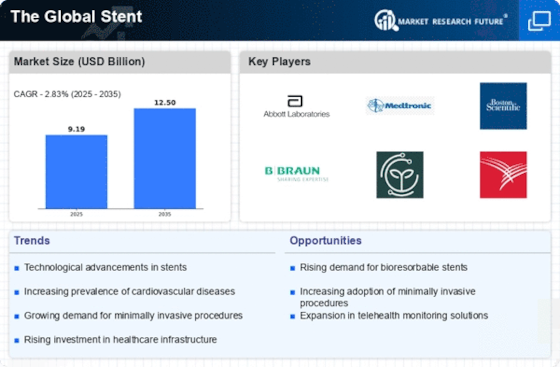
As per Market Research Future analysis, The Global Stent Market Size was estimated at 9.193 USD Billion in 2024. The stent industry is projected to grow from 9.453 USD Billion in 2025 to 12.5 USD Billion by 2035, exhibiting a compound annual growth rate (CAGR) of 2.83% during the forecast period 2025 - 2035

Key Market Trends & Highlights

The Global Stent Market is poised for substantial growth driven by technological advancements and increasing healthcare investments.

  • North America remains the largest market for stents, driven by advanced healthcare infrastructure and high prevalence of cardiovascular diseases.
  • The Asia-Pacific region is emerging as the fastest-growing market, fueled by rising healthcare investments and increasing awareness of cardiovascular health.
  • Drug Eluting Stents dominate the market, while Bioresorbable Stents are gaining traction as the fastest-growing segment.
  • Technological advancements in stent design and the rising prevalence of cardiovascular diseases are key drivers propelling market growth.

Market Size & Forecast

2024 Market Size 9.193 (USD Billion)
2035 Market Size 12.5 (USD Billion)
CAGR (2025 - 2035) 2.83%

Major Players

Abbott (US), Medtronic (US), Boston Scientific (US), B. Braun (DE), Terumo (JP), Cardinal Health (US), Cook Medical (US), Johnson & Johnson (US), St. Jude Medical (US)

Our Impact
Enabled $4.3B Revenue Impact for Fortune 500 and Leading Multinationals
Partnering with 2000+ Global Organizations Each Year
30K+ Citations by Top-Tier Firms in the Industry

Stent Market Trends

The Global Stent Market is currently experiencing a dynamic evolution, driven by advancements in technology and increasing demand for minimally invasive procedures. The market appears to be influenced by a growing awareness of cardiovascular diseases, which has led to a heightened focus on effective treatment options. Innovations in stent design, such as bioresorbable materials and drug-eluting technologies, seem to enhance patient outcomes and reduce complications. Furthermore, the expansion of healthcare infrastructure in emerging economies may contribute to the accessibility of stenting procedures, thereby fostering market growth. In addition, regulatory bodies are likely to play a crucial role in shaping the landscape of The Global Stent Market. Stricter guidelines and approval processes may ensure the safety and efficacy of stents, which could instill greater confidence among healthcare providers and patients alike. As the market continues to evolve, collaboration between manufacturers, healthcare professionals, and regulatory agencies appears essential for addressing challenges and maximizing the potential of stenting technologies. Overall, The Global Stent Market seems poised for continued growth, driven by innovation and a commitment to improving patient care.

Technological Advancements

The Global Stent Market is witnessing rapid technological advancements that enhance the effectiveness of stenting procedures. Innovations such as drug-eluting stents and bioresorbable stents are becoming increasingly prevalent, potentially improving patient outcomes and reducing the risk of complications. These advancements may lead to a shift in preference among healthcare providers towards more sophisticated stenting solutions.

Rising Prevalence of Cardiovascular Diseases

The increasing incidence of cardiovascular diseases globally appears to be a significant driver for The Global Stent Market. As awareness of these conditions grows, there is a corresponding demand for effective treatment options, including stenting procedures. This trend may lead to a greater emphasis on developing and marketing stents that cater to diverse patient needs.

Regulatory Influence

Regulatory bodies are likely to exert considerable influence on The Global Stent Market. Stricter regulations and approval processes may ensure that only safe and effective stents reach the market. This could foster trust among healthcare providers and patients, potentially impacting the adoption rates of new stenting technologies.

Stent Market Drivers

Technological Advancements in Stent Design

The Global Stent Industry is experiencing a transformative phase due to rapid technological advancements in stent design and materials. Innovations such as bioresorbable stents and drug-eluting stents are gaining traction, offering improved patient outcomes and reduced complications. The introduction of advanced imaging techniques and minimally invasive procedures enhances the precision of stent placement, thereby increasing the overall efficacy of cardiovascular interventions. According to recent data, the market for drug-eluting stents is projected to grow significantly, driven by their ability to reduce restenosis rates. As healthcare providers increasingly adopt these advanced technologies, The Global Stent Industry is likely to witness substantial growth, reflecting a shift towards more effective and patient-friendly treatment options.

Rising Prevalence of Cardiovascular Diseases

The Global Stent Industry is significantly influenced by the rising prevalence of cardiovascular diseases, which remain a leading cause of mortality worldwide. Factors such as sedentary lifestyles, unhealthy diets, and increasing stress levels contribute to the growing incidence of conditions like coronary artery disease. Recent statistics indicate that cardiovascular diseases account for approximately 31% of all global deaths, underscoring the urgent need for effective treatment solutions. As healthcare systems respond to this escalating health crisis, the demand for stents is expected to rise correspondingly. This trend not only propels the market forward but also encourages innovation in stent technology, as manufacturers strive to meet the evolving needs of patients and healthcare providers alike.

Regulatory Influence on Stent Approval Processes

The Global Stent Industry is shaped by the regulatory landscape governing the approval and commercialization of stents. Regulatory bodies play a crucial role in ensuring the safety and efficacy of medical devices, which directly impacts market dynamics. Stricter regulations may lead to longer approval times, potentially hindering market entry for new products. Conversely, streamlined approval processes can facilitate quicker access to innovative stent technologies, thereby enhancing market growth. Recent initiatives aimed at expediting the review of breakthrough devices suggest a positive trend for manufacturers. As regulations evolve, The Global Stent Industry must adapt to maintain compliance while fostering innovation and meeting the demands of healthcare providers.

Increasing Investment in Healthcare Infrastructure

The Global Stent Industry is benefiting from increasing investment in healthcare infrastructure across various regions. Governments and private entities are recognizing the importance of enhancing healthcare facilities to address the growing burden of cardiovascular diseases. This investment often translates into improved access to advanced medical technologies, including stents. For instance, the establishment of specialized cardiac care centers is likely to drive demand for stents, as these facilities are equipped to perform complex procedures. Furthermore, enhanced healthcare infrastructure can lead to better patient education and awareness, ultimately resulting in earlier diagnosis and treatment. As investments continue to rise, The Global Stent Industry is poised for growth, reflecting the commitment to improving cardiovascular health outcomes.

Growing Awareness and Education on Cardiovascular Health

The Global Stent Industry is also influenced by the growing awareness and education surrounding cardiovascular health. Public health campaigns and initiatives aimed at educating individuals about the risks associated with cardiovascular diseases are becoming increasingly prevalent. This heightened awareness encourages individuals to seek medical attention sooner, leading to earlier interventions and a higher likelihood of stent placement when necessary. Additionally, healthcare providers are focusing on patient education regarding the benefits and risks of stenting procedures. As awareness continues to grow, the demand for stents is expected to rise, further propelling The Global Stent Industry. This trend highlights the importance of proactive health management and the role of stents in improving patient outcomes.


Market Segment Insights

By Type: Drug Eluting Stents (Largest) vs. Bioresorbable Stents (Fastest-Growing)

In The Global Stent Market, Drug Eluting Stents (DES) hold the largest market share owing to their advanced capabilities in preventing restenosis. Their therapeutic efficiencies and proven track record in clinical settings have fortified their dominance. Bare Metal Stents (BMS), while still relevant, are characterized by their simple structure and are gradually losing space to more sophisticated technologies. Bioresorbable Stents (BRS), although currently occupying a smaller market share, are demonstrating significant potential for growth due to innovations in material science and patient demand for more biocompatible options.

Drug Eluting Stents (Dominant) vs. Bare Metal Stents (Emerging)

Drug Eluting Stents are highly favored in the current market due to their ability to release medication that effectively prevents restenosis and improves patient outcomes. Their advanced design allows them to deliver drugs locally at the site of the artery, significantly enhancing their efficacy. On the other hand, Bare Metal Stents, while historically the go-to option for many interventional procedures, are increasingly seen as an emerging option due to their lower costs and quick deployment in emergency situations. However, as patient preferences shift toward innovative and effective solutions, Bare Metal Stents may face challenges in capturing market share in the long term. The competition between these two types is shaping the future landscape of The Global Stent Market.

By Material: Cobalt Chromium (Largest) vs. Stainless Steel (Fastest-Growing)

In The Global Stent Market, the material composition plays a crucial role in determining performance and patient outcomes. Cobalt Chromium holds a significant share in the market due to its superior properties such as strength and biocompatibility, making it the preferred choice for many manufacturers. Stainless Steel also remains a strong contender, known for its resilience and cost-effectiveness, appealing to hospitals that prioritize budget-friendly options. The dynamics between these materials indicate a competitive landscape where each material serves distinct clinical preferences and manufacturer innovations. Analyzing growth trends, Cobalt Chromium is projected to continue its dominance, driven by advancements in stent design that enhance drug delivery and reduce restenosis rates. Conversely, Stainless Steel, while currently in the fast-growing category, is increasingly integrated into innovative stent systems, capturing market interest through research into coatings and hybrid designs. The upward trajectory of Polymer materials is noteworthy as they introduce bioabsorbable options, reflecting a shift towards transient scaffolding that aligns with patient-centric approaches in cardiology.

Material: Cobalt Chromium (Dominant) vs. Stainless Steel (Emerging)

Cobalt Chromium stands out as a dominant material in The Global Stent Market, favored for its remarkable stress resistance and corrosion properties, which contribute to prolonged stent patency and reduced complications. Its unique mechanical strength allows for thinner yet durable stent designs, making it a go-to option in high-performance cases. Meanwhile, Stainless Steel, categorized as an emerging material, is also evolving; manufacturers are innovating with surface coatings and treatment techniques to enhance its functionality. The cost-effectiveness of Stainless Steel further positions it as an attractive option for healthcare systems navigating budget constraints, fostering an environment of competitive pricing and accessibility in stent technology.

By Application: Coronary Artery Disease (Largest) vs. Peripheral Artery Disease (Fastest-Growing)

The Global Stent Market is predominantly driven by the application in Coronary Artery Disease (CAD), which holds the largest share. This segment's substantial market size can be attributed to the rising prevalence of cardiovascular disorders globally, with increased awareness and advancements in stenting technologies enhancing treatment effectiveness. Conversely, the market for Peripheral Artery Disease (PAD) stents is gaining momentum, emerging as the fastest-growing segment. The demand for peripheral interventions is on the rise due to increasing awareness and the aging population, along with lifestyle changes that predispose individuals to vascular diseases.

Coronary Artery Disease (Dominant) vs. Neurovascular Disease (Emerging)

Coronary Artery Disease (CAD) continues to dominate The Global Stent Market, reflecting its extensive clinical applications and effective treatment protocols. Advances in drug-eluting stents specifically for CAD are driving innovation and improving patient outcomes. In contrast, Neurovascular Disease, while currently an emerging segment, is witnessing rapid growth due to technological advancements and increasing recognition of treating conditions such as intracranial aneurysms and strokes. The neurovascular stent market is fueled by enhanced imaging techniques and broader procedures adoption, with ongoing research advancing device safety and efficacy, marking it as a promising area for future development.

By End Use: Hospitals (Largest) vs. Ambulatory Surgical Centers (Fastest-Growing)

In The Global Stent Market, the end use segment comprises several critical categories, notably Hospitals, Ambulatory Surgical Centers (ASCs), and Specialty Clinics. Hospitals lead this segment, capturing a significant market share due to their extensive resources, advanced technology, and comprehensive patient care capabilities. ASCs, however, are rapidly gaining traction thanks to their efficient processes, lower costs, and increased patient preference for outpatient procedures. Specialty Clinics also hold a niche segment but lag behind the larger players in overall share. The growth of the end use segment is notably influenced by the rising prevalence of cardiovascular diseases and the increasing adoption of minimally invasive procedures. Hospitals remain dominant due to their ability to handle complex cases, while ASCs are becoming the fastest-growing due to a shift towards outpatient services, enabling quicker surgeries and discharges. Additionally, technological advancements in stent design and delivery systems play a crucial role in driving demand across all end-use categories.

Hospitals (Dominant) vs. Ambulatory Surgical Centers (Emerging)

Hospitals are the dominant force in The Global Stent Market, providing comprehensive cardiac care with state-of-the-art facilities and advanced surgical capabilities. They cater to a wide array of patients, offering not only stent placement but also post-operative care and follow-up, contributing to their market leadership. In contrast, Ambulatory Surgical Centers (ASCs) are emerging as a significant alternative, focusing on minimally invasive procedures that allow for quicker patient turnover and reduced hospital stays. ASCs are increasingly preferred for elective surgeries due to lower costs and convenience, leading to their rapid growth. The evolving landscape of healthcare towards outpatient services positions ASCs as a formidable competitor in the stent market, attracting a growing segment of patients seeking efficiency.

Get more detailed insights about Stent Market

Regional Insights

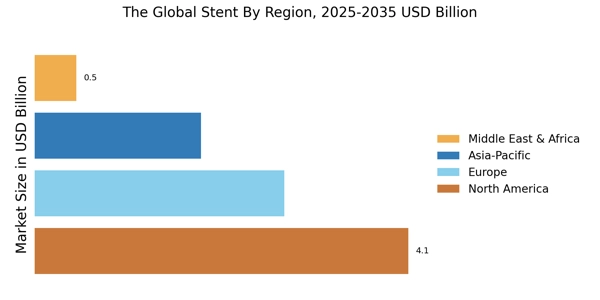
The Regional segment of the Global Stent Market reflects significant diversity in terms of market value and growth potential. In 2024, North America led with a valuation of 4.0 USD Billion, expected to grow to 5.5 USD Billion in 2035, indicating its dominant position due to advanced healthcare infrastructure and higher adoption rates of stenting procedures.

Europe follows closely with a market value of 2.5 USD Billion in 2024, projected to reach 3.4 USD Billion by 2035, driven by an expanding aging population and increasing prevalence of cardiovascular diseases.

The APAC region, valued at 1.8 USD Billion in 2024 and estimated to grow to 2.5 USD Billion by 2035, presents substantial opportunities as healthcare investments increase, particularly in countries like China and India. South America and MEA are smaller markets, with valuations of 0.5 USD Billion and 0.4 USD Billion in 2024, respectively, and growth prospects reliant on improving healthcare systems.

Despite their smaller sizes, these regions represent untapped potential for the Global Stent Market revenue, especially as awareness of cardiovascular health rises.The Global Stent Market data underscores a multi-faceted landscape where each region contributes uniquely to the overall market growth and dynamics.

Stent Market Regional Image

Key Players and Competitive Insights

The competitive insights of the Global Stent Market reveal a dynamic and rapidly evolving landscape characterized by technological advancements, strategic collaborations, and a growing emphasis on patient outcomes. As cardiovascular diseases remain a leading cause of morbidity and mortality worldwide, the demand for stents used to treat coronary artery disease and other vascular conditions continues to rise.Key players in the market are focusing on innovation and product differentiation, developing new stent designs, materials, and delivery systems to enhance clinical efficacy and safety profiles. The competitive environment is further intensified by regulatory changes, reimbursement policies, and increased competition from emerging companies offering cost-effective solutions. As a result, established firms are increasingly investing in research and development to maintain their competitive edge and capture market share in this lucrative sector.Abbott Laboratories has established a strong presence in the Global Stent Market through its innovative product offerings and robust clinical evidence supporting their use.The company is known for its commitment to advancing cardiovascular care by developing high-quality stents that address the needs of patients with coronary artery disease. Strengths include a well-respected portfolio of drug-eluting stents that have consistently demonstrated superior patient outcomes, leading to significant market acceptance. Additionally, Abbott Laboratories benefits from extensive global distribution networks and strong relationships with healthcare providers, which enable it to market its stent products effectively. The company's ongoing focus on research and development ensures a steady pipeline of innovative solutions that meet regulatory standards and improve patient care.Terumo Corporation is another significant player in the Global Stent Market, recognized for its versatile approach to vascular intervention products. With a commitment to facilitating improvements in patient outcomes, Terumo continually invests in advanced technologies and processes that enhance the performance of its stents. The company's strengths lie in its strong research and development capabilities, leading to a range of innovative stent solutions that cater to different therapeutic needs. Terumo's global footprint allows it to penetrate various regional markets effectively, aided by its partnerships with healthcare institutions and professionals.The company's dedication to quality assurance and regulatory compliance further strengthens its reputation, allowing it to maintain a competitive edge in an industry that is constantly evolving.

Key Companies in the Stent Market include

Industry Developments

The Global Stent Market has seen significant developments recently, particularly in technological advancements and regulatory approvals across major companies such as Abbott Laboratories and Boston Scientific, which highlight ongoing innovation in biocompatible materials. Furthermore, Terumo Corporation has engaged in partnerships aimed at enhancing the delivery systems for stent implantation. Current affairs point towards increasing interest from private equity firms in companies like MicroPort Scientific and Medtronic, indicating a trend towards consolidation in the market. 

In terms of mergers and acquisitions, AbbVie has announced plans to acquire a stake in certain market players, which has sent ripples through the investment and healthcare sectors, showcasing confidence in the stent market's growth trajectory. Asahi Intecc and Cook Medical have also reported increased revenues, suggesting a competitive landscape thriving on advancements in minimally invasive procedures.

The rising prevalence of cardiovascular diseases continues to propel growth, with Lepu Medical Technology and Cardiovascular segments growing steadily, influencing market valuation positively. Overall, these dynamics create a complex yet promising environment as industry leaders strive for innovative solutions to meet increasing healthcare demands.

Future Outlook

Stent Market Future Outlook

The Global Stent Market is projected to grow at a 2.83% CAGR from 2025 to 2035, driven by technological advancements, increasing cardiovascular diseases, and rising healthcare expenditures.

New opportunities lie in:

  • Development of biodegradable stents for enhanced patient outcomes.

  • Expansion into emerging markets with tailored stent solutions.
  • Investment in telemedicine platforms for remote stent monitoring.

By 2035, the market is expected to achieve robust growth, reflecting evolving healthcare needs and innovations.

Market Segmentation

Stent Market Type Outlook

  • Drug Eluting Stents
  • Bare Metal Stents
  • Bioresorbable Stents

Stent Market End Use Outlook

  • Hospitals
  • Ambulatory Surgical Centers
  • Specialty Clinics

Stent Market Material Outlook

  • Stainless Steel
  • Cobalt Chromium
  • Polymer

Stent Market Application Outlook

  • Coronary Artery Disease
  • Peripheral Artery Disease
  • Neurovascular Disease

Report Scope

MARKET SIZE 2024 9.193(USD Billion)
MARKET SIZE 2025 9.453(USD Billion)
MARKET SIZE 2035 12.5(USD Billion)
COMPOUND ANNUAL GROWTH RATE (CAGR) 2.83% (2025 - 2035)
REPORT COVERAGE Revenue Forecast, Competitive Landscape, Growth Factors, and Trends
BASE YEAR 2024
Market Forecast Period 2025 - 2035
Historical Data 2019 - 2024
Market Forecast Units USD Billion
Key Companies Profiled Abbott (US), Medtronic (US), Boston Scientific (US), B. Braun (DE), Terumo (JP), Cardinal Health (US), Cook Medical (US), Johnson & Johnson (US), St. Jude Medical (US)
Segments Covered Types, Material, Applications, End Use, Regional
Key Market Opportunities Advancements in biodegradable stent technology enhance patient outcomes and drive market growth in The Global Stent.
Key Market Dynamics Technological advancements in stent design and materials drive competitive dynamics and regulatory adaptations in the market.
Countries Covered North America, Europe, APAC, South America, MEA
Leave a Comment

FAQs

What is the projected market valuation of The Global Stent by 2035?

The Global Stent is projected to reach a valuation of 12.5 USD Billion by 2035.

What was the market valuation of The Global Stent in 2024?

In 2024, The Global Stent was valued at 9.193 USD Billion.

What is the expected CAGR for The Global Stent during the forecast period 2025 - 2035?

The expected CAGR for The Global Stent during the forecast period 2025 - 2035 is 2.83%.

Which type of stent segment had the highest valuation in 2024?

In 2024, the Drug Eluting Stents segment had the highest valuation at 3.5 USD Billion.

What is the projected valuation for Bioresorbable Stents by 2035?

The projected valuation for Bioresorbable Stents is expected to reach 4.5 USD Billion by 2035.

Which material segment is anticipated to grow the most by 2035?

The Polymer material segment is anticipated to grow to 5.0 USD Billion by 2035.

What was the valuation of the Peripheral Artery Disease application segment in 2024?

The valuation of the Peripheral Artery Disease application segment was 2.5 USD Billion in 2024.

Which end-use segment is expected to have the highest growth by 2035?

The Specialty Clinics end-use segment is expected to grow to 5.5 USD Billion by 2035.

Who are the key players in The Global Stent?

Key players in The Global Stent include Abbott, Medtronic, Boston Scientific, and Johnson & Johnson.

What was the valuation of the Bare Metal Stents segment in 2024?

The Bare Metal Stents segment was valued at 2.5 USD Billion in 2024.

Download Free Sample

Kindly complete the form below to receive a free sample of this Report

Compare Licence

×
Features License Type
Single User Multiuser License Enterprise User
Price $4,950 $5,950 $7,250
Maximum User Access Limit 1 User Upto 10 Users Unrestricted Access Throughout the Organization
Free Customization
Direct Access to Analyst
Deliverable Format
Platform Access
Discount on Next Purchase 10% 15% 15%
Printable Versions