Healthcare Robotics Adoption
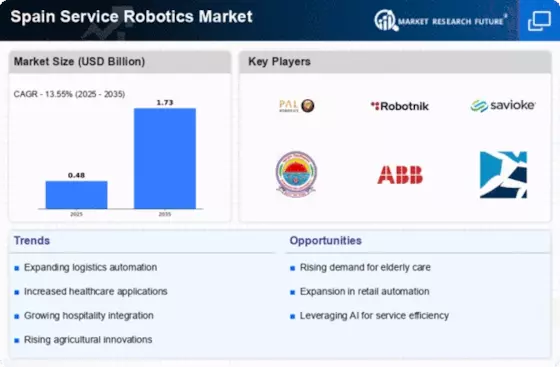
The Spain Service Robotics Market is experiencing a notable surge in the adoption of healthcare robotics. This trend is primarily driven by the increasing demand for efficient patient care and the need to alleviate the burden on healthcare professionals. In Spain, the healthcare sector has been investing significantly in robotic technologies, with projections indicating a growth rate of approximately 15% annually. Hospitals are integrating robotic systems for surgeries, rehabilitation, and patient monitoring, which enhances precision and reduces recovery times. Furthermore, the Spanish government has been supportive of this transition, implementing policies that encourage innovation in healthcare technology. As a result, the Spain Service Robotics Market is poised for substantial growth, reflecting a broader global trend towards automation in healthcare.
Hospitality Sector Innovations
The hospitality sector in Spain is increasingly embracing service robotics, which is a key driver for the Spain Service Robotics Market. With the rise of tourism and the need for enhanced customer experiences, hotels and restaurants are deploying robots for various functions, including room service, cleaning, and customer interaction. Recent data suggests that the market for service robots in the hospitality industry could reach a valuation of over 200 million euros by 2027. This growth is fueled by the desire to improve operational efficiency and provide unique experiences to guests. Additionally, Spanish cities like Barcelona and Madrid are leading the way in integrating robotics into their hospitality services, showcasing the potential of the Spain Service Robotics Market to transform traditional service models.
Government Initiatives and Funding
Government initiatives and funding play a crucial role in shaping the Spain Service Robotics Market. The Spanish government has recognized the potential of robotics to drive economic growth and innovation. Various funding programs and grants have been established to support research and development in robotics, particularly in sectors such as healthcare, manufacturing, and agriculture. For instance, the 'Spain Digital 2025' plan aims to promote digital transformation across industries, including the integration of robotics. This proactive approach not only fosters innovation but also encourages collaboration between public and private sectors. As a result, the Spain Service Robotics Market is likely to benefit from increased investment and a favorable regulatory environment, paving the way for future advancements.
Logistics and Supply Chain Automation
The logistics and supply chain sectors in Spain are undergoing a transformation, significantly impacting the Spain Service Robotics Market. The increasing complexity of supply chains and the demand for faster delivery times have led companies to adopt robotic solutions for warehousing and distribution. Recent statistics indicate that the use of robotics in logistics could enhance operational efficiency by up to 30%. Major logistics firms in Spain are investing in automated guided vehicles (AGVs) and robotic picking systems to streamline their operations. This trend not only reduces labor costs but also minimizes errors in order fulfillment. As the logistics landscape continues to evolve, the Spain Service Robotics Market is likely to see sustained growth driven by these technological advancements.
Rising Labor Costs and Workforce Shortages
Rising labor costs and workforce shortages are emerging as significant drivers for the Spain Service Robotics Market. As the cost of labor continues to escalate, businesses are increasingly looking towards automation as a viable solution to maintain profitability. In Spain, sectors such as manufacturing and agriculture are facing challenges in finding skilled labor, prompting companies to invest in robotic technologies to fill these gaps. The implementation of service robots can lead to substantial cost savings and improved productivity. Moreover, the Spanish government is encouraging this shift by providing incentives for companies that adopt automation technologies. Consequently, the Spain Service Robotics Market is expected to grow as businesses seek to leverage robotics to address labor-related challenges.