×
Request Free Sample ×

Kindly complete the form below to receive a free sample of this Report

* Please use a valid business email

Leading companies partner with us for data-driven Insights

clients tt-cursor
Hero Background

Spain Service Lifecycle Management Market

ID: MRFR/ICT/63268-HCR
200 Pages
Aarti Dhapte
February 2026

Spain Service Lifecycle Management Market Size, Share and Trends Analysis Report By Software Type (Cloud-Based Software, Web-Based Software), By Service Based Models (Dealer-Based Model, Performance-Based Model, Depot-Based Model, Field-Based Model), By Solutions (Customer Contact and Support, Field Service Management, Warranty and Service Management) and By End-Use Industry (Automotive and Transportation, A&D, Medical Equipment, High Technology, Industrial Machinery and Equipment, Telecommunication)- Forecast to 2035

Share:
Download PDF ×

We do not share your information with anyone. However, we may send you emails based on your report interest from time to time. You may contact us at any time to opt-out.

Spain Service Lifecycle Management Market Infographic
Purchase Options

Spain Service Lifecycle Management Market Summary

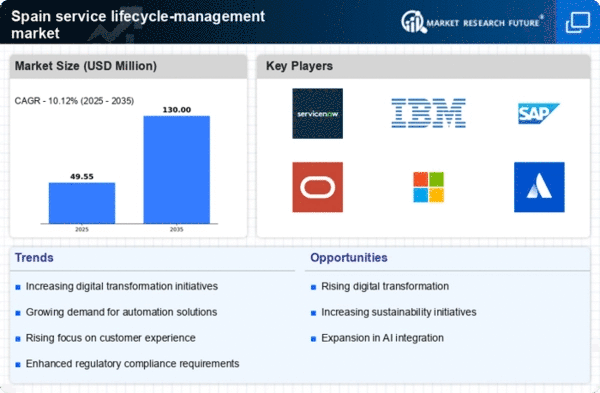
As per Market Research Future analysis, the Spain service lifecycle-management market Size was estimated at 45.0 USD Million in 2024. The Spain service lifecycle-management market industry is projected to grow from 49.55 USD Million in 2025 to 130.0 USD Million by 2035, exhibiting a compound annual growth rate (CAGR) of 10.1% during the forecast period 2025 - 2035

Key Market Trends & Highlights

The Spain service lifecycle-management market is experiencing a transformative shift driven by technological advancements and evolving customer expectations.

  • Technological integration is reshaping service lifecycle-management, enhancing efficiency and responsiveness.
  • The sustainability focus is becoming increasingly prominent, influencing service strategies across various sectors.
  • Regulatory influence is driving compliance and standardization, particularly in the largest segment of IT services.
  • Rising demand for automation and a growing emphasis on customer experience are key drivers propelling market growth.

Market Size & Forecast

2024 Market Size 45.0 (USD Million)
2035 Market Size 130.0 (USD Million)
CAGR (2025 - 2035) 10.12%

Major Players

ServiceNow (US), IBM (US), SAP (DE), Oracle (US), Microsoft (US), Atlassian (AU), BMC Software (US), CA Technologies (US), Micro Focus (GB)

Our Impact
Enabled $4.3B Revenue Impact for Fortune 500 and Leading Multinationals
Partnering with 2000+ Global Organizations Each Year
30K+ Citations by Top-Tier Firms in the Industry

Spain Service Lifecycle Management Market Trends

The service lifecycle-management market in Spain is currently experiencing a notable evolution, driven by the increasing demand for efficient service delivery and management solutions. Organizations are recognizing the importance of optimizing their service processes to enhance customer satisfaction and operational efficiency. This shift is largely influenced by advancements in technology, which facilitate better tracking and management of service lifecycles. As businesses strive to remain competitive, the integration of innovative tools and methodologies becomes essential. Furthermore, regulatory frameworks in Spain are evolving, encouraging companies to adopt more structured approaches to service lifecycle management. This regulatory support may lead to increased investments in technology and training, ultimately fostering a more robust market environment. In addition, the growing emphasis on sustainability and environmental responsibility is shaping the service lifecycle-management market. Companies are increasingly focusing on reducing their carbon footprint and improving resource efficiency throughout the service lifecycle. This trend aligns with broader societal expectations and governmental initiatives aimed at promoting sustainable practices. As a result, organizations are likely to invest in solutions that not only enhance service delivery but also contribute positively to environmental goals. The interplay of these factors suggests a dynamic landscape for the service lifecycle-management market in Spain, characterized by innovation, regulatory support, and a commitment to sustainability.

Technological Integration

The service lifecycle-management market is witnessing a surge in the adoption of advanced technologies. Tools such as artificial intelligence and machine learning are being integrated to streamline processes and enhance decision-making. This trend indicates a shift towards data-driven strategies, allowing organizations to optimize service delivery and improve customer experiences.

Sustainability Focus

There is a growing trend towards sustainability within the service lifecycle-management market. Companies are increasingly prioritizing eco-friendly practices and resource efficiency. This shift reflects a broader commitment to environmental responsibility, aligning with governmental initiatives and societal expectations.

Regulatory Influence

Regulatory frameworks are evolving, impacting the service lifecycle-management market. New policies are encouraging organizations to adopt structured approaches to service management. This regulatory influence may lead to increased investments in technology and training, fostering a more competitive market environment.

Spain Service Lifecycle Management Market Drivers

Rising Demand for Automation

The service lifecycle-management market in Spain experiences a notable increase in demand for automation solutions. Businesses are increasingly seeking to streamline their operations, reduce manual errors, and enhance efficiency. Automation technologies, such as artificial intelligence and machine learning, are being integrated into service management processes. This trend is driven by the need for faster service delivery and improved customer satisfaction. According to recent data, the automation segment is projected to grow at a CAGR of 15% over the next five years. As organizations recognize the potential of automation to optimize service delivery, the service lifecycle-management market is likely to expand significantly.

Adoption of Agile Methodologies

The service lifecycle-management market in Spain is experiencing a shift towards agile methodologies. Organizations are increasingly adopting agile practices to enhance flexibility and responsiveness in service delivery. This approach allows businesses to adapt quickly to changing customer needs and market dynamics. The adoption of agile methodologies is likely to lead to improved collaboration among teams and faster service deployment. As companies seek to remain competitive, the service lifecycle-management market is expected to benefit from this trend. Research indicates that organizations implementing agile practices can achieve a 30% reduction in time-to-market for new services, highlighting the potential impact on the market.

Growing Emphasis on Customer Experience

In Spain, the service lifecycle-management market is witnessing a shift towards prioritizing customer experience. Companies are increasingly aware that exceptional service can differentiate them in a competitive landscape. This focus on customer satisfaction drives investments in service management tools that enhance communication, feedback, and responsiveness. Data indicates that organizations that prioritize customer experience see a 20% increase in customer retention rates. As businesses strive to create personalized and seamless interactions, the demand for advanced service lifecycle-management solutions is expected to rise, further propelling market growth.

Increased Focus on Data-Driven Decision Making

The service lifecycle-management market in Spain is increasingly influenced by the emphasis on data-driven decision making. Organizations are leveraging data analytics to gain insights into service performance, customer behavior, and operational efficiency. This trend enables businesses to make informed decisions that enhance service quality and optimize resource allocation. As companies recognize the value of data in driving service improvements, the demand for analytics-driven service lifecycle-management solutions is expected to grow. It is estimated that the data analytics market in Spain will expand at a CAGR of 12% over the next few years, further supporting the service lifecycle-management market.

Expansion of Digital Transformation Initiatives

The ongoing digital transformation initiatives across various sectors in Spain significantly impact the service lifecycle-management market. Organizations are adopting digital tools and platforms to modernize their service delivery processes. This transformation is characterized by the integration of cloud computing, data analytics, and mobile technologies. As companies transition to digital-first strategies, the service lifecycle-management market is likely to benefit from increased investments in innovative solutions. Reports suggest that the digital transformation market in Spain is set to reach €30 billion by 2026, indicating a robust environment for service lifecycle-management solutions.


Market Segment Insights

By Software Type: Cloud-Based Software (Largest) vs. Web-Based Software (Fastest-Growing)

Within the Spain service lifecycle-management market, the distribution of market share reflects a strong preference for cloud-based software solutions, which currently hold the largest segment share. Web-based software, while slightly trailing, is experiencing rapid adoption as businesses seek more flexible and accessible solutions, making the competitive landscape quite dynamic. As companies continue to transition towards digital platforms, the emphasis on integration and efficiency becomes paramount. Growth trends are notably influenced by increasing investments in technology and the need for businesses to optimize operations. Cloud-based software is favored for its scalability and reliability, enabling organizations to streamline processes effectively. Conversely, web-based software is recognized as the fastest-growing segment, driven by the rise in remote working, which has prompted firms to prioritize accessible solutions that enhance collaboration. The shift towards subscriptions and pay-as-you-go models further highlights the evolving preferences in the market.

Software: Cloud-Based (Dominant) vs. Web-Based (Emerging)

Cloud-based software represents the dominant force in the Spain service lifecycle-management market, characterized by its robust architecture that supports extensive data processing and storage capabilities. This type of software empowers businesses to deploy applications seamlessly across various devices while ensuring high availability and security. In contrast, web-based software is emerging as a compelling alternative, catering to organizations seeking cost-effective solutions that require minimal installation or maintenance. This segment is particularly appealing to small and medium enterprises, offering features that facilitate real-time collaboration and user-friendly interfaces. As the demand for innovative and adaptive software solutions grows, both segments are poised to play significant roles in shaping future market dynamics, with cloud-based offerings leading the charge.

By Service-Based Models: Dealer-Based Model (Largest) vs. Performance-Based Model (Fastest-Growing)

In the Spain service lifecycle-management market, the market share distribution among service-based models showcases the Dealer-Based Model as the dominant player, capturing the largest segment of the market. Performance-Based Models, while smaller in share, are quickly gaining traction and have attracted increasing attention from service providers, indicating a shift in market dynamics. Growth trends reveal that the Performance-Based Model is driven by advancements in technology and customer demands for efficiency, while the Dealer-Based Model benefits from established relationships and brand loyalty. As companies seek tailored solutions and enhanced service offerings, both models are expected to evolve, fostering a competitive landscape where innovation leads to further market penetration.

Dealer-Based Model (Dominant) vs. Field-Based Model (Emerging)

The Dealer-Based Model serves as the backbone of the Spain service lifecycle-management market, characterized by strong distribution networks and trusted partnerships. This model leverages significant customer relationships, ensuring consistent service delivery and satisfaction. In contrast, the Field-Based Model is emerging as a response to the increasing need for localized service solutions, allowing for rapid response times and personalized customer interactions. While the Dealer-Based Model enjoys broad market acceptance, the Field-Based Model's flexibility and adaptability to client needs are positioning it as a significant player in the future, drawing interest from innovative service providers looking to enhance engagement and efficiency.

By Solutions: Customer Contact and Support (Largest) vs. Field Service Management (Fastest-Growing)

In the Spain service lifecycle-management market, 'Customer Contact and Support' holds the largest market share, reflecting the critical need for businesses to enhance customer engagement and satisfaction. This segment dominates due to its fundamental role in service delivery, effectively managing customer interactions and inquiries while facilitating overall service efficiency. Conversely, the 'Field Service Management' segment exhibits growth driven by advancements in technology and the increasing need for real-time service deployment, allowing companies to respond swiftly to customer needs and optimize field operations. Looking ahead, the growth trends for these segments are notable. As organizations continue to focus on customer satisfaction, investments in 'Customer Contact and Support' are expected to remain a priority for improving operational capabilities. On the other hand, 'Field Service Management' is emerging as a crucial area due to innovations such as AI and IoT, which enhance service delivery and operational efficiency. These technological advancements not only improve customer experience but also lead to cost reductions and better resource management across the service lifecycle.

Customer Contact and Support (Dominant) vs. Field Service Management (Emerging)

The 'Customer Contact and Support' segment is characterized by its extensive engagement strategies aimed at nurturing customer relationships and addressing service inquiries effectively. This segment's dominance is underscored by its ability to leverage multi-channel communication platforms, enabling companies to reach customers through various touchpoints. Additionally, it focuses on employing analytics to enhance customer understanding and tailor service experiences. Meanwhile, 'Field Service Management' is emerging as a pivotal segment, driven by the need for agile service teams equipped with real-time data access. This transition towards digital tools empowers technicians in the field, facilitating timely responses to service requests while ensuring efficient resource allocation. Both segments play vital roles in the broader context of service lifecycle management, with each contributing uniquely to customer satisfaction and operational success.

By End Use Industry: Automotive and Transportation (Largest) vs. Aerospace and Defense (Fastest-Growing)

In the Spain service lifecycle-management market, the distribution of market share among various end-use industries reveals that Automotive and Transportation holds a significant position as the largest segment. This sector benefits from a robust supply chain and increasing demand for optimized lifecycle management solutions, allowing for enhanced efficiency and profitability. In contrast, Aerospace and Defense, while smaller in share, is rapidly gaining traction due to advancements in technology and heightened regulatory standards that necessitate comprehensive management solutions. Growth trends within the end-use industries indicate a strong upward trajectory for Aerospace and Defense, driven by an increase in governmental investments and a focus on technological innovations. The Automotive and Transportation sector continues to thrive, propelled by the rise of electric vehicles and a shift toward more sustainable practices. Overall, the Spain service lifecycle-management market is experiencing dynamic shifts, with both segments poised for considerable development in the coming years.

Automotive and Transportation: Dominant vs. Aerospace and Defense: Emerging

The Automotive and Transportation segment is characterized by its robustness and adaptability, dominating the Spain service lifecycle-management market. Companies within this sector leverage advanced technologies to streamline operations, reduce costs, and enhance customer satisfaction. With a strong emphasis on sustainability and innovation, the segment is actively integrating electric and autonomous vehicles into its lifecycle management processes. On the other hand, Aerospace and Defense is emerging as a vital segment, focusing on compliance and precision. As governments invest heavily in defense capabilities and the aerospace sector seeks to improve efficiency, lifecycle management solutions are becoming integral to meeting both operational and regulatory demands.

Get more detailed insights about Spain Service Lifecycle Management Market

Key Players and Competitive Insights

The service lifecycle-management market in Spain is characterized by a dynamic competitive landscape, driven by the increasing demand for efficient service delivery and operational excellence. Key players such as ServiceNow (US), IBM (US), and SAP (DE) are at the forefront, each adopting distinct strategies to enhance their market positioning. ServiceNow (US) focuses on innovation through its cloud-based solutions, aiming to streamline service management processes. IBM (US), on the other hand, emphasizes digital transformation and AI integration, leveraging its extensive research capabilities to develop advanced analytics tools. SAP (DE) is strategically expanding its regional presence, enhancing its offerings to cater to local market needs, thereby fostering a more tailored approach to service lifecycle management. Collectively, these strategies contribute to a competitive environment that is increasingly centered around technological advancement and customer-centric solutions.In terms of business tactics, companies are increasingly localizing their operations to better serve the Spanish market. This includes optimizing supply chains and enhancing customer engagement through localized service offerings. The market structure appears moderately fragmented, with several key players exerting influence while also facing competition from emerging firms. The collective actions of these major companies shape a landscape where innovation and responsiveness to market demands are paramount.

In September ServiceNow (US) announced a strategic partnership with a leading Spanish telecommunications provider to enhance service delivery through integrated cloud solutions. This collaboration is expected to significantly improve operational efficiencies and customer satisfaction, indicating ServiceNow's commitment to leveraging local partnerships for growth. Such strategic moves not only bolster ServiceNow's market presence but also reflect a broader trend of companies seeking synergies to enhance service capabilities.

In October IBM (US) unveiled a new AI-driven analytics platform tailored for the Spanish market, aimed at optimizing service management processes. This initiative underscores IBM's focus on harnessing artificial intelligence to provide actionable insights, thereby enabling organizations to make data-driven decisions. The introduction of this platform is likely to strengthen IBM's competitive edge by addressing specific local needs and enhancing service delivery.

In August SAP (DE) launched a localized version of its service lifecycle management software, specifically designed for Spanish enterprises. This move is indicative of SAP's strategy to deepen its engagement with local businesses, ensuring that its solutions are aligned with regional operational requirements. By customizing its offerings, SAP positions itself as a more relevant player in the market, potentially increasing its market share.

As of November the competitive trends in the service lifecycle-management market are increasingly defined by digitalization, sustainability, and the integration of AI technologies. Strategic alliances are becoming more prevalent, as companies recognize the value of collaboration in enhancing service capabilities. Looking ahead, competitive differentiation is likely to evolve, with a shift from traditional price-based competition towards a focus on innovation, technological advancement, and supply chain reliability. This transition suggests that companies that prioritize these elements will be better positioned to thrive in an increasingly complex market.

Key Companies in the Spain Service Lifecycle Management Market include

Industry Developments

Recent developments in the Spain Service Lifecycle Management Market have highlighted significant advancements and activities among key players such as Oracle, Siemens, and ServiceNow. For instance, in June 2023, Oracle expanded its cloud offerings in Spain, focusing on enhancing service lifecycle capabilities, which is expected to boost enterprise efficiency. 

Moreover, Siemens has been actively integrating its Digital Industries and Smart Infrastructure segments to offer more robust lifecycle management solutions, enhancing their competitive edge in the region. On the acquisition front, in April 2023, ServiceNow completed its acquisition of an AI-driven service platform, augmenting its capabilities in Spain's digital transformation efforts. 

Notably, the economic outlook for the service lifecycle management industry in Spain seems optimistic, with projections indicating considerable growth in market valuation due to increased investment in automation and digital services. In the past couple of years, several initiatives have focused on sustainability and advanced technologies, reflecting a growing trend towards eco-friendly practices and innovation in service lifecycle management. The Spanish government's support for digitalization further solidifies the market's trajectory, making it an essential sector for industry stakeholders.

Future Outlook

Spain Service Lifecycle Management Market Future Outlook

The Service Lifecycle Management Market in Spain is projected to grow at a 10.12% CAGR from 2025 to 2035, driven by technological advancements and increasing demand for efficiency.

New opportunities lie in:

  • Integration of AI-driven analytics for predictive maintenance solutions.
  • Development of subscription-based service models for enhanced customer engagement.
  • Expansion of mobile service applications to streamline field operations.

By 2035, the market is expected to achieve robust growth, positioning itself as a leader in service efficiency.

Market Segmentation

Spain Service Lifecycle Management Market Solutions Outlook

  • Customer Contact and Support
  • Field Service Management
  • Warranty and Service Management
  • Service Parts Information Management

Spain Service Lifecycle Management Market Software Type Outlook

  • Cloud-Based Software
  • Web-Based Software

Spain Service Lifecycle Management Market End Use Industry Outlook

  • Automotive and Transportation
  • Aerospace and Defense
  • Medical Equipment
  • High Technology
  • Industrial Machinery and Equipment
  • Telecommunication

Spain Service Lifecycle Management Market Service-Based Models Outlook

  • Dealer-Based Model
  • Performance-Based Model
  • Depot-Based Model
  • Field-Based Model

Report Scope

MARKET SIZE 2024 45.0(USD Million)
MARKET SIZE 2025 49.55(USD Million)
MARKET SIZE 2035 130.0(USD Million)
COMPOUND ANNUAL GROWTH RATE (CAGR) 10.12% (2025 - 2035)
REPORT COVERAGE Revenue Forecast, Competitive Landscape, Growth Factors, and Trends
BASE YEAR 2024
Market Forecast Period 2025 - 2035
Historical Data 2019 - 2024
Market Forecast Units USD Million
Key Companies Profiled ServiceNow (US), IBM (US), SAP (DE), Oracle (US), Microsoft (US), Atlassian (AU), BMC Software (US), CA Technologies (US), Micro Focus (GB)
Segments Covered Software Type, Service-Based Models, Solutions, End Use Industry
Key Market Opportunities Integration of artificial intelligence in service lifecycle-management enhances efficiency and customer satisfaction.
Key Market Dynamics Growing emphasis on digital transformation drives innovation in service lifecycle-management solutions across various sectors.
Countries Covered Spain
Leave a Comment

FAQs

What is the expected market size of the Spain Service Lifecycle Management Market in 2024?

The Spain Service Lifecycle Management Market is expected to be valued at 28.0 USD Million in 2024.

What is the projected market size of the Spain Service Lifecycle Management Market by 2035?

By 2035, the market is projected to reach a value of 71.0 USD Million.

What is the expected compound annual growth rate (CAGR) for the Spain Service Lifecycle Management Market from 2025 to 2035?

The expected CAGR for the Spain Service Lifecycle Management Market is 8.827% from 2025 to 2035.

What are the values of cloud-based software and web-based software segments in the Spain Service Lifecycle Management Market in 2024?

In 2024, cloud-based software is valued at 12.0 USD Million, while web-based software is valued at 16.0 USD Million.

What will be the valuation of cloud-based software in the Spain Service Lifecycle Management Market by 2035?

Cloud-based software is expected to be valued at 30.0 USD Million by the year 2035.

What is the anticipated value of web-based software in the market by 2035?

Web-based software is projected to reach a valuation of 41.0 USD Million by 2035.

Who are the major players in the Spain Service Lifecycle Management Market?

Key players in the market include Oracle, Hexagon, Dell Technologies, Siemens, and Broadcom among others.

What is driving growth in the Spain Service Lifecycle Management Market?

Growth is driven by increasing demand for efficient lifecycle management practices across various sectors.

What are the key emerging trends in the Spain Service Lifecycle Management Market?

Emerging trends include the adoption of cloud-based solutions and integration with advanced analytics and AI technologies.

What challenges does the Spain Service Lifecycle Management Market currently face?

The market faces challenges such as the need for skilled professionals and resistance to adopting new technologies.

Download Free Sample

Kindly complete the form below to receive a free sample of this Report

Compare Licence

×
Features License Type
Single User Multiuser License Enterprise User
Price $4,950 $5,950 $7,250
Maximum User Access Limit 1 User Upto 10 Users Unrestricted Access Throughout the Organization
Free Customization
Direct Access to Analyst
Deliverable Format
Platform Access
Discount on Next Purchase 10% 15% 15%
Printable Versions