×
Request Free Sample ×

Kindly complete the form below to receive a free sample of this Report

* Please use a valid business email

Leading companies partner with us for data-driven Insights

clients tt-cursor
Hero Background

Spain Communications Interface Market

ID: MRFR/ICT/57824-HCR
200 Pages
Aarti Dhapte
February 2026

Spain Communications Interface Market Size, Share and Trends Analysis Report By Technology (Wireless Communication, Wired Communication, Satellite Communication, Optical Communication), By Application (Telecommunications, Automotive, Consumer Electronics, Industrial Automation, Healthcare), By End Use (Residential, Commercial, Government, Transportation) and By Data Transmission Type (Analog, Digital, Hybrid)- Forecast to 2035

Share:
Download PDF ×

We do not share your information with anyone. However, we may send you emails based on your report interest from time to time. You may contact us at any time to opt-out.

Spain Communications Interface Market Infographic
Purchase Options

Spain Communications Interface Market Summary

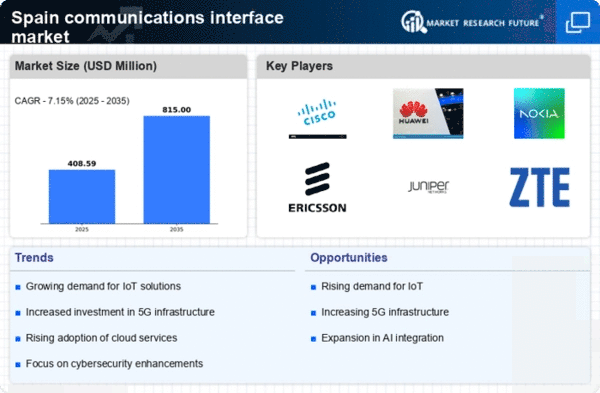
As per Market Research Future analysis, the Spain Communications Interface Market size was estimated at 381.33 USD Million in 2024. The Communications Interface market is projected to grow from 408.59 USD Million in 2025 to 815.0 USD Million by 2035, exhibiting a compound annual growth rate (CAGR) of 7.1% during the forecast period 2025 - 2035

Key Market Trends & Highlights

The Spain communications interface market is experiencing robust growth driven by technological advancements and evolving user needs.

  • The rise of IoT integration is transforming communication interfaces across various sectors.
  • User-centric design innovations are becoming increasingly prevalent, enhancing user experience and engagement.
  • The largest segment in the market is telecommunications, while the fastest-growing segment is remote communication solutions.
  • Key market drivers include the expansion of 5G infrastructure and rising cybersecurity concerns.

Market Size & Forecast

2024 Market Size 381.33 (USD Million)
2035 Market Size 815.0 (USD Million)
CAGR (2025 - 2035) 7.15%

Major Players

Cisco Systems (US), Huawei Technologies (CN), Nokia (FI), Ericsson (SE), Juniper Networks (US), ZTE Corporation (CN), Alcatel-Lucent (FR), Avaya (US), Mitel Networks (CA)

Our Impact
Enabled $4.3B Revenue Impact for Fortune 500 and Leading Multinationals
Partnering with 2000+ Global Organizations Each Year
30K+ Citations by Top-Tier Firms in the Industry

Spain Communications Interface Market Trends

The Spain Communications Interface Market in Spain is evolving dynamically, driven by advancements in technology and increasing demand for seamless connectivity. The proliferation of smart devices and the Internet of Things (IoT) has led to a heightened need for efficient communication solutions. As businesses and consumers alike seek to enhance their digital experiences, the market is adapting to meet these expectations. Innovations in software and hardware are facilitating more robust interfaces, which are essential for effective data exchange and user interaction. Furthermore, regulatory frameworks are evolving to support the integration of new technologies, ensuring that the market remains competitive and compliant with international standards. In addition, the emphasis on cybersecurity is becoming increasingly prominent within the communications interface market. As digital threats continue to rise, stakeholders are prioritizing secure communication channels to protect sensitive information. This focus on security is likely to shape product development and service offerings, as companies strive to build trust with their users. Overall, the landscape of the communications interface market in Spain appears poised for growth, with a strong emphasis on innovation, security, and user-centric design.

Rise of IoT Integration

The integration of Internet of Things (IoT) technologies is transforming the communications interface market. As more devices become interconnected, the demand for interfaces that facilitate seamless communication between these devices is increasing. This trend is likely to drive innovation in interface design and functionality.

Focus on Cybersecurity

With the growing prevalence of cyber threats, there is a heightened focus on cybersecurity within the communications interface market. Companies are prioritizing secure communication protocols and data protection measures to safeguard user information, which may influence product development and market strategies.

User-Centric Design Innovations

The emphasis on user experience is shaping the development of communications interfaces. Companies are increasingly adopting user-centric design principles to create intuitive and accessible interfaces. This trend suggests a shift towards prioritizing user needs and preferences in product offerings.

Spain Communications Interface Market Drivers

Rising Cybersecurity Concerns

As the reliance on digital communication grows, so do concerns regarding cybersecurity, which is a critical driver for the communications interface market. In Spain, businesses are increasingly aware of the potential risks associated with data breaches and cyberattacks. This awareness has led to a heightened demand for secure communication interfaces that incorporate advanced encryption and authentication measures. Recent studies indicate that 70% of Spanish companies prioritize cybersecurity in their technology investments. This trend suggests that the communications interface market needs to adapt to these security challenges, potentially leading to innovations in secure communication protocols and user authentication methods.

Expansion of 5G Infrastructure

The ongoing expansion of 5G infrastructure in Spain is a pivotal driver for the communications interface market. With the deployment of 5G networks, the demand for advanced communication interfaces is expected to surge. This technology enables faster data transmission and lower latency, which are crucial for applications such as smart cities and autonomous vehicles. As of 2025, the Spanish government has allocated approximately €1 billion to enhance telecommunications infrastructure, which is likely to stimulate growth in the communications interface market. The integration of 5G technology is anticipated to create new opportunities for businesses, enhancing connectivity and enabling innovative solutions that rely on robust communication interfaces.

Adoption of Artificial Intelligence Technologies

The integration of artificial intelligence (AI) technologies into communication systems is emerging as a transformative driver for the communications interface market in Spain. AI can enhance user experience by enabling intelligent features such as natural language processing and predictive analytics. As businesses seek to improve customer engagement and streamline operations, the demand for AI-driven communication interfaces is likely to increase. Market analysis indicates that the AI communications sector in Spain could grow by 30% by 2026. This growth reflects the potential for AI to revolutionize how communication interfaces function, making them more intuitive and responsive to user needs.

Government Initiatives for Digital Transformation

The Spanish government has launched various initiatives aimed at promoting digital transformation across industries, which serves as a significant driver for the communications interface market. Programs such as the Digital Spain 2025 agenda focus on enhancing digital infrastructure and fostering innovation. By investing in technology and communication systems, the government aims to improve connectivity and accessibility for businesses and citizens alike. This initiative is expected to result in a market growth rate of approximately 20% over the next few years. As organizations align with these government objectives, the demand for sophisticated communication interfaces is likely to increase, driving further advancements in the market.

Increased Demand for Remote Communication Solutions

The rise in remote work and virtual collaboration tools has significantly influenced the communications interface market in Spain. As organizations adapt to new working models, there is a growing need for reliable and efficient communication interfaces that facilitate seamless interaction among remote teams. According to recent data, the market for remote communication solutions in Spain is projected to grow by 25% annually through 2025. This trend indicates a strong demand for advanced interfaces that support video conferencing, instant messaging, and collaborative platforms. Consequently, companies are investing in developing user-friendly and secure communication interfaces to meet the evolving needs of the workforce.


Market Segment Insights

By Technology: Wireless Communication (Largest) vs. Optical Communication (Fastest-Growing)

In the Spain communications interface market, market share distribution reveals that Wireless Communication leads the sector, holding a significant portion of the overall market. Following closely are Wired Communication and Satellite Communication, which capture respectable shares; however, they are overshadowed by the dominant presence of wireless technologies. Optical Communication, while a smaller segment, is witnessing rapid adoption and growth due to advancements in technology and increasing demand for high-speed data transmission. Growth trends in the Spain communications interface market show a clear trajectory towards emerging technologies. The rise in mobile connectivity and the proliferation of IoT devices have propelled Wireless Communication to the forefront. Conversely, Optical Communication stands out as the fastest-growing segment, driven by the need for greater bandwidth and lower latency solutions. Increased investments in fiber optic networks and enhancements in technology further bolster its expansion, making it a promising area for future developments.

Wireless Communication: Dominant vs. Optical Communication: Emerging

Wireless Communication enjoys a dominant position in the market, thanks to its extensive adoption across various sectors, including personal, commercial, and industrial applications. It benefits from high mobility and versatility, catering to the evolving needs of modern users. Additionally, its integration with emerging technologies, such as 5G, has solidified its market share. On the other hand, Optical Communication represents an emerging segment characterized by its ability to handle vast data flows efficiently. The increasing deployment of optical networks in urban regions signifies its growth potential. Its advantages, such as enhanced speed and reduced interference, make it appealing to telecom providers seeking to improve service quality. The market is poised for significant changes as demand for reliable data transmission continues to rise.

By Application: Telecommunications (Largest) vs. Automotive (Fastest-Growing)

In the Spain communications interface market, the telecommunications sector holds the largest share, dominating the landscape due to its established infrastructure and a wide range of applications in both consumer and business segments. This steady market share is supported by the continuous demand for advanced communication technologies and services, which cater to the growing need for connectivity and data transmission. On the other hand, the automotive segment is identified as the fastest-growing area within the market. The rise of smart vehicles and the integration of communication technologies in transportation is driving growth in this segment. This surge is fueled by advancements in automotive technology, including connected cars and smart traffic systems, which are becoming increasingly essential in modern urban environments.

Telecommunications (Dominant) vs. Automotive (Emerging)

The telecommunications segment is characterized by its robust infrastructure and essential role in providing connectivity among various devices and networks. It serves as the backbone for various applications, including mobile communications and internet services, making it a dominant force in the Spain communications interface market. Conversely, the automotive segment is emerging rapidly, powered by innovations such as vehicle-to-everything (V2X) communication and the increasing adoption of electric and autonomous vehicles. This segment's growth is indicative of a larger trend towards digitization and IoT integration in transportation, fundamentally shifting how vehicles interact with their environment.

By End Use: Residential (Largest) vs. Commercial (Fastest-Growing)

The Spain communications interface market shows a diverse distribution among its end-use segments. Residential applications dominate the market, accounting for the largest share as households increasingly adopt smart technologies and automation. Commercial usage follows closely, driven by the growth of digital corporate communications and the need for efficient connectivity in offices and workplaces. Growth trends indicate that the commercial segment is experiencing the fastest expansion due to the rising demand for innovative communication solutions among businesses. This segment is propelled by advancements in technology, increased broadband adoption, and enhanced services like cloud-based communication systems, which are becoming essential for modern enterprises in Spain.

Residential (Dominant) vs. Commercial (Emerging)

The residential segment is characterized by a strong preference for user-friendly interfaces that facilitate communication and control over smart home devices. Households are increasingly investing in integrated solutions that enhance convenience, security, and energy efficiency. In contrast, the commercial segment is emerging as a robust player, driven by businesses adopting advanced communication tools for collaboration and productivity enhancement. Businesses are leaning towards scalable solutions that allow for seamless integration of various communication technologies, ensuring that operations are efficient and responsive to market demands. This dichotomy shows the evolving landscape of user needs between personal and business applications.

By Data Transmission Type: Digital (Largest) vs. Hybrid (Fastest-Growing)

In the Spain communications interface market, the data transmission type segment exhibits a competitive landscape, with Digital holding the largest market share. Following Digital, Hybrid solutions are gaining traction, driven by their versatility and the growing demand for integrated communication solutions. Analog systems, while present, are diminishing in share due to the shift towards more robust digital technologies that offer enhanced features and reliability. The growth trends indicate that Digital transmission continues to dominate due to its established presence and reliability in various communication applications. However, Hybrid systems are emerging rapidly, fueled by advancements in technology and the need for flexible communication frameworks. This shift is driven by increasing consumer demands for faster, more efficient communication methods that combine the strengths of both Analog and Digital platforms.

Digital (Dominant) vs. Hybrid (Emerging)

Digital transmission technology plays a pivotal role in the Spain communications interface market, characterized by its ability to provide high-speed, reliable communication across various channels. This dominant segment leverages advanced coding techniques and bandwidth efficiency, making it the preferred choice for many businesses. Meanwhile, Hybrid solutions are emerging as versatile options that blend the benefits of both Analog and Digital systems. They are particularly appealing for environments requiring adaptability, allowing users to transition smoothly between different communication protocols. This adaptability is propelling their market growth, as businesses seek solutions that can evolve with changing communication demands.

Get more detailed insights about Spain Communications Interface Market

Key Players and Competitive Insights

The communications interface market in Spain is characterized by a dynamic competitive landscape, driven by rapid technological advancements and increasing demand for seamless connectivity. Major players such as Cisco Systems (US), Huawei Technologies (CN), and Nokia (FI) are at the forefront, each adopting distinct strategies to enhance their market presence. Cisco Systems (US) focuses on innovation through its robust portfolio of networking solutions, while Huawei Technologies (CN) emphasizes regional expansion and partnerships to bolster its foothold in Europe. Nokia (FI), on the other hand, is heavily investing in digital transformation initiatives, aiming to leverage AI and IoT technologies to optimize network performance. Collectively, these strategies contribute to a competitive environment that is both collaborative and fiercely contested, as companies seek to differentiate themselves in a rapidly evolving market.
Key business tactics employed by these companies include localizing manufacturing and optimizing supply chains to enhance operational efficiency. The market structure appears moderately fragmented, with several key players exerting influence over various segments. This fragmentation allows for a diverse range of offerings, catering to different customer needs while fostering innovation through competition.
In October 2025, Cisco Systems (US) announced a strategic partnership with a leading Spanish telecommunications provider to enhance its cloud-based communication solutions. This collaboration is expected to facilitate the deployment of advanced networking technologies, thereby improving service delivery and customer experience. The strategic importance of this partnership lies in Cisco's ability to leverage local expertise while expanding its market reach in Spain, aligning with its broader goal of driving digital transformation across Europe.
In September 2025, Huawei Technologies (CN) unveiled a new 5G communication interface tailored for smart cities in Spain. This initiative underscores Huawei's commitment to innovation and its strategic focus on urban development projects. By introducing cutting-edge technology that supports smart infrastructure, Huawei positions itself as a key player in the burgeoning smart city sector, potentially enhancing its competitive edge in the region.
In August 2025, Nokia (FI) launched a comprehensive sustainability initiative aimed at reducing its carbon footprint across its operations in Spain. This move not only aligns with global sustainability trends but also enhances Nokia's brand reputation as a responsible corporate entity. The strategic importance of this initiative is multifaceted; it addresses growing consumer demand for environmentally friendly solutions while potentially reducing operational costs through energy efficiency.
As of November 2025, current competitive trends in the communications interface market are increasingly defined by digitalization, sustainability, and AI integration. Strategic alliances are becoming pivotal in shaping the landscape, as companies collaborate to harness emerging technologies and address evolving consumer demands. Looking ahead, competitive differentiation is likely to shift from traditional price-based competition to a focus on innovation, technological advancements, and supply chain reliability. This evolution suggests that companies must not only invest in cutting-edge solutions but also prioritize sustainable practices to remain competitive in an ever-changing market.

Key Companies in the Spain Communications Interface Market include

Industry Developments

Recent developments in the Spain Communications Interface Market have seen significant movements from major players, including Qualcomm and Orange. In September 2023, Orange launched a new 5G service in select urban areas, enhancing connectivity and potentially increasing competition among operators like Vodafone and Cellnex, which is also expanding its fiber optic network to accommodate the growing demand for high-speed internet. Notably, in July 2023, Cellnex completed the acquisition of a telecommunications tower portfolio from a consortium of leading companies, including Ericsson and Nokia, solidifying its position in the market.

On the cooperative front, Samsung and LG Electronics have been actively working on innovative solutions to improve network capabilities in Spain, contributing to technological advancements in the sector. The growing investment in Research and Development by Huawei is further influencing the market landscape by increasing competitive offerings. In the past two years, this sector has seen a notable shift towards expanding digital infrastructure, resulting in a robust increase in market valuation, which catalyzes further investments and partnerships among the leading firms. Such trends define a dynamic and evolving environment within the Spanish Communications Interface Market.

Future Outlook

Spain Communications Interface Market Future Outlook

The communications interface market in Spain is projected to grow at a 7.15% CAGR from 2025 to 2035, driven by technological advancements and increasing demand for connectivity solutions.

New opportunities lie in:

  • Development of AI-driven communication platforms for enhanced user engagement.
  • Expansion of IoT integration services to streamline operations across industries.
  • Launch of subscription-based models for software updates and support services.

By 2035, the market is expected to achieve robust growth, positioning itself as a leader in innovative communication solutions.

Market Segmentation

Spain Communications Interface Market End Use Outlook

  • Residential
  • Commercial
  • Government
  • Transportation

Spain Communications Interface Market Technology Outlook

  • Wireless Communication
  • Wired Communication
  • Satellite Communication
  • Optical Communication

Spain Communications Interface Market Application Outlook

  • Telecommunications
  • Automotive
  • Consumer Electronics
  • Industrial Automation
  • Healthcare

Spain Communications Interface Market Data Transmission Type Outlook

  • Analog
  • Digital
  • Hybrid

Report Scope

MARKET SIZE 2024 381.33(USD Million)
MARKET SIZE 2025 408.59(USD Million)
MARKET SIZE 2035 815.0(USD Million)
COMPOUND ANNUAL GROWTH RATE (CAGR) 7.15% (2025 - 2035)
REPORT COVERAGE Revenue Forecast, Competitive Landscape, Growth Factors, and Trends
BASE YEAR 2024
Market Forecast Period 2025 - 2035
Historical Data 2019 - 2024
Market Forecast Units USD Million
Key Companies Profiled Cisco Systems (US), Huawei Technologies (CN), Nokia (FI), Ericsson (SE), Juniper Networks (US), ZTE Corporation (CN), Alcatel-Lucent (FR), Avaya (US), Mitel Networks (CA)
Segments Covered Technology, Application, End Use, Data Transmission Type
Key Market Opportunities Integration of advanced artificial intelligence in the communications interface market enhances user experience and operational efficiency.
Key Market Dynamics Growing demand for advanced communications interfaces driven by technological innovations and regulatory compliance in Spain.
Countries Covered Spain
Leave a Comment

FAQs

What is the expected market size for the Spain Communications Interface Market in 2024?

The Spain Communications Interface Market is expected to be valued at 369.5 million USD in 2024.

What will the market size be in 2035?

In 2035, the Spain Communications Interface Market is projected to reach 743.0 million USD.

What is the anticipated compound annual growth rate (CAGR) for the market from 2025 to 2035?

The expected CAGR for the Spain Communications Interface Market from 2025 to 2035 is 6.556%.

What are the market segments for the Spain Communications Interface Market by technology?

The market is segmented into Wireless Communication, Wired Communication, Satellite Communication, and Optical Communication.

What is the market value of Wireless Communication in 2024?

Wireless Communication is valued at 120.0 million USD in 2024.

How much is the Wired Communication segment expected to be valued in 2035?

The Wired Communication segment is expected to be valued at 180.0 million USD in 2035.

What are the key players in the Spain Communications Interface Market?

Major players in the market include Qualcomm, Cellnex, Orange, Cisco, Vodafone, Nokia, Huawei, Samsung, LG Electronics, and Ericsson.

What is the projected value of Optical Communication in 2035?

Optical Communication is projected to be valued at 170.0 million USD in 2035.

What is the expected market size for Satellite Communication in 2024?

Satellite Communication is expected to be valued at 75.0 million USD in 2024.

What opportunities are driving the growth of the Spain Communications Interface Market?

The growth drivers include increasing demand for connectivity and advancements in communication technologies.

Download Free Sample

Kindly complete the form below to receive a free sample of this Report

Compare Licence

×
Features License Type
Single User Multiuser License Enterprise User
Price $4,950 $5,950 $7,250
Maximum User Access Limit 1 User Upto 10 Users Unrestricted Access Throughout the Organization
Free Customization
Direct Access to Analyst
Deliverable Format
Platform Access
Discount on Next Purchase 10% 15% 15%
Printable Versions