×
Request Free Sample ×

Kindly complete the form below to receive a free sample of this Report

* Please use a valid business email

Leading companies partner with us for data-driven Insights

clients tt-cursor
Hero Background

Spain Body Composition Analyzers Market

ID: MRFR/HC/49448-HCR
200 Pages
Rahul Gotadki
February 2026

Spain Body Composition Analyzers Market Research Report By Application (Fitness Centers, Healthcare, Sports Organizations, Research Institutions), By Product Type (Bioelectrical Impedance Analysis Devices, Dual-Energy X-ray Absorptiometry Devices, Infrared Body Composition Analyzers, Skinfold Calipers), By End User (Individuals, Clinics, Gyms and Fitness Centers, Hospitals, Sports Teams) and By Distribution Channel (Online Retail, Offline Retail, Direct Sales) -Forecast to 2035

Share:
Download PDF ×

We do not share your information with anyone. However, we may send you emails based on your report interest from time to time. You may contact us at any time to opt-out.

Spain Body Composition Analyzers Market Infographic
Purchase Options

Spain Body Composition Analyzers Market Summary

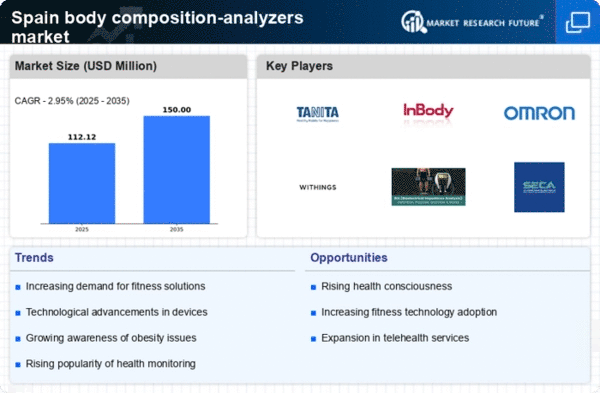
As per Market Research Future analysis, the Spain Body Composition Analyzers Market size was estimated at 108.9 USD Million in 2024. The Body Composition-analyzers market is projected to grow from 112.12 USD Million in 2025 to 150.0 USD Million by 2035, exhibiting a compound annual growth rate (CAGR) of 2.9% during the forecast period 2025 - 2035

Key Market Trends & Highlights

The Spain body composition-analyzers market is experiencing a robust growth trajectory driven by health awareness and technological advancements.

  • Rising health consciousness among consumers is propelling demand for body composition-analyzers in Spain.
  • Technological integration in health monitoring devices is enhancing the functionality and appeal of body composition-analyzers.
  • The largest segment in the market is the fitness sector, while the fastest-growing segment is the wellness industry.
  • Key market drivers include increasing demand for fitness solutions and government initiatives promoting health.

Market Size & Forecast

2024 Market Size 108.9 (USD Million)
2035 Market Size 150.0 (USD Million)
CAGR (2025 - 2035) 2.95%

Major Players

Tanita (JP), InBody (KR), Omron (JP), Withings (FR), Bioelectrical Impedance Analysis (BIA) (US), Seca (DE), BodyMetrix (US), Fitbit (US)

Our Impact
Enabled $4.3B Revenue Impact for Fortune 500 and Leading Multinationals
Partnering with 2000+ Global Organizations Each Year
30K+ Citations by Top-Tier Firms in the Industry

Spain Body Composition Analyzers Market Trends

The Spain Body Composition Analyzers Market is experiencing notable growth, driven by increasing health awareness among consumers. Individuals are becoming more conscious of their body metrics, leading to a rising demand for devices that provide detailed insights into body fat, muscle mass, and hydration levels. This trend is further supported by the growing prevalence of lifestyle-related health issues, prompting consumers to seek tools that assist in monitoring their physical well-being. As a result, manufacturers are innovating and enhancing their product offerings to meet the evolving needs of health-conscious individuals. Moreover, technological advancements are playing a crucial role in shaping the body composition-analyzers market. The integration of smart technology into these devices allows for improved accuracy and user experience. Features such as mobile app connectivity and real-time data tracking are becoming increasingly common, appealing to tech-savvy consumers. This shift towards more sophisticated devices indicates a potential for sustained growth in the market, as consumers seek not only functionality but also convenience in their health monitoring solutions.

Rising Health Consciousness

There is a growing trend of health awareness among consumers, leading to increased interest in body composition-analyzers. Individuals are actively seeking ways to monitor their health metrics, which drives demand for these devices.

Technological Integration

The incorporation of advanced technology into body composition-analyzers is becoming prevalent. Features such as app connectivity and enhanced data tracking capabilities are appealing to consumers, indicating a shift towards smarter health monitoring solutions.

Focus on Personalization

Consumers are increasingly looking for personalized health solutions. Body composition-analyzers that offer tailored insights and recommendations are gaining traction, as individuals seek to understand their unique health profiles.

Spain Body Composition Analyzers Market Drivers

Rising Obesity Rates

The rising obesity rates in Spain are a critical driver for the body composition-analyzers market. Recent statistics indicate that approximately 30% of the adult population is classified as obese, which has prompted a national focus on weight management and health improvement. This alarming trend has led to an increased interest in tools that can provide detailed insights into body composition, such as fat mass, muscle mass, and hydration levels. As healthcare providers and fitness professionals emphasize the importance of understanding body composition for effective weight management, the demand for body composition analyzers is likely to grow. This market response to rising obesity rates underscores the necessity for individuals to monitor their health metrics closely.

Growing Fitness and Wellness Industry

The growing fitness and wellness industry in Spain is a significant driver for the body composition-analyzers market. With an increasing number of gyms, fitness studios, and wellness centers emerging across the country, there is a heightened demand for tools that assist in personal health assessments. The fitness industry is projected to expand, with revenues expected to reach €2.5 billion by 2025. This growth creates a favorable environment for the adoption of body composition analyzers, as fitness professionals seek to provide clients with detailed insights into their health metrics. The integration of these devices into fitness programs not only enhances client engagement but also supports the overall growth of the body composition-analyzers market.

Government Initiatives Promoting Health

Government initiatives aimed at promoting health and wellness are significantly influencing the body composition-analyzers market in Spain. Various public health campaigns encourage citizens to adopt healthier lifestyles, which includes regular monitoring of body composition. The Spanish government has allocated substantial funding towards health promotion programs, which may lead to increased accessibility of body composition analyzers in public health facilities and fitness centers. As a result, the market could see a rise in demand for these devices, as they become integral to health assessments and preventive care strategies. The emphasis on preventive health measures is expected to drive growth in the body composition-analyzers market, as more individuals seek to understand their body metrics in the context of overall health.

Increasing Demand for Fitness Solutions

The body composition-analyzers market in Spain is experiencing a notable surge in demand for fitness solutions. This trend is largely driven by a growing awareness of health and wellness among the population. As individuals increasingly seek to monitor their physical health, the need for accurate body composition analysis becomes paramount. In 2025, the fitness industry in Spain is projected to reach approximately €2 billion, indicating a robust market for related technologies. The integration of body composition analyzers into fitness regimes allows users to track their progress effectively, thereby enhancing their overall fitness experience. This increasing demand for fitness solutions is likely to propel the body composition-analyzers market forward, as consumers prioritize tools that provide detailed insights into their health metrics.

Technological Advancements in Health Monitoring

Technological advancements in health monitoring are reshaping the body composition-analyzers market in Spain. Innovations such as Bluetooth connectivity, mobile app integration, and enhanced accuracy in measurements are making these devices more appealing to consumers. The incorporation of advanced algorithms and user-friendly interfaces allows individuals to easily interpret their body composition data. As technology continues to evolve, the body composition-analyzers market is expected to benefit from increased consumer adoption. In 2025, it is anticipated that the market will witness a growth rate of around 8% annually, driven by these technological enhancements. This trend suggests that consumers are more likely to invest in sophisticated body composition analyzers that offer comprehensive health insights.


Market Segment Insights

By Application: Fitness Centers (Largest) vs. Healthcare (Fastest-Growing)

In the Spain body composition-analyzers market, Fitness Centers hold the largest share among application segments, showcasing their leading role in adopting body composition technology. This segment caters to a broad base of fitness enthusiasts who seek to monitor their health and performance metrics. In contrast, Healthcare, while smaller, is rapidly growing due to an increasing focus on preventive health measures and chronic disease management, contributing to its competitive position in the market. Currently, the growth trends indicate a surge in demand for body composition analyzers among Healthcare providers as they incorporate advanced diagnostic tools into patient care. This expansion is propelled by technological advancements and a greater emphasis on personalized health insights. Sports Organizations and Research Institutions are also significant contributors, but they exhibit slower growth, mainly driven by their specialized needs and limited market reach compared to the dominant segments.

Fitness Centers (Dominant) vs. Healthcare (Emerging)

Fitness Centers represent a dominant force in the application of body composition analyzers, catering to both individual clients and group fitness programs. These centers leverage advanced technologies to provide clients with detailed information on body fat, muscle mass, and overall fitness levels, enhancing their training outcomes. Meanwhile, the Healthcare segment is emerging as a key player, where medical professionals increasingly utilize these devices to provide comprehensive health assessments. This shift is being driven by the recognition of the importance of body composition metrics in diagnosing and managing various health conditions, positioning Healthcare as an increasingly vital application area in the Spain body composition-analyzers market.

By Product Type: Bioelectrical Impedance Analysis Devices (Largest) vs. Dual-Energy X-ray Absorptiometry Devices (Fastest-Growing)

In the Spain body composition-analyzers market, Bioelectrical Impedance Analysis Devices dominate the product type segment, holding a substantial market share due to their widespread adoption in both home and clinical settings. Dual-Energy X-ray Absorptiometry Devices follow closely, recognized for their accuracy and reliability in measuring body composition. Infrared Body Composition Analyzers and Skinfold Calipers represent smaller segments but offer unique advantages that cater to specific user needs, fostering diversity in the market. The growth trends within this segment are highly influenced by increasing health consciousness and rising obesity rates among the population. Bioelectrical Impedance Analysis Devices benefit from innovative technological advancements, enhancing user-friendliness and increasing accessibility. Meanwhile, Dual-Energy X-ray Absorptiometry Devices are becoming increasingly prevalent in clinical applications, spurred by the rising demand for precise body composition analysis. The dual focus on wellness and accuracy continues to drive the market forward, presenting considerable opportunities.

Bioelectrical Impedance Analysis Devices (Dominant) vs. Dual-Energy X-ray Absorptiometry Devices (Emerging)

Bioelectrical Impedance Analysis Devices are characterized by their ease of use and affordability, making them a popular choice among consumers seeking to monitor body composition at home. They provide quick results without the need for specialized training. In contrast, Dual-Energy X-ray Absorptiometry Devices offer superior accuracy and are often utilized in clinical settings for detailed body composition analysis. They are considered the gold standard due to their reliability in providing detailed insights into fat and lean mass. Both segments are essential in the Spain body composition-analyzers market, with Bioelectrical Impedance Analysis Devices catering to the growing consumer health trend, while Dual-Energy X-ray Absorptiometry Devices appeal to professionals seeking precision in health assessments.

By End User: Individuals (Largest) vs. Clinics (Fastest-Growing)

In the Spain body composition-analyzers market, the distribution among end-user segments reveals that Individuals hold the largest market share. This segment benefits from a growing focus on health and personal fitness, leading to increased uptake of body composition monitors for home use. Clinics follow as a rapidly growing segment due to rising demand for personalized healthcare and preventive measures in medical settings, highlighting a shift towards holistic health approaches. Additionally, market growth in these segments is fueled by technological advancements in body composition analysis, making devices more accessible and user-friendly for individuals. For clinics, the integration of these analyzers in routine diagnostics and patient monitoring is driving their adoption. As health awareness continues to rise, both segments are projected to expand significantly in the coming years.

Individuals (Dominant) vs. Clinics (Emerging)

The Individuals segment stands as the dominant force within the Spain body composition-analyzers market, characterized by a diverse demographic ranging from fitness enthusiasts to health-conscious consumers. This segment leverages innovative technology that allows users to easily monitor their body composition metrics at home, promoting a proactive approach to health management. In contrast, the Clinics segment is emerging swiftly, with medical practitioners increasingly recognizing the importance of these analyzers in providing personalized health assessments and improving patient outcomes. As clinics adopt more advanced models, the synergy between healthcare services and user engagement will likely drive growth, making it a pivotal area in the landscape of body composition analysis.

By Distribution Channel: Online Retail (Largest) vs. Offline Retail (Fastest-Growing)

In the Spain body composition-analyzers market, online retail dominates the distribution channel landscape, capturing the largest share due to the increasing trend of consumers shopping online for health-related products. The ease of access to a wide range of products and the convenience of home delivery have significantly bolstered online sales, making it the preferred choice for many consumers. Conversely, the offline retail segment, while smaller in comparison, is the fastest-growing channel, driven by a resurgence of physical stores focusing on personalized customer experiences and hands-on demonstrations of body composition-analyzers. Growth in these distribution channels is being fueled by the rise of health consciousness among consumers and an increasing emphasis on fitness. As people seek to monitor their health metrics, both online platforms and traditional retail outlets are enhancing their strategies to attract more customers, with online retailers offering better deals and offline stores enhancing their in-store experience. This dual approach caters to diverse consumer preferences, thus contributing to the overall expansion of the market.

Online Retail (Dominant) vs. Offline Retail (Emerging)

Online retail holds a dominant position in the Spain body composition-analyzers market, characterized by extensive product variety, competitive pricing, and convenience. Consumers are increasingly relying on e-commerce platforms to purchase body composition-analyzers due to the ease of comparing different models and reading reviews, which enhances purchasing confidence. On the other hand, offline retail is viewed as an emerging segment, gaining traction as stores focus on creating engaging shopping experiences with knowledgeable staff and interactive displays. Offline channels are proving vital for consumers wanting to physically examine products before purchase, bridging the gap between digital research and in-person buying.

Get more detailed insights about Spain Body Composition Analyzers Market

Key Players and Competitive Insights

The body composition-analyzers market in Spain is characterized by a dynamic competitive landscape, driven by increasing health awareness and the growing demand for personalized fitness solutions. Key players such as Tanita (Japan), InBody (South Korea), and Withings (France) are at the forefront, each adopting distinct strategies to enhance their market presence. Tanita (Japan) focuses on innovation, consistently launching advanced models that integrate smart technology, while InBody (South Korea) emphasizes partnerships with fitness centers to expand its reach. Withings (France) leverages its expertise in digital health to offer comprehensive health monitoring solutions, thereby positioning itself as a leader in the integration of technology and health metrics. Collectively, these strategies contribute to a competitive environment that is increasingly centered around technological advancement and consumer engagement.In terms of business tactics, companies are localizing manufacturing to reduce costs and optimize supply chains, which appears to be a critical factor in maintaining competitive pricing. The market structure is moderately fragmented, with several players vying for market share, yet the influence of major companies remains substantial. This fragmentation allows for niche players to emerge, but the dominance of established brands like Omron (Japan) and Seca (Germany) ensures that competition remains fierce.

In October Tanita (Japan) announced the launch of its latest body composition analyzer, which features enhanced connectivity options and a user-friendly interface. This strategic move is significant as it not only showcases Tanita's commitment to innovation but also addresses the growing consumer demand for devices that seamlessly integrate with mobile applications. Such advancements are likely to strengthen Tanita's market position and attract tech-savvy consumers.

In September InBody (South Korea) entered into a strategic partnership with a leading fitness chain in Spain, aiming to provide tailored body composition analysis services to gym members. This collaboration is pivotal as it allows InBody to tap into a broader customer base while enhancing the value proposition for fitness enthusiasts. By embedding its technology within fitness facilities, InBody is likely to increase brand visibility and consumer trust.

In August Withings (France) launched a new subscription service that offers personalized health insights based on data collected from its body composition analyzers. This initiative reflects a growing trend towards subscription-based models in health technology, which could potentially create a steady revenue stream for Withings. By providing ongoing value through personalized insights, the company may enhance customer loyalty and engagement.

As of November the competitive trends in the body composition-analyzers market are increasingly defined by digitalization, sustainability, and the integration of artificial intelligence (AI). Strategic alliances are becoming more prevalent, as companies recognize the value of collaboration in enhancing product offerings and market reach. Looking ahead, competitive differentiation is likely to evolve from traditional price-based competition to a focus on innovation, technological advancements, and supply chain reliability. This shift suggests that companies that prioritize R&D and consumer-centric solutions will be better positioned to thrive in an increasingly competitive landscape.

Key Companies in the Spain Body Composition Analyzers Market include

Industry Developments

In recent months, the Spain Body Composition Analyzers Market has witnessed significant developments, driven by increasing consumer awareness regarding health and fitness. Companies such as Medisana and Withings are expanding their product offerings, integrating advanced technology and artificial intelligence features to enhance user experience and accuracy in body measurement assessments. The emphasis on health monitoring has resulted in a growing demand for innovative devices, with firms like InBody and Tanita leading in market share. Additionally, Bioelectrical Impedance Analysis technology is gaining traction, reflecting a shift toward more precise measurements.

In April 2023, Garmin announced a strategic partnership with a local fitness center chain in Spain to promote their devices, aiming to increase market penetration. Recent financial reports indicate a significant growth trajectory for companies like Omron, which saw a valuation increase attributed to the rising health consciousness post-COVID-19 lockdowns. Furthermore, the merger between Fitbit and Google's health divisions announced in August 2023 signifies an overarching trend towards consolidation within the health tech sector, enhancing competition in the body composition analyzers market.

Such movements have created a dynamic landscape in Spain, where health technology and fitness integration continue to evolve rapidly.

Future Outlook

Spain Body Composition Analyzers Market Future Outlook

The Body Composition Analyzers Market is projected to grow at a 2.95% CAGR from 2025 to 2035, driven by increasing health awareness and technological advancements.

New opportunities lie in:

  • Development of AI-driven analytics for personalized health insights.

  • Expansion into telehealth services for remote body composition assessments.
  • Partnerships with fitness centers for integrated health monitoring solutions.

By 2035, the market is expected to achieve robust growth, reflecting evolving consumer health trends.

Market Segmentation

Spain Body Composition Analyzers Market End User Outlook

  • Individuals
  • Clinics
  • Gyms and Fitness Centers
  • Hospitals
  • Sports Teams

Spain Body Composition Analyzers Market Application Outlook

  • Fitness Centers
  • Healthcare
  • Sports Organizations
  • Research Institutions

Spain Body Composition Analyzers Market Product Type Outlook

  • Bioelectrical Impedance Analysis Devices
  • Dual-Energy X-ray Absorptiometry Devices
  • Infrared Body Composition Analyzers
  • Skinfold Calipers

Spain Body Composition Analyzers Market Distribution Channel Outlook

  • Online Retail
  • Offline Retail
  • Direct Sales

Report Scope

MARKET SIZE 2024 108.9(USD Million)
MARKET SIZE 2025 112.12(USD Million)
MARKET SIZE 2035 150.0(USD Million)
COMPOUND ANNUAL GROWTH RATE (CAGR) 2.95% (2025 - 2035)
REPORT COVERAGE Revenue Forecast, Competitive Landscape, Growth Factors, and Trends
BASE YEAR 2024
Market Forecast Period 2025 - 2035
Historical Data 2019 - 2024
Market Forecast Units USD Million
Key Companies Profiled Tanita (JP), InBody (KR), Omron (JP), Withings (FR), Bioelectrical Impedance Analysis (BIA) (US), Seca (DE), BodyMetrix (US), Fitbit (US)
Segments Covered Application, Product Type, End User, Distribution Channel
Key Market Opportunities Growing demand for personalized health solutions drives innovation in the body composition-analyzers market.
Key Market Dynamics Rising consumer health awareness drives demand for advanced body composition-analyzers in Spain's competitive market.
Countries Covered Spain
Leave a Comment

FAQs

What is the expected market size of the Spain Body Composition Analyzers Market in 2024?

The expected market size of the Spain Body Composition Analyzers Market in 2024 is 87.85 million USD.

What is the projected market value for the Spain Body Composition Analyzers Market by 2035?

By 2035, the projected market value for the Spain Body Composition Analyzers Market is 184.0 million USD.

What is the expected compound annual growth rate (CAGR) for the Spain Body Composition Analyzers Market from 2025 to 2035?

The expected CAGR for the Spain Body Composition Analyzers Market from 2025 to 2035 is 6.952%.

Which application is anticipated to dominate the Spain Body Composition Analyzers Market in 2024?

In 2024, the application for healthcare is anticipated to dominate the Spain Body Composition Analyzers Market with a value of 35.0 million USD.

What is the projected market value for the Fitness Centers application by 2035?

The projected market value for the Fitness Centers application by 2035 is 58.0 million USD.

Who are the key players in the Spain Body Composition Analyzers Market?

Key players in the Spain Body Composition Analyzers Market include Medisana, Withings, InBody, Tanita, and Fitbit.

What is the anticipated market value for Sports Organizations in 2024?

The anticipated market value for Sports Organizations in 2024 is 12.85 million USD.

How much is the Research Institutions application expected to be valued at by 2035?

By 2035, the Research Institutions application is expected to be valued at 31.0 million USD.

What market growth trends are expected in the Spain Body Composition Analyzers Market?

The Spain Body Composition Analyzers Market is expected to witness growth driven by increasing health awareness and fitness trends.

How does the growth rate of Body Composition Analyzers vary by application sector?

The growth rate of Body Composition Analyzers varies, with healthcare showing significant growth potential followed closely by fitness centers.

Download Free Sample

Kindly complete the form below to receive a free sample of this Report

Compare Licence

×
Features License Type
Single User Multiuser License Enterprise User
Price $4,950 $5,950 $7,250
Maximum User Access Limit 1 User Upto 10 Users Unrestricted Access Throughout the Organization
Free Customization
Direct Access to Analyst
Deliverable Format
Platform Access
Discount on Next Purchase 10% 15% 15%
Printable Versions