×
Request Free Sample ×

Kindly complete the form below to receive a free sample of this Report

* Please use a valid business email

Leading companies partner with us for data-driven Insights

clients tt-cursor
Hero Background

South Korea Voice Payment Market

ID: MRFR/ICT/60619-HCR
200 Pages
Aarti Dhapte
February 2026

South Korea Voice Payment Market Research Report By Component (Software, Hardware), By Enterprise Size (Large Enterprises, Small & Medium Enterprises) and By End-use (BFSI, Automotive, Healthcare, Retail, Government, Others)-Forecast to 2035

Share:
Download PDF ×

We do not share your information with anyone. However, we may send you emails based on your report interest from time to time. You may contact us at any time to opt-out.

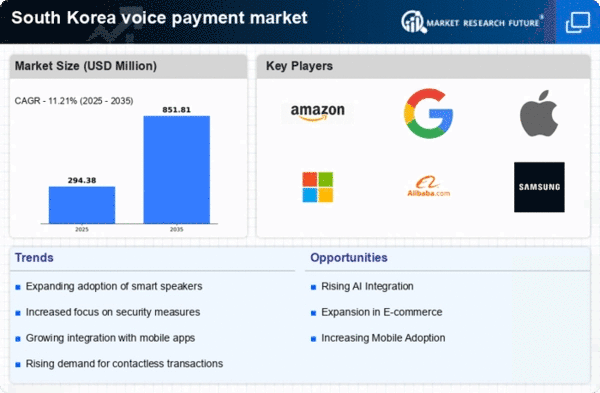
South Korea Voice Payment Market Infographic
Purchase Options

South Korea Voice Payment Market Summary

As per Market Research Future analysis, the South Korea voice payment market size was estimated at 264.71 USD Million in 2024. The South Korea voice payment market is projected to grow from 294.38 USD Million in 2025 to 851.81 USD Million by 2035, exhibiting a compound annual growth rate (CAGR) of 11.2% during the forecast period 2025 - 2035

Key Market Trends & Highlights

The South Korea The South Korea voice payment market is experiencing robust growth. This growth is driven by technological advancements and changing consumer preferences.

  • Technological integration is enhancing the functionality and user experience of voice payment systems.
  • The largest segment in the South Korea voice payment market is e-commerce, while the fastest-growing segment is mobile payments.
  • Consumer behavior is shifting towards greater acceptance of voice-activated transactions, reflecting a broader trend in digital payments.
  • Key market drivers include rising smartphone penetration and government initiatives for digital payments, which are fostering a conducive environment for growth.

Market Size & Forecast

2024 Market Size 264.71 (USD Million)
2035 Market Size 851.81 (USD Million)
CAGR (2025 - 2035) 11.21%

Major Players

Amazon (US), Google (US), Apple (US), Microsoft (US), Alibaba (CN), Samsung (KR), PayPal (US), Nuance Communications (US), IBM (US)

Our Impact
Enabled $4.3B Revenue Impact for Fortune 500 and Leading Multinationals
Partnering with 2000+ Global Organizations Each Year
30K+ Citations by Top-Tier Firms in the Industry

South Korea Voice Payment Market Trends

The voice payment market in South Korea is experiencing notable growth, driven by advancements in technology and increasing consumer acceptance. The integration of artificial intelligence and machine learning into payment systems enhances user experience, making transactions more seamless and efficient. As mobile devices become ubiquitous, the convenience of voice-activated payments appeals to a tech-savvy population. Furthermore, the rise of smart home devices facilitates the adoption of voice payment solutions, as consumers seek to streamline their daily activities. This trend indicates a shift towards more intuitive payment methods, aligning with the fast-paced lifestyle of South Koreans. In addition, the regulatory environment in South Korea appears to support innovation in the voice payment market. Government initiatives aimed at promoting digital payment solutions contribute to a favorable landscape for businesses. As security concerns remain paramount, the emphasis on robust authentication methods is likely to shape the future of voice payments. Overall, the voice payment market is poised for further expansion, reflecting broader trends in digital finance and consumer behavior in South Korea.

Technological Integration

Advanced technologies increasingly influence the voice payment market. Innovations in artificial intelligence and natural language processing enhance the accuracy and efficiency of voice recognition systems. This technological evolution not only improves user experience but also fosters greater trust among consumers, encouraging wider adoption of voice payment solutions.

Consumer Behavior Shift

There is a noticeable shift in consumer behavior towards contactless and convenient payment methods. As South Koreans become more accustomed to digital transactions, the preference for voice-activated payments grows. This trend suggests that consumers are seeking faster, more efficient ways to complete transactions, aligning with their busy lifestyles.

Regulatory Support

The regulatory framework in South Korea is increasingly supportive of digital payment innovations. Government initiatives aimed at enhancing cybersecurity and promoting digital finance create a conducive environment for the voice payment market. This regulatory backing may encourage further investment and development in voice payment technologies.

South Korea Voice Payment Market Drivers

E-commerce Growth

The rapid expansion of e-commerce in South Korea significantly influences the voice payment market. In 2025, e-commerce sales are projected to reach over $200 billion, reflecting a robust growth trajectory. This surge in online shopping creates a fertile ground for voice payment solutions, as consumers increasingly seek convenient and efficient ways to complete transactions. Voice payments offer a hands-free alternative that aligns with the preferences of tech-savvy consumers who prioritize speed and ease of use. Additionally, the integration of voice payment options into e-commerce platforms enhances the overall shopping experience, potentially increasing customer satisfaction and loyalty. As more retailers adopt voice payment technologies, the market is expected to expand, driven by the growing demand for innovative payment solutions in the e-commerce sector.

Increased Focus on Security

Security concerns are paramount in the financial sector, and the voice payment market is no exception. In South Korea, the emphasis on secure payment methods is driving the adoption of voice recognition technologies that offer enhanced security features. Biometric authentication, including voice recognition, is gaining traction as a reliable method to prevent fraud and unauthorized transactions. As consumers become more aware of security risks, they are likely to gravitate towards payment solutions that provide robust protection. The voice payment market is responding to this demand by incorporating advanced security measures. These measures may include multi-factor authentication and encryption. This focus on security not only builds consumer trust but also encourages wider acceptance of voice payment systems across various sectors, including retail and banking.

Rising Smartphone Penetration

The increasing penetration of smartphones in South Korea is a pivotal driver for the voice payment market. As of 2025, approximately 95% of the population owns a smartphone, facilitating the adoption of voice-activated payment systems. This trend indicates a growing comfort level among consumers with mobile technology, which is essential for the voice payment market. The convenience of making transactions through voice commands aligns with the fast-paced lifestyle of South Koreans, who often seek efficiency in their daily activities. Furthermore, the integration of advanced voice recognition technologies in smartphones enhances user experience, making voice payments more appealing. As smartphone manufacturers continue to innovate, the voice payment market is likely to see a surge in usage, driven by the seamless integration of payment applications and voice assistants.

Cultural Acceptance of Technology

The cultural landscape in South Korea is characterized by a high acceptance of technology, which serves as a catalyst for the voice payment market. South Koreans are known for their early adoption of innovative technologies, and this trend extends to payment solutions. The societal inclination towards embracing digital advancements fosters an environment where voice payments can thrive. As consumers become accustomed to using voice-activated devices in their daily lives, the transition to voice payment systems appears seamless. This cultural acceptance is further supported by marketing efforts from tech companies that highlight the convenience and efficiency of voice payments. Consequently, the voice payment market is likely to benefit from this cultural affinity, leading to increased usage and integration into everyday transactions.

Government Initiatives for Digital Payments

Government initiatives aimed at promoting digital payment solutions are playing a crucial role in shaping the voice payment market. In South Korea, the government has implemented policies to encourage the adoption of cashless transactions, which includes support for voice payment technologies. These initiatives are designed to enhance financial inclusion and streamline payment processes across various sectors. By providing a regulatory framework that supports innovation, the government is fostering an environment conducive to the growth of the voice payment market. Additionally, public awareness campaigns aimed at educating consumers about the benefits of digital payments are likely to increase acceptance and usage. As these initiatives continue to evolve, they may significantly impact the trajectory of the voice payment market, driving further adoption and integration into the financial ecosystem.


Market Segment Insights

By Component: Software (Largest) vs. Hardware (Fastest-Growing)

In the South Korea voice payment market, the software component holds a significant share, reflecting its established presence and user acceptance. This segment has dominated due to the increasing adoption of voice recognition technologies among businesses and consumers alike. Conversely, the hardware segment is rapidly gaining traction as advancements in technology drive innovative solutions. The growing demand for integrated devices that support voice payment systems is propelling hardware growth, making it the fastest-growing component within the market.

Software (Dominant) vs. Hardware (Emerging)

The software segment is characterized by its flexibility and scalability, offering businesses various solutions to integrate voice payment capabilities seamlessly. It enables superior user experiences and enhances transaction security, establishing a strong foothold in the market. On the other hand, the hardware segment is emerging with cutting-edge devices designed to facilitate voice payments. This includes smart speakers and advanced payment terminals that incorporate voice technology, catering to a tech-savvy consumer base that values convenience and efficiency.

By Enterprise Size: Large Enterprises (Largest) vs. Small & Medium Enterprises (Fastest-Growing)

In the South Korea voice payment market, Large Enterprises dominate with a significant share, leveraging their resources and infrastructure to implement advanced voice payment technologies. Small & Medium Enterprises, however, are quickly gaining ground, driven by their agility and ability to adapt to new payment trends, making the market share distribution increasingly competitive. Growth trends in this segment are propelled by the rising adoption of digital payment solutions, with large enterprises leading the way through extensive investments in technology. Meanwhile, Small & Medium Enterprises are capitalizing on niche markets and evolving consumer preferences, contributing to their rapid growth and pushing for a more inclusive market landscape. This dynamic interplay between large and smaller players reflects the overall strengthening of the voice payment ecosystem.

Large Enterprises (Dominant) vs. Small & Medium Enterprises (Emerging)

Large Enterprises in the South Korea voice payment market utilize their scale and financial strength to maintain dominance, often offering comprehensive solutions that appeal to a broader customer base. They invest heavily in technology, infrastructure, and consumer insights to enhance user experiences. In contrast, Small & Medium Enterprises represent an emerging force, characterized by flexibility and innovative approaches to meet consumer demands. These enterprises are increasingly integrating voice payment solutions as part of their digital strategy, targeting local markets and specialized services, which fosters a vibrant competitive environment. Their adaptability and understanding of customer preferences position them well for sustained growth, despite their smaller operational scale compared to Large Enterprises.

By End-use: Retail (Largest) vs. Healthcare (Fastest-Growing)

The South Korea voice payment market exhibits a diverse distribution among various end-use segments. The retail sector stands as the largest end-user, driven by the increasing adoption of contactless payment technologies and the demand for enhanced customer experience. In contrast, the healthcare segment is rapidly gaining traction, leveraging voice payment solutions to streamline patient interactions and improve service efficiency. This competitive landscape indicates a shift in consumer preferences towards convenience and security, with both retail and healthcare segments capitalizing on these trends. Growth trends in the South Korea voice payment market indicate a significant rise in technology adoption across all sectors. The retail segment is benefiting from digital transformation initiatives, prompting major retailers to integrate voice payment capabilities into their point-of-sale systems. Meanwhile, the healthcare sector is experiencing the fastest growth due to the expansion of telemedicine and the need for secure patient authentication methods. Factors driving this growth include increased smartphone penetration, consumer willingness to adopt innovative payment solutions, and a heightened focus on user-friendly interfaces.

Retail: Dominant vs. Healthcare: Emerging

The retail segment maintains a dominant position in the South Korea voice payment market, characterized by extensive integration of voice technology at checkout points, which enhances the shopping experience. Retailers prioritize convenience, leading to the rapid deployment of voice-enabled payment systems. Conversely, the healthcare sector is emerging with innovative applications, utilizing voice payments to facilitate more secure transactions during telehealth consultations and medical services. This sector is seeing increased investments to improve infrastructure and address patient needs efficiently, thus capturing a growing share of the overall market. The evolving landscape highlights the importance of adopting advanced technologies to meet customer expectations in both retail and healthcare settings.

Get more detailed insights about South Korea Voice Payment Market

Key Players and Competitive Insights

The voice payment market exhibits a dynamic competitive landscape, characterized by rapid technological advancements and evolving consumer preferences. Key players such as Amazon (US), Google (US), and Samsung (KR) are at the forefront, leveraging their technological prowess to enhance user experience and streamline payment processes. Amazon (US) focuses on integrating voice payment capabilities into its Alexa ecosystem, while Google (US) emphasizes the use of artificial intelligence to improve transaction security and efficiency. Samsung (KR), on the other hand, is strategically positioning itself by incorporating voice payment features into its smart devices, thereby enhancing its ecosystem and fostering customer loyalty. Collectively, these strategies contribute to a competitive environment that is increasingly driven by innovation and user-centric solutions.In terms of business tactics, companies are increasingly localizing their operations to better cater to regional preferences and regulatory requirements. This localization often involves optimizing supply chains and enhancing customer service capabilities. The market structure appears moderately fragmented, with several players vying for market share, yet dominated by a few key companies that significantly influence trends and consumer behavior. The collective influence of these major players shapes the competitive dynamics, as they continuously innovate and adapt to changing market conditions.

In October Amazon (US) announced the launch of a new voice payment feature that allows users to make purchases directly through their Alexa-enabled devices without needing to confirm transactions verbally. This strategic move is likely to enhance user convenience and drive adoption rates, positioning Amazon (US) as a leader in the voice payment space. The integration of seamless payment options into everyday tasks could potentially increase customer engagement and loyalty, further solidifying Amazon's market position.

In September Google (US) unveiled an upgraded version of its Google Assistant, which includes enhanced voice recognition capabilities specifically designed for financial transactions. This development suggests a strong commitment to improving user experience and security in voice payments. By focusing on AI-driven enhancements, Google (US) aims to differentiate itself from competitors and capture a larger share of the market, particularly among tech-savvy consumers who prioritize security and efficiency.

In August Samsung (KR) entered into a partnership with a leading fintech company to develop a new voice payment platform that integrates with its smart home devices. This collaboration indicates Samsung's strategic focus on creating a comprehensive ecosystem that facilitates seamless transactions across various devices. By enhancing interoperability and user experience, Samsung (KR) is likely to strengthen its competitive edge in the voice payment market, appealing to consumers seeking convenience and innovation.

As of November current trends in the voice payment market are heavily influenced by digitalization, AI integration, and a growing emphasis on sustainability. Strategic alliances among key players are shaping the landscape, fostering innovation and enhancing service offerings. The competitive differentiation appears to be shifting from price-based competition to a focus on technological advancements and supply chain reliability. Companies that prioritize innovation and customer-centric solutions are likely to thrive in this evolving market, as consumers increasingly seek seamless and secure payment experiences.

Key Companies in the South Korea Voice Payment Market include

Industry Developments

Recent developments in the South Korea Voice Payment Market have been significant, driven by advancements in technology and changing consumer preferences. Payco has also expanded its capabilities in the voice payment sector, partnering with local retailers to facilitate seamless transactions.

In September 2023, Kakao announced an upgrade in its voice recognition technology, improving payment accuracy, which aligns with the surging interest in seamless payments among consumers in South Korea. Notably, Samsung has intensified Research and Development efforts to incorporate AI and voice technology into their payment platforms.

Major firms like Toss and BC Card are exploring integrations that enhance user engagement through voice-activated payments. Additionally, there have been no major mergers or acquisitions reported in this sector recently. The continuous growth of the South Korea voice payment market, which is projected to increase in valuation, is reshaping the landscape as competitors strive to offer innovative solutions, responding to a tech-savvy consumer base that increasingly prefers contactless and voice-activated payment methods.

Future Outlook

South Korea Voice Payment Market Future Outlook

The Voice Payment Market is projected to grow at a CAGR of 11.21% from 2025 to 2035. This growth is driven by advancements in AI, increased smartphone penetration, and consumer demand for convenience.

New opportunities lie in:

  • Integration of voice payment systems in retail POS solutions.
  • Development of secure voice authentication technologies for financial transactions.
  • Partnerships with e-commerce platforms to enhance voice-enabled shopping experiences.

By 2035, the voice payment market is expected to be a robust sector, driven by innovation and consumer adoption.

Market Segmentation

South Korea Voice Payment Market End-use Outlook

  • BFSI
  • Automotive
  • Healthcare
  • Retail
  • Government
  • Others

South Korea Voice Payment Market Component Outlook

  • Software
  • Hardware

South Korea Voice Payment Market Enterprise Size Outlook

  • Large Enterprises
  • Small & Medium Enterprises

Report Scope

MARKET SIZE 2024 264.71(USD Million)
MARKET SIZE 2025 294.38(USD Million)
MARKET SIZE 2035 851.81(USD Million)
COMPOUND ANNUAL GROWTH RATE (CAGR) 11.21% (2025 - 2035)
REPORT COVERAGE Revenue Forecast, Competitive Landscape, Growth Factors, and Trends
BASE YEAR 2024
Market Forecast Period 2025 - 2035
Historical Data 2019 - 2024
Market Forecast Units USD Million
Key Companies Profiled Amazon (US), Google (US), Apple (US), Microsoft (US), Alibaba (CN), Samsung (KR), PayPal (US), Nuance Communications (US), IBM (US)
Segments Covered Component, Enterprise Size, End-use
Key Market Opportunities Integration of artificial intelligence enhances user experience in the voice payment market.
Key Market Dynamics Rising consumer preference for seamless transactions drives innovation in voice payment technologies and competitive market strategies.
Countries Covered South Korea
Leave a Comment

FAQs

What is the expected market size of the South Korea Voice Payment Market in 2024?

The South Korea Voice Payment Market is expected to be valued at 211.68 million USD in 2024.

What is the projected market size of the South Korea Voice Payment Market by 2035?

By 2035, the South Korea Voice Payment Market is projected to be valued at 609.43 million USD.

What is the expected compound annual growth rate (CAGR) for the South Korea Voice Payment Market from 2025 to 2035?

The expected CAGR for the South Korea Voice Payment Market from 2025 to 2035 is 10.09%.

Which companies are considered major players in the South Korea Voice Payment Market?

Major players in the South Korea Voice Payment Market include SK Telecom, Payco, Hanwha Techwin, and Samsung among others.

What was the market value for software in the South Korea Voice Payment Market in 2024?

In 2024, the market value for software in the South Korea Voice Payment Market is expected to be 106.68 million USD.

What is the projected market value for hardware in the South Korea Voice Payment Market by 2035?

The projected market value for hardware in the South Korea Voice Payment Market by 2035 is estimated to be 290.0 million USD.

How does the South Korea Voice Payment Market correlate with emerging trends?

The market shows potential with emerging trends such as increased consumer adoption and advancements in voice recognition technology.

What challenges does the South Korea Voice Payment Market face in achieving growth?

Challenges in the South Korea Voice Payment Market include security concerns and varying consumer trust levels regarding voice transactions.

What are the key applications of voice payment technology in South Korea?

Key applications of voice payment technology in South Korea include e-commerce, banking, and smart device interactions.

What is the voice payment market growth outlook in South Korea until 2035?

The growth outlook for the South Korea Voice Payment Market remains strong, with significant expansion anticipated through 2035.

Download Free Sample

Kindly complete the form below to receive a free sample of this Report

Compare Licence

×
Features License Type
Single User Multiuser License Enterprise User
Price $4,950 $5,950 $7,250
Maximum User Access Limit 1 User Upto 10 Users Unrestricted Access Throughout the Organization
Free Customization
Direct Access to Analyst
Deliverable Format
Platform Access
Discount on Next Purchase 10% 15% 15%
Printable Versions