×
Request Free Sample ×

Kindly complete the form below to receive a free sample of this Report

* Please use a valid business email

Leading companies partner with us for data-driven Insights

clients tt-cursor
Hero Background

South Korea V2X Market

ID: MRFR/AT/52475-HCR
200 Pages
Sejal Akre
February 2026

South Korea V2X Market Research Report By Technology (Automated Driver Assistance, Intelligent Traffic System, Emergency Vehicle Notification, Passenger Information System, Fleet & Asset Management, Parking Management System, Line of Sight, Non-line of Sight, Others), By Component (Hardware, Software), By Communication Type (V2C, V2D, V2G, V2P, V2V, V2I), By Propulsion (Electric Vehicle (EV), ICE Vehicle), By Connectivity (DSRC, Cellular), By Unit Type (Onboard Unit, Roadside Unit) and By Vehicle Type (Passenger Car, Commercial Vehicle) - Growth & Industry Forecast 2025 To 2035

Share:
Download PDF ×

We do not share your information with anyone. However, we may send you emails based on your report interest from time to time. You may contact us at any time to opt-out.

South Korea V2X Market Infographic
Purchase Options

South Korea V2X Market Summary

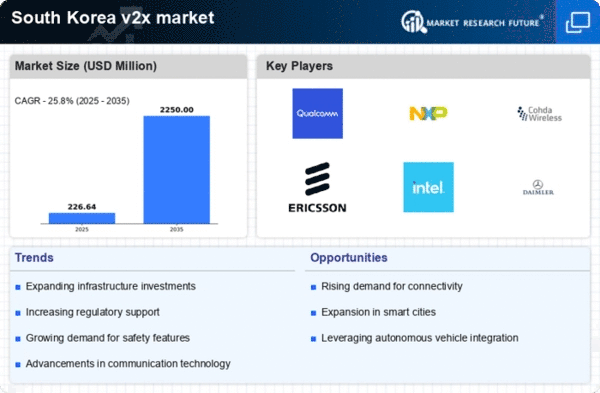
As per Market Research Future analysis, the South Korea v2x market Size was estimated at 180.16 USD Million in 2024. The South Korea v2x market is projected to grow from 226.64 USD Million in 2025 to 2250.0 USD Million by 2035, exhibiting a compound annual growth rate (CAGR) of 25% during the forecast period 2025 - 2035

Key Market Trends & Highlights

The South Korea v2x market is poised for substantial growth driven by government initiatives and technological advancements.

  • Government initiatives are fostering a conducive environment for the expansion of the v2x market in South Korea.
  • Collaboration among stakeholders is increasingly evident, enhancing the development of integrated smart transportation solutions.
  • The electric vehicle segment is the largest, while the infrastructure development segment is the fastest-growing in the v2x market.
  • Technological advancements in communication and rising demand for smart transportation solutions are key drivers propelling market growth.

Market Size & Forecast

2024 Market Size 180.16 (USD Million)
2035 Market Size 2250.0 (USD Million)
CAGR (2025 - 2035) 25.8%

Major Players

Qualcomm (US), NXP Semiconductors (NL), Cohda Wireless (AU), Ericsson (SE), Intel (US), Daimler AG (DE), Toyota Motor Corporation (JP), Volkswagen AG (DE), Ford Motor Company (US)

Our Impact
Enabled $4.3B Revenue Impact for Fortune 500 and Leading Multinationals
Partnering with 2000+ Global Organizations Each Year
30K+ Citations by Top-Tier Firms in the Industry

South Korea V2X Market Trends

The v2x market in South Korea is currently experiencing a transformative phase, driven by advancements in communication technologies and a growing emphasis on road safety. The government has been actively promoting the integration of vehicle-to-everything (V2X) technologies to enhance traffic management and reduce accidents. This initiative aligns with South Korea's broader smart city strategy, which aims to leverage technology for improved urban living. As a result, various stakeholders, including automotive manufacturers and tech companies, are collaborating to develop innovative solutions that facilitate seamless communication between vehicles, infrastructure, and pedestrians. Moreover, the increasing adoption of electric vehicles (EVs) is likely to further propel the v2x market. With the rise of EVs, there is a heightened need for efficient communication systems that can support charging infrastructure and optimize energy consumption. The South Korean government has set ambitious targets for EV adoption, which may create additional opportunities for V2X applications. Overall, the v2x market appears poised for growth, driven by technological advancements and supportive government policies that encourage innovation and collaboration among industry players.

Government Initiatives

The South Korean government is actively investing in V2X technologies to enhance road safety and traffic efficiency. Initiatives include funding for research and development, as well as pilot projects aimed at integrating V2X systems into existing infrastructure. These efforts are part of a broader strategy to create smart cities that utilize advanced technologies for improved urban mobility.

Collaboration Among Stakeholders

There is a noticeable trend of collaboration among automotive manufacturers, technology firms, and government agencies in South Korea. This partnership aims to accelerate the development and deployment of V2X solutions. By pooling resources and expertise, stakeholders are working towards creating a cohesive ecosystem that supports the seamless exchange of information between vehicles and infrastructure.

Focus on Electric Vehicles

The increasing adoption of electric vehicles in South Korea is likely to drive demand for V2X technologies. As more EVs enter the market, the need for efficient communication systems to manage charging stations and optimize energy use becomes critical. This trend suggests a growing intersection between V2X applications and the expanding EV landscape.

South Korea V2X Market Drivers

Consumer Awareness and Acceptance

Consumer awareness and acceptance play a pivotal role in the growth of the v2x market in South Korea. As the public becomes more informed about the benefits of connected vehicle technologies, there is a growing willingness to adopt these innovations. Surveys indicate that approximately 70% of consumers are open to using vehicles equipped with v2x capabilities, recognizing their potential to improve safety and convenience. This shift in consumer sentiment is likely to encourage manufacturers to invest in v2x technologies, further propelling the market forward. The interplay between consumer acceptance and technological advancements is expected to create a robust ecosystem for the v2x market.

Government Regulations and Policies

In South Korea, stringent government regulations and policies are shaping the v2x market landscape. The government has implemented various initiatives aimed at promoting intelligent transportation systems (ITS) and enhancing road safety. For instance, the Ministry of Land, Infrastructure and Transport has set ambitious targets for the adoption of connected vehicle technologies, aiming for a 50% penetration rate by 2030. Such regulatory frameworks not only encourage manufacturers to innovate but also create a conducive environment for the v2x market to thrive. The alignment of public policy with technological advancements is expected to bolster the market's growth trajectory.

Investment in Infrastructure Development

Investment in infrastructure development is a critical driver for the v2x market in South Korea. The government has allocated substantial funds for upgrading transportation infrastructure, including the installation of smart traffic signals and communication networks. This investment is expected to reach approximately $2 billion by 2027, significantly enhancing the capabilities of the v2x market. Improved infrastructure not only supports the deployment of connected vehicle technologies but also fosters public acceptance of these innovations. As infrastructure continues to evolve, the v2x market is likely to benefit from increased connectivity and enhanced operational efficiency.

Technological Advancements in Communication

The v2x market in South Korea is experiencing a surge due to rapid technological advancements in communication systems. The integration of 5G technology is particularly noteworthy, as it enables real-time data exchange between vehicles and infrastructure. This capability is projected to enhance traffic management and safety, potentially reducing accidents by up to 30%. Furthermore, the development of dedicated short-range communications (DSRC) is facilitating seamless interactions among vehicles, which is crucial for the growth of the v2x market. As South Korea continues to invest in smart city initiatives, the demand for advanced communication technologies is likely to escalate, driving the v2x market forward.

Rising Demand for Smart Transportation Solutions

The increasing urbanization in South Korea is driving the demand for smart transportation solutions, which is a key driver for the v2x market. As cities become more congested, the need for efficient traffic management systems is paramount. The v2x market is positioned to address these challenges by providing solutions that enhance mobility and reduce congestion. According to recent studies, the smart transportation sector is anticipated to grow at a CAGR of 15% over the next five years. This growth is likely to be fueled by the integration of v2x technologies that facilitate better communication between vehicles and infrastructure, ultimately improving the overall transportation experience.


Market Segment Insights

By Technology: Automated Driver Assistance (Largest) vs. Intelligent Traffic System (Fastest-Growing)

The South Korea v2x market showcases significant competition among various technology segments, with Automated Driver Assistance leading in market share. This segment is favored due to its advanced features, enhancing vehicle safety and user experience. Meanwhile, Intelligent Traffic System is rapidly gaining traction, driven by increasing urbanization and a need for smarter transportation solutions that optimize traffic flow and improve safety. The growth trends within these segments are stimulated by governmental initiatives aimed at promoting smart city projects and reducing congestion. The demand for more efficient transportation systems is propelling advancements in Emergency Vehicle Notification and Fleet & Asset Management as well. As technology evolves, Parking Management Systems and Passenger Information Systems are also witnessing heightened interest, reflecting a shift towards integrated mobility solutions.

Technology: Automated Driver Assistance (Dominant) vs. Intelligent Traffic System (Emerging)

Automated Driver Assistance is the dominant technology in the South Korea v2x market, characterized by its comprehensive suite of features designed to improve vehicle safety and enhance driver experience. This segment primarily focuses on collision avoidance, adaptive cruise control, and lane-keeping assistance, appealing to consumers looking for cutting-edge safety technologies. In contrast, the Intelligent Traffic System, seen as an emerging technology, emphasizes real-time traffic management solutions that leverage data analytics and communication technologies. This system aims to reduce traffic congestion and enhance road safety through efficient traffic signal control and real-time information dissemination, positioning itself as a critical component of smart city initiatives in the region.

By Component: Hardware (Largest) vs. Software (Fastest-Growing)

In the South Korea v2x market, the hardware segment accounts for the largest share, driven by the increasing demand for advanced vehicular technologies. It includes components like sensors and communication devices that are crucial for vehicle-to-everything communications. The software segment, while smaller in size, is gaining traction as the fastest-growing area, primarily due to the rising need for data analytics and integration in smart vehicular systems. Growth in the South Korea v2x market is significantly influenced by the government’s initiatives to develop smart transportation networks and the rising adoption of connected vehicles. The hardware segment’s dominance is supported by infrastructure investments, whereas the software segment is rapidly evolving due to technological advancements and the increasing importance of software-driven solutions to enhance vehicle performance and safety features.

Hardware (Dominant) vs. Software (Emerging)

The hardware segment is characterized by robust production and deployment of essential components like chipsets and communication modules that form the backbone of V2X interactions. This segment enjoys strong market stability due to the established demand for physical components in automotive applications. Conversely, the software segment is an emerging force within the South Korea v2x market, marked by rapid innovation and the need for sophisticated algorithmic solutions that improve vehicle connectivity and safety. As the market shifts toward more integrated systems, the importance of software solutions in driving efficiency and enhancing user experiences is becoming increasingly vital, thereby positioning it as a burgeoning area with great potential.

By Communication Type: V2V (Largest) vs. V2G (Fastest-Growing)

In the South Korea v2x market, V2V (Vehicle-to-Vehicle) communication holds a dominant position, contributing significantly to the overall market share. This communication type is widely implemented in various automotive applications, ensuring vehicles can share information effectively to enhance safety and operational efficiency. Following closely is V2I (Vehicle-to-Infrastructure) and its alignment with smart city initiatives, notably contributing to the growing ecosystem. As the market evolves, V2G (Vehicle-to-Grid) is emerging rapidly as a key player, propelled by the advancements in electric vehicle technology and renewable energy integration. Rising government initiatives to promote eco-friendly transportation solutions drive this growth, facilitating seamless communication between vehicles and energy grids. Moreover, V2P (Vehicle-to-Pedestrian) is gaining traction as safety measures around pedestrian traffic increase, reflecting changing transportation needs in urban areas.

V2V (Dominant) vs. V2G (Emerging)

V2V (Vehicle-to-Vehicle) communication is characterized by its ability to enable real-time data exchange between vehicles, significantly enhancing road safety and efficiency. This communication type allows vehicles to alert each other about potential hazards, traffic conditions, and instant decisions, which is crucial for the implementation of autonomous driving technologies. The robust infrastructure supporting V2V systems ensures a high trust level among users and industry stakeholders. Conversely, V2G (Vehicle-to-Grid) represents an emerging trend within the South Korea v2x market, focusing on the interaction between electric vehicles and power grids. As electric vehicles proliferate, V2G systems facilitate energy sharing between vehicles and the grid, enhancing energy efficiency and supporting renewable energy integration. This growth reflects the increasing importance of sustainable transportation solutions and smart energy management.

By Propulsion: Electric Vehicle (Largest) vs. ICE Vehicle (Fastest-Growing)

In the South Korea v2x market, the propulsion segment is significantly dominated by Electric Vehicles (EVs), which account for a substantial share of the overall market. ICE vehicles, while still holding a relevant position, have seen their market share diminish as consumer preferences shift towards more sustainable technology, indicating a growing bullish sentiment towards EVs. This trend points to a major transformation in transportation modalities across the region, aligning with global sustainability trends. Looking into growth trends, the EV segment is poised for robust expansion due to increased government support, advancements in battery technology, and rising consumer demand for cleaner mobility options. Conversely, ICE vehicles are currently experiencing a shift marked by innovation aimed at improving fuel efficiency and reducing emissions, creating a hybrid preference among consumers. As the market evolves, the dynamic interplay between these segments presents opportunities and challenges within the broader mobility landscape.

Electric Vehicle (Dominant) vs. ICE Vehicle (Emerging)

The Electric Vehicle (EV) segment in the South Korea v2x market stands as the dominant force due to its advanced technology, extensive infrastructure development, and favorable government policies promoting green energy. EVs offer efficient energy consumption and environmental sustainability, appealing to a growing eco-conscious consumer base. On the other hand, ICE vehicles are emerging with improved technologies focusing on lower emissions and enhanced fuel efficiency. While traditionally seen as less favorable, innovations within this category are helping to retain consumer interest. Both segments are vital in shaping the future of transportation, with EVs leading the charge towards a sustainable future while ICE vehicles adapt to meet changing market demands.

By Connectivity: Cellular (Largest) vs. DSRC (Fastest-Growing)

In the South Korea v2x market, the connectivity segment is led by Cellular technology, which holds the largest market share compared to Dedicated Short Range Communications (DSRC). Cellular technology is favored for its widespread coverage, enhanced data transmission capabilities, and ability to integrate with existing mobile networks. Meanwhile, DSRC, while currently smaller in market share, shows promising growth potential driven by advancements in vehicle-to-vehicle communication and increased deployment among transport authorities. The growth trends for these connectivity technologies are influenced by several key factors. The demand for smart transportation solutions and increased regulatory support for vehicle automation are significant drivers. Cellular connectivity's advantages in terms of range and reliability position it as the dominant choice, whereas DSRC's focus on low-latency communication for safety applications allows it to emerge quickly as a favored option for specific use cases within the market.

Connectivity: Cellular (Dominant) vs. DSRC (Emerging)

Cellular technology in the South Korea v2x market is characterized by its robust performance and extensive network infrastructure, allowing seamless integration with various automotive applications. Its dominance is underscored by its capability to support high-speed data transmission and wide coverage, which are essential for real-time communication in connected vehicles. Conversely, DSRC is emerging as a vital technology, especially favored for its low-latency communication attributes, which are crucial for safety and collision avoidance applications. While Cellular leads in overall infrastructure, DSRC is rapidly gaining traction due to increased investments in smart city initiatives and emphasis on safety standards, driving a nuanced competition in the connectivity landscape.

By Unit Type: Onboard Unit (Largest) vs. Roadside Unit (Fastest-Growing)

In the South Korea v2x market, the Onboard Unit segment currently holds the largest market share due to its critical role in facilitating communication between vehicles and infrastructure. This unit type is widely adopted in various applications such as traffic management, safety enhancements, and real-time information dissemination, thus solidifying its position. Conversely, the Roadside Unit segment is witnessing rapid growth, driven by the increasing demand for connected infrastructure solutions and smart city initiatives. As municipalities upgrade their traffic systems, the adoption of Roadside Units is anticipated to rise significantly, attracting more investments. The growth trends for these unit types are primarily fueled by the escalating emphasis on road safety and efficient traffic management. The South Korea v2x market is experiencing innovations in technology, with both Onboard and Roadside Units becoming more sophisticated and integrated into larger ecosystems. Additionally, government policies promoting technology-driven transport solutions are catalyzing the adoption of both unit types, with Roadside Units emerging as a vital component of next-generation traffic systems designed to enhance mobility and reduce congestion.

Onboard Unit (Dominant) vs. Roadside Unit (Emerging)

The Onboard Unit segment stands as the dominant force in the South Korea v2x market, characterized by its extensive use in vehicles equipped with advanced driver-assistance systems (ADAS). These units leverage cutting-edge technology to enhance vehicle-to-vehicle (V2V) and vehicle-to-infrastructure (V2I) communication, substantially improving road safety and traffic efficiency. On the other hand, the Roadside Unit segment, while currently classified as emerging, is rapidly gaining traction as cities invest in digital infrastructure. These units facilitate real-time data exchange and play a crucial role in smart city developments. Together, both units are essential for the advancement of intelligent transportation systems that aim to optimize urban mobility and support sustainability initiatives.

By Vehicle Type: Passenger Car (Largest) vs. Commercial Vehicle (Fastest-Growing)

In the South Korea v2x market, the distribution of market share across vehicle types is seen predominantly with passenger cars, which hold the largest share due to their extensive use in daily commuting and urban mobility. Commercial vehicles, while capturing a smaller segment, are rapidly gaining traction as the demand for logistics and freight services increases, driven by the rise of e-commerce and delivery services that require enhanced connectivity. Growth trends in the vehicle type segment indicate a robust expansion for commercial vehicles, which are becoming the fastest-growing sector. Factors driving this growth include advancements in telematics, stricter emission regulations, and a shift towards smart logistics solutions. On the other hand, the passenger car segment remains strong, bolstered by consumer preference for convenience and safety features, alongside government incentives for electric vehicles that enhance their appeal in the market.

Passenger Car (Dominant) vs. Commercial Vehicle (Emerging)

The passenger car segment in the South Korea v2x market is characterized by its dominant position, appealing primarily to consumers seeking convenience and advanced safety features. These vehicles are increasingly equipped with V2X technology, enhancing driver experience through real-time information exchange. Meanwhile, commercial vehicles represent an emerging trend in the market, particularly due to rising e-commerce activities which are pushing the demand for efficient logistics solutions. These vehicles are integrating advanced V2X communications to improve fleet management and operational efficiency, making them indispensable in modern supply chain frameworks. As both segments evolve, their respective market strategies adapt to meet consumer needs and technological advancements.

Get more detailed insights about South Korea V2X Market

Key Players and Competitive Insights

The v2x market exhibits a dynamic competitive landscape, characterized by rapid technological advancements and increasing investments in smart transportation solutions. Key growth drivers include the rising demand for enhanced road safety, efficient traffic management, and the integration of autonomous vehicles. Major players such as Qualcomm (US), NXP Semiconductors (NL), and Toyota Motor Corporation (JP) are strategically positioned to leverage these trends. Qualcomm (US) focuses on innovation in communication technologies, while NXP Semiconductors (NL) emphasizes its expertise in secure connectivity solutions. Toyota Motor Corporation (JP) is actively pursuing partnerships to enhance its v2x capabilities, collectively shaping a competitive environment that prioritizes technological leadership and strategic collaborations.In terms of business tactics, companies are increasingly localizing manufacturing and optimizing supply chains to enhance operational efficiency. The market structure appears moderately fragmented, with several key players exerting substantial influence. This fragmentation allows for diverse approaches to v2x solutions, fostering innovation while also creating competitive pressures that drive companies to differentiate themselves through technology and service offerings.
In October Qualcomm (US) announced a partnership with a leading South Korean telecommunications provider to develop advanced v2x communication systems. This collaboration aims to enhance real-time data exchange between vehicles and infrastructure, potentially improving traffic flow and safety. The strategic importance of this partnership lies in Qualcomm's commitment to integrating cutting-edge technology into urban mobility solutions, positioning itself as a leader in the v2x ecosystem.
In September NXP Semiconductors (NL) unveiled a new suite of v2x solutions designed to enhance vehicle-to-infrastructure communication. This launch is significant as it underscores NXP's focus on secure and reliable connectivity, which is crucial for the successful deployment of autonomous driving technologies. By enhancing its product offerings, NXP aims to solidify its market position and respond to the growing demand for integrated smart city solutions.
In August Toyota Motor Corporation (JP) expanded its collaboration with local governments in South Korea to pilot smart city initiatives that incorporate v2x technology. This strategic move reflects Toyota's commitment to sustainability and innovation in urban mobility. By engaging with local stakeholders, Toyota not only enhances its brand presence but also positions itself as a key player in shaping the future of smart transportation in the region.
As of November current competitive trends in the v2x market include a strong emphasis on digitalization, sustainability, and the integration of artificial intelligence. Strategic alliances are increasingly shaping the landscape, enabling companies to pool resources and expertise to accelerate innovation. Looking ahead, competitive differentiation is likely to evolve from traditional price-based competition to a focus on technological innovation, reliability in supply chains, and the ability to deliver comprehensive, integrated solutions that meet the demands of modern transportation systems.

Key Companies in the South Korea V2X Market include

Industry Developments

Recent developments in the South Korea Vehicle-to-Everything (V2X) Market indicate a significant growth trajectory, driven primarily by major players like Hyundai Motor and Kia Motors, who are investing heavily in advanced vehicular communication systems. As of September 2023, KT Corporation announced plans to enhance its V2X infrastructure to support smart city initiatives, underscoring the government's push for smart transportation solutions. Meanwhile, Samsung Electronics is collaborating with Netmarble to integrate V2X functionalities into their gaming platforms, creating a unique intersection between entertainment and transportation.

In terms of mergers and acquisitions, Hanwha Group completed an acquisition of a small tech firm focused on V2X technology in July 2023, aimed at bolstering its capabilities in the smart mobility sector. Furthermore, LG Electronics launched a new automotive communication device in August 2023, indicating ongoing innovation in the space. The South Korean V2X Market has also seen increased interest from foreign investors, following policy changes that promote technology collaborations and investments, thereby setting a conducive environment for robust growth in the coming years.


Future Outlook

South Korea V2X Market Future Outlook

The V2X Market in South Korea is projected to grow at a 25.8% CAGR from 2025 to 2035, driven by advancements in connectivity, regulatory support, and increasing demand for smart transportation solutions.

New opportunities lie in:

  • Development of integrated V2X communication platforms for urban mobility solutions. Investment in AI-driven traffic management systems to enhance vehicle efficiency. Partnerships with telecom providers for 5G-enabled V2X infrastructure deployment.

By 2035, the v2x market is expected to achieve substantial growth, positioning itself as a leader in smart transportation.

Market Segmentation

South Korea V2X Market Component Outlook

  • Hardware
  • Software

South Korea V2X Market Unit Type Outlook

  • Onboard Unit
  • Roadside Unit

South Korea V2X Market Propulsion Outlook

  • Electric Vehicle (EV)
  • ICE Vehicle

South Korea V2X Market Technology Outlook

  • Automated Driver Assistance
  • Intelligent Traffic System
  • Emergency Vehicle Notification
  • Passenger Information System
  • Fleet & Asset Management
  • Parking Management System
  • Line of Sight
  • Non-line of Sight
  • Others

South Korea V2X Market Connectivity Outlook

  • DSRC
  • Cellular

South Korea V2X Market Vehicle Type Outlook

  • Passenger Car
  • Commercial Vehicle

South Korea V2X Market Communication Type Outlook

  • V2C
  • V2D
  • V2G
  • V2P
  • V2V
  • V2I

Report Scope

MARKET SIZE 2024 180.16(USD Million)
MARKET SIZE 2025 226.64(USD Million)
MARKET SIZE 2035 2250.0(USD Million)
COMPOUND ANNUAL GROWTH RATE (CAGR) 25.8% (2025 - 2035)
REPORT COVERAGE Revenue Forecast, Competitive Landscape, Growth Factors, and Trends
BASE YEAR 2024
Market Forecast Period 2025 - 2035
Historical Data 2019 - 2024
Market Forecast Units USD Million
Key Companies Profiled Qualcomm (US), NXP Semiconductors (NL), Cohda Wireless (AU), Ericsson (SE), Intel (US), Daimler AG (DE), Toyota Motor Corporation (JP), Volkswagen AG (DE), Ford Motor Company (US)
Segments Covered Technology, Component, Communication Type, Propulsion, Connectivity, Unit Type, Vehicle Type
Key Market Opportunities Integration of advanced communication technologies enhances safety and efficiency in the v2x market.
Key Market Dynamics Rapid advancements in vehicle-to-everything technology drive competitive innovation and regulatory adaptation in South Korea.
Countries Covered South Korea
Leave a Comment

FAQs

What is the expected market size of the South Korea V2X Market in 2024?

The South Korea V2X Market is expected to be valued at 225.0 million USD in 2024.

What will be the projected market value of the South Korea V2X Market by 2035?

By 2035, the South Korea V2X Market is projected to reach a value of 780.0 million USD.

What is the compound annual growth rate (CAGR) for the South Korea V2X Market between 2025 and 2035?

The CAGR for the South Korea V2X Market from 2025 to 2035 is expected to be 11.965%.

Which technology segment of the South Korea V2X Market is expected to see the highest value growth from 2024 to 2035?

The Intelligent Traffic System segment is expected to grow from 60.0 million USD in 2024 to 210.0 million USD by 2035.

What are some of the key players in the South Korea V2X Market?

Key players in the South Korea V2X Market include Samsung Electronics, Hyundai Motor, and LG Electronics.

How much is the Automated Driver Assistance technology expected to be valued in 2035?

The Automated Driver Assistance technology segment is expected to be valued at 145.5 million USD in 2035.

What is the anticipated market value for the Emergency Vehicle Notification technology in 2024?

The Emergency Vehicle Notification segment is anticipated to be valued at 30.0 million USD in 2024.

What challenges does the South Korea V2X Market currently face?

Challenges include rapid technological changes and regulatory hurdles impacting market adoption.

How will the Passenger Information System segment perform from 2024 to 2035?

The Passenger Information System is expected to grow from 50.0 million USD in 2024 to 180.0 million USD by 2035.

What opportunities are emerging in the South Korea V2X Market?

Emerging opportunities include innovative applications in smart city initiatives and integrated mobility solutions.

Download Free Sample

Kindly complete the form below to receive a free sample of this Report

Compare Licence

×
Features License Type
Single User Multiuser License Enterprise User
Price $4,950 $5,950 $7,250
Maximum User Access Limit 1 User Upto 10 Users Unrestricted Access Throughout the Organization
Free Customization
Direct Access to Analyst
Deliverable Format
Platform Access
Discount on Next Purchase 10% 15% 15%
Printable Versions