×
Request Free Sample ×

Kindly complete the form below to receive a free sample of this Report

* Please use a valid business email

Leading companies partner with us for data-driven Insights

clients tt-cursor
Hero Background

South Korea Tokenization Market

ID: MRFR/ICT/56362-HCR
200 Pages
Garvit Vyas
February 2026

South Korea Tokenization Market Size, Share and Trends Analysis Report By Application (Payment Security, Data Security, Identity Protection, Fraud Prevention, Compliance Management), By Type (Application Tokenization, Database Tokenization, Network Tokenization), By Deployment Type (On-Premises, Cloud-Based) and By End User (Banking, Healthcare, Retail, Government, Telecommunication) - Forecast to 2035

Share:
Download PDF ×

We do not share your information with anyone. However, we may send you emails based on your report interest from time to time. You may contact us at any time to opt-out.

South Korea Tokenization Market Infographic
Purchase Options

South Korea Tokenization Market Summary

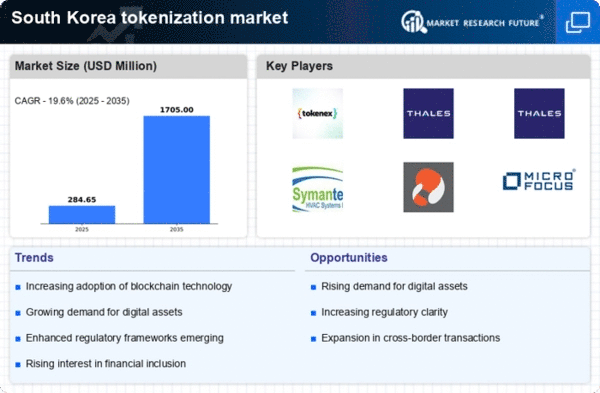
As per Market Research Future analysis, the South Korea tokenization market Size was estimated at 238.0 USD Million in 2024. The South Korea tokenization market is projected to grow from 284.65 USD Million in 2025 to 1705.0 USD Million by 2035, exhibiting a compound annual growth rate (CAGR) of 19% during the forecast period 2025 - 2035

Key Market Trends & Highlights

The South Korea tokenization market is experiencing robust growth driven by technological integration and regulatory support.

  • The financial services segment represents the largest share of the South Korea tokenization market.
  • The e-commerce sector is emerging as the fastest-growing segment, reflecting increased consumer engagement.
  • Regulatory support for tokenization is fostering a conducive environment for market expansion.
  • Key drivers include the growing demand for secure transactions and supportive government initiatives.

Market Size & Forecast

2024 Market Size 238.0 (USD Million)
2035 Market Size 1705.0 (USD Million)
CAGR (2025 - 2035) 19.6%

Major Players

TokenEx (US), Thales (FR), Gemalto (NL), Symantec (US), Protegrity (US), Micro Focus (GB), FIS (US), CipherCloud (US)

Our Impact
Enabled $4.3B Revenue Impact for Fortune 500 and Leading Multinationals
Partnering with 2000+ Global Organizations Each Year
30K+ Citations by Top-Tier Firms in the Industry

South Korea Tokenization Market Trends

The tokenization market in South Korea is currently experiencing a notable evolution, driven by advancements in technology and increasing demand for secure digital transactions. As businesses and consumers alike seek to enhance their security measures, the adoption of tokenization solutions appears to be gaining momentum. This trend is likely influenced by the growing awareness of data privacy and the need to protect sensitive information from cyber threats. Furthermore, regulatory frameworks in South Korea are evolving to support the integration of tokenization technologies, which may facilitate broader acceptance across various sectors. In addition, the financial services sector in South Korea is increasingly recognizing the potential of tokenization to streamline operations and improve customer experiences. By converting sensitive data into non-sensitive tokens, organizations can reduce the risk of data breaches while maintaining operational efficiency. This shift towards tokenization may also be bolstered by the rise of digital currencies and blockchain technology, which are becoming more prevalent in the South Korean market. Overall, the tokenization market is poised for growth as stakeholders continue to explore innovative solutions to enhance security and efficiency in transactions.

Increased Adoption in Financial Services

The financial services sector in South Korea is witnessing a surge in the adoption of tokenization technologies. This trend is driven by the need for enhanced security measures to protect sensitive customer data. Financial institutions are increasingly implementing tokenization to mitigate risks associated with data breaches, thereby fostering trust among consumers.

Regulatory Support for Tokenization

Regulatory bodies in South Korea are actively developing frameworks that support the implementation of tokenization solutions. This regulatory backing is likely to encourage businesses to adopt tokenization practices, as compliance with evolving regulations becomes a priority. Such support may lead to a more robust tokenization market.

Integration with Emerging Technologies

The tokenization market is increasingly integrating with emerging technologies such as blockchain and artificial intelligence. This convergence appears to enhance the capabilities of tokenization solutions, making them more efficient and secure. As these technologies evolve, they may further drive innovation within the tokenization landscape.

South Korea Tokenization Market Drivers

Rising E-commerce Activities

The surge in e-commerce activities in South Korea significantly influences the tokenization market. With online shopping becoming increasingly popular, businesses are seeking ways to protect customer payment information. Tokenization serves as a vital tool in this context, allowing merchants to process transactions without exposing sensitive data. In 2025, e-commerce sales in South Korea are expected to reach $100 billion, driving the need for secure payment solutions. As more consumers engage in online transactions, the demand for tokenization services is likely to increase, propelling the growth of the tokenization market.

Supportive Government Initiatives

Government initiatives aimed at promoting digital transformation are playing a crucial role in the tokenization market. In South Korea, the government has introduced policies to encourage the adoption of advanced technologies, including tokenization. These initiatives often include funding for research and development, as well as incentives for businesses to implement secure data management practices. As a result, the tokenization market is likely to benefit from increased investment and innovation. By 2025, government support is expected to contribute to a 30% growth in the adoption of tokenization solutions across various industries, enhancing overall market dynamics.

Growing Demand for Secure Transactions

The increasing need for secure transactions is a primary driver in the tokenization market. As cyber threats evolve, businesses in South Korea are prioritizing data protection. Tokenization offers a method to safeguard sensitive information by replacing it with non-sensitive equivalents. This approach not only enhances security but also helps organizations comply with stringent regulations. In 2025, the market for tokenization solutions in South Korea is projected to grow by approximately 25%, reflecting the rising demand for secure transaction methods. Companies are investing in tokenization technologies to mitigate risks associated with data breaches, thereby fostering growth in the tokenization market.

Integration with Financial Technologies

The integration of tokenization with financial technologies is emerging as a significant driver in the tokenization market. As fintech companies in South Korea innovate and expand their services, the need for secure transaction methods becomes paramount. Tokenization provides a robust framework for protecting sensitive financial data, which is essential for maintaining consumer trust. In 2025, the fintech sector in South Korea is projected to grow by 20%, further fueling the demand for tokenization solutions. This integration not only enhances security but also streamlines payment processes, thereby fostering a more efficient financial ecosystem.

Enhanced Consumer Awareness of Data Privacy

Consumer awareness regarding data privacy is on the rise in South Korea, acting as a catalyst for the tokenization market. As individuals become more informed about their rights and the risks associated with data sharing, they are demanding greater protection for their personal information. This shift in consumer behavior compels businesses to adopt tokenization solutions to ensure compliance with privacy regulations and to build trust with their customers. In 2025, it is estimated that 70% of consumers in South Korea will prioritize data security when choosing service providers, thereby driving the adoption of tokenization technologies in various sectors.


Market Segment Insights

By Application: Payment Security (Largest) vs. Fraud Prevention (Fastest-Growing)

In the South Korea tokenization market, Payment Security holds the largest market share among the application segments, catering to the increasing demand for secure online transactions. Its significance has intensified as businesses prioritize safeguarding sensitive payment information amidst the rising digital payment trends. Moreover, Fraud Prevention is currently the fastest-growing segment, driven by heightened awareness of cybersecurity threats and the necessity for robust fraud mitigation strategies. The growth trends indicate a robust demand for solutions that enhance data protection, driven by advancements in technology and regulatory requirements. Factors such as digital transformation across industries and the increasing adoption of e-commerce are propelling both Payment Security and Fraud Prevention forward. This shift highlights the importance of not only securing payments but also developing sophisticated fraud detection capabilities to keep pace with evolving cyber threats.

Payment Security (Dominant) vs. Fraud Prevention (Emerging)

Payment Security is the dominant application in the South Korea tokenization market, as organizations demand reliable systems to protect transaction data from breaches. Its market position is bolstered by a growing need for secure payment gateways and encryption technologies. On the other hand, Fraud Prevention is emerging rapidly, characterized by innovative solutions that leverage artificial intelligence and machine learning to detect anomalies in real-time. This segment responds effectively to the increasing sophistication of fraud schemes, offering businesses the tools needed to adapt and secure their operations. Both segments are integral to a comprehensive security strategy, but they cater to different aspects of transaction and data protection, each critical for maintaining consumer trust in digital transactions.

By Type: Application Tokenization (Largest) vs. Database Tokenization (Fastest-Growing)

In the South Korea tokenization market, the market share distribution reveals that Application Tokenization holds the largest share, driven by its wide adoption across various industries aiming to secure sensitive data. Meanwhile, Database Tokenization is gaining traction, characterized by its rapidly increasing demand as organizations seek robust security for their database systems, ensuring compliance with regulatory requirements. Growth trends indicate that Application Tokenization is primarily driven by the escalating need for data privacy and security in financial services and healthcare sectors. In contrast, Database Tokenization is emerging as the fastest-growing segment, propelled by the surge in cyber threats and the need for organizations to implement advanced security measures for sensitive information stored in databases. This trend reflects an overarching shift towards comprehensive data protection solutions in the South Korea tokenization market.

Application Tokenization (Dominant) vs. Database Tokenization (Emerging)

Application Tokenization is a dominant force within the South Korea tokenization market, renowned for its ability to convert sensitive data into a non-sensitive equivalent, significantly reducing the risk of data breaches. This segment is extensively utilized in sectors such as finance and healthcare, where regulatory compliance is critical. Conversely, Database Tokenization is an emerging segment focused on providing enhanced security for stored data. Organizations are increasingly recognizing the value of database tokenization as part of their security strategies, particularly in light of stringent data protection regulations. The growing concerns over data integrity and security breaches are fueling the adoption of this technology, making it a vital player in the overall landscape.

By Deployment Type: Cloud-Based (Largest) vs. On-Premises (Fastest-Growing)

In the South Korea tokenization market, the deployment type reveals distinct preferences among businesses. Cloud-based solutions dominate the market, capturing the largest share due to their flexibility, scalability, and lower operational costs. On-premises solutions, while lagging in overall market share, are gaining traction as organizations prioritize data sovereignty and control over sensitive information. Growth trends highlight a significant shift towards cloud-based deployments, driven by the increasing adoption of digital payment platforms and the demand for enhanced security measures. Conversely, the on-premises segment is emerging as the fastest-growing option, propelled by regulatory requirements and concerns over data privacy. Companies are investing in on-premises solutions to ensure compliance with local laws and retain ownership of their data assets.

Cloud-Based (Dominant) vs. On-Premises (Emerging)

Cloud-based deployment in the South Korea tokenization market stands out as the dominant choice for many organizations due to its inherent advantages such as ease of access, lower maintenance costs, and the ability to scale resources according to business needs. It supports seamless integration with existing systems, allowing businesses to streamline operations. On the other hand, the on-premises deployment is emerging as an important segment, appealing to firms that prioritize data security and regulatory compliance. This option provides companies with greater control over their data and systems, making it attractive in environments with strict data privacy regulations. As organizations navigate the complexities of data management, both deployment types will continue to shape the landscape of tokenization.

By End User: Banking (Largest) vs. Healthcare (Fastest-Growing)

In the South Korea tokenization market, the distribution of market share among various end users reveals banking as the dominant sector, capturing a significant portion due to its reliance on secure transactions and data protection measures. Following banking, the healthcare sector is increasingly gaining traction, reflecting the need for secure patient data management and compliance with regulations, positioning it as a promising player in the market landscape. Growth trends indicate that while banking maintains its stronghold, healthcare is on an upward trajectory, fueled by advancements in digital health initiatives and an increasing focus on patient confidentiality. Retail is also evolving, yet it lags in comparison to healthcare's rapid growth, influenced by changing consumer behavior towards digital payments. The government and telecommunication sectors exhibit steady growth, however, they are not projected to challenge the dominance of banking or the emerging status of healthcare in the near future.

Banking: Dominant vs. Healthcare: Emerging

The banking sector in the South Korea tokenization market is characterized by its advanced infrastructure and deep-rooted practices in security and compliance, making it the cornerstone of tokenization initiatives. With a vast amount of sensitive financial data at stake, banks prioritize enhanced security protocols, adopting tokenization to mitigate risks associated with fraud and data breaches. On the other hand, the healthcare sector is considered an emerging player, witnessing rapid adoption of tokenization driven by strict regulatory environments and the pressing need for secure medical records. As digital health technologies proliferate, healthcare organizations are increasingly transforming their data security strategies, establishing themselves as key participants in the tokenization landscape with a growing focus on patient confidentiality and data integrity.

Get more detailed insights about South Korea Tokenization Market

Key Players and Competitive Insights

The tokenization market exhibits a dynamic competitive landscape, characterized by rapid technological advancements and increasing demand for secure data management solutions. Key growth drivers include the rising need for data protection amid escalating cyber threats and regulatory compliance requirements. Major players such as TokenEx (US), Thales (FR), and Gemalto (NL) are strategically positioned to leverage these trends. TokenEx (US) focuses on cloud-based tokenization solutions, emphasizing scalability and flexibility, while Thales (FR) integrates advanced encryption technologies into its offerings, enhancing security features. Gemalto (NL), on the other hand, prioritizes partnerships with financial institutions to expand its market reach, thereby shaping a competitive environment that is increasingly collaborative and innovation-driven.
In terms of business tactics, companies are localizing their operations to better serve regional markets, optimizing supply chains to enhance efficiency. The competitive structure of the tokenization market appears moderately fragmented, with several key players exerting influence over various segments. This fragmentation allows for niche players to emerge, fostering innovation and competition among established firms.
In October 2025, TokenEx (US) announced a strategic partnership with a leading financial services provider to enhance its tokenization capabilities, aiming to deliver more robust security solutions tailored to the financial sector. This move is significant as it not only expands TokenEx's client base but also reinforces its commitment to addressing the specific needs of financial institutions, which are under constant pressure to protect sensitive data.
In September 2025, Thales (FR) launched a new suite of tokenization services designed to integrate seamlessly with existing IT infrastructures. This initiative is crucial as it positions Thales to capture a larger share of the market by appealing to organizations seeking to modernize their data protection strategies without overhauling their entire systems. The ease of integration is likely to attract clients who prioritize operational continuity.
In August 2025, Gemalto (NL) secured a multi-year contract with a major telecommunications company to provide tokenization solutions for customer data protection. This contract underscores Gemalto's strategy of aligning with industries that handle vast amounts of personal data, thereby enhancing its reputation as a trusted provider in the tokenization space. Such strategic alliances are pivotal in establishing credibility and expanding market presence.
As of November 2025, current competitive trends in the tokenization market are heavily influenced by digitalization, sustainability, and the integration of AI technologies. Companies are increasingly forming strategic alliances to enhance their technological capabilities and market reach. The competitive differentiation is likely to evolve from traditional price-based competition towards a focus on innovation, technological advancement, and supply chain reliability. This shift suggests that firms that prioritize these aspects will be better positioned to thrive in an increasingly complex market.

Key Companies in the South Korea Tokenization Market include

Industry Developments

In the South Korea Tokenization Market, SK Telecom has recently made strides in blockchain technology while focusing on enhancing secure financial transactions through tokenization. ICON Foundation has been involved in expanding its blockchain interoperability solutions, contributing to the growth of DeFi applications across the region. Upbit continues to lead the cryptocurrency exchange space, with growth in user engagement and trading volumes. Furthermore, Metadium has been gaining traction with its identity verification services based on blockchain. In recent months, Hana Financial Group and Dunamu have shown increasing collaboration in delivering fintech solutions emphasizing tokenization. 

Coinone and Bithumb have introduced new token products, resulting in a positive impact on their market valuations. Notably, Chain Partners achieved significant growth due to its popular solutions for token management. In a recent development from September 2023, Samsung SDS and Blocko announced a synergistic partnership aimed at enhancing enterprise blockchain capabilities within various sectors. The tokenization market in South Korea has seen a rise in market valuation, driven by innovation and regulatory support from the government emphasizing blockchain technology integration. The ongoing growth reflects a dynamic landscape poised for further advancements.


Future Outlook

South Korea Tokenization Market Future Outlook

The tokenization market in South Korea is projected to grow at a 19.6% CAGR from 2025 to 2035, driven by technological advancements and regulatory support.

New opportunities lie in:

  • Development of tokenized real estate platforms for fractional ownership.
  • Integration of blockchain-based identity verification systems for secure transactions.
  • Launch of tokenized loyalty programs to enhance customer engagement.

By 2035, the market is expected to achieve substantial growth, positioning itself as a leader in innovative financial solutions.

Market Segmentation

South Korea Tokenization Market Type Outlook

  • Application Tokenization
  • Database Tokenization
  • Network Tokenization

South Korea Tokenization Market End User Outlook

  • Banking
  • Healthcare
  • Retail
  • Government
  • Telecommunication

South Korea Tokenization Market Application Outlook

  • Payment Security
  • Data Security
  • Identity Protection
  • Fraud Prevention
  • Compliance Management

South Korea Tokenization Market Deployment Type Outlook

  • On-Premises
  • Cloud-Based

Report Scope

MARKET SIZE 2024 238.0(USD Million)
MARKET SIZE 2025 284.65(USD Million)
MARKET SIZE 2035 1705.0(USD Million)
COMPOUND ANNUAL GROWTH RATE (CAGR) 19.6% (2025 - 2035)
REPORT COVERAGE Revenue Forecast, Competitive Landscape, Growth Factors, and Trends
BASE YEAR 2024
Market Forecast Period 2025 - 2035
Historical Data 2019 - 2024
Market Forecast Units USD Million
Key Companies Profiled TokenEx (US), Thales (FR), Gemalto (NL), Symantec (US), Protegrity (US), Micro Focus (GB), FIS (US), CipherCloud (US)
Segments Covered Application, Type, Deployment Type, End User
Key Market Opportunities Emerging regulatory frameworks enhance security and drive growth in the tokenization market.
Key Market Dynamics Rising regulatory frameworks in South Korea drive innovation and competition in the tokenization market.
Countries Covered South Korea
Leave a Comment

FAQs

What is the expected market size of the South Korea Tokenization Market by 2035?

The South Korea Tokenization Market is expected to reach a value of 750.0 USD Million by 2035.

What is the expected CAGR for the South Korea Tokenization Market from 2025 to 2035?

The expected CAGR for the South Korea Tokenization Market from 2025 to 2035 is 15.411 %.

Which application segment is projected to dominate the South Korea Tokenization Market by 2035?

The Payment Security application segment is projected to dominate the South Korea Tokenization Market with a valuation of 220.0 USD Million by 2035.

What is the estimated market value for Data Security in the South Korea Tokenization Market by 2035?

The estimated market value for Data Security in the South Korea Tokenization Market is projected to be 150.0 USD Million by 2035.

Who are the major players in the South Korea Tokenization Market?

Major players in the South Korea Tokenization Market include SK Telecom, ICON Foundation, Upbit, and Kakao among others.

What is the expected market value for Fraud Prevention in the South Korea Tokenization Market by 2035?

The expected market value for Fraud Prevention in the South Korea Tokenization Market is forecasted to be 160.0 USD Million by 2035.

What will the market size for Compliance Management be in the South Korea Tokenization Market by 2035?

The market size for Compliance Management in the South Korea Tokenization Market is expected to reach 100.0 USD Million by 2035.

How much is the Identity Protection segment expected to grow by 2035 in the South Korea Tokenization Market?

The Identity Protection segment is expected to grow to a valuation of 120.0 USD Million in the South Korea Tokenization Market by 2035.

What market value is anticipated for the Payment Security segment in 2024?

The Payment Security segment is anticipated to have a market value of 45.0 USD Million in 2024.

What challenges and opportunities are present in the South Korea Tokenization Market?

The South Korea Tokenization Market presents growth opportunities driven by increasing demand for security applications while facing challenges from regulatory considerations.

Download Free Sample

Kindly complete the form below to receive a free sample of this Report

Compare Licence

×
Features License Type
Single User Multiuser License Enterprise User
Price $4,950 $5,950 $7,250
Maximum User Access Limit 1 User Upto 10 Users Unrestricted Access Throughout the Organization
Free Customization
Direct Access to Analyst
Deliverable Format
Platform Access
Discount on Next Purchase 10% 15% 15%
Printable Versions