×
Request Free Sample ×

Kindly complete the form below to receive a free sample of this Report

* Please use a valid business email

Leading companies partner with us for data-driven Insights

clients tt-cursor
Hero Background

South Korea Surgical Site Infection Control Market

ID: MRFR/MED/48976-HCR
200 Pages
Rahul Gotadki
February 2026

South Korea Surgical Site Infection Control Market Research Report By Product Type (Disinfectants, Antiseptics, Surgical Drapes, Surgical Gloves), By End User (Hospitals, Ambulatory Surgical Centers, Clinics), By Infection Control Method (Preoperative, Intraoperative, Postoperative) and By Formulation (Liquids, Gels, Sprays) - Growth & Industry Forecast 2025 To 2035

Share:
Download PDF ×

We do not share your information with anyone. However, we may send you emails based on your report interest from time to time. You may contact us at any time to opt-out.

South Korea Surgical Site Infection Control Market Infographic
Purchase Options

South Korea Surgical Site Infection Control Market Summary

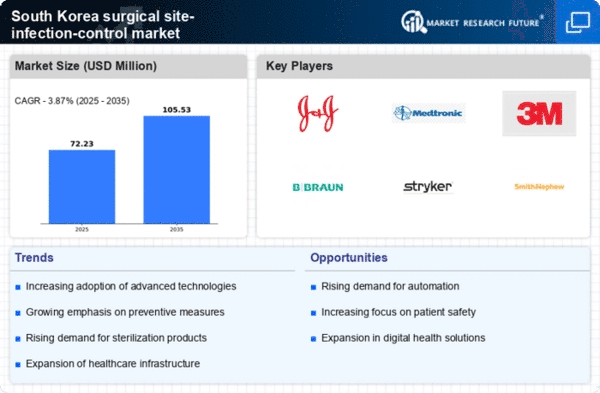
As per Market Research Future analysis, the South Korea surgical site-infection-control market size was estimated at 69.54 USD Million in 2024. The South Korea surgical site-infection-control market is projected to grow from 72.23 USD Million in 2025 to 105.53 USD Million by 2035, exhibiting a compound annual growth rate (CAGR) of 3.8% during the forecast period 2025 - 2035

Key Market Trends & Highlights

The South Korea surgical site-infection-control market is poised for growth driven by regulatory enhancements and technological advancements.

  • Regulatory enhancements are shaping the landscape of surgical site-infection control, ensuring compliance and safety.
  • Technological integration is becoming increasingly prevalent, with advanced infection control solutions gaining traction.
  • Increased awareness and training among healthcare professionals are contributing to improved patient outcomes.
  • Rising surgical procedures and government initiatives are key drivers propelling market expansion.

Market Size & Forecast

2024 Market Size 69.54 (USD Million)
2035 Market Size 105.53 (USD Million)
CAGR (2025 - 2035) 3.87%

Major Players

Johnson & Johnson (US), Medtronic (US), 3M (US), B. Braun Melsungen AG (DE), Stryker Corporation (US), Smith & Nephew (GB), ConvaTec Group (GB), Cardinal Health (US), Hollister Incorporated (US)

Our Impact
Enabled $4.3B Revenue Impact for Fortune 500 and Leading Multinationals
Partnering with 2000+ Global Organizations Each Year
30K+ Citations by Top-Tier Firms in the Industry

South Korea Surgical Site Infection Control Market Trends

The surgical site-infection-control market is currently experiencing notable developments, driven by an increasing emphasis on patient safety and quality of care in healthcare facilities. In South Korea, the government has implemented stringent regulations and guidelines aimed at reducing infection rates associated with surgical procedures. This regulatory framework encourages hospitals and surgical centers to adopt advanced infection control measures, including the use of sterilization technologies and antimicrobial agents. Furthermore, the rising awareness among healthcare professionals regarding the importance of infection prevention is fostering a culture of safety, which is likely to enhance the overall effectiveness of surgical procedures. In addition, the surgical site-infection-control market is witnessing a shift towards innovative solutions, such as the integration of digital technologies and data analytics. These advancements enable healthcare providers to monitor infection rates in real-time, facilitating prompt interventions when necessary. The collaboration between public health authorities and private sector entities is also contributing to the development of comprehensive infection control programs. As the healthcare landscape continues to evolve, the surgical site-infection-control market appears poised for growth, with a focus on improving patient outcomes and minimizing healthcare-associated infections.

Regulatory Enhancements

The surgical site-infection-control market is influenced by rigorous regulatory measures established by South Korean health authorities. These regulations mandate compliance with infection prevention protocols, compelling healthcare facilities to invest in advanced sterilization and disinfection technologies. This trend indicates a proactive approach to safeguarding patient health and reducing surgical complications.

Technological Integration

There is a growing trend towards the adoption of innovative technologies within the surgical site-infection-control market. Digital solutions, such as automated monitoring systems and data analytics, are being utilized to track infection rates and enhance compliance with hygiene standards. This integration of technology is likely to improve the efficiency of infection control practices.

Increased Awareness and Training

The emphasis on education and training for healthcare professionals is becoming more pronounced in the surgical site-infection-control market. Continuous professional development programs are being implemented to ensure that staff are well-versed in the latest infection prevention techniques. This trend suggests a commitment to fostering a culture of safety and excellence in surgical care.

South Korea Surgical Site Infection Control Market Drivers

Rising Surgical Procedures

The increasing number of surgical procedures in South Korea is a primary driver for the surgical site-infection-control market. As the population ages and the prevalence of chronic diseases rises, the demand for surgical interventions escalates. In 2025, it is estimated that over 1.5 million surgeries will be performed annually in South Korea, leading to a heightened focus on infection control measures. Hospitals and surgical centers are investing in advanced sterilization techniques and infection prevention protocols to mitigate the risk of surgical site infections. This trend indicates a growing recognition of the importance of maintaining high standards of hygiene and safety in surgical environments, thereby propelling the surgical site-infection-control market forward.

Rising Healthcare Expenditure

The upward trend in healthcare expenditure in South Korea is a crucial driver for the surgical site-infection-control market. With healthcare spending projected to reach 10% of GDP by 2025, hospitals are allocating more resources towards infection control measures. This increase in funding allows for the procurement of advanced sterilization equipment and the implementation of rigorous infection prevention protocols. Furthermore, as patients become more aware of the risks associated with surgical procedures, they are demanding higher standards of care, prompting healthcare providers to enhance their infection control practices. Consequently, the surgical site-infection-control market is expected to benefit from this increased investment in healthcare quality.

Increased Focus on Patient Safety

There is a growing emphasis on patient safety within the healthcare sector, which is significantly impacting the surgical site-infection-control market. Hospitals are increasingly prioritizing infection prevention as part of their quality assurance programs. This shift is driven by both regulatory requirements and patient expectations for safer surgical experiences. In South Korea, healthcare institutions are implementing comprehensive infection control protocols, which include preoperative screening and postoperative monitoring. As a result, the surgical site-infection-control market is likely to expand as hospitals invest in training staff and adopting best practices to ensure patient safety and minimize infection risks.

Government Initiatives and Funding

Government initiatives aimed at improving healthcare quality and patient safety are significantly influencing the surgical site-infection-control market. In South Korea, the Ministry of Health and Welfare has launched various programs to enhance infection control practices in healthcare facilities. These initiatives often include funding for training healthcare professionals and upgrading medical equipment. For instance, a recent allocation of $50 million for infection control measures in hospitals underscores the government's commitment to reducing surgical site infections. Such financial support not only encourages hospitals to adopt better practices but also fosters innovation in infection control technologies, thereby stimulating market growth.

Emerging Infection Control Technologies

The surgical site-infection-control market is experiencing a surge in innovative technologies designed to prevent infections during surgical procedures. Advancements in antimicrobial coatings, sterilization equipment, and monitoring systems are becoming increasingly prevalent. For example, the introduction of smart surgical instruments equipped with real-time infection monitoring capabilities is revolutionizing the way infections are managed in operating rooms. The market for these technologies is projected to grow at a CAGR of 8% through 2027, reflecting the increasing demand for effective infection control solutions. As healthcare providers seek to enhance patient outcomes, the adoption of these cutting-edge technologies is likely to drive the surgical site-infection-control market further.


Market Segment Insights

By Product Type: Disinfectants (Largest) vs. Surgical Gloves (Fastest-Growing)

In the South Korea surgical site-infection-control market, disinfectants are currently the largest segment, holding a significant portion of the overall market share. Surgical drapes and antiseptics also command substantial shares, but their growth rates are not as strong as that of surgical gloves, which have emerged as a critical component of infection control in surgical settings. The dynamic characteristics of these segments highlight their respective roles in maintaining sterile environments and preventing infections. As awareness of surgical site infections rises, the demand for surgical gloves continues to grow, driven by innovations in material and design. Disinfectants maintain their stronghold due to their essential role in pre-operative and post-operative procedures. Factors such as regulatory support for infection control measures and an increasing number of surgical procedures are propelling the growth of these segments, making them indispensable in healthcare facilities across the country.

Disinfectants (Dominant) vs. Surgical Gloves (Emerging)

Disinfectants are recognized as the dominant force in the South Korea surgical site-infection-control market due to their critical role in sterilization and hygiene practices. They are often formulated with advanced antimicrobial properties, providing high efficacy against a variety of pathogens. As the market evolves, surgical gloves are emerging as a vital segment, propelled by technological advancements and heightened awareness of infection prevention among healthcare professionals. While disinfectants primarily serve as agents for cleaning, surgical gloves are pivotal in preventing cross-contamination during surgeries. The dual focus on rigorous disinfectant application and the expansion of surgical glove options underscores a comprehensive approach to infection control.

By End User: Hospitals (Largest) vs. Ambulatory Surgical Centers (Fastest-Growing)

In the South Korea surgical site-infection-control market, hospitals represent the largest segment, holding a significant share of the total market. They dominate the landscape due to their extensive surgical operations and higher patient volumes, which necessitate rigorous infection control measures. Ambulatory surgical centers, while smaller in comparison, are rapidly growing as more procedures shift from hospitals to these settings, driven by cost-effectiveness and convenience. The growth trends in this segment indicate a notable increase in the establishment of ambulatory surgical centers as they adapt to evolving healthcare demands. Factors driving this growth include technological advancements, an increase in outpatient surgeries, and a rising emphasis on patient safety. The market is also witnessing a push for innovative infection control solutions in these settings to enhance patient outcomes, thereby supporting a positive growth trajectory for ambulatory surgical centers.

Hospitals (Dominant) vs. Ambulatory Surgical Centers (Emerging)

Hospitals in the South Korea surgical site-infection-control market remain the dominant force due to their comprehensive infrastructure and resources aimed at infection prevention. They are crucial in implementing stringent protocols and utilizing advanced technologies to ensure patient safety during surgical procedures. In contrast, ambulatory surgical centers are recognized as an emerging segment, characterized by their focus on outpatient procedures and streamlined operations. This segment is adapting rapidly to the market's demands and is increasingly adopting innovative infection control measures to improve efficiency and patient safety. As the healthcare system evolves, both segments will continue to play vital roles, with hospitals leading in scale and ambulatory surgical centers gaining momentum through agility and patient-oriented services.

By Infection Control Method: Preoperative (Largest) vs. Intraoperative (Fastest-Growing)

In the South Korea surgical site-infection-control market, the distribution of market share among the infection control methods reveals that the Preoperative segment holds the largest share due to its critical role in patient preparation and infection prevention. This segment's dominance can be attributed to early interventions, including antiseptic skin preparation and the administration of prophylactic antibiotics prior to surgery, which together significantly reduce the risk of infections. Conversely, the Intraoperative segment is recognized as the fastest-growing area, fueled by advancements in surgical technology and techniques that enhance infection control during procedures. As surgical procedures become more sophisticated, there is an increasing emphasis on maintaining sterile conditions and using innovative tools, thus driving growth in this segment as healthcare providers seek to minimize the risk of surgical site infections.

Preoperative (Dominant) vs. Intraoperative (Emerging)

The Preoperative segment is characterized by its comprehensive approach to infection control, focusing on essential protocols such as patient antisepsis and antibiotic prophylaxis. This method is considered the backbone of infection prevention, making it dominant within the market. In contrast, the Intraoperative segment is gaining traction as an emerging value, driven by developments in minimally invasive surgical techniques and improved sterilization products. These advancements underscore the growing importance of intraoperative measures to combat infections, thereby reshaping the infection control landscape. As a result, while the Preoperative method remains the staple approach, the Intraoperative method is quickly becoming a vital area of focus in infection control strategies.

By Formulation: Liquids (Largest) vs. Gels (Fastest-Growing)

In the South Korea surgical site-infection-control market, the formulation segment is primarily dominated by Liquids, which have established themselves as the largest category due to their ease of use and effectiveness in providing thorough coverage. According to recent trends, Liquids hold a significant share thanks to their widespread application across various surgical procedures, making them indispensable. Gels, although currently smaller in terms of overall share, are rapidly gaining traction as they offer unique benefits such as enhanced adhesion and retention on surgical sites, contributing to their growing popularity. Growth trends indicate an increasing preference for Gels, as healthcare professionals seek alternatives that not only enhance patient comfort but also provide effective infection control. The surge in surgical procedures in South Korea has propelled the demand for innovative formulation types, leading to heightened interest in Gels, which are expected to witness the fastest growth. Factors such as advancements in formulation technology and a focus on improving surgical outcomes further drive this trend, enhancing the competitive landscape within the segment.

Liquids: Dominant vs. Gels: Emerging

Liquids are the dominant force within the formulation segment of the South Korea surgical site-infection-control market. Their formulation typically offers robust antimicrobial properties and is versatile for various surgical applications. Medical professionals appreciate Liquid antiseptics for their simplicity and widespread acceptance in operating rooms. In contrast, Gels are emerging as a noteworthy alternative, characterized by their ability to create a protective barrier that adheres effectively to the skin and surgical sites. This property not only enhances patient comfort but also reduces the risk of infections. As healthcare providers increasingly recognize the benefits of Gels, their adoption is projected to rise, fostering greater innovation and competition within the segment.

Get more detailed insights about South Korea Surgical Site Infection Control Market

Key Players and Competitive Insights

The surgical site-infection-control market in South Korea is characterized by a competitive landscape that is increasingly shaped by innovation, strategic partnerships, and a focus on digital transformation. Key players such as Johnson & Johnson (US), Medtronic (US), and 3M (US) are actively pursuing strategies that enhance their market positioning. For instance, Johnson & Johnson (US) has been focusing on expanding its product portfolio through innovative solutions aimed at reducing infection rates during surgical procedures. This emphasis on innovation not only strengthens their competitive edge but also aligns with the growing demand for advanced infection control technologies.In terms of business tactics, companies are increasingly localizing manufacturing and optimizing supply chains to enhance efficiency and responsiveness to market needs. The competitive structure of the market appears moderately fragmented, with several key players exerting influence. This fragmentation allows for a diverse range of products and solutions, catering to various segments within the surgical site-infection-control domain. The collective actions of these companies contribute to a dynamic environment where competition is driven by both technological advancements and operational efficiencies.

In October Medtronic (US) announced a strategic partnership with a local South Korean healthcare provider to enhance the distribution of its infection control products. This collaboration is expected to leverage local expertise and improve market penetration, thereby positioning Medtronic (US) as a more formidable player in the region. Such partnerships are indicative of a broader trend where companies seek to integrate local knowledge into their operational strategies, potentially leading to improved customer engagement and satisfaction.

In September 3M (US) launched a new line of antimicrobial surgical drapes designed to minimize the risk of surgical site infections. This product introduction reflects 3M's commitment to innovation and its proactive approach to addressing the evolving needs of healthcare providers. The strategic importance of this launch lies in its potential to enhance patient outcomes and solidify 3M's reputation as a leader in infection control solutions.

As of November the competitive trends within the surgical site-infection-control market are increasingly defined by digitalization, sustainability, and the integration of artificial intelligence (AI) into product offerings. Companies are forming strategic alliances to enhance their technological capabilities and expand their market reach. This shift indicates a movement away from traditional price-based competition towards a focus on innovation, technology, and supply chain reliability. Looking ahead, it seems likely that competitive differentiation will increasingly hinge on the ability to deliver cutting-edge solutions that not only meet regulatory standards but also address the growing demand for sustainable and efficient healthcare practices.

Key Companies in the South Korea Surgical Site Infection Control Market include

Industry Developments

The South Korea Surgical Site Infection Control Market has seen significant developments recently, characterized by innovations and a growing focus on infection prevention methods. Major companies like ConvaTec, Integra LifeSciences, Ecolab, and Becton Dickinson are actively engaging in expanding their product offerings to enhance surgical patient safety. 

Notably, the market valuation of surgical infection control products has experienced growth due to increased awareness regarding post-surgical complications, which has prompted healthcare facilities to adopt advanced infection control measures. Moreover, in March 2023, Medtronic announced the acquisition of a local technology firm that specializes in infection prevention solutions, aiming to bolster its portfolio in the South Korean market. Smith and Nephew have also invested in Research and Development to create innovative antimicrobial dressings to further address surgical site infections. 

Regulatory shifts in South Korea, particularly by the Ministry of Health and Welfare, are driving compliance and standardization across infection control practices, enhancing the overall market landscape. In the past two years, initiatives to improve surgical hygiene and protocols have solidified the imperative role of these companies in safeguarding health outcomes within the domestic healthcare system.

Future Outlook

South Korea Surgical Site Infection Control Market Future Outlook

The Surgical Site Infection Control Market is projected to grow at 3.87% CAGR from 2025 to 2035, driven by technological advancements, increasing surgical procedures, and heightened infection control awareness.

New opportunities lie in:

  • Development of advanced antimicrobial coatings for surgical instruments.
  • Integration of AI-driven infection monitoring systems in hospitals.
  • Expansion of training programs for surgical staff on infection prevention protocols.

By 2035, the market is expected to achieve robust growth, reflecting enhanced infection control measures.

Market Segmentation

South Korea Surgical Site Infection Control Market End User Outlook

  • Hospitals
  • Ambulatory Surgical Centers
  • Clinics

South Korea Surgical Site Infection Control Market Formulation Outlook

  • Liquids
  • Gels
  • Sprays

South Korea Surgical Site Infection Control Market Product Type Outlook

  • Disinfectants
  • Antiseptics
  • Surgical Drapes
  • Surgical Gloves

South Korea Surgical Site Infection Control Market Infection Control Method Outlook

  • Preoperative
  • Intraoperative
  • Postoperative

Report Scope

MARKET SIZE 2024 69.54(USD Million)
MARKET SIZE 2025 72.23(USD Million)
MARKET SIZE 2035 105.53(USD Million)
COMPOUND ANNUAL GROWTH RATE (CAGR) 3.87% (2025 - 2035)
REPORT COVERAGE Revenue Forecast, Competitive Landscape, Growth Factors, and Trends
BASE YEAR 2024
Market Forecast Period 2025 - 2035
Historical Data 2019 - 2024
Market Forecast Units USD Million
Key Companies Profiled Johnson & Johnson (US), Medtronic (US), 3M (US), B. Braun Melsungen AG (DE), Stryker Corporation (US), Smith & Nephew (GB), ConvaTec Group (GB), Cardinal Health (US), Hollister Incorporated (US)
Segments Covered Product Type, End User, Infection Control Method, Formulation
Key Market Opportunities Integration of advanced antimicrobial technologies in surgical site-infection-control market enhances patient safety and operational efficiency.
Key Market Dynamics Rising regulatory scrutiny drives innovation in surgical site-infection-control technologies and practices in South Korea.
Countries Covered South Korea
Leave a Comment

FAQs

What is the expected market size of the South Korea Surgical Site Infection Control Market by 2024?

The South Korea Surgical Site Infection Control Market is expected to be valued at 87.0 million USD by the year 2024.

What will the market size of the South Korea Surgical Site Infection Control Market be in 2035?

In 2035, the South Korea Surgical Site Infection Control Market is anticipated to reach a value of 140.0 million USD.

What is the expected compound annual growth rate (CAGR) of the South Korea Surgical Site Infection Control Market from 2025 to 2035?

The expected CAGR for the South Korea Surgical Site Infection Control Market from 2025 to 2035 is 4.42%.

What are the primary product types in the South Korea Surgical Site Infection Control Market?

The primary product types in the market include disinfectants, antiseptics, surgical drapes, and surgical gloves.

How much is the disinfectants segment valued at in 2024 and 2035?

The disinfectants segment is valued at 25.0 million USD in 2024 and is expected to reach 40.0 million USD by 2035.

What is the market size for surgical gloves in 2024 and how is it projected to grow by 2035?

The surgical gloves segment is valued at 27.0 million USD in 2024 and is projected to grow to 44.0 million USD by 2035.

Who are the major players in the South Korea Surgical Site Infection Control Market?

Major players in the market include ConvaTec, Integra LifeSciences, Ecolab, Becton Dickinson, Medtronic, and Cardinal Health.

What is the size of the antiseptics market in 2024 and what is its projected value in 2035?

The antiseptics market is valued at 20.0 million USD in 2024 and is projected to grow to 32.0 million USD by 2035.

What growth opportunities exist within the South Korea Surgical Site Infection Control Market?

Growth opportunities in this market stem from increasing surgical procedures and a growing emphasis on infection prevention protocols.

What are the key challenges facing the South Korea Surgical Site Infection Control Market?

Key challenges include maintaining product efficacy, regulatory compliance, and competition from alternative infection prevention solutions.

Download Free Sample

Kindly complete the form below to receive a free sample of this Report

Compare Licence

×
Features License Type
Single User Multiuser License Enterprise User
Price $4,950 $5,950 $7,250
Maximum User Access Limit 1 User Upto 10 Users Unrestricted Access Throughout the Organization
Free Customization
Direct Access to Analyst
Deliverable Format
Platform Access
Discount on Next Purchase 10% 15% 15%
Printable Versions