×
Request Free Sample ×

Kindly complete the form below to receive a free sample of this Report

* Please use a valid business email

Leading companies partner with us for data-driven Insights

clients tt-cursor
Hero Background

South Korea STD Testing Devices Market

ID: MRFR/HC/49815-HCR
200 Pages
Rahul Gotadki
February 2026

South Korea STD Testing Devices Market Research Report By Type of Test (Serological Tests, Molecular Tests, Rapid Tests, Nucleic Acid Amplification Tests), By End User (Hospitals, Diagnostic Laboratories, Home Care Settings, Public Health Organizations), By Product Type (Test Kits, Equipment, Consumables) and By Application (Chlamydia Testing, Gonorrhea Testing, Syphilis Testing, HIV Testing, Hepatitis Testing) - Growth & Industry Forecast 2025 To 2035

Share:
Download PDF ×

We do not share your information with anyone. However, we may send you emails based on your report interest from time to time. You may contact us at any time to opt-out.

South Korea STD Testing Devices Market Infographic
Purchase Options

South Korea STD Testing Devices Market Summary

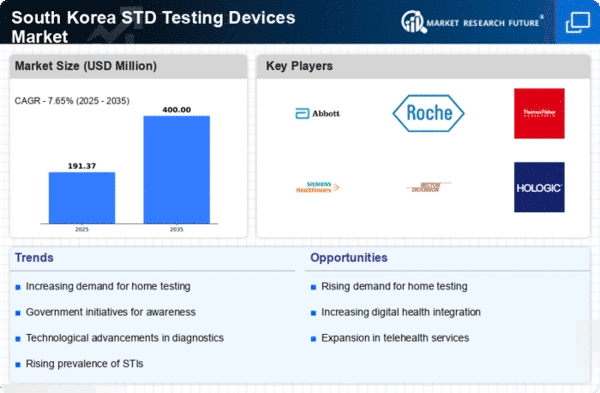
As per Market Research Future analysis, the South Korea STD Testing Devices Market Size was estimated at 177.77 USD Million in 2024. The South Korea std testing-devices market is projected to grow from 191.37 USD Million in 2025 to 400.0 USD Million by 2035, exhibiting a compound annual growth rate (CAGR) of 7.6% during the forecast period 2025 - 2035

Key Market Trends & Highlights

The South Korea STD testing-devices market is experiencing robust growth driven by technological advancements and increased awareness.

  • Technological advancements are enhancing the accuracy and efficiency of STD testing devices.
  • The largest segment in the market is the at-home testing solutions, reflecting a shift towards convenience and privacy.
  • The fastest-growing segment is the digital health technologies, indicating a trend towards integrated health solutions.
  • Key market drivers include the growing demand for rapid testing solutions and government initiatives supporting preventive healthcare.

Market Size & Forecast

2024 Market Size 177.77 (USD Million)
2035 Market Size 400.0 (USD Million)
CAGR (2025 - 2035) 7.65%

Major Players

Abbott Laboratories (US), Roche Diagnostics (CH), Thermo Fisher Scientific (US), Siemens Healthineers (DE), Becton Dickinson and Company (US), Hologic Inc. (US), Cepheid (US), Bio-Rad Laboratories (US)

Our Impact
Enabled $4.3B Revenue Impact for Fortune 500 and Leading Multinationals
Partnering with 2000+ Global Organizations Each Year
30K+ Citations by Top-Tier Firms in the Industry

South Korea STD Testing Devices Market Trends

The std testing-devices market in South Korea is currently experiencing notable growth, driven by increasing awareness of sexually transmitted infections (STIs) and the importance of early detection. The government has been proactive in promoting sexual health education, which appears to have led to a rise in demand for testing devices. Furthermore, advancements in technology have facilitated the development of more efficient and user-friendly testing solutions, making them accessible to a broader population. This trend is likely to continue as public health initiatives emphasize the significance of regular testing and the reduction of stigma associated with STIs. In addition, the rise of telehealth services has transformed how individuals access std testing. Many consumers now prefer the convenience of at-home testing kits, which offer privacy and ease of use. This shift in consumer behavior suggests a potential for further innovation in the std testing-devices market, as manufacturers adapt to meet the evolving needs of users. As South Korea continues to prioritize public health, the market is expected to expand, with a focus on enhancing the accuracy and reliability of testing devices, ultimately contributing to better health outcomes for the population.

Technological Advancements

Recent innovations in testing technology have led to the development of more accurate and rapid testing devices. These advancements are likely to enhance user experience and increase the reliability of results, thereby encouraging more individuals to seek testing.

Increased Awareness and Education

Ongoing public health campaigns aimed at raising awareness about STIs have contributed to a growing acceptance of testing. This trend indicates a shift in societal attitudes, which may lead to higher testing rates and improved health outcomes.

Rise of At-Home Testing Solutions

The demand for at-home testing kits is on the rise, driven by consumer preferences for privacy and convenience. This trend suggests that manufacturers may focus on developing user-friendly products that cater to this growing market segment.

South Korea STD Testing Devices Market Drivers

Rising Incidence of STDs

The rising incidence of STDs in South Korea is a significant driver for the std testing-devices market. Recent statistics indicate that reported cases of STDs have increased by approximately 18% over the last few years, prompting a greater need for effective testing solutions. This alarming trend has led to increased public health awareness and a push for more comprehensive testing options. As healthcare providers respond to this rise, the demand for innovative and reliable testing devices is expected to grow. Consequently, the std testing-devices market is likely to expand as stakeholders seek to address this pressing public health issue.

Government Initiatives and Support

Government initiatives play a crucial role in shaping the std testing-devices market in South Korea. The government has implemented various programs aimed at increasing accessibility to testing services, particularly in underserved regions. Financial support and subsidies for testing devices have been introduced, which may lead to a broader adoption of these technologies. Furthermore, public health campaigns aimed at reducing the stigma associated with STD testing are likely to enhance awareness and encourage more individuals to seek testing. As a result, the std testing-devices market is expected to benefit from these supportive measures, potentially increasing market penetration by 15% over the next few years.

Increased Focus on Preventive Healthcare

There is a growing emphasis on preventive healthcare within South Korea, which is positively impacting the std testing-devices market. As individuals become more health-conscious, there is a heightened awareness of the importance of regular testing for STDs. This shift towards preventive measures is supported by educational campaigns that highlight the benefits of early detection and treatment. Market analysis indicates that the preventive healthcare segment is projected to grow by 20% in the coming years, which may lead to increased sales of std testing devices. This trend suggests that consumers are more willing to invest in their health, thereby driving the growth of the std testing-devices market.

Growing Demand for Rapid Testing Solutions

The std testing-devices market in South Korea is experiencing a notable surge in demand for rapid testing solutions. This trend is driven by the increasing need for quick and accurate results, particularly among younger populations. The convenience of rapid tests aligns with the fast-paced lifestyle prevalent in urban areas. Recent data indicates that the market for rapid testing devices has expanded by approximately 25% over the past year, reflecting a shift in consumer preferences towards immediate results. This growing demand is likely to encourage manufacturers to innovate and enhance their product offerings, thereby contributing to the overall growth of the std testing-devices market.

Integration of Digital Health Technologies

The integration of digital health technologies is transforming the std testing-devices market in South Korea. The rise of telemedicine and mobile health applications has facilitated remote consultations and follow-ups, making it easier for individuals to access testing services. This trend is particularly appealing to tech-savvy consumers who prefer digital solutions. Data suggests that the use of digital platforms for health services has increased by 30% in recent years, indicating a shift towards more integrated healthcare solutions. Consequently, the std testing-devices market is likely to see a rise in demand for devices that can seamlessly connect with digital health platforms, enhancing user experience and engagement.


Market Segment Insights

By Type: Molecular Tests (Largest) vs. Rapid Tests (Fastest-Growing)

In the South Korea std testing-devices market, the market share distribution among test types reflects a strong preference for molecular tests, which dominate the segment due to their accuracy and reliability. Serological tests follow behind, while rapid tests have made significant inroads, appealing to consumers' demand for quicker results. Nucleic acid amplification tests contribute to the market by offering precise detection capabilities, balancing the competitive landscape among various testing methodologies. Growth trends in this segment are being driven by advancements in technology and increasing awareness about sexually transmitted diseases. The rise of rapid tests is indicative of changing consumer behavior, where convenience and speed are prioritized. Simultaneously, molecular tests continue to experience robust demand, supported by ongoing investments in healthcare infrastructure and public health initiatives aimed at improving overall diagnostic capabilities.

Molecular Tests (Dominant) vs. Rapid Tests (Emerging)

Molecular tests are characterized by their high specificity and sensitivity, making them essential for accurate diagnosis in the South Korea std testing-devices market. These tests are capable of detecting very low levels of pathogens, thereby ensuring reliable results. In contrast, rapid tests, which are gaining popularity, provide results in a much shorter timeframe, appealing to the immediate needs of patients. While molecular tests remain the dominant choice for healthcare providers due to their clinical significance, rapid tests are emerging as a valuable alternative, particularly in non-traditional settings like clinics and home testing. This dynamic between established and emerging technologies indicates a diverse landscape where both types are essential for comprehensive healthcare delivery.

By End User: Hospitals (Largest) vs. Diagnostic Laboratories (Fastest-Growing)

In the South Korea std testing-devices market, the distribution of market share among end users shows that hospitals hold the largest share, driven by their essential role in healthcare and diagnostics. Diagnostic laboratories, while smaller in share, are seeing rapid growth due to increased demand for specialized testing services. Home care settings and public health organizations represent emerging segments, but they currently contribute less to the overall market than hospitals and diagnostic laboratories. The growth trends for these segments are influenced by several factors, including advancements in testing technologies and a growing emphasis on preventive healthcare. Hospitals are expanding their capabilities to incorporate more sophisticated testing devices, while diagnostic laboratories are investing in innovative technologies to meet the needs of consumers. Additionally, the rising preference for at-home testing in home care settings is set to increase the market's competitiveness, making it essential for all participants to adapt to these evolving dynamics.

Hospitals (Dominant) vs. Diagnostic Laboratories (Emerging)

Hospitals remain the dominant end user in the South Korea std testing-devices market due to their comprehensive range of services and the high volume of patients they serve. They utilize a variety of testing devices to provide accurate and timely diagnoses, which is crucial for effective treatment. Conversely, diagnostic laboratories represent an emerging segment benefiting from technological advancements and increasing demand for specialized tests. The adaptability and focus on innovation enable these laboratories to cater to niche markets, thus positioning them favorably for future growth.

By Product Type: Test Kits (Largest) vs. Equipment (Fastest-Growing)

In the South Korea std testing-devices market, the distribution of market share among product types reveals a significant dominance of test kits, which command a substantial portion of the overall market. Test kits are often favored for their convenience and efficiency, making them the preferred choice among healthcare professionals. In contrast, equipment category, while smaller in share, is experiencing rapid growth as technological advancements and increased demand for accurate testing solutions drive its adoption. The growth trends for the South Korea std testing-devices market indicate a robust expansion of both test kits and equipment. The rising prevalence of sexually transmitted infections (STIs) has heightened the demand for rapid and reliable testing methods, thereby propelling the test kits segment. Moreover, equipment is emerging as the fastest-growing segment, with innovations in design and functionality leading to improved performance and reliability. As healthcare systems prioritize diagnostic accuracy, the market for consumables is also witnessing steady growth, reflecting a holistic advancement in testing capabilities.

Test Kits (Dominant) vs. Equipment (Emerging)

Test kits serve as the dominant product type in the South Korea std testing-devices market, primarily due to their ease of use and rapid results, which align with the increasing need for immediate testing solutions in clinical settings. On the other hand, equipment is categorized as an emerging segment, gaining traction due to ongoing technological enhancements and a focus on improving overall testing processes. The versatility of equipment not only supports various testing methodologies but also ensures compliance with stringent healthcare regulations. As such, the market dynamics favor a synergistic growth pathway for these product types, with test kits remaining at the forefront and equipment quickly evolving to meet the rising demands of healthcare providers.

By Application: HIV Testing (Largest) vs. Chlamydia Testing (Fastest-Growing)

In the South Korea std testing-devices market, HIV testing currently holds the largest share among various testing applications. It is followed closely by Gonorrhea and Syphilis testing. Chlamydia testing, while smaller in comparison, is rapidly gaining traction and reflects the changing priorities in public health initiatives. There is an increasing awareness and demand for accurate STD testing methods, leading to a more segmented market tailored to specific demographic needs. Growth trends indicate that HIV testing continues to benefit from government and healthcare investment in awareness programs, as well as advancements in technology that improve accuracy and speed. Conversely, Chlamydia testing has been identified as the fastest-growing segment, driven by rising infection rates and tailored initiatives targeting younger populations. The focus on proactive screening and early diagnosis is further propelling growth in this area.

HIV Testing (Dominant) vs. Chlamydia Testing (Emerging)

HIV testing is the dominant segment in the South Korea std testing-devices market, characterized by robust infrastructure for testing and established protocols. This segment enjoys high acceptance and is often included in routine health check-ups, reflecting its critical public health importance. Meanwhile, Chlamydia testing is an emerging segment, gaining prominence due to heightened awareness campaigns and improved accessibility of testing services. Innovative testing methods, including at-home kits, have also played a role in its rapid growth. The strategic focus on awareness for sexually transmitted infections among younger populations has positioned Chlamydia testing as a vital component of modern healthcare, creating a diverse landscape where both segments thrive.

Get more detailed insights about South Korea STD Testing Devices Market

Key Players and Competitive Insights

The std testing-devices market in South Korea is characterized by a dynamic competitive landscape, driven by increasing awareness of sexually transmitted diseases (STDs) and the growing demand for rapid and accurate testing solutions. Key players such as Abbott Laboratories (US), Roche Diagnostics (CH), and Thermo Fisher Scientific (US) are at the forefront, leveraging innovation and strategic partnerships to enhance their market presence. These companies focus on developing advanced testing technologies, which not only improve diagnostic accuracy but also reduce time to results, thereby addressing the urgent needs of healthcare providers and patients alike. Their collective strategies contribute to a competitive environment that is increasingly focused on technological advancement and customer-centric solutions.In terms of business tactics, companies are localizing manufacturing and optimizing supply chains to enhance efficiency and reduce costs. The market structure appears moderately fragmented, with several players vying for market share. However, the influence of major companies is substantial, as they set industry standards and drive innovation. This competitive structure allows for a diverse range of products and services, catering to various segments of the healthcare market.

In October Roche Diagnostics (CH) announced the launch of a new point-of-care testing device designed specifically for rapid STD detection. This strategic move is significant as it aligns with the increasing demand for quick and reliable testing solutions, particularly in remote and underserved areas. By enhancing accessibility to testing, Roche aims to capture a larger share of the market while addressing public health concerns related to STDs.

In September Abbott Laboratories (US) expanded its partnership with local healthcare providers to enhance the distribution of its STD testing devices. This initiative is crucial as it not only strengthens Abbott's market position but also facilitates better access to testing services for patients. The collaboration with local entities is likely to improve awareness and encourage more individuals to seek testing, thereby potentially increasing the overall market size.

In August Thermo Fisher Scientific (US) acquired a smaller biotech firm specializing in molecular diagnostics for STDs. This acquisition is indicative of a broader trend where larger companies seek to bolster their product portfolios through strategic acquisitions. By integrating innovative technologies from the acquired firm, Thermo Fisher aims to enhance its competitive edge and offer more comprehensive testing solutions to healthcare providers.

As of November the competitive trends in the std testing-devices market are increasingly defined by digitalization, sustainability, and the integration of artificial intelligence (AI) in testing processes. Strategic alliances among key players are shaping the landscape, fostering innovation and improving product offerings. Looking ahead, it is anticipated that competitive differentiation will evolve, with a shift from price-based competition to a focus on innovation, technological advancements, and supply chain reliability. This evolution underscores the importance of adaptability and responsiveness to market demands in maintaining a competitive advantage.

Key Companies in the South Korea STD Testing Devices Market include

Industry Developments

The South Korea STD Testing Devices Market has witnessed significant developments recently, particularly due to the increased awareness and demand for effective STD testing solutions amid rising infection rates. Noteworthy growth in market valuation is seen as companies like Abbott Laboratories and Thermo Fisher Scientific expand their product portfolios to include advanced diagnostic tools that enhance the accuracy and speed of STD detection. 

In August 2023, Abbott Molecular launched a new testing platform aimed at improving sexually transmitted infection diagnostics, catering specifically to the South Korean demographic.Additionally, Hologic has made strides in enhancing its market presence with new partnerships aimed at streamlining access to testing in urban and rural healthcare facilities. In the administrative landscape, regulatory bodies in South Korea have introduced expedited review processes for diagnostic devices, fostering a conducive environment for innovation. 

In terms of mergers and acquisitions, no recent noteworthy news specific to the companies of interest has been reported, but several firms are actively collaborating to enhance Research and Development initiatives. Overall, the environment remains dynamic as leading players like Roche Diagnostics and Cepheid work towards addressing public health challenges associated with STDs in South Korea.

Future Outlook

South Korea STD Testing Devices Market Future Outlook

The STD Testing Devices Market is projected to grow at a 7.65% CAGR from 2025 to 2035, driven by technological advancements, increasing awareness, and rising healthcare investments.

New opportunities lie in:

  • Development of mobile testing units for remote areas
  • Integration of AI for enhanced diagnostic accuracy
  • Expansion of subscription-based testing services for regular monitoring

By 2035, the market is expected to achieve substantial growth, driven by innovation and increased accessibility.

Market Segmentation

South Korea STD Testing Devices Market Type Outlook

  • Serological Tests
  • Molecular Tests
  • Rapid Tests
  • Nucleic Acid Amplification Tests

South Korea STD Testing Devices Market End User Outlook

  • Hospitals
  • Diagnostic Laboratories
  • Home Care Settings
  • Public Health Organizations

South Korea STD Testing Devices Market Application Outlook

  • Chlamydia Testing
  • Gonorrhea Testing
  • Syphilis Testing
  • HIV Testing
  • Hepatitis Testing

South Korea STD Testing Devices Market Product Type Outlook

  • Test Kits
  • Equipment
  • Consumables

Report Scope

MARKET SIZE 2024 177.77(USD Million)
MARKET SIZE 2025 191.37(USD Million)
MARKET SIZE 2035 400.0(USD Million)
COMPOUND ANNUAL GROWTH RATE (CAGR) 7.65% (2025 - 2035)
REPORT COVERAGE Revenue Forecast, Competitive Landscape, Growth Factors, and Trends
BASE YEAR 2024
Market Forecast Period 2025 - 2035
Historical Data 2019 - 2024
Market Forecast Units USD Million
Key Companies Profiled Abbott Laboratories (US), Roche Diagnostics (CH), Thermo Fisher Scientific (US), Siemens Healthineers (DE), Becton Dickinson and Company (US), Hologic Inc. (US), Cepheid (US), Bio-Rad Laboratories (US)
Segments Covered Type, End User, Product Type, Application
Key Market Opportunities Integration of advanced digital technologies enhances accessibility and efficiency in the std testing-devices market.
Key Market Dynamics Rising demand for rapid STD testing devices driven by technological advancements and changing consumer preferences in South Korea.
Countries Covered South Korea
Leave a Comment

FAQs

What is the expected market size of the South Korea STD Testing Devices Market in 2024?

The South Korea STD Testing Devices Market is expected to be valued at 174.75 USD Million in 2024.

What is the projected market size for the South Korea STD Testing Devices Market by 2035?

By 2035, the market is anticipated to reach a valuation of 442.3 USD Million.

What is the expected CAGR for the South Korea STD Testing Devices Market from 2025 to 2035?

The market is expected to grow at a CAGR of 8.809% from 2025 to 2035.

Which type of test is expected to dominate the South Korea STD Testing Devices Market by 2035?

By 2035, Serological Tests are projected to hold a significant portion of the market, valued at approximately 128.54 USD Million.

How much is the Rapid Tests segment valued in 2024 and what is its expected growth by 2035?

In 2024, the Rapid Tests segment is valued at 35.0 USD Million and is expected to grow to 89.8 USD Million by 2035.

What are the key players in the South Korea STD Testing Devices Market?

Major players in this market include Abbott Molecular, Thermo Fisher Scientific, and Hologic among others.

What is the current market value of Molecular Tests in the South Korea STD Testing Devices Market for 2024?

Molecular Tests are valued at 40.0 USD Million in the year 2024.

What challenges and opportunities are arising in the South Korea STD Testing Devices Market?

Emerging trends indicate growth opportunities in new testing technologies despite challenges in market accessibility.

What is the expected market growth for Nucleic Acid Amplification Tests by 2035?

By 2035, Nucleic Acid Amplification Tests are projected to be valued at 121.56 USD Million.

What market dynamics are influencing the growth of STD Testing Devices in South Korea?

Growing awareness and increasing prevalence of STDs are driving the demand for testing devices in South Korea.

Download Free Sample

Kindly complete the form below to receive a free sample of this Report

Compare Licence

×
Features License Type
Single User Multiuser License Enterprise User
Price $4,950 $5,950 $7,250
Maximum User Access Limit 1 User Upto 10 Users Unrestricted Access Throughout the Organization
Free Customization
Direct Access to Analyst
Deliverable Format
Platform Access
Discount on Next Purchase 10% 15% 15%
Printable Versions