×
Request Free Sample ×

Kindly complete the form below to receive a free sample of this Report

* Please use a valid business email

Leading companies partner with us for data-driven Insights

clients tt-cursor
Hero Background

South Korea Runtime Application Self Protection Market

ID: MRFR/ICT/60193-HCR
200 Pages
Aarti Dhapte
February 2026

South Korea Runtime Application Self-Protection Market Size, Share and Trends Analysis Report By Application (Web Applications, Mobile Applications, Cloud Applications, API Security), By Deployment Type (On-Premises, Cloud-Based, Hybrid), By End User (BFSI, Healthcare, Retail, Government, Telecommunications) and By Technology (Machine Learning, Behavioral Analysis, Signature-Based Detection)-Forecast to 2035

Share:
Download PDF ×

We do not share your information with anyone. However, we may send you emails based on your report interest from time to time. You may contact us at any time to opt-out.

South Korea Runtime Application Self Protection Market Infographic
Purchase Options

South Korea Runtime Application Self Protection Market Summary

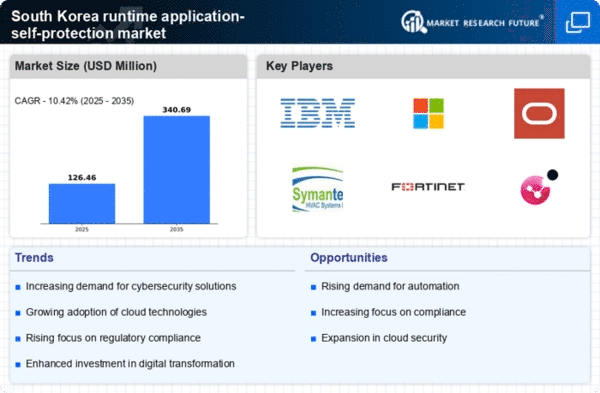
As per Market Research Future analysis, the South Korea runtime application-self-protection market Size was estimated at 114.53 USD Million in 2024. The South Korea runtime application-self-protection market is projected to grow from 126.46 USD Million in 2025 to 340.69 USD Million by 2035, exhibiting a compound annual growth rate (CAGR) of 10.4% during the forecast period 2025 - 2035

Key Market Trends & Highlights

The South Korea runtime application-self-protection market is experiencing robust growth driven by technological advancements and increasing regulatory demands.

  • The market is witnessing increased adoption of AI and machine learning technologies to enhance security measures.
  • Regulatory compliance and data protection are becoming critical factors influencing market dynamics.
  • Cloud-based solutions are in high demand, reflecting a shift towards more flexible and scalable security options.
  • Rising cybersecurity threats and the growing regulatory landscape are key drivers propelling market expansion.

Market Size & Forecast

2024 Market Size 114.53 (USD Million)
2035 Market Size 340.69 (USD Million)
CAGR (2025 - 2035) 10.42%

Major Players

IBM (US), Microsoft (US), Oracle (US), Symantec (US), Fortinet (US), Check Point Software (IL), Palo Alto Networks (US), Trend Micro (JP)

Our Impact
Enabled $4.3B Revenue Impact for Fortune 500 and Leading Multinationals
Partnering with 2000+ Global Organizations Each Year
30K+ Citations by Top-Tier Firms in the Industry

South Korea Runtime Application Self Protection Market Trends

The runtime application-self-protection market is experiencing notable growth in South Korea, driven by increasing concerns over cybersecurity threats and the need for robust application security measures. Organizations are increasingly recognizing the importance of protecting applications in real-time, as cyberattacks become more sophisticated and prevalent. This market is characterized by a shift towards proactive security measures, where applications are equipped with self-protection capabilities to detect and respond to threats autonomously. As a result, businesses are investing in advanced technologies that enhance their security posture and ensure compliance with regulatory requirements. In addition, the South Korean government is actively promoting initiatives to bolster cybersecurity across various sectors. This includes support for research and development in security technologies, which further fuels the demand for runtime application-self-protection solutions. The market is also witnessing a rise in partnerships between technology providers and enterprises, aimed at integrating self-protection features into existing applications. Overall, the runtime application-self-protection market in South Korea appears poised for continued expansion, as organizations prioritize security in their digital transformation journeys.

Increased Adoption of AI and Machine Learning

The runtime application-self-protection market is seeing a trend towards the integration of artificial intelligence (AI) and machine learning technologies. These advancements enable applications to learn from past incidents and adapt their security measures accordingly. This proactive approach enhances the ability to identify and mitigate threats in real-time, making applications more resilient against attacks.

Regulatory Compliance and Data Protection

With the rise of data breaches and stringent regulations, organizations are increasingly focusing on compliance and data protection. The runtime application-self-protection market is responding to this demand by offering solutions that help businesses meet regulatory requirements while safeguarding sensitive information. This trend is particularly relevant in sectors such as finance and healthcare, where data security is paramount.

Growing Demand for Cloud-Based Solutions

There is a noticeable shift towards cloud-based runtime application-self-protection solutions, driven by the increasing adoption of cloud computing. Organizations are seeking flexible and scalable security options that can be easily integrated into their cloud environments. This trend reflects a broader movement towards digital transformation, where businesses prioritize agility and efficiency in their operations.

South Korea Runtime Application Self Protection Market Drivers

Growing Regulatory Landscape

The evolving regulatory landscape in South Korea is significantly impacting the runtime application-self-protection market. With stringent data protection laws such as the Personal Information Protection Act (PIPA), organizations are compelled to adopt comprehensive security measures to ensure compliance. Non-compliance can result in hefty fines, which may reach up to 3% of annual revenue. As a result, businesses are increasingly investing in runtime application self-protection solutions to safeguard sensitive information and maintain compliance. The runtime application-self-protection market is thus likely to experience growth as companies prioritize regulatory adherence and seek to mitigate potential legal risks.

Rising Cybersecurity Threats

The runtime application-self-protection market is experiencing growth due to the increasing frequency and sophistication of cyber threats in South Korea. As organizations face a surge in ransomware attacks and data breaches, the need for robust security measures becomes paramount. In 2025, it is estimated that cybercrime could cost the global economy over $10 trillion annually, prompting South Korean enterprises to invest heavily in runtime application self-protection solutions. This market segment is expected to see a compound annual growth rate (CAGR) of approximately 15% as businesses prioritize the protection of sensitive data and applications. The runtime application-self-protection market is thus positioned to benefit from this heightened awareness and urgency surrounding cybersecurity.

Increased Awareness of Data Privacy

There is a growing awareness of data privacy among consumers and businesses in South Korea, which is influencing the runtime application-self-protection market. As individuals become more conscious of how their data is used and protected, organizations are compelled to implement stronger security measures. This trend is reflected in the rising demand for solutions that ensure data integrity and confidentiality. In 2025, it is estimated that 60% of South Korean consumers will prioritize data privacy when choosing service providers. Consequently, the runtime application-self-protection market is likely to benefit from this shift, as companies strive to enhance their security frameworks to meet consumer expectations.

Integration of Advanced Technologies

The integration of advanced technologies such as artificial intelligence (AI) and machine learning (ML) is driving the runtime application-self-protection market forward. These technologies enhance the ability of applications to detect and respond to threats in real-time, thereby improving overall security posture. In South Korea, the adoption of AI-driven security solutions is projected to grow by 20% in the next few years, as organizations seek to leverage automation for threat detection and response. The runtime application-self-protection market is likely to see increased demand for solutions that incorporate these technologies, as they provide a proactive approach to security, reducing the risk of successful attacks.

Shift Towards Digital Transformation

The ongoing digital transformation across various sectors in South Korea is a key driver for the runtime application-self-protection market. As organizations migrate to cloud-based environments and adopt digital solutions, the need for enhanced security measures becomes critical. In 2025, it is anticipated that over 70% of South Korean enterprises will have adopted cloud services, creating a fertile ground for runtime application self-protection solutions. This shift not only increases the attack surface but also necessitates robust security frameworks to protect applications in real-time. The runtime application-self-protection market is thus poised for growth as businesses seek to secure their digital assets amidst this transformation.

Market Segment Insights

By Application: Web Applications (Largest) vs. Mobile Applications (Fastest-Growing)

In the South Korea runtime application-self-protection market, Web Applications hold a significant market share, dominating due to their critical role in business operations and e-commerce platforms. Their robustness and comprehensive security features make them the preferred choice for organizations focused on safeguarding user data and ensuring compliance with regulations. On the other hand, Mobile Applications are rapidly gaining traction, particularly as more consumers shift towards mobile devices for daily transactions, leading to an increase in target attacks and the demand for enhanced security measures. The growth trends indicate that the Mobile Applications segment is poised for substantial expansion, driven by the rise of mobile banking, shopping, and social networking. The increasing sophistication of cyber threats is pushing businesses to invest heavily in runtime application-self-protection solutions, especially for mobile platforms. Additionally, the demand for API Security is also rising, as businesses leverage APIs to connect services and applications, highlighting the critical need for protective measures against potential breaches.

Web Applications: Dominant vs. Mobile Applications: Emerging

Web Applications maintain a dominant position in the South Korea runtime application-self-protection market, primarily due to their widespread use in various industries and the complexity of their functionalities. They are designed to withstand various cyber threats, providing comprehensive protection against attacks and ensuring that sensitive customer information remains secure. Conversely, Mobile Applications are emerging as a pivotal market force, driven by the increasing reliance on smartphones. As mobile app usage escalates, so do security vulnerabilities associated with them. This emergence is marked by rapid adoption rates and tailored security offerings to address specific mobile needs, positioning them as essential tools for user engagement and data safety in the modern landscape.

By Deployment Type: Cloud-Based (Largest) vs. Hybrid (Fastest-Growing)

The market share distribution in the runtime application-self-protection segment showcases a clear dominance of cloud-based solutions. These offer flexibility and scalability, making them highly attractive to businesses looking for comprehensive protection against runtime threats. In comparison, hybrid solutions have steadily gained traction, appealing to organizations that require a balanced approach, leveraging both on-premises control and cloud-based efficiency. Growth trends indicate increasing adoption of cloud-based deployment as businesses recognize the benefits of ease of implementation and cost-effectiveness. Hybrid solutions are emerging as the fastest-growing deployment type, driven by the need for customizable security frameworks that adapt to dynamic business environments. This shift reflects a broader trend towards integration and flexibility in IT security strategies, as organizations seek to optimize their operational capabilities.

Cloud-Based (Dominant) vs. Hybrid (Emerging)

Cloud-based solutions are the dominant deployment type in the runtime application-self-protection market, characterized by their ability to provide broad security coverage with minimal maintenance overhead. They allow organizations to quickly scale their security efforts in accordance with evolving threats, thus appealing to diverse industries. Conversely, hybrid solutions are emerging as a key player, offering a blend of cloud and on-premises strengths. These solutions are particularly valued by organizations that prioritize stringent control over sensitive data while still seeking the advantages of cloud agility. The flexibility of hybrid solutions enables businesses to tailor their security posture effectively, blending traditional security frameworks with modern cloud capabilities.

By End User: BFSI (Largest) vs. Healthcare (Fastest-Growing)

In the South Korea runtime application-self-protection market, the BFSI segment holds the largest market share, driven by an increasing demand for robust security solutions to protect sensitive financial data. The sector has been expanding rapidly due to the rising frequency of cyber threats, necessitating advanced application self-protection solutions. In contrast, the Healthcare segment, while smaller, has been identified as the fastest-growing due to the need for safeguarding patient information and complying with stringent regulatory requirements. As digital health solutions rise, this segment is seeing accelerated adoption of security technologies. Growth trends in the South Korea runtime application-self-protection market are heavily influenced by the rising digitization across various sectors. BFSI continues to lead the market as financial institutions prioritize cybersecurity, while the Healthcare segment is experiencing rapid evolution attributed to telehealth innovations and data privacy concerns. Furthermore, government initiatives promoting digital transformations are contributing positively to the Telecommunications sector, while Retail is focusing on securing e-commerce platforms, making it essential for all these sectors to adopt application self-protection measures strategically for resilience against cyber threats.

BFSI: Dominant vs. Healthcare: Emerging

In the South Korea runtime application-self-protection market, the BFSI sector is characterized by a high penetration of sophisticated security solutions due to the critical nature of financial data and transactions. A strong compliance framework drives this dominance, requiring institutions to invest in advanced runtime application protection. Conversely, the Healthcare segment, though emergent, is rapidly evolving as organizations prioritize the protection of patient data and the integrity of health information systems. The emphasis on data privacy regulations and the adoption of digital health solutions are stimulating market growth in this sector. As both segments navigate an increasingly complex cybersecurity landscape, their characteristics and needs will shape their future trajectories in the market.

By Technology: Machine Learning (Largest) vs. Behavioral Analysis (Fastest-Growing)

In the South Korea runtime application-self-protection market, the segmentation displays a notable distribution where Machine Learning has emerged as the largest sector, commanding a significant share. Following closely, Behavioral Analysis is carving a niche, capitalizing on emerging security threats and innovative detection capabilities. Signature-Based Detection, while important, holds a smaller yet stable share, serving traditional security needs. The growth trends indicate a robust trajectory, with Machine Learning continuing to dominate due to its advanced predictive capabilities and adaptive responses. Meanwhile, Behavioral Analysis is the fastest-growing segment, driven by an increasing demand for more dynamic threat detection methods. This shift reflects a growing recognition of sophisticated attack methodologies, necessitating more adaptable security solutions that can respond in real-time to evolving threats.

Technology: Machine Learning (Dominant) vs. Behavioral Analysis (Emerging)

Machine Learning stands as the dominant force in the South Korea runtime application-self-protection market, characterized by its ability to analyze vast amounts of data to predict and neutralize threats before they manifest. This technology utilizes advanced algorithms to identify patterns and anomalies, making it essential for proactive security management. On the other hand, Behavioral Analysis is swiftly emerging as a key player, focusing on the behavior of applications and users to discover unusual patterns that may indicate security breaches. This innovative approach is becoming increasingly vital as organizations seek to enhance their security posture in response to more sophisticated cyber threats.

Get more detailed insights about South Korea Runtime Application Self Protection Market

Key Players and Competitive Insights

The runtime application-self-protection market is currently characterized by a dynamic competitive landscape, driven by the increasing demand for robust cybersecurity solutions amid rising cyber threats. Key players such as IBM (US), Microsoft (US), and Fortinet (US) are strategically positioned to leverage their technological expertise and extensive resources. IBM (US) focuses on innovation through its Watson AI capabilities, enhancing threat detection and response mechanisms. Microsoft (US) emphasizes cloud integration and security, aiming to provide comprehensive solutions that cater to diverse enterprise needs. Fortinet (US) is known for its high-performance security appliances, which are increasingly integrated with AI to bolster real-time threat mitigation. Collectively, these strategies contribute to a competitive environment that is both collaborative and adversarial, as companies seek to differentiate themselves through technological advancements and strategic partnerships.In terms of business tactics, companies are increasingly localizing their operations to better serve the South Korean market, optimizing supply chains to enhance efficiency and responsiveness. The market structure appears moderately fragmented, with several key players holding substantial market shares while also facing competition from emerging firms. This fragmentation allows for a variety of solutions and innovations, fostering a competitive atmosphere where established companies must continuously adapt to maintain their market positions.

In October IBM (US) announced a strategic partnership with a leading South Korean telecommunications provider to enhance its cloud security offerings. This collaboration aims to integrate IBM's advanced AI-driven security solutions with the telecom's extensive network infrastructure, thereby improving threat detection capabilities for enterprise clients. The significance of this partnership lies in its potential to expand IBM's footprint in the region while providing localized solutions tailored to the unique cybersecurity challenges faced by South Korean businesses.

In September Microsoft (US) launched a new initiative focused on enhancing its Azure platform's security features, specifically targeting the South Korean market. This initiative includes the introduction of advanced threat protection tools designed to safeguard sensitive data in cloud environments. The strategic importance of this move is underscored by the growing reliance on cloud services among South Korean enterprises, positioning Microsoft as a leader in providing secure cloud solutions that meet local compliance requirements.

In August Fortinet (US) unveiled a new line of security appliances specifically designed for the South Korean market, featuring enhanced AI capabilities for real-time threat analysis. This product launch is particularly noteworthy as it reflects Fortinet's commitment to addressing the evolving cybersecurity landscape in the region. By tailoring its offerings to local needs, Fortinet aims to strengthen its competitive edge and capture a larger share of the market.

As of November current trends in the runtime application-self-protection market are heavily influenced by digitalization, AI integration, and a growing emphasis on sustainability. Strategic alliances are increasingly shaping the competitive landscape, as companies recognize the value of collaboration in addressing complex cybersecurity challenges. Looking ahead, it appears that competitive differentiation will evolve from traditional price-based strategies to a focus on innovation, technological advancements, and supply chain reliability. This shift suggests that companies that prioritize these elements are likely to gain a competitive advantage in an increasingly crowded market.

Key Companies in the South Korea Runtime Application Self Protection Market include

Industry Developments

The South Korea Runtime Application Self-Protection Market has seen notable developments recently, with significant growth attributed to heightened cybersecurity concerns. The increasing frequency of cyberattacks has prompted companies like SK Infosec and AhnLab to enhance their security solutions. In August 2023, Cisco announced the integration of enhanced security features into its platform, addressing the rising demand for advanced application protection in South Korea.

Meanwhile, Samsung SDS has been expanding its capabilities, focusing on AI-driven security innovations to adapt to the evolving threat landscape. There has also been increased collaboration among major players; for instance, in February 2023, Trend Micro partnered with LG CNS to offer integrated security solutions tailored for enterprise applications.

Noteworthy mergers and acquisitions within the sector have included NortonLifeLock acquiring a key cybersecurity firm in South Korea earlier this year, enhancing its market position significantly. The government's push for stricter cybersecurity regulations has further influenced market dynamics, leading to a surge in investments from companies aiming to strengthen their offerings. As organizations increasingly prioritize application security, the market is poised for substantial growth amid these developments.

Future Outlook

South Korea Runtime Application Self Protection Market Future Outlook

The Runtime Application Self Protection Market is projected to grow at a 10.42% CAGR from 2025 to 2035, driven by increasing cybersecurity threats and regulatory compliance demands.

New opportunities lie in:

  • Development of AI-driven threat detection systems
  • Integration of runtime protection with cloud services
  • Expansion of training programs for cybersecurity professionals

By 2035, the market is expected to achieve robust growth, positioning itself as a leader in cybersecurity solutions.

Market Segmentation

South Korea Runtime Application Self Protection Market End User Outlook

  • BFSI
  • Healthcare
  • Retail
  • Government
  • Telecommunications

South Korea Runtime Application Self Protection Market Technology Outlook

  • Machine Learning
  • Behavioral Analysis
  • Signature-Based Detection

South Korea Runtime Application Self Protection Market Application Outlook

  • Web Applications
  • Mobile Applications
  • Cloud Applications
  • API Security

South Korea Runtime Application Self Protection Market Deployment Type Outlook

  • On-Premises
  • Cloud-Based
  • Hybrid

Report Scope

MARKET SIZE 2024 114.53(USD Million)
MARKET SIZE 2025 126.46(USD Million)
MARKET SIZE 2035 340.69(USD Million)
COMPOUND ANNUAL GROWTH RATE (CAGR) 10.42% (2025 - 2035)
REPORT COVERAGE Revenue Forecast, Competitive Landscape, Growth Factors, and Trends
BASE YEAR 2024
Market Forecast Period 2025 - 2035
Historical Data 2019 - 2024
Market Forecast Units USD Million
Key Companies Profiled IBM (US), Microsoft (US), Oracle (US), Symantec (US), Fortinet (US), Check Point Software (IL), Palo Alto Networks (US), Trend Micro (JP)
Segments Covered Application, Deployment Type, End User, Technology
Key Market Opportunities Integration of artificial intelligence enhances threat detection in the runtime application-self-protection market.
Key Market Dynamics Growing demand for enhanced security solutions drives innovation in the runtime application-self-protection market.
Countries Covered South Korea
Leave a Comment

FAQs

What is the projected market size for the South Korea Runtime Application Self-Protection Market in 2024?

The projected market size for the South Korea Runtime Application Self-Protection Market in 2024 is valued at 112.5 million USD.

What is the expected market size for the South Korea Runtime Application Self-Protection Market by 2035?

By 2035, the expected market size for the South Korea Runtime Application Self-Protection Market is projected to reach 289.0 million USD.

What is the compound annual growth rate (CAGR) for the South Korea Runtime Application Self-Protection Market from 2025 to 2035?

The expected CAGR for the South Korea Runtime Application Self-Protection Market from 2025 to 2035 is 8.956%.

Which application segment will dominate the South Korea Runtime Application Self-Protection Market in 2035?

The Web Applications segment is expected to dominate the South Korea Runtime Application Self-Protection Market in 2035, valued at 115.0 million USD.

How is the market value for Mobile Applications in the South Korea Runtime Application Self-Protection Market projected for 2035?

In 2035, the market value for Mobile Applications in the South Korea Runtime Application Self-Protection Market is projected to reach 75.0 million USD.

What is the expected market value for Cloud Applications in the South Korea Runtime Application Self-Protection Market by 2035?

The expected market value for Cloud Applications in the South Korea Runtime Application Self-Protection Market by 2035 is 60.0 million USD.

What role does API Security play in the South Korea Runtime Application Self-Protection Market in 2035?

By 2035, API Security is projected to reach a market value of 39.0 million USD in the South Korea Runtime Application Self-Protection Market.

Who are the key players in the South Korea Runtime Application Self-Protection Market as of 2025?

Key players in the South Korea Runtime Application Self-Protection Market as of 2025 include SK Infosec, NortonLifeLock, Samsung SDS, and Cisco among others.

What challenges does the South Korea Runtime Application Self-Protection Market face today?

The South Korea Runtime Application Self-Protection Market currently faces challenges such as evolving cybersecurity threats and the need for continuous updates to technology.

What opportunities exist for growth in the South Korea Runtime Application Self-Protection Market?

There are significant opportunities for growth in the South Korea Runtime Application Self-Protection Market due to the increasing need for enhanced security in digital applications.

Download Free Sample

Kindly complete the form below to receive a free sample of this Report

Compare Licence

×
Features License Type
Single User Multiuser License Enterprise User
Price $4,950 $5,950 $7,250
Maximum User Access Limit 1 User Upto 10 Users Unrestricted Access Throughout the Organization
Free Customization
Direct Access to Analyst
Deliverable Format
Platform Access
Discount on Next Purchase 10% 15% 15%
Printable Versions