×
Request Free Sample ×

Kindly complete the form below to receive a free sample of this Report

* Please use a valid business email

Leading companies partner with us for data-driven Insights

clients tt-cursor
Hero Background

South Korea Radiology Services Market

ID: MRFR/HC/48985-HCR
200 Pages
Rahul Gotadki
February 2026

South Korea Radiology Services Market Research Report: Size, Share, Trend Analysis By Imaging Technique (X-ray, Ultrasound, Computed Tomography, Magnetic Resonance Imaging, Nuclear Medicine), By Service Type (Diagnostic Imaging, Interventional Radiology, Radiation Oncology), By End Users (Hospitals, Diagnostic Imaging Centers, Outpatient Clinics, Research Institutions) and By Applications (Oncology, Cardiology, Neurology, Orthopedics) - Growth Outlook & Industry Forecast 2025 To 2035

Share:
Download PDF ×

We do not share your information with anyone. However, we may send you emails based on your report interest from time to time. You may contact us at any time to opt-out.

South Korea Radiology Services Market Infographic
Purchase Options

South Korea Radiology Services Market Summary

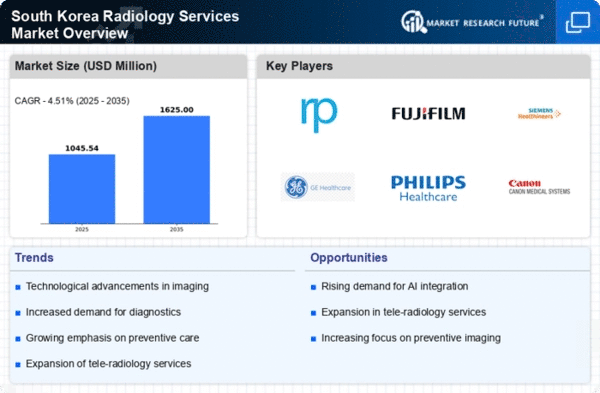
As per Market Research Future analysis, the South Korea radiology services market size was estimated at 1000.42 USD Million in 2024. The South Korea radiology services market is projected to grow from 1045.54 USD Million in 2025 to 1625.0 USD Million by 2035, exhibiting a compound annual growth rate (CAGR) of 4.5% during the forecast period 2025 - 2035

Key Market Trends & Highlights

The South Korea radiology services market is experiencing robust growth driven by technological advancements and increasing demand for preventive care.

  • Technological integration in radiology services is enhancing diagnostic accuracy and efficiency.
  • The demand for preventive care is rising, leading to increased utilization of radiology services.
  • Outpatient services are expanding, reflecting a shift towards more accessible healthcare delivery.
  • Key market drivers include the rising aging population and government initiatives supporting healthcare infrastructure.

Market Size & Forecast

2024 Market Size 1000.42 (USD Million)
2035 Market Size 1625.0 (USD Million)
CAGR (2025 - 2035) 4.51%

Major Players

Radiology Partners (US), Fujifilm Holdings Corporation (JP), Siemens Healthineers (DE), GE Healthcare (US), Philips Healthcare (NL), Canon Medical Systems Corporation (JP), Hologic, Inc. (US), Agfa-Gevaert Group (BE)

Our Impact
Enabled $4.3B Revenue Impact for Fortune 500 and Leading Multinationals
Partnering with 2000+ Global Organizations Each Year
30K+ Citations by Top-Tier Firms in the Industry

South Korea Radiology Services Market Trends

the radiology services market in South Korea is experiencing notable advancements, driven by technological innovations and an increasing demand for diagnostic imaging. The integration of artificial intelligence (AI) into imaging processes appears to enhance accuracy and efficiency, potentially leading to improved patient outcomes. Furthermore, the growing prevalence of chronic diseases necessitates more frequent imaging services, thereby expanding the market's scope. The government’s investment in healthcare infrastructure and initiatives to promote early diagnosis may also contribute to the sector's growth. In addition, the rising awareness of preventive healthcare among the population seems to be influencing the demand for radiological examinations. As patients become more proactive about their health, the utilization of imaging services is likely to increase. This trend is further supported by the expansion of outpatient facilities and advancements in mobile imaging technologies, which provide greater accessibility to radiology services. Overall, the radiology services market in South Korea is poised for continued growth, driven by both technological advancements and changing consumer behaviors.

Technological Integration

The incorporation of advanced technologies, such as AI and machine learning, is transforming the radiology services market. These innovations enhance diagnostic accuracy and streamline workflows, potentially reducing the time required for image analysis. As a result, healthcare providers may experience improved operational efficiency and patient satisfaction.

Increased Demand for Preventive Care

There is a growing trend towards preventive healthcare in South Korea, leading to a higher demand for radiological services. Patients are increasingly seeking early diagnosis through imaging, which may contribute to better health outcomes. This shift in consumer behavior is likely to drive the expansion of the radiology services market.

Expansion of Outpatient Services

The rise of outpatient facilities is significantly impacting the radiology services market. These centers often provide more accessible imaging services, catering to the needs of patients who prefer convenience. This trend may lead to an increase in the utilization of radiological examinations, further supporting market growth.

South Korea Radiology Services Market Drivers

Rising Aging Population

The increasing aging population in South Korea is a pivotal driver for the radiology services market. As individuals age, they typically experience a higher incidence of chronic diseases and conditions that necessitate advanced imaging techniques for diagnosis and management. According to recent statistics, approximately 15% of the population is aged 65 and older, a figure projected to rise significantly in the coming years. This demographic shift is likely to escalate the demand for radiological examinations, including MRI and CT scans, as healthcare providers seek to enhance patient outcomes. Consequently, the radiology services market is expected to expand, with an emphasis on tailored imaging solutions that cater to the unique health needs of older adults.

Government Initiatives and Funding

Government initiatives aimed at improving healthcare infrastructure are significantly influencing the radiology services market. The South Korean government has implemented various policies to enhance healthcare access and quality, including increased funding for medical facilities and imaging technologies. In 2025, the government allocated approximately $1.5 billion to upgrade hospital equipment, including radiology departments. Such funding is expected to facilitate the acquisition of state-of-the-art imaging technologies, thereby improving diagnostic capabilities. Additionally, these initiatives may lead to the establishment of more radiology centers, further expanding the market and ensuring that patients receive timely and effective imaging services.

Growing Awareness of Early Diagnosis

There is a growing awareness among the South Korean population regarding the importance of early diagnosis in disease management, which is driving the radiology services market. Public health campaigns and educational programs have emphasized the role of imaging in detecting conditions such as cancer and cardiovascular diseases at earlier stages. This heightened awareness is likely to increase the demand for routine imaging services, as individuals seek preventive care options. As a result, healthcare providers are expanding their radiology offerings to accommodate this trend, potentially leading to a market growth rate of around 8% annually in the coming years.

Technological Advancements in Imaging

Technological advancements in imaging modalities are transforming the radiology services market. Innovations such as artificial intelligence (AI) and machine learning are enhancing diagnostic accuracy and efficiency. For instance, AI algorithms can analyze imaging data more rapidly than traditional methods, potentially reducing the time required for diagnosis. Furthermore, the introduction of portable imaging devices is making radiology services more accessible, particularly in rural areas. The South Korean government has invested heavily in healthcare technology, with expenditures reaching approximately $2 billion in recent years. This investment is likely to foster further advancements in imaging technologies, thereby driving growth in the radiology services market.

Increased Investment in Healthcare Infrastructure

The South Korean government and private sector are significantly increasing investments in healthcare infrastructure, which is positively impacting the radiology services market. Recent reports indicate that healthcare spending is projected to reach $200 billion by 2026, with a substantial portion allocated to upgrading medical facilities and imaging technologies. This investment is likely to enhance the capacity and capabilities of radiology departments, allowing for more comprehensive and efficient services. Additionally, the establishment of new hospitals and outpatient centers is expected to create a greater demand for radiology services, further propelling market growth in the near future.


Market Segment Insights

By Imaging Technique: X-Ray (Largest) vs. Ultrasound (Fastest-Growing)

The radiology services market exhibits a diverse array of imaging techniques, with X-Ray commanding the largest share among the modalities. X-Ray is widely utilized for its cost-effectiveness and efficiency, prominently used in various diagnostic scenarios. On the other hand, Ultrasound captures increasing attention due to its non-invasive nature and real-time imaging capabilities, which enhance diagnostic accuracy, positioning it as a growing choice in clinical settings. Growth in this segment is primarily driven by advancements in technology and an increasing emphasis on early diagnosis. As healthcare providers continually seek improved patient outcomes, modalities like Ultrasound are rapidly gaining traction, encouraging research and development in imaging services. The trend towards minimally invasive procedures fuels the demand for Ultrasound, while X-Ray remains a staple due to its established utility in routine diagnostics.

X-Ray (Dominant) vs. Ultrasound (Emerging)

X-Ray serves as the cornerstone of the imaging techniques utilized in the market, owing to its accessibility and rapid results, making it indispensable in emergency settings. With a comprehensive range of applications from dental to chest imaging, its ubiquitous presence marks its dominance. Alternatively, Ultrasound is emerging as a versatile and preferred technique for various applications, particularly in obstetrics and abdominal imaging, thanks to its safety profile and capability to provide real-time insights. This has led to an increase in ultrasound machines in hospitals and outpatient facilities. The rising preference for Ultrasound reflects a shift towards more patient-friendly imaging options, providing healthcare professionals with crucial data while minimizing patient discomfort.

By Service Type: Diagnostic Imaging (Largest) vs. Interventional Radiology (Fastest-Growing)

The South Korea radiology services market exhibits a diverse allocation among its service types, with Diagnostic Imaging holding the largest share. This segment includes techniques such as X-rays, CT scans, and MRIs, making it essential for various diagnostic processes. Meanwhile, Interventional Radiology, although smaller, is rapidly gaining traction due to its minimally invasive procedures and efficient patient outcomes. As healthcare advancements continue, this sector is expected to resonate more with patient preferences. Growth within this market can be attributed to several factors, including technological advancements in imaging modalities, increasing chronic disease prevalence, and a growing demand for early diagnosis. Additionally, the emphasis on patient-centric care and cost-effective treatment options has propelled the Interventional Radiology segment to emerge as the fastest-growing area. Innovations in imaging technology and procedural techniques are further expected to enhance the effectiveness and uptake of these services.

Diagnostic Imaging (Dominant) vs. Interventional Radiology (Emerging)

Diagnostic Imaging has established itself as the dominant force in the South Korea radiology services market, primarily due to its widespread applications across various healthcare settings. It encompasses numerous imaging techniques that aid in accurate diagnosis and treatment planning. The segment's robust infrastructure, backed by advanced technologies and skilled professionals, ensures high-quality imaging services. In contrast, Interventional Radiology is gaining recognition as an emerging segment, characterized by its ability to perform minimally invasive surgeries using image guidance. This approach significantly reduces recovery times and hospital stays, aligning with contemporary healthcare trends toward efficiency and patient comfort. Overall, both segments are pivotal in shaping the future of radiological services, with a focus on innovation and improved patient outcomes.

By End User: Hospitals (Largest) vs. Diagnostic Imaging Centers (Fastest-Growing)

In the South Korea radiology services market, hospitals command the largest share, being the primary providers of comprehensive radiological care. They have established extensive facilities and equipment to manage a wide range of diagnostic imaging needs, resulting in a stable market position. In contrast, diagnostic imaging centers are witnessing rapid growth due to increasing public awareness and demand for health screenings, making them a vital part of the healthcare delivery system. The growth trends for outpatient clinics and research institutions reflect a shift towards more specialized services and advanced technologies. Outpatient clinics are expanding as patients favor convenience and quicker access to imaging services, whereas research institutions are benefitting from advancements in diagnostic technologies. Together, these segments showcase the dynamism of the South Korea radiology services market and highlight evolving consumer preferences for accessible and effective healthcare solutions.

Hospitals (Dominant) vs. Diagnostic Imaging Centers (Emerging)

Hospitals, as the dominant end user in the South Korea radiology services market, offer extensive imaging capabilities, ranging from X-rays to MRIs, all under one roof. Their established infrastructure and comprehensive services allow for integrated patient care, which is crucial for accurate diagnostics and treatment planning. Conversely, diagnostic imaging centers are emerging as a critical force, especially for outpatient services, providing specialized imaging in a more focused environment. This shift is driven by technological advancements that enable rapid results and enhance diagnostic accuracy. As patients increasingly seek convenience and personalized services, diagnostic imaging centers are positioning themselves to meet these demands, making them vital players in the market.

By Application: Oncology (Largest) vs. Cardiology (Fastest-Growing)

In the South Korea radiology services market, the application segment is primarily dominated by oncology, which captures the largest share. Followed closely is cardiology, which shows promising growth potential. Neurology and orthopedics are steadily growing, but their market shares remain lower compared to the top two segments. The distribution reflects the increasing focus on cancer diagnostics and treatments, alongside advancements in cardiac imaging technologies. Growth trends indicate that oncology will continue to thrive due to rising cancer incidences, prompting enhancements in radiology services. Cardiology is experiencing the fastest growth owing to a heightened awareness of cardiovascular diseases and the integration of innovative imaging techniques. Neurology and orthopedics remain significant, benefiting from technological advancements and an aging population that demands comprehensive imaging services.

Oncology (Dominant) vs. Cardiology (Emerging)

Oncology stands out as the dominant segment in the application category of the South Korea radiology services market, driven by the critical need for advanced imaging techniques in cancer detection and management. The segment leverages cutting-edge technologies, including MRI and PET scans, enhancing diagnostic accuracy. In contrast, cardiology is emerging rapidly, fueled by increasing cardiovascular disease prevalence and a shift towards proactive diagnostic measures. The integration of advanced imaging methodologies, such as 3D echocardiography, significantly enhances the evaluation of heart conditions. Both segments display resilient growth patterns, yet oncology maintains its supremacy as the leading focus area, while cardiology is quickly adapting to fulfill the rising demands in patient care.

Get more detailed insights about South Korea Radiology Services Market

Key Players and Competitive Insights

The radiology services market in South Korea is characterized by a dynamic competitive landscape, driven by technological advancements and increasing demand for diagnostic imaging. Key players such as Siemens Healthineers (DE), GE Healthcare (US), and Fujifilm Holdings Corporation (JP) are at the forefront, leveraging innovation and strategic partnerships to enhance their market presence. Siemens Healthineers (DE) focuses on integrating artificial intelligence (AI) into imaging solutions, which not only improves diagnostic accuracy but also streamlines workflows. Meanwhile, GE Healthcare (US) emphasizes regional expansion and has been actively investing in local partnerships to enhance service delivery and accessibility. Fujifilm Holdings Corporation (JP) is also notable for its commitment to digital transformation, particularly in developing cloud-based solutions that facilitate remote diagnostics and patient management.The business tactics employed by these companies reflect a concerted effort to optimize operations and adapt to local market needs. For instance, localizing manufacturing and supply chain optimization are prevalent strategies aimed at reducing costs and improving service responsiveness. The market structure appears moderately fragmented, with several players competing for market share, yet the influence of major companies is substantial, shaping the overall competitive dynamics.

In October Siemens Healthineers (DE) announced a strategic partnership with a leading South Korean hospital network to implement AI-driven imaging solutions. This collaboration is expected to enhance diagnostic capabilities and improve patient outcomes, indicating a shift towards more integrated healthcare solutions. The strategic importance of this partnership lies in its potential to set a benchmark for future collaborations in the region, emphasizing the role of technology in healthcare.

In September GE Healthcare (US) launched a new line of portable ultrasound devices tailored for use in rural healthcare settings in South Korea. This initiative not only addresses the accessibility challenges faced by underserved populations but also aligns with the company’s strategy to expand its footprint in emerging markets. The introduction of these devices is likely to enhance diagnostic capabilities in remote areas, thereby increasing the overall market demand for radiology services.

In August Fujifilm Holdings Corporation (JP) unveiled a cloud-based platform designed to streamline radiology workflows and enhance data sharing among healthcare providers. This innovation is particularly significant as it reflects the growing trend towards digitalization in healthcare, allowing for more efficient patient management and improved collaboration among medical professionals. The strategic move positions Fujifilm as a leader in the digital transformation of radiology services.

As of November the competitive trends in the radiology services market are increasingly defined by digitalization, sustainability, and the integration of AI technologies. Strategic alliances are becoming more prevalent, fostering innovation and enhancing service delivery. The competitive differentiation is likely to evolve from traditional price-based competition towards a focus on technological innovation, reliability in supply chains, and the ability to provide comprehensive, integrated healthcare solutions. This shift underscores the importance of adaptability and forward-thinking strategies in maintaining a competitive edge in the market.

Key Companies in the South Korea Radiology Services Market include

Industry Developments

The South Korea Radiology Services Market has seen significant activity recently, driven by advancements in medical imaging technology and a growing emphasis on early diagnosis. Notable players in this sector include Chung-Ang University Hospital, Pusan National University Hospital, and Asan Medical Center, which have been enhancing their capabilities through investment in digital imaging and artificial intelligence.

In recent reports, Samsung Medical Center has announced collaborations with technology firms to improve radiology workflows, reflecting a broader trend toward integrating technology in healthcare settings. Additionally, Korea University Anam Hospital and Haeundae Paik Hospital have expanded their diagnostic imaging facilities to meet increasing patient demand.

In terms of mergers and acquisitions, Pusan National University Hospital's acquisition of Myeongji Hospital was recorded in July 2023, aimed at consolidating radiology resources and services in the region. Overall, the market's growth trajectory is supported by an increase in health awareness and an aging population, leading to enhanced investment and infrastructure development in radiology services throughout South Korea.

Future Outlook

South Korea Radiology Services Market Future Outlook

The Radiology Services Market is projected to grow at a 4.51% CAGR from 2025 to 2035, driven by technological advancements, increasing healthcare demands, and enhanced diagnostic capabilities.

New opportunities lie in:

  • Expansion of tele-radiology services to remote areas
  • Investment in AI-driven diagnostic tools for efficiency
  • Development of specialized imaging centers for niche markets

By 2035, the radiology services market is expected to achieve robust growth and enhanced service delivery.

Market Segmentation

South Korea Radiology Services Market End User Outlook

  • Hospitals
  • Diagnostic Imaging Centers
  • Outpatient Clinics
  • Research Institutions

South Korea Radiology Services Market Application Outlook

  • Oncology
  • Cardiology
  • Neurology
  • Orthopedics

South Korea Radiology Services Market Service Type Outlook

  • Diagnostic Imaging
  • Interventional Radiology
  • Radiation Oncology

South Korea Radiology Services Market Imaging Technique Outlook

  • X-Ray
  • Ultrasound
  • Computed Tomography
  • Magnetic Resonance Imaging
  • Nuclear Medicine

Report Scope

MARKET SIZE 2024 1000.42(USD Million)
MARKET SIZE 2025 1045.54(USD Million)
MARKET SIZE 2035 1625.0(USD Million)
COMPOUND ANNUAL GROWTH RATE (CAGR) 4.51% (2025 - 2035)
REPORT COVERAGE Revenue Forecast, Competitive Landscape, Growth Factors, and Trends
BASE YEAR 2024
Market Forecast Period 2025 - 2035
Historical Data 2019 - 2024
Market Forecast Units USD Million
Key Companies Profiled Radiology Partners (US), Fujifilm Holdings Corporation (JP), Siemens Healthineers (DE), GE Healthcare (US), Philips Healthcare (NL), Canon Medical Systems Corporation (JP), Hologic, Inc. (US), Agfa-Gevaert Group (BE)
Segments Covered Imaging Technique, Service Type, End User, Application
Key Market Opportunities Integration of artificial intelligence in diagnostic imaging enhances efficiency and accuracy in the radiology services market.
Key Market Dynamics Technological advancements and regulatory changes drive competitive dynamics in South Korea's radiology services market.
Countries Covered South Korea
Leave a Comment

FAQs

What is the expected market size of the South Korea Radiology Services Market in 2024?

The South Korea Radiology Services Market is expected to be valued at 800.4 million USD in 2024.

What is the expected market size of the South Korea Radiology Services Market in 2035?

The market is projected to reach 1600.8 million USD by 2035.

What is the expected CAGR for the South Korea Radiology Services Market from 2025 to 2035?

The expected CAGR for the market during this period is 6.504%.

Which imaging technique will have the highest market value in 2035?

Computed Tomography is anticipated to have the highest market value, reaching 420.6 million USD in 2035.

Which key players dominate the South Korea Radiology Services Market?

Key players include ChungAng University Hospital, Samsung Medical Center, and Asan Medical Center, among others.

What will the market value of X-Ray services be in 2035?

The value of X-Ray services is expected to reach 320.2 million USD by 2035.

How much is the Ultrasound segment projected to be worth in 2024?

The Ultrasound segment is projected to be valued at 130.2 million USD in 2024.

What are the growth drivers for the South Korea Radiology Services Market?

Key growth drivers include technological advancements and an increasing prevalence of chronic diseases.

What is the market value of Nuclear Medicine services in 2035?

Nuclear Medicine services are expected to have a market value of 218.8 million USD by 2035.

What challenges does the South Korea Radiology Services Market face?

The market faces challenges such as high operational costs and regulatory compliance issues.

Download Free Sample

Kindly complete the form below to receive a free sample of this Report

Compare Licence

×
Features License Type
Single User Multiuser License Enterprise User
Price $4,950 $5,950 $7,250
Maximum User Access Limit 1 User Upto 10 Users Unrestricted Access Throughout the Organization
Free Customization
Direct Access to Analyst
Deliverable Format
Platform Access
Discount on Next Purchase 10% 15% 15%
Printable Versions