×
Request Free Sample ×

Kindly complete the form below to receive a free sample of this Report

* Please use a valid business email

Leading companies partner with us for data-driven Insights

clients tt-cursor
Hero Background

South Korea Pupillometer Market

ID: MRFR/HC/50743-HCR
200 Pages
Rahul Gotadki
February 2026

South Korea Pupillometer Market Research Report By Mobility (Table-top, Hand-held), By Type (Video, Digital), By End-use (Hospitals, Eye Clinics, Others) and By Application (Ophthalmology, Neurology, Oncology, Others) - Growth & Industry Forecast 2025 To 2035

Share:
Download PDF ×

We do not share your information with anyone. However, we may send you emails based on your report interest from time to time. You may contact us at any time to opt-out.

South Korea Pupillometer Market Infographic
Purchase Options

South Korea Pupillometer Market Summary

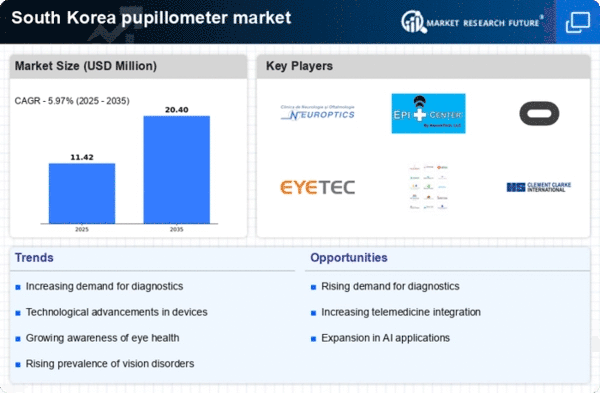
As per Market Research Future analysis, the South Korea pupillometer market Size was estimated at 10.78 USD Million in 2024. The South Korea pupillometer market is projected to grow from 11.42 USD Million in 2025 to 20.4 USD Million by 2035, exhibiting a compound annual growth rate (CAGR) of 5.9% during the forecast period 2025 - 2035

Key Market Trends & Highlights

The South Korea pupillometer market is experiencing robust growth driven by technological advancements and increasing health awareness.

  • Technological advancements are enhancing the accuracy and efficiency of pupillometers, leading to greater adoption in clinical settings.
  • The largest segment in the South Korea pupillometer market is the hospital segment, while the fastest-growing segment is the home healthcare segment.
  • Increased health awareness among consumers is driving demand for eye care solutions, particularly in urban areas.
  • Rising demand for eye care solutions and integration of digital health technologies are key drivers propelling market growth.

Market Size & Forecast

2024 Market Size 10.78 (USD Million)
2035 Market Size 20.4 (USD Million)
CAGR (2025 - 2035) 5.97%

Major Players

Neuroptics (US), PupilMetrics (US), Oculus (DE), Eyetec (DE), MediGage (US), Clement Clarke International (GB), Konan Medical (JP), Huvitz (KR)

Our Impact
Enabled $4.3B Revenue Impact for Fortune 500 and Leading Multinationals
Partnering with 2000+ Global Organizations Each Year
30K+ Citations by Top-Tier Firms in the Industry

South Korea Pupillometer Market Trends

The pupillometer market in South Korea is currently experiencing notable growth, driven by advancements in technology and increasing awareness of eye health. The integration of digital solutions in ophthalmic devices has led to enhanced accuracy and efficiency in measuring pupil responses. This trend is particularly relevant in clinical settings, where precise diagnostics are essential for effective treatment plans. Furthermore, the rising prevalence of vision-related disorders among the population has prompted healthcare providers to invest in sophisticated pupillometric devices, thereby expanding the market's reach. In addition, the South Korean government is actively promoting initiatives aimed at improving eye care services, which further supports the demand for pupillometers. Educational campaigns and public health programs are likely to increase the understanding of the importance of regular eye examinations. As a result, the pupillometer market is poised for continued expansion, with innovations in product design and functionality expected to play a crucial role in meeting the evolving needs of healthcare professionals and patients alike.

Technological Advancements

Recent innovations in pupillometer technology are enhancing measurement precision and user experience. Devices now incorporate advanced imaging techniques and software algorithms, allowing for real-time data analysis and improved diagnostic capabilities.

Increased Health Awareness

Growing public awareness regarding eye health is driving demand for pupillometric devices. Educational initiatives by health authorities are encouraging regular eye check-ups, which in turn boosts the need for accurate measurement tools.

Government Support

The South Korean government is implementing policies to enhance eye care services. This support includes funding for research and development in ophthalmic technologies, which is likely to stimulate growth in the pupillometer market.

South Korea Pupillometer Market Drivers

Rising Demand for Eye Care Solutions

The increasing prevalence of eye-related disorders in South Korea is driving the demand for advanced diagnostic tools, including pupillometers. As the population ages, the incidence of conditions such as glaucoma and diabetic retinopathy rises, necessitating effective monitoring and assessment methods. The pupillometer market is expected to benefit from this trend, as healthcare providers seek to enhance their diagnostic capabilities. In 2025, the market is projected to grow by approximately 15%, reflecting the urgent need for precise eye care solutions. This growth is further supported by the integration of pupillometers into routine eye examinations, thereby improving patient outcomes and fostering a more proactive approach to eye health. Consequently, the rising demand for eye care solutions is a significant driver for the pupillometer market in South Korea.

Increased Focus on Preventive Healthcare

The shift towards preventive healthcare in South Korea is influencing the pupillometer market positively. As healthcare providers emphasize early detection and prevention of eye diseases, the demand for diagnostic tools like pupillometers is expected to rise. This trend aligns with the broader public health initiatives aimed at reducing the burden of chronic eye conditions. By 2025, it is anticipated that the focus on preventive healthcare will lead to a 25% increase in the adoption of pupillometers among ophthalmologists and optometrists. This proactive approach not only enhances patient care but also aligns with the national health strategy to promote wellness and reduce healthcare costs. Thus, the increased focus on preventive healthcare serves as a crucial driver for the pupillometer market in South Korea.

Integration of Digital Health Technologies

The integration of digital health technologies into the healthcare system in South Korea is transforming the pupillometer market. With the advent of telemedicine and remote patient monitoring, pupillometers are increasingly being utilized in conjunction with digital platforms to facilitate real-time data collection and analysis. This trend not only enhances the efficiency of eye examinations but also allows for better patient engagement and follow-up care. As of 2025, it is estimated that the adoption of digital health solutions will contribute to a 20% increase in the utilization of pupillometers across various healthcare settings. The synergy between digital health technologies and pupillometers is likely to streamline workflows and improve diagnostic accuracy, thereby propelling the growth of the pupillometer market in South Korea.

Rising Awareness of Eye Health Among Consumers

Consumer awareness regarding eye health is on the rise in South Korea, significantly impacting the pupillometer market. Educational campaigns and initiatives by health organizations are fostering a greater understanding of the importance of regular eye examinations and the role of advanced diagnostic tools. As individuals become more informed about eye health, the demand for pupillometers is likely to increase, as patients seek comprehensive eye care services. In 2025, it is projected that consumer awareness initiatives will contribute to a 30% growth in the utilization of pupillometers in clinical settings. This heightened awareness not only drives demand but also encourages healthcare providers to invest in advanced diagnostic technologies, thereby propelling the growth of the pupillometer market.

Growing Investment in Healthcare Infrastructure

The South Korean government's commitment to enhancing healthcare infrastructure is a pivotal driver for the pupillometer market. Significant investments are being made to modernize healthcare facilities and expand access to advanced medical technologies. In 2025, the government is expected to allocate over $1 billion towards upgrading diagnostic equipment, including pupillometers, in hospitals and clinics nationwide. This investment aims to improve healthcare delivery and ensure that patients receive timely and accurate diagnoses. As healthcare facilities adopt state-of-the-art technologies, the demand for pupillometers is likely to surge, reflecting the broader trend of modernization within the healthcare sector. Consequently, the growing investment in healthcare infrastructure is poised to significantly impact the pupillometer market in South Korea.


Market Segment Insights

By Mobility: Table-top (Largest) vs. Hand-held (Fastest-Growing)

In the South Korea pupillometer market, the Table-top segment holds a significant share, owing to its extensive use in clinical settings and hospitals where precision and stability are paramount. This segment is favored for its larger display and ease of use, attracting a substantial customer base looking for reliable and effective diagnostic tools. On the other hand, the Hand-held segment is gaining traction, particularly among mobile healthcare providers and field professionals who require portability and convenience in diagnostic equipment. The growth of the Hand-held segment is driven by increasing demand for mobile healthcare solutions and advancements in technology that enhance the functionality of these devices. Factors such as rising awareness about pupil response assessment and the need for quick diagnostic tools in emergency situations contribute to the rapid adoption of Hand-held pupillometers. As technology continues to evolve, this segment is expected to witness accelerated growth, catering to a diverse range of healthcare professionals.

Mobility: Table-top (Dominant) vs. Hand-held (Emerging)

The Table-top segment is considered the dominant force in the South Korea pupillometer market, primarily due to its robust design and high level of accuracy, making it ideal for stationary use in hospitals and clinics. It serves as a trusted choice for medical practitioners who prioritize reliability over portability. In contrast, the Hand-held segment is emerging rapidly, appealing to a younger generation of healthcare providers seeking versatile and portable solutions. This segment is characterized by innovative designs and enhanced functionalities that allow for greater flexibility in patient assessment. While Table-top devices continue to cater to traditional clinical environments, Hand-held models are expected to transform diagnostic practices, offering new opportunities for real-time assessment in various settings.

By Type: Video (Largest) vs. Non-Video (Fastest-Growing)

In the South Korea pupillometer market, the Video segment holds the largest share due to its advanced technology and ability to provide real-time visual feedback that is crucial during examinations. This segment appeals to healthcare professionals who prioritize accuracy and efficiency in their diagnostic processes. On the other hand, the Non-Video segment has been gaining traction, particularly among smaller clinics and practices that seek cost-effective solutions for basic pupillometry needs. Growth in the South Korea pupillometer market can be attributed to increasing awareness about the importance of eye health and advancements in diagnostic technology. The Non-Video segment is particularly characterized by a surge in demand as healthcare providers invest in affordable and portable options. Consequently, this segment is rapidly becoming the fastest-growing category, as it is tailored to meet the requirements of diverse healthcare settings while maintaining clinical integrity.

Video: Dominant vs. Non-Video: Emerging

The Video segment in the South Korea pupillometer market is distinguished by its sophisticated imaging capabilities, making it the dominant choice for precision in eye examinations. Healthcare providers favor this technology for its ability to enhance patient assessment through comprehensive data visualization. Conversely, the Non-Video segment is emerging as a notable alternative for institutions with budget constraints. This segment's growth is driven by its simplicity and ease of use, making it appealing for small clinics and outpatient settings. While the Video segment continues to lead market activities, the Non-Video segment is poised for rapid expansion as professionals look for practical solutions without compromising diagnostic quality.

By End-use: Hospitals (Largest) vs. Eye Clinics (Fastest-Growing)

In the South Korea pupillometer market, hospitals hold the largest market share among the end-use segments, driven by the high demand for comprehensive eye care services. Eye clinics, however, are emerging as a significant player, showing robust growth as they offer specialized services tailored to ocular health, attracting more patients seeking quick and effective eye assessments. The growth in this segment is propelled by increasing awareness of eye health and the rising prevalence of vision-related issues. Hospitals are investing in advanced pupillometer technologies to enhance diagnostic accuracy, while eye clinics capitalize on the trend of preventive care and early detection. This dual approach positions both segments for sustained growth in the evolving healthcare landscape.

Hospitals (Dominant) vs. Eye Clinics (Emerging)

Hospitals play a dominant role in the South Korea pupillometer market due to their extensive resources and comprehensive healthcare services. They utilize advanced pupillometry technologies for a wide range of diagnostic purposes, benefiting from their ability to integrate these tools into multidisciplinary care. In contrast, eye clinics are emerging players, focusing on specialized ocular assessments with pupillometers. These clinics cater to a growing demographic seeking convenience and targeted eye care services, enhancing patient accessibility. The agility of eye clinics to adopt new technologies rapidly enables them to meet the demands of the modern patient, fostering competition with larger hospital networks.

By Application: Ophthalmology (Largest) vs. Neurology (Fastest-Growing)

The market share distribution in the South Korea pupillometer market reveals that Ophthalmology holds a significant position, catering to a broad client base with extensive applications. This segment benefits from high demand, driven by the increasing prevalence of eye disorders and a rising aging population. Neurology, while newer, shows rapid growth fueled by heightened awareness and advancements in neurological assessments, making it a notable contender in the market. Growth trends in this segment are heavily influenced by innovations and technological advancements in pupillometry. Increased investments in healthcare infrastructure and the rising incidence of neurological conditions are propelling the Neurology segment forward. Additionally, educational initiatives and improved access to healthcare facilities are contributing to the demand for pupillometers across both Ophthalmology and Neurology, underscoring their importance in modern clinical practice.

Ophthalmology (Dominant) vs. Neurology (Emerging)

Ophthalmology represents the dominant segment in the South Korea pupillometer market, characterized by its extensive utilization in diagnosing and managing various eye conditions. This segment benefits from established protocols and widespread adoption among healthcare practitioners. On the other hand, Neurology stands as an emerging segment, increasingly gaining traction due to the growing emphasis on neurological health and the incorporation of pupillometry in assessing conditions like concussions and other brain injuries. This dual focus enhances the market's resilience, with Ophthalmology grounded in tradition while Neurology carves out a rapid growth trajectory within the healthcare landscape.

Get more detailed insights about South Korea Pupillometer Market

Key Players and Competitive Insights

The pupillometer market exhibits a dynamic competitive landscape characterized by rapid technological advancements and a growing emphasis on precision in ophthalmic diagnostics. Key players such as Neuroptics (US), Huvitz (KR), and Oculus (DE) are at the forefront, leveraging innovation and strategic partnerships to enhance their market positions. Neuroptics (US) focuses on developing advanced pupillometry solutions that integrate seamlessly with existing ophthalmic equipment, thereby enhancing diagnostic capabilities. Meanwhile, Huvitz (KR) emphasizes regional expansion and localization of manufacturing to cater to the specific needs of the South Korean market, which appears to be a strategic move to bolster its competitive edge. Oculus (DE) is also notable for its commitment to digital transformation, investing in AI-driven technologies to improve the accuracy and efficiency of its pupillometry devices.The business tactics employed by these companies reflect a moderately fragmented market structure, where localized manufacturing and supply chain optimization play crucial roles. The collective influence of these key players shapes a competitive environment that encourages innovation while also addressing the unique demands of regional markets. This fragmentation allows for niche players to thrive, although the presence of established companies often sets high standards for product quality and technological advancement.

In September Neuroptics (US) announced a strategic partnership with a leading telemedicine provider to integrate its pupillometry technology into remote diagnostic platforms. This collaboration is poised to enhance accessibility to eye care, particularly in underserved regions, thereby expanding Neuroptics' market reach and reinforcing its commitment to innovation in ophthalmic diagnostics. The strategic importance of this move lies in its potential to redefine patient care paradigms, making advanced diagnostic tools more widely available.

In October Huvitz (KR) launched a new line of portable pupillometers designed specifically for use in field settings, such as rural clinics and mobile health units. This product launch not only reflects Huvitz's dedication to addressing local healthcare challenges but also positions the company as a leader in providing adaptable solutions that meet diverse clinical needs. The strategic significance of this initiative is underscored by the growing demand for mobile healthcare solutions, particularly in regions with limited access to traditional healthcare facilities.

In August Oculus (DE) unveiled an AI-enhanced pupillometer that utilizes machine learning algorithms to provide real-time analysis of pupil responses. This innovation is indicative of a broader trend towards the integration of AI in medical devices, which is likely to enhance diagnostic accuracy and streamline clinical workflows. The strategic importance of this development lies in its potential to set new benchmarks for performance in the pupillometer market, thereby influencing competitive dynamics.

As of November the competitive trends in the pupillometer market are increasingly defined by digitalization, sustainability, and the integration of AI technologies. Strategic alliances are becoming more prevalent, as companies recognize the value of collaboration in driving innovation and expanding market reach. Looking ahead, competitive differentiation is expected to evolve, with a notable shift from price-based competition towards a focus on technological innovation, reliability in supply chains, and enhanced customer experiences. This transition suggests that companies that prioritize these aspects will likely emerge as leaders in the evolving landscape.

Key Companies in the South Korea Pupillometer Market include

Industry Developments

In recent months, the South Korea Pupillometer Market has experienced notable advancements, particularly with companies like Medmont International, Neuroptics, and Ziemer Ophthalmic Systems expanding their product offerings. DGH Technology and IBRA have also contributed to the technological innovations focusing on precision and user-friendliness. A significant growth trajectory in market valuation has been observed, driven by an increasing demand for efficient diagnostic tools in ophthalmology. Major developments over the last couple of years include the strengthening of partnerships and collaborations; for instance, in April 2022, Mediworks announced a strategic alliance with various healthcare institutions to enhance product accessibility. 

The rise in disposable income among the South Korean population and a growing awareness of ocular health have further propelled the market. While no recent mergers or acquisitions have been publicly disclosed, the ongoing investments from companies like Kowa Company and EssilorLuxottica indicate strong market confidence. Additionally, Luneau Technology and Reichert Technologies have reported enhanced distribution channels within the nation, which is expected to impact market dynamics positively. Overall, these developments reflect a proactive approach within the South Korean Pupillometer Market, fostering innovation and accessibility in eye-care solutions.

Future Outlook

South Korea Pupillometer Market Future Outlook

The Pupillometer Market is projected to grow at a 5.97% CAGR from 2025 to 2035, driven by technological advancements, increasing healthcare investments, and rising demand for diagnostic tools.

New opportunities lie in:

  • Development of portable pupillometers for home healthcare settings.
  • Integration of AI for enhanced diagnostic accuracy and patient monitoring.
  • Partnerships with telemedicine platforms to expand market reach and accessibility.

By 2035, the market is expected to achieve substantial growth, driven by innovation and strategic partnerships.

Market Segmentation

South Korea Pupillometer Market Type Outlook

  • Video
  • Non-Video

South Korea Pupillometer Market End-use Outlook

  • Hospitals
  • Eye Clinics
  • Others

South Korea Pupillometer Market Mobility Outlook

  • Table-top
  • Hand-held

South Korea Pupillometer Market Application Outlook

  • Ophthalmology
  • Neurology
  • Oncology
  • Others

Report Scope

MARKET SIZE 2024 10.78(USD Million)
MARKET SIZE 2025 11.42(USD Million)
MARKET SIZE 2035 20.4(USD Million)
COMPOUND ANNUAL GROWTH RATE (CAGR) 5.97% (2025 - 2035)
REPORT COVERAGE Revenue Forecast, Competitive Landscape, Growth Factors, and Trends
BASE YEAR 2024
Market Forecast Period 2025 - 2035
Historical Data 2019 - 2024
Market Forecast Units USD Million
Key Companies Profiled Neuroptics (US), PupilMetrics (US), Oculus (DE), Eyetec (DE), MediGage (US), Clement Clarke International (GB), Konan Medical (JP), Huvitz (KR)
Segments Covered Mobility, Type, End-use, Application
Key Market Opportunities Integration of advanced digital technologies enhances accuracy and efficiency in the pupillometer market.
Key Market Dynamics Technological advancements drive innovation in pupillometer devices, enhancing diagnostic accuracy and patient care in South Korea.

Countries Covered South Korea
Leave a Comment

FAQs

What is the expected market size of the South Korea Pupillometer Market in 2024?

The South Korea Pupillometer Market is expected to be valued at 10.75 USD Million in 2024.

What will the market size of the South Korea Pupillometer Market reach by 2035?

By 2035, the South Korea Pupillometer Market is projected to reach a value of 24.0 USD Million.

What is the expected CAGR for the South Korea Pupillometer Market from 2025 to 2035?

The expected CAGR for the South Korea Pupillometer Market from 2025 to 2035 is 7.575%.

Which segment of the South Korea Pupillometer Market is projected to have the highest value in 2035?

The Table-top segment is projected to have the highest value, reaching 15.0 USD Million in 2035.

What is the market value of the Hand-held segment in 2024?

The Hand-held segment of the South Korea Pupillometer Market is valued at 4.0 USD Million in 2024.

Who are the key players in the South Korea Pupillometer Market?

Major players in the South Korea Pupillometer Market include Medmont International, Columbia Scientific, and Neuroptics among others.

What is the market value of the Table-top segment in 2024?

The Table-top segment is valued at 6.75 USD Million in the South Korea Pupillometer Market in 2024.

What growth opportunities are present in the South Korea Pupillometer Market?

The market presents growth opportunities due to increasing awareness of ophthalmic devices and technological advancements.

How does the South Korea Pupillometer Market growth rate compare between segments?

The growth rate for both Table-top and Hand-held segments is expected to contribute positively to the overall market growth.

What is the impact of technology on the South Korea Pupillometer Market?

Technological innovations are driving growth in the South Korea Pupillometer Market by improving product functionality and accuracy.

Download Free Sample

Kindly complete the form below to receive a free sample of this Report

Compare Licence

×
Features License Type
Single User Multiuser License Enterprise User
Price $4,950 $5,950 $7,250
Maximum User Access Limit 1 User Upto 10 Users Unrestricted Access Throughout the Organization
Free Customization
Direct Access to Analyst
Deliverable Format
Platform Access
Discount on Next Purchase 10% 15% 15%
Printable Versions