×
Request Free Sample ×

Kindly complete the form below to receive a free sample of this Report

* Please use a valid business email

Leading companies partner with us for data-driven Insights

clients tt-cursor
Hero Background

South Korea Physical Therapy Equipment Market

ID: MRFR/MED/49133-HCR
200 Pages
Rahul Gotadki
February 2026

South Korea Physical Therapy Equipment Market Research Report By Type (Practice Management Software, Patient Communication Software, Treatment Planning Software, Patient Education Software, Dental Imaging Software), By Deployment (On-Premise, Web-Based, Cloud-Based), and By End User (Dental Clinics, Hospitals) -Forecast to 2035

Share:
Download PDF ×

We do not share your information with anyone. However, we may send you emails based on your report interest from time to time. You may contact us at any time to opt-out.

South Korea Physical Therapy Equipment Market Infographic
Purchase Options

South Korea Physical Therapy Equipment Market Summary

As per Market Research Future analysis, the South Korea physical therapy-equipment market size was estimated at 342.5 USD Million in 2024. The South Korea physical therapy-equipment market is projected to grow from 365.17 USD Million in 2025 to 693.0 USD Million by 2035, exhibiting a compound annual growth rate (CAGR) of 6.6% during the forecast period 2025 - 2035

Key Market Trends & Highlights

The South Korea physical therapy-equipment market is experiencing robust growth driven by technological advancements and increasing health awareness.

  • Technological advancements are reshaping the physical therapy-equipment landscape, enhancing treatment efficacy and patient outcomes.
  • The largest segment in this market is rehabilitation equipment, while the fastest-growing segment is home therapy devices.
  • Increased government support is fostering innovation and accessibility in physical therapy solutions across the region.
  • Key market drivers include an aging population and rising incidence of chronic diseases, which are propelling demand for effective therapy solutions.

Market Size & Forecast

2024 Market Size 342.5 (USD Million)
2035 Market Size 693.0 (USD Million)
CAGR (2025 - 2035) 6.62%

Major Players

Medtronic (US), TheraGun (US), Hewlett Packard (US), DJO Global (US), Kinetec (GB), Biodex Medical Systems (US), Patterson Medical (US), Zynex Medical (US)

Our Impact
Enabled $4.3B Revenue Impact for Fortune 500 and Leading Multinationals
Partnering with 2000+ Global Organizations Each Year
30K+ Citations by Top-Tier Firms in the Industry

South Korea Physical Therapy Equipment Market Trends

The physical therapy-equipment market in South Korea is experiencing notable growth, driven by increasing awareness of health and wellness among the population. The government has been actively promoting rehabilitation services, which has led to a rise in demand for various therapeutic devices. This trend is further supported by advancements in technology, enabling the development of innovative equipment that enhances treatment efficacy. As a result, healthcare providers are increasingly investing in modern physical therapy tools to improve patient outcomes. Moreover, the aging population in South Korea is contributing to the expansion of the physical therapy-equipment market. Older adults often require rehabilitation services due to age-related ailments, thereby increasing the need for specialized equipment. The integration of digital health solutions, such as tele-rehabilitation, is also gaining traction, allowing patients to access therapy remotely. This shift not only broadens the reach of physical therapy services but also encourages the adoption of advanced equipment tailored for home use. Overall, the market appears poised for continued growth as it adapts to the evolving needs of healthcare providers and patients alike.

Technological Advancements

The physical therapy-equipment market is witnessing a surge in technological innovations. Equipment incorporating smart technology, such as sensors and data analytics, is becoming more prevalent. These advancements enable therapists to monitor patient progress in real-time, enhancing treatment effectiveness and personalizing rehabilitation plans.

Increased Government Support

Government initiatives aimed at improving healthcare infrastructure are positively impacting the physical therapy-equipment market. Policies promoting rehabilitation services and funding for healthcare facilities are likely to drive demand for advanced therapeutic devices, ensuring better access to care for patients.

Rising Health Awareness

There is a growing emphasis on health and wellness among the South Korean population. This trend is leading to an increased focus on preventive care and rehabilitation, which in turn fuels the demand for physical therapy equipment. As more individuals seek therapy for various conditions, the market is expected to expand.

South Korea Physical Therapy Equipment Market Drivers

Aging Population

The aging population in South Korea is a crucial driver for the physical therapy-equipment market. As the demographic shifts towards an older age group, the demand for rehabilitation and physical therapy services increases. Older adults often experience mobility issues, chronic pain, and other health conditions that necessitate physical therapy interventions. According to recent statistics, approximately 15% of the South Korean population is aged 65 and older, a figure projected to rise significantly in the coming years. This demographic trend is likely to spur investments in physical therapy equipment, as healthcare providers seek to enhance their service offerings to cater to the needs of elderly patients. Consequently, the physical therapy-equipment market is expected to expand as facilities upgrade their equipment to provide effective rehabilitation solutions for this growing segment.

Technological Integration

The integration of advanced technologies into the physical therapy market is transforming treatment methodologies in South Korea. Innovations such as telehealth platforms, wearable devices, and smart rehabilitation equipment are becoming increasingly prevalent. These technologies facilitate remote monitoring and personalized treatment plans, enhancing patient engagement and outcomes. For instance, the use of virtual reality in rehabilitation has shown promising results in improving patient motivation and recovery rates. The market for smart rehabilitation devices is projected to grow at a CAGR of around 10% over the next five years, indicating a robust demand for technologically advanced equipment. As healthcare providers adopt these innovations, the physical therapy-equipment market is likely to witness significant growth, driven by the need for more effective and efficient treatment options.

Increased Health Expenditure

In South Korea, the increase in health expenditure is a notable driver for the physical therapy-equipment market. The government and private sectors are investing more in healthcare services, including rehabilitation and physical therapy. Recent data indicates that health expenditure as a share of GDP has risen to approximately 8%, reflecting a growing commitment to improving healthcare infrastructure. This increase in funding allows healthcare facilities to acquire advanced physical therapy equipment, enhancing the quality of care provided to patients. As hospitals and clinics expand their services to meet the rising demand for rehabilitation, the physical therapy-equipment market is likely to experience substantial growth. The trend suggests a positive outlook for manufacturers and suppliers of physical therapy equipment in the region.

Rising Incidence of Chronic Diseases

The rising incidence of chronic diseases in South Korea is a significant driver for the physical therapy-equipment market. Conditions such as diabetes, obesity, and cardiovascular diseases are becoming increasingly prevalent, leading to a higher demand for rehabilitation services. According to health reports, nearly 30% of the adult population in South Korea is classified as obese, which is associated with various health complications requiring physical therapy. This trend necessitates the use of specialized equipment designed for rehabilitation and recovery. As healthcare systems focus on managing chronic conditions through physical therapy, the market for related equipment is expected to grow. The physical therapy market is thus positioned to benefit from the increasing need for effective treatment solutions tailored to chronic disease management.

Growing Awareness of Preventive Healthcare

The growing awareness of preventive healthcare among the South Korean population is driving the physical therapy-equipment market. As individuals become more conscious of the importance of maintaining physical health and preventing injuries, there is an increasing demand for physical therapy services. Educational campaigns and health initiatives have contributed to this shift in mindset, encouraging people to seek therapy not only for rehabilitation but also for preventive measures. This trend is reflected in the rising number of fitness centers and wellness programs that incorporate physical therapy services. Consequently, the physical therapy-equipment market is likely to benefit from this heightened awareness, as facilities invest in equipment that supports both rehabilitation and preventive care. The market is expected to expand as more individuals prioritize their health and seek professional guidance.


Market Segment Insights

By Type: Practice Management Software (Largest) vs. Patient Communication Software (Fastest-Growing)

In the South Korea physical therapy-equipment market, Practice Management Software commands a significant share, making it the largest segment. This type of software provides critical support in scheduling, billing, and patient management, catering to the needs of clinics and health facilities across the region. On the other hand, Patient Communication Software is gaining traction, reflecting an increased focus on patient engagement and satisfaction, which is vital in today's healthcare landscape. The growth trends indicate a rising adoption of digital solutions in physical therapy practices, driven by the need for efficiency and improved patient outcomes. The emphasis on telehealth solutions has accelerated the demand for Patient Communication Software, while the versatility and functionality of Practice Management Software continue to solidify its position. As practices adapt to evolving patient needs, both segments are expected to thrive, albeit at different rates.

Practice Management Software (Dominant) vs. Patient Communication Software (Emerging)

Practice Management Software stands out as the dominant segment within the South Korea physical therapy-equipment market, offering an extensive range of features that streamline operations for healthcare providers. Its comprehensive capabilities include appointment scheduling, billing management, and patient record keeping, which are essential for enhancing productivity. In contrast, Patient Communication Software is emerging as a key player, focusing on enhancing the interaction between providers and patients. Its tools facilitate appointment reminders, secure messaging, and feedback mechanisms. This segment is particularly appealing due to the growing recognition of patient engagement as a critical component of successful healthcare delivery. The increasing preference for user-friendly solutions and remote communications positions Patient Communication Software as a vital complement to traditional practice management systems.

By Deployment: On-Premise (Largest) vs. Cloud-Based (Fastest-Growing)

In the South Korea physical therapy-equipment market, the deployment segment showcases a diverse landscape with On-Premise solutions commanding a significant portion of the market share. This segment appeals to many traditional therapy practices, providing users with complete control over their equipment and data, thus promoting a strong trust factor among practitioners. In contrast, the Cloud-Based segment is rapidly gaining traction, attracting modern facilities seeking flexible, scalable solutions that innovate patient management and data accessibility. The growth of these alternatives points to shifting preferences towards adaptable technology solutions. The growth trends indicate a compelling shift toward Cloud-Based platforms as they cater to the increasing need for remote access and online patient engagement. As healthcare facilities increasingly adopt digital solutions, Cloud-Based offerings are becoming the preferred choice for many. Key drivers include the rising demand for telehealth services, technological advancements, and the need for enhanced operational efficiency. Consequently, while On-Premise systems continue to hold a predominant position, Cloud-Based solutions are set to reshape the market dynamics significantly.

On-Premise (Dominant) vs. Cloud-Based (Emerging)

On-Premise solutions remain the dominant force in the South Korea physical therapy-equipment market, favored for their security and comprehensive functionality. These systems are particularly prevalent in established clinics that value in-house management of patient data and equipment. The familiarity and reliability of On-Premise solutions foster a loyal user base, contributing to their sustained popularity. Conversely, Cloud-Based offerings, while emerging, are transforming the landscape with their innovative features and ease of integration into existing operations. These platforms allow therapists to access patient data from various locations, enhancing the service delivery model with remote consultation capabilities. The flexibility and adaptability of Cloud-Based solutions are gradually captivating a broader market segment, evidencing a potential shift in long-term industry trends.

By End User: Hospitals (Largest) vs. Dental Clinics (Fastest-Growing)

In the South Korea physical therapy-equipment market, hospitals hold a significant share, dominating the end-user segment with their extensive facilities and patient turnover. Dental clinics are emerging as a notable player, capturing a smaller yet rapidly increasing portion of the market as more clinics adopt advanced physical therapy equipment to enhance patient treatment outcomes. Growth trends in the end-user segment are driven largely by the increasing focus on rehabilitation services in hospitals, coupled with a rising awareness of physical therapy benefits in dental clinics. The growth of the elderly population in South Korea also elevates the demand for comprehensive rehabilitation services. Furthermore, technological advancements in physical therapy equipment are fostering quicker adoption rates, especially in dental clinics looking to improve their service offerings.

Dental Clinics (Emerging) vs. Hospitals (Dominant)

Hospitals are the dominant players in the South Korea physical therapy-equipment market, characterized by their extensive resources and capacity to implement diverse treatment protocols. Their investment in cutting-edge equipment enables them to provide comprehensive rehabilitation services to a large patient base. In contrast, dental clinics, although currently categorized as emerging players, are swiftly gaining market share by integrating physical therapy solutions into their service offerings. This growth is motivated by an increasing consumer demand for holistic treatment approaches, driving dental practices to adopt innovative tools that enhance patient recovery and engagement.

Get more detailed insights about South Korea Physical Therapy Equipment Market

Key Players and Competitive Insights

The physical therapy-equipment market in South Korea is characterized by a dynamic competitive landscape, driven by technological advancements and an increasing focus on rehabilitation solutions. Key players such as Medtronic (US), TheraGun (US), and DJO Global (US) are strategically positioned to leverage innovation and expand their market presence. Medtronic (US) emphasizes the integration of advanced technologies into its product offerings, while TheraGun (US) focuses on enhancing user experience through ergonomic designs and digital health solutions. DJO Global (US) appears to be concentrating on strategic partnerships to broaden its distribution channels, thereby enhancing its competitive edge. Collectively, these strategies contribute to a robust competitive environment, fostering continuous improvement and innovation within the market.
In terms of business tactics, companies are increasingly localizing manufacturing to reduce costs and improve supply chain efficiency. This approach is particularly relevant in a moderately fragmented market where several players vie for market share. The collective influence of these key players shapes the market structure, as they engage in strategic collaborations and optimize their operations to meet the growing demand for physical therapy solutions.
In October 2025, Medtronic (US) announced the launch of a new line of wearable rehabilitation devices designed to enhance patient mobility and recovery outcomes. This strategic move underscores the company's commitment to innovation and positions it favorably in a market that increasingly values technology-driven solutions. The introduction of these devices is likely to attract a broader customer base, particularly among tech-savvy consumers seeking effective rehabilitation options.
In September 2025, TheraGun (US) expanded its product line by introducing a new range of percussion therapy devices aimed at professional athletes and rehabilitation centers. This expansion reflects the company's strategy to penetrate niche markets and cater to specific consumer needs. By focusing on high-performance products, TheraGun (US) is likely to strengthen its brand presence and enhance customer loyalty in a competitive landscape.
In August 2025, DJO Global (US) entered into a strategic partnership with a leading telehealth provider to integrate remote monitoring capabilities into its rehabilitation equipment. This collaboration is indicative of the growing trend towards digital health solutions, allowing for more personalized patient care. By embracing telehealth, DJO Global (US) positions itself at the forefront of a market increasingly driven by technology and patient-centric approaches.
As of November 2025, current trends in the physical therapy-equipment market include a pronounced shift towards digitalization, sustainability, and the integration of artificial intelligence (AI) in product development. Strategic alliances are becoming increasingly vital, as companies seek to enhance their technological capabilities and expand their service offerings. Looking ahead, competitive differentiation is expected to evolve, with a greater emphasis on innovation and technology rather than solely on price. The ability to provide reliable supply chains and cutting-edge solutions will likely define success in this rapidly changing market.

Key Companies in the South Korea Physical Therapy Equipment Market include

Industry Developments

The South Korea Physical Therapy Equipment Market has seen notable developments recently, particularly with advancements in technology and increasing demand for rehabilitation solutions. Companies like Curexo and Chungho Nais have been focusing on enhanced product offerings, showcasing innovations in robotic rehabilitation devices and smart physical therapy tools. In recent months, Inbody reported growth in their market valuation due to their innovative body composition analyzers, contributing positively to the overall market dynamics.MediKing initiated strategic partnerships to bolster its presence in the market, while Samsung Medison has been expanding its range of ultrasound and imaging technologies tailored for rehabilitation.

Additionally, in May 2023, Daewon Medical announced a merger with a local startup to enhance its Research and Development capabilities, thus strengthening its product portfolio. The overall growth trajectory of these companies reflects the increasing consumer focus on effective rehabilitation therapies, particularly in light of an aging population and rising awareness of wellness trends in South Korea. The sector is witnessing increased investment, with a particular emphasis on integrating artificial intelligence and telehealth solutions into physical therapy practices.


Future Outlook

South Korea Physical Therapy Equipment Market Future Outlook

The Physical Therapy Equipment Market is projected to grow at a 6.62% CAGR from 2025 to 2035, driven by technological advancements, increasing healthcare expenditure, and a growing aging population.

New opportunities lie in:

  • Development of telehealth-enabled rehabilitation devices
  • Expansion of portable therapy equipment for home use
  • Integration of AI-driven analytics in therapy equipment

By 2035, the market is expected to achieve substantial growth, reflecting evolving healthcare needs.

Market Segmentation

South Korea Physical Therapy Equipment Market Type Outlook

  • Practice Management Software
  • Patient Communication Software
  • Treatment Planning Software
  • Patient Education Software
  • Dental Imaging Software

South Korea Physical Therapy Equipment Market End User Outlook

  • Dental Clinics
  • Hospitals

South Korea Physical Therapy Equipment Market Deployment Outlook

  • On-Premise
  • Web-Based
  • Cloud-Based

Report Scope

MARKET SIZE 2024 342.5(USD Million)
MARKET SIZE 2025 365.17(USD Million)
MARKET SIZE 2035 693.0(USD Million)
COMPOUND ANNUAL GROWTH RATE (CAGR) 6.62% (2025 - 2035)
REPORT COVERAGE Revenue Forecast, Competitive Landscape, Growth Factors, and Trends
BASE YEAR 2024
Market Forecast Period 2025 - 2035
Historical Data 2019 - 2024
Market Forecast Units USD Million
Key Companies Profiled Medtronic (US), TheraGun (US), Hewlett Packard (US), DJO Global (US), Kinetec (GB), Biodex Medical Systems (US), Patterson Medical (US), Zynex Medical (US)
Segments Covered Type, Deployment, End User
Key Market Opportunities Integration of advanced telehealth solutions enhances accessibility in the physical therapy-equipment market.
Key Market Dynamics Rising demand for innovative physical therapy equipment driven by technological advancements and changing consumer preferences in South Korea.
Countries Covered South Korea
Leave a Comment

FAQs

What is the expected market size of the South Korea Physical Therapy Equipment Market in 2024?

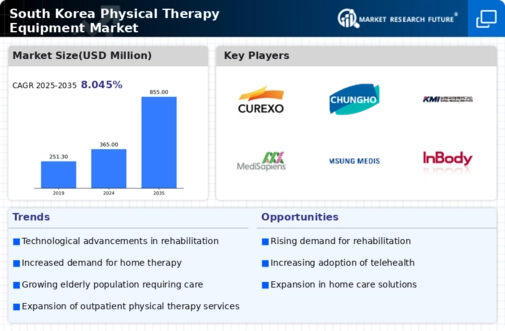
The South Korea Physical Therapy Equipment Market is expected to be valued at 365.0 USD Million in 2024.

How much is the South Korea Physical Therapy Equipment Market projected to grow by 2035?

By 2035, the overall market is projected to reach a valuation of 855.0 USD Million.

What is the expected CAGR for the South Korea Physical Therapy Equipment Market from 2025 to 2035?

The market is expected to grow at a CAGR of 8.045% from 2025 to 2035.

Which type of software is expected to dominate the South Korea Physical Therapy Equipment Market?

Practice Management Software is expected to be valued at 180.0 USD Million by 2035.

What is the market size of the Patient Communication Software segment in 2024?

The Patient Communication Software segment is valued at 70.0 USD Million in 2024.

Who are the key players in the South Korea Physical Therapy Equipment Market?

Major players include Curexo, Chungho Nais, Korea Medical, MediSapiens, and Samsung Medison.

What are the expected applications of the South Korea Physical Therapy Equipment Market?

Key applications include Practice Management Software, Patient Communication Software, and Treatment Planning Software.

How much is the Treatment Planning Software segment projected to be worth by 2035?

The Treatment Planning Software segment is projected to reach 200.0 USD Million by 2035.

What challenges might the South Korea Physical Therapy Equipment Market face?

Challenges may include regulatory hurdles and competition from emerging technologies in healthcare.

What factors are driving growth in the South Korea Physical Therapy Equipment Market?

Growth drivers include increasing demand for innovative healthcare solutions and advancements in physical therapy technology.

Download Free Sample

Kindly complete the form below to receive a free sample of this Report

Compare Licence

×
Features License Type
Single User Multiuser License Enterprise User
Price $4,950 $5,950 $7,250
Maximum User Access Limit 1 User Upto 10 Users Unrestricted Access Throughout the Organization
Free Customization
Direct Access to Analyst
Deliverable Format
Platform Access
Discount on Next Purchase 10% 15% 15%
Printable Versions