×
Request Free Sample ×

Kindly complete the form below to receive a free sample of this Report

* Please use a valid business email

Leading companies partner with us for data-driven Insights

clients tt-cursor
Hero Background

South Korea Mixed Reality Market

ID: MRFR/ICT/59215-HCR
200 Pages
Aarti Dhapte
February 2026

South Korea Mixed Reality Market Size, Share and Trends Analysis Report By Application (Gaming, Healthcare, Education, Retail, Real Estate), By Technology (Hardware-based, Software-based, Mixed Reality as a Service), By End Use (Consumer, Commercial, Industrial) and By Device Type (Head-mounted Display, Smart Glasses, Smart Phones, Tablets)- Forecast to 2035

Share:
Download PDF ×

We do not share your information with anyone. However, we may send you emails based on your report interest from time to time. You may contact us at any time to opt-out.

South Korea Mixed Reality Market Infographic
Purchase Options

South Korea Mixed Reality Market Summary

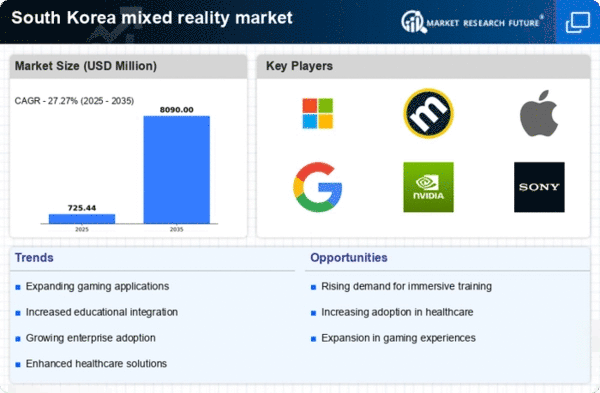
As per Market Research Future analysis, the South Korea mixed reality market Size was estimated at 570.0 USD Million in 2024. The South Korea mixed reality market is projected to grow from 725.44 USD Million in 2025 to 8090.0 USD Million by 2035, exhibiting a compound annual growth rate (CAGR) of 27.2% during the forecast period 2025 - 2035

Key Market Trends & Highlights

The South Korea mixed reality market is experiencing robust growth driven by diverse applications across various sectors.

  • The education sector emerges as the largest segment, showcasing increased adoption of mixed reality technologies for enhanced learning experiences.
  • Healthcare applications represent the fastest-growing segment, leveraging mixed reality for improved patient care and training.
  • The entertainment and gaming industries are expanding rapidly, indicating a strong consumer interest in immersive experiences.
  • Technological advancements in hardware and government initiatives are key drivers propelling the market forward.

Market Size & Forecast

2024 Market Size 570.0 (USD Million)
2035 Market Size 8090.0 (USD Million)
CAGR (2025 - 2035) 27.27%

Major Players

Microsoft (US), Meta (US), Apple (US), Google (US), NVIDIA (US), Sony (JP), Samsung (KR), Magic Leap (US), HTC (TW)

Our Impact
Enabled $4.3B Revenue Impact for Fortune 500 and Leading Multinationals
Partnering with 2000+ Global Organizations Each Year
30K+ Citations by Top-Tier Firms in the Industry

South Korea Mixed Reality Market Trends

The mixed reality market in South Korea is currently experiencing a notable evolution, driven by advancements in technology and increasing consumer interest. The integration of augmented reality (AR) and virtual reality (VR) is becoming more prevalent across various sectors, including education, healthcare, and entertainment. This convergence is fostering innovative applications that enhance user experiences and engagement. Furthermore, the South Korean government is actively promoting the development of this market through supportive policies and funding initiatives, which may further stimulate growth and adoption. In addition, the demand for immersive experiences is rising among consumers, leading to a surge in investments from both established companies and startups. As businesses recognize the potential of mixed reality to transform operations and customer interactions, collaborations between tech firms and industry leaders are likely to increase. This collaborative environment could pave the way for new solutions that address specific market needs, thereby solidifying South Korea's position as a key player in the mixed reality landscape.

Increased Adoption in Education

Educational institutions are increasingly integrating mixed reality technologies into their curricula. This trend appears to enhance learning outcomes by providing interactive and immersive experiences that engage students more effectively.

Growth in Healthcare Applications

The healthcare sector is witnessing a rise in the use of mixed reality for training and surgical simulations. This development suggests a potential for improved medical training and patient outcomes, as practitioners gain hands-on experience in a controlled environment.

Expansion in Entertainment and Gaming

The entertainment industry is rapidly embracing mixed reality, particularly in gaming. This trend indicates a shift towards more interactive and engaging content, appealing to a broader audience and enhancing user experiences.

South Korea Mixed Reality Market Drivers

Expanding Use Cases in Retail

The retail sector in South Korea is increasingly adopting mixed reality technologies to enhance customer experiences and streamline operations. Retailers are utilizing mixed reality for virtual try-ons, interactive displays, and immersive shopping experiences, which are proving to be effective in attracting consumers. In 2025, the retail segment is anticipated to represent around 20% of the mixed reality market, reflecting a growing trend towards experiential shopping. This shift indicates that as retailers recognize the benefits of mixed reality in driving sales and customer engagement, the market is likely to witness substantial growth, further solidifying its position in the broader retail landscape.

Government Initiatives and Support

The South Korean government is actively promoting the mixed reality market through various initiatives and funding programs. By investing in research and development, the government aims to position the country as a leader in mixed reality technologies. In 2025, government funding for mixed reality projects is expected to reach $200 million, fostering innovation and collaboration between public and private sectors. This support not only encourages startups to enter the mixed reality market but also enhances the overall ecosystem, driving growth and adoption across industries such as education, healthcare, and entertainment. The proactive stance of the government suggests a robust future for the mixed reality market.

Technological Advancements in Hardware

The mixed reality market in South Korea is experiencing a surge due to rapid advancements in hardware technology. Innovations in headsets, sensors, and display technologies are enhancing user experiences, making mixed reality applications more accessible and appealing. For instance, the introduction of lightweight, high-resolution headsets has led to increased adoption across various sectors. In 2025, the hardware segment is projected to account for approximately 45% of the total market share, reflecting a growing consumer preference for immersive experiences. This trend indicates that as hardware becomes more sophisticated and affordable, the mixed reality market will likely expand significantly, attracting both consumers and businesses alike.

Integration with Artificial Intelligence

The integration of artificial intelligence (AI) with mixed reality technologies is creating new opportunities within the mixed reality market in South Korea. AI enhances the capabilities of mixed reality applications by enabling more personalized and adaptive experiences. For example, AI-driven analytics can provide insights into user behavior, allowing developers to tailor content and interactions accordingly. This synergy is expected to propel the mixed reality market, with AI applications projected to contribute to a 25% increase in market growth by 2026. The combination of AI and mixed reality suggests a transformative potential that could redefine user experiences across various sectors.

Rising Demand for Remote Collaboration Tools

The increasing need for remote collaboration tools is significantly influencing the mixed reality market in South Korea. As businesses seek innovative solutions to enhance communication and teamwork, mixed reality applications are emerging as viable options. In 2025, the demand for remote collaboration tools is projected to grow by 30%, with mixed reality technologies playing a crucial role in facilitating virtual meetings and interactive sessions. This trend indicates that organizations are recognizing the potential of mixed reality to improve productivity and engagement, thereby driving further investment and development in the mixed reality market.


Market Segment Insights

By Application: Gaming (Largest) vs. Healthcare (Fastest-Growing)

The South Korea mixed reality market shows a diverse application distribution among various segments. Gaming holds the largest market share, driven by the country's strong gaming culture and advanced technological infrastructure. Following gaming, sectors like healthcare and education are also making notable contributions, expanding their presence as users increasingly adopt mixed reality solutions for enhancing their experiences. Retail and real estate, while currently smaller segments, are emerging as vital players in this growing market. Growth in the mixed reality application segments is primarily fueled by rapid technological advancements and increasing investments in digital solutions. The healthcare sector, in particular, is witnessing significant growth as hospitals and clinics adopt mixed reality technologies for training and patient engagement. Education is also leveraging these technologies to enhance learning experiences. Retail and real estate applications are expanding as businesses seek innovative ways to engage customers and showcase properties, respectively.

Gaming: Dominant vs. Healthcare: Emerging

Gaming has established itself as the dominant application in the mixed reality market, with numerous platforms and titles available that leverage immersive experiences. The strong network of gamers in South Korea propels continuous demand and innovation within this sphere. On the other hand, healthcare stands out as an emerging application, harnessing mixed reality for training medical professionals and enhancing patient care. As healthcare providers adopt these technologies, they are enabling simulations and interactive learning environments that could revolutionize traditional practices. Both segments are crucial for driving the South Korea mixed reality market's growth, but gaming currently enjoys a solid lead in terms of market presence and user engagement.

By Technology: Hardware-based (Largest) vs. Software-based (Fastest-Growing)

In the South Korea mixed reality market, the distribution between hardware-based and software-based technologies reveals a competitive landscape. Hardware-based solutions hold a significant share, driven by the demand for advanced devices and immersive experiences. Meanwhile, software-based offerings are increasingly capturing consumer interest, reflecting a strategic shift towards applications that enhance user engagement and flexibility. As a result, both segments are essential in shaping the overall market dynamics and consumer preferences. Growth trends highlight that the software-based segment is the fastest-growing, propelled by innovations in applications and services. Factors contributing to this growth include rising consumer expectations for interactive experiences and the need for businesses to adopt mixed reality solutions for training and operational efficiency. As a result, both hardware and software segments are poised to evolve, addressing diverse market needs and enhancing overall user satisfaction.

Technology: Hardware-based (Dominant) vs. Software-based (Emerging)

The hardware-based segment stands as a dominant force in the South Korea mixed reality market, characterized by robust demand for devices that facilitate immersive experiences. This includes VR headsets and AR glasses, which are essential for a wide range of applications from gaming to industrial training. Conversely, the software-based segment serves as an emerging area, focusing on developing applications that leverage the capabilities of hardware devices. This includes everything from gaming software to enterprise solutions that enhance efficiency. Both segments interact significantly; hardware development drives software innovations, and vice versa, ultimately shaping the future landscape of mixed reality experiences.

By End Use: Consumer (Largest) vs. Commercial (Fastest-Growing)

The South Korea mixed reality market exhibits a clear division among its end-use segments, with the Consumer segment commanding the largest share. This segment includes a wide array of applications, ranging from gaming to educational tools, attracting a broad audience due to the proliferation of affordable devices. On the other hand, the Commercial segment, while smaller in share, is rapidly gaining traction as businesses recognize the productivity and engagement benefits of mixed reality applications. Growth in the South Korea mixed reality market is largely driven by technological advancements and the increasing need for interactive solutions across various industries. The Consumer segment benefits from continuous innovations in gaming technology and immersive experiences, while the Commercial segment's expansion is fueled by rising investments in employee training and virtual collaboration tools. As businesses seek to enhance operational efficiency and user engagement, mixed reality solutions are poised to shape the future landscape for both consumers and enterprises.

Consumer (Dominant) vs. Commercial (Emerging)

The Consumer segment in the South Korea mixed reality market stands out as the dominant force, characterized by high adoption rates and a diverse range of applications that appeal to various demographics. This segment covers entertainment, education, and social interaction, allowing users to engage with content in immersive ways. In contrast, the Commercial segment is emerging, focusing on business applications such as training simulations and virtual meetings. While still growing, the Commercial segment is becoming increasingly important, as businesses leverage mixed reality to improve productivity and collaboration. This duality in market focus highlights a vibrant landscape where both segments can coexist, with consumer demand driving innovation while commercial applications tap into corporate needs.

By Device Type: Head-mounted Display (Largest) vs. Smart Glasses (Fastest-Growing)

In the South Korea mixed reality market, the distribution of market share among device types reveals a clear dominance of head-mounted displays, which are preferred by consumers for immersive experiences. Smart glasses, while capturing a smaller share, are quickly gaining attention for their innovative features and versatility in various applications, including retail and enterprise solutions. Growth trends indicate that head-mounted displays have sustained their lead due to consistent advancements in technology and user engagement. However, smart glasses are emerging as the fastest-growing segment driven by increased demand in augmented reality applications and the integration of AI features. This dynamic shift suggests that manufacturers will focus more on smart glasses to cater to evolving consumer needs.

Head-mounted Display (Dominant) vs. Smart Glasses (Emerging)

Head-mounted displays stand as the dominant device type in the South Korea mixed reality market, characterized by their ability to deliver fully immersive experiences suitable for gaming and training simulations. These devices leverage advanced optics and processing power, appealing to tech-savvy consumers and enterprises. On the other hand, smart glasses are becoming an emerging force, designed for ease of use and portability. They are increasingly utilized in industries like logistics and healthcare, providing hands-free access to data and enhancing operational efficiency. As these technologies evolve, the competitive landscape is expected to shift, with smart glasses potentially closing the market share gap.

Get more detailed insights about South Korea Mixed Reality Market

Key Players and Competitive Insights

The mixed reality market in South Korea is characterized by a dynamic competitive landscape, driven by rapid technological advancements and increasing consumer demand for immersive experiences. Major players such as Microsoft (US), Meta (US), and Samsung (KR) are at the forefront, each adopting distinct strategies to enhance their market presence. Microsoft (US) focuses on innovation through its HoloLens platform, emphasizing enterprise solutions that integrate mixed reality into business operations. Meanwhile, Meta (US) is heavily investing in social and gaming applications, aiming to create a comprehensive ecosystem that fosters user engagement. Samsung (KR), leveraging its strong local manufacturing capabilities, is concentrating on developing affordable mixed reality devices tailored to the South Korean market, thereby enhancing accessibility and user adoption.The business tactics employed by these companies reflect a concerted effort to optimize supply chains and localize manufacturing processes. The market structure appears moderately fragmented, with a mix of established giants and emerging players vying for market share. This fragmentation is indicative of a competitive environment where innovation and strategic partnerships play crucial roles in shaping market dynamics. The collective influence of these key players is likely to drive further advancements in technology and user experience, fostering a more integrated mixed reality ecosystem.

In October Microsoft (US) announced a strategic partnership with a leading South Korean telecommunications company to enhance the connectivity of its HoloLens devices. This collaboration is expected to facilitate the deployment of mixed reality applications in various sectors, including healthcare and education, thereby expanding the user base and enhancing the overall value proposition of its offerings. Such partnerships are pivotal as they not only bolster Microsoft's market position but also signify a trend towards collaborative innovation in the mixed reality space.

In September Meta (US) unveiled a new mixed reality headset designed specifically for the Asian market, featuring advanced AI capabilities for personalized user experiences. This launch underscores Meta's commitment to tailoring its products to meet regional preferences, which may enhance its competitive edge in South Korea. By integrating AI into its devices, Meta is likely positioning itself as a leader in user-centric design, potentially reshaping consumer expectations in the mixed reality domain.

In November Samsung (KR) revealed plans to invest €500M in the development of next-generation mixed reality technologies, focusing on sustainability and energy efficiency. This initiative not only aligns with global trends towards environmentally conscious technology but also positions Samsung as a forward-thinking player in the market. The emphasis on sustainable practices may resonate well with consumers, thereby enhancing brand loyalty and market share.

As of November the competitive trends in the mixed reality market are increasingly defined by digitalization, AI integration, and sustainability. Strategic alliances among key players are shaping the landscape, fostering innovation and enhancing product offerings. The shift from price-based competition to a focus on technological advancement and supply chain reliability is evident, suggesting that future competitive differentiation will hinge on the ability to innovate and adapt to evolving consumer needs.

Key Companies in the South Korea Mixed Reality Market include

Industry Developments

The South Korea Mixed Reality Market has seen significant developments recently, particularly among major companies like LG Display, Samsung Electronics, and SK Telecom. In June 2023, LG Display announced a partnership with a leading tech firm to enhance its OLED display technology for augmented reality applications. Meanwhile, Samsung Electronics launched its next-generation AR headset, demonstrating advancements in user experience and integration with mobile devices. 

SK Telecom has been actively expanding its 5G infrastructure to support Mixed Reality applications, contributing to an increase in market valuation as more companies invest in this technology. Notably, in August 2023, Daum Kakao established a joint venture with Unity Technologies to develop immersive content for virtual environments, reflecting the growing collaboration within the industry. 

Additionally, the market has felt the impact of SK hynix's focus on semiconductors for graphics processing, optimizing the performance of Mixed Reality devices. Over the last 2-3 years, companies like KT Corporation and LG Electronics have also made strides in enhancing content delivery platforms, further validating the dynamic growth trajectory in South Korea's Mixed Reality landscape. The ongoing investments and partnerships suggest a robust future for the market.

Future Outlook

South Korea Mixed Reality Market Future Outlook

The Mixed Reality Market in South Korea is projected to grow at 27.27% CAGR from 2025 to 2035, driven by technological advancements and increasing adoption across industries.

New opportunities lie in:

  • Development of immersive training programs for corporate sectors.
  • Integration of mixed reality in remote collaboration tools.
  • Creation of customized mixed reality solutions for healthcare applications.

By 2035, the mixed reality market is expected to achieve substantial growth and innovation.

Market Segmentation

South Korea Mixed Reality Market End Use Outlook

  • Consumer
  • Commercial
  • Industrial

South Korea Mixed Reality Market Technology Outlook

  • Hardware-based
  • Software-based
  • Mixed Reality as a Service

South Korea Mixed Reality Market Application Outlook

  • Gaming
  • Healthcare
  • Education
  • Retail
  • Real Estate

South Korea Mixed Reality Market Device Type Outlook

  • Head-mounted Display
  • Smart Glasses
  • Smart Phones
  • Tablets

Report Scope

MARKET SIZE 2024 570.0(USD Million)
MARKET SIZE 2025 725.44(USD Million)
MARKET SIZE 2035 8090.0(USD Million)
COMPOUND ANNUAL GROWTH RATE (CAGR) 27.27% (2025 - 2035)
REPORT COVERAGE Revenue Forecast, Competitive Landscape, Growth Factors, and Trends
BASE YEAR 2024
Market Forecast Period 2025 - 2035
Historical Data 2019 - 2024
Market Forecast Units USD Million
Key Companies Profiled Microsoft (US), Meta (US), Apple (US), Google (US), NVIDIA (US), Sony (JP), Samsung (KR), Magic Leap (US), HTC (TW)
Segments Covered Application, Technology, End Use, Device Type
Key Market Opportunities Growing demand for immersive training solutions in various industries enhances prospects in the mixed reality market.
Key Market Dynamics Rapid technological advancements drive competitive dynamics in the mixed reality market, influencing consumer adoption and regulatory frameworks.
Countries Covered South Korea
Leave a Comment

FAQs

What is the projected market size of the South Korea Mixed Reality Market by 2035?

The South Korea Mixed Reality Market is expected to be valued at 8928.0 USD Million by 2035.

What is the expected CAGR for the South Korea Mixed Reality Market from 2025 to 2035?

The expected CAGR for the South Korea Mixed Reality Market from 2025 to 2035 is 26.936%.

Which application segment holds the largest market value in 2024 within the South Korea Mixed Reality Market?

The Gaming segment holds the largest market value at 194.3 USD Million in 2024.

What is the growth projection for the Gaming segment in the South Korea Mixed Reality Market by 2035?

The Gaming segment is projected to grow to 2660.0 USD Million by 2035.

How much is the Healthcare application valued in 2024 within the South Korea Mixed Reality Market?

The Healthcare application is valued at 130.0 USD Million in 2024.

What is the expected market size for the Real Estate application in 2035?

The Real Estate application is expected to reach a market size of 1968.0 USD Million by 2035.

Who are the major players in the South Korea Mixed Reality Market?

Major players in the South Korea Mixed Reality Market include LG Display, Samsung Electronics, and SK Telecom among others.

What is the market value for the Education segment in 2024?

The Education segment is valued at 95.0 USD Million in the year 2024.

What is the projected market value for the Retail segment by 2035?

The Retail segment is projected to reach a market value of 1200.0 USD Million by 2035.

What challenges and opportunities exist in the South Korea Mixed Reality Market?

The market presents growth drivers driven by technological advancements and increased applications across various sectors.

Download Free Sample

Kindly complete the form below to receive a free sample of this Report

Compare Licence

×
Features License Type
Single User Multiuser License Enterprise User
Price $4,950 $5,950 $7,250
Maximum User Access Limit 1 User Upto 10 Users Unrestricted Access Throughout the Organization
Free Customization
Direct Access to Analyst
Deliverable Format
Platform Access
Discount on Next Purchase 10% 15% 15%
Printable Versions