×
Request Free Sample ×

Kindly complete the form below to receive a free sample of this Report

* Please use a valid business email

Leading companies partner with us for data-driven Insights

clients tt-cursor
Hero Background

South Korea Medical Washer Disinfectors Market

ID: MRFR/MED/50920-HCR
200 Pages
Rahul Gotadki
February 2026

South Korea Medical Washer Disinfectors Market Research Report By Product Type (Floor-standing, Benchtop, Other Product Types), By Type (Single Chamber, Multi-Chamber), By Technology (Fully Automated, Semi-automated), By Application (Medical, Dental, Other Applications), and By End-Use (Hospitals and Clinics, Ambulatory Surgical Centers, Laboratories, Other End-Users) - Growth & Industry Forecast 2025 To 2035

Share:
Download PDF ×

We do not share your information with anyone. However, we may send you emails based on your report interest from time to time. You may contact us at any time to opt-out.

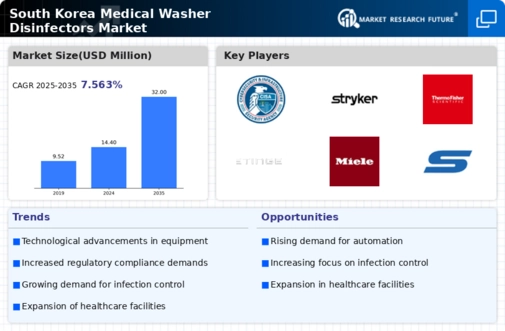
South Korea Medical Washer Disinfectors Market Infographic
Purchase Options

South Korea Medical Washer Disinfectors Market Summary

As per Market Research Future analysis, the South Korea medical washer-disinfectors market size was estimated at 13.75 USD Million in 2024. The South Korea medical washer-disinfectors market is projected to grow from 14.85 USD Million in 2025 to 32.06 USD Million by 2035, exhibiting a compound annual growth rate (CAGR) of 8% during the forecast period 2025 - 2035

Key Market Trends & Highlights

The South Korea medical washer-disinfectors market is poised for growth driven by technological advancements and increasing regulatory compliance.

  • Technological advancements in washer-disinfectors are enhancing efficiency and effectiveness in healthcare settings.
  • The largest segment in the market is the hospital sector, while the outpatient clinic segment is the fastest-growing.
  • Regulatory compliance is becoming increasingly stringent, pushing healthcare facilities to upgrade their disinfection processes.
  • Key market drivers include the rising demand for infection control solutions and a focus on patient safety and quality of care.

Market Size & Forecast

2024 Market Size 13.75 (USD Million)
2035 Market Size 32.06 (USD Million)
CAGR (2025 - 2035) 8.0%

Major Players

Getinge (SE), Miele (DE), STERIS (US), Ecolab (US), Belimed (CH), Hygiena (US), Cisa (IT), Lancer (US)

Our Impact
Enabled $4.3B Revenue Impact for Fortune 500 and Leading Multinationals
Partnering with 2000+ Global Organizations Each Year
30K+ Citations by Top-Tier Firms in the Industry

South Korea Medical Washer Disinfectors Market Trends

The medical washer-disinfectors market in South Korea is currently experiencing notable growth. This growth is driven by increasing demand for efficient and reliable cleaning solutions in healthcare settings. The rise in healthcare facilities, coupled with stringent regulations regarding infection control, has led to a heightened focus on the adoption of advanced washer-disinfectors. These devices are essential for ensuring the safety and hygiene of medical instruments, thereby reducing the risk of healthcare-associated infections. Furthermore, technological advancements in washer-disinfectors, such as automation and improved energy efficiency, are likely to enhance their appeal among healthcare providers. In addition, the South Korean government is actively promoting initiatives aimed at improving healthcare infrastructure, which may further stimulate the medical washer-disinfectors market. The emphasis on quality and compliance with international standards is expected to drive innovation and investment in this sector. As healthcare providers seek to optimize their operations and maintain high standards of cleanliness, the demand for sophisticated washer-disinfectors is anticipated to rise. Overall, the market appears poised for continued expansion, reflecting the critical role of these devices in modern healthcare practices.

Technological Advancements

The medical washer-disinfectors market is witnessing a trend towards the integration of advanced technologies. Innovations such as IoT connectivity and automated cleaning cycles are enhancing operational efficiency. These advancements not only streamline processes but also ensure consistent disinfection outcomes, which is crucial in healthcare settings.

Regulatory Compliance

Stringent regulations regarding infection control and hygiene standards are shaping the medical washer-disinfectors market. Healthcare facilities are increasingly required to comply with these regulations, driving the demand for high-quality washer-disinfectors that meet specific safety and performance criteria.

Sustainability Initiatives

There is a growing emphasis on sustainability within the medical washer-disinfectors market. Manufacturers are focusing on developing eco-friendly products that minimize water and energy consumption. This trend aligns with broader environmental goals and reflects the commitment of healthcare providers to reduce their ecological footprint.

South Korea Medical Washer Disinfectors Market Drivers

Rising Healthcare Expenditure

The increase in healthcare expenditure in South Korea is a significant driver for the medical washer-disinfectors market. With the government and private sectors investing heavily in healthcare infrastructure, hospitals are upgrading their facilities to meet modern standards. This includes the procurement of advanced washer-disinfectors that ensure effective cleaning and disinfection of medical instruments. According to recent data, healthcare spending in South Korea is expected to rise by XX% annually, which will likely lead to increased investments in medical equipment, including washer-disinfectors. As healthcare facilities expand and modernize, the demand for efficient and reliable cleaning solutions is anticipated to grow, thereby positively impacting the medical washer-disinfectors market.

Government Initiatives and Support

Government initiatives aimed at improving healthcare standards are playing a crucial role in the medical washer-disinfectors market. In South Korea, policies promoting the adoption of advanced medical technologies are encouraging healthcare facilities to invest in modern cleaning solutions. These initiatives often include financial incentives and grants for hospitals to upgrade their equipment, which directly impacts the demand for washer-disinfectors. As the government continues to support the enhancement of healthcare infrastructure, the medical washer-disinfectors market is expected to experience growth. The alignment of public health goals with technological advancements suggests a promising future for the market, as facilities seek to comply with evolving standards.

Focus on Patient Safety and Quality of Care

The emphasis on patient safety and quality of care is increasingly shaping the medical washer-disinfectors market. Healthcare providers in South Korea are prioritizing the implementation of stringent cleaning protocols to minimize the risk of hospital-acquired infections. This focus is driving the demand for high-performance washer-disinfectors that can effectively eliminate pathogens from medical instruments. As hospitals strive to enhance their reputation and meet regulatory standards, the adoption of advanced cleaning technologies is becoming essential. The medical washer-disinfectors market is likely to benefit from this trend, as facilities invest in equipment that ensures the highest levels of hygiene and safety for patients.

Technological Innovations in Washer-Disinfectors

Technological advancements are significantly influencing the medical washer-disinfectors market. Innovations such as smart sensors, IoT connectivity, and energy-efficient designs are becoming increasingly prevalent in South Korea. These advancements not only improve the efficiency of the cleaning process but also reduce operational costs for healthcare facilities. For instance, the introduction of automated monitoring systems allows for real-time tracking of cleaning cycles, ensuring compliance with hygiene standards. The market is projected to grow at a CAGR of XX% over the next few years, driven by these technological innovations. As healthcare providers seek to enhance their operational efficiency and reduce costs, the demand for state-of-the-art washer-disinfectors is likely to increase, further propelling market growth.

Increasing Demand for Infection Control Solutions

The rising awareness regarding infection control in healthcare settings is driving the medical washer-disinfectors market. Hospitals and clinics in South Korea are increasingly adopting advanced cleaning technologies to ensure the safety of patients and staff. This trend is reflected in the growing market size, which is projected to reach approximately $XX million by 2027. The emphasis on maintaining high hygiene standards is likely to propel the demand for efficient washer-disinfectors, as they play a crucial role in the decontamination process. Furthermore, the integration of automated systems in these devices enhances their effectiveness, making them indispensable in modern healthcare facilities. As a result, the medical washer-disinfectors market is expected to witness robust growth, fueled by the need for reliable infection control solutions.


Market Segment Insights

By Product: Floor-standing (Largest) vs. Benchtop (Fastest-Growing)

In the South Korea medical washer-disinfectors market, the segment distribution reflects a strong preference for floor-standing models, which dominate the overall market share due to their robust performance and high capacity. In contrast, benchtop models are gaining traction, appealing to smaller healthcare facilities looking for space-efficient solutions. The growth trends in this market segment indicate a rising inclination toward benchtop washer-disinfectors, recognized for their compact design and efficiency. This growth is largely driven by increasing demand in outpatient settings and small clinics that require versatile, streamlined cleaning solutions. Meanwhile, floor-standing units continue to thrive, bolstered by the need for high-volume disinfection in large hospitals and surgical centers.

Benchtop (Emerging) vs. Floor-standing (Dominant)

Floor-standing washer-disinfectors hold a dominant position in the South Korea medical washer-disinfectors market, primarily due to their capacity to handle larger volumes of instruments and equipment. These units are designed for high throughput in larger healthcare environments, ensuring compliance with stringent hygiene standards. Conversely, benchtop models have emerged as a significant trend, offering compact alternatives that are particularly appealing to smaller healthcare facilities. These devices not only optimize space but also enhance workflow efficiency, catering to the diverse needs of today’s medical settings. As the market evolves, both segment types will coexist, fulfilling distinct roles in the broader healthcare landscape.

By Type: Multi-chamber (Largest) vs. Single chamber (Fastest-Growing)

In the South Korea medical washer-disinfectors market, multi-chamber units hold the largest share due to their capacity to handle a greater volume of instruments simultaneously. This higher efficiency makes them preferable in larger healthcare settings, such as hospitals, where throughput is critical for patient care. Conversely, single chamber units are gaining traction, especially in smaller clinics and offices, as they offer a compact solution for disinfecting and washing a limited number of instruments at a time. The growth trend for single chamber medical washer-disinfectors is fueled by the increasing focus on infection control and the rising number of outpatient procedures. As clinics seek cost-effective solutions without compromising sterilization quality, the demand for single chamber units is expected to surge. Conversely, multi-chamber washers continue to thrive because of the demand for higher efficiency in medium to large healthcare facilities, adapting to the volume of instruments processed daily.

Multi-chamber (Dominant) vs. Single chamber (Emerging)

Multi-chamber washer-disinfectors are characterized by their ability to process multiple loads efficiently, making them dominant in larger healthcare settings where time and throughput are critical factors. These systems are ideally suited for hospitals and surgical centers, often equipped with advanced technology to ensure thorough cleaning and disinfection. In contrast, single chamber washer-disinfectors serve as an emerging solution for smaller clinics and outpatient facilities. They are valued for their space-saving design and ease of use, appealing to practices that require effective disinfection without the need for high volume processing. As the focus on hygiene intensifies, both segment values are positioned uniquely within the market.

By Technology: Fully automated (Largest) vs. Semi-automated (Fastest-Growing)

In the South Korea medical washer-disinfectors market, the distribution of market share indicates that fully automated systems hold a significant portion, making them the largest segment. This segment is primarily favored in hospitals due to its efficiency in handling a high volume of instruments and ensuring reliability in disinfection. Meanwhile, semi-automated systems are gaining traction, catering to facilities that prefer a cost-effective solution without compromising on quality. Growth trends in the South Korea medical washer-disinfectors market show a robust adoption of technological advancements. Fully automated washers are increasingly seen as essential in modern healthcare settings, driving their demand, while semi-automated units are recognized for their flexibility and efficiency as an emerging alternative. Factors such as rising healthcare standards, increased surgical procedures, and a focus on infection control bolster the growth of both segments.

Technology: Fully automated (Dominant) vs. Semi-automated (Emerging)

Fully automated washer-disinfectors are characterized by their advanced technology, enabling seamless operation with minimal human intervention. This makes them ideal for large medical facilities with high turnover rates, as they provide consistent and reliable disinfection results. On the other hand, semi-automated washer-disinfectors offer a balance between manual control and automation, catering to smaller establishments or those with budget constraints. While their market position is currently growing, they appeal to users seeking operational flexibility and lower upfront costs. As a result, both segment types contribute uniquely to the South Korea medical washer-disinfectors landscape, addressing diverse healthcare needs.

By Application: Medical (Largest) vs. Dental (Fastest-Growing)

In the South Korea medical washer-disinfectors market, the application segments are diverse, with the medical application holding the largest share. This segment dominates the landscape due to the increasing number of healthcare facilities and stringent regulations regarding infection control. Conversely, the dental segment is rapidly gaining ground, supported by a rising emphasis on hygiene and effective sterilization practices in dental clinics. The growth trends indicate that while the medical application remains the cornerstone of the market, the dental segment is emerging as the fastest-growing area. Factors driving this growth include technological advancements in dental practices and increased public awareness of dental health. Additionally, the ongoing expansion of dental care services contributes significantly to the demand for washer-disinfectors in this segment.

Medical (Dominant) vs. Dental (Emerging)

The medical application segment is characterized by its robust demand stemming from hospitals and surgical centers, where high levels of cleanliness are imperative. This segment is supported by regulatory requirements that mandate effective cleaning and disinfection of medical instruments. On the other hand, the dental application is emerging rapidly, fueled by innovations in dental technology and an uptick in dental procedures. This segment is increasingly recognized for its unique requirements, necessitating specialized washer-disinfectors that cater specifically to dental tools and instruments, thus positioning it as a key growth area in the market.

By End-use: Hospitals and clinics (Largest) vs. Ambulatory surgical centers (Fastest-Growing)

In the South Korea medical washer-disinfectors market, the distribution of market share among various end-use segments reveals a strong dominance of hospitals and clinics, which constitute the largest portion of the market. This is primarily due to the higher demand for sterilization and disinfection processes in these settings, where patient turnover is frequent, and strict hygiene standards are paramount. Ambulatory surgical centers are also notable, reflecting a growing trend in outpatient care services that further boosts their relevance in the overall market share distribution. The growth trends in this segment are largely driven by the increasing emphasis on infection control and the expansion of healthcare services, particularly in outpatient settings. As the healthcare landscape evolves, ambulatory surgical centers are emerging rapidly, fuelled by technological advancements and the push for more efficient patient care solutions. This creates opportunities for innovation and improved efficiency in medical washer-disinfectors, catering to the specialized needs of different end-users while adhering to stringent regulatory requirements.

Hospitals and clinics (Dominant) vs. Laboratories (Emerging)

The hospitals and clinics segment represents the dominant force in the South Korea medical washer-disinfectors market, characterized by a high volume of surgical procedures and a constant need for effective disinfection practices. These spaces often operate under strict regulatory frameworks that dictate sanitation protocols, driving sustained demand for sophisticated washer-disinfectors. In contrast, laboratories are emerging as a significant end-user group, largely due to the expansion of research activities and diagnostic testing. Laboratories require washer-disinfectors that ensure the elimination of contaminants, highlighting the need for equipment capable of handling diverse laboratory ware. As this segment grows, innovation will focus on integrating advanced technologies to enhance efficiency and meet the specific disinfection needs required in clinical laboratory environments.

Get more detailed insights about South Korea Medical Washer Disinfectors Market

Key Players and Competitive Insights

The medical washer-disinfectors market in South Korea exhibits a competitive landscape characterized by rapid innovation and strategic partnerships among key players. The market is driven by increasing healthcare standards, a growing emphasis on infection control, and technological advancements. Major companies such as Getinge (SE), STERIS (US), and Miele (DE) are at the forefront, each adopting distinct strategies to enhance their market presence. Getinge (SE) focuses on innovation in product development, particularly in automated solutions, while STERIS (US) emphasizes comprehensive service offerings and customer support. Miele (DE) positions itself through high-quality manufacturing and sustainability initiatives, collectively shaping a competitive environment that prioritizes efficiency and reliability.
Key business tactics within this market include localizing manufacturing and optimizing supply chains to enhance responsiveness to regional demands. The competitive structure appears moderately fragmented, with several players vying for market share. However, the influence of major companies is substantial, as they leverage their resources to establish a foothold in the market. This dynamic fosters a competitive atmosphere where innovation and operational excellence are paramount.
In October 2025, Getinge (SE) announced the launch of a new line of washer-disinfectors designed to improve energy efficiency and reduce water consumption. This strategic move aligns with global sustainability trends and positions the company as a leader in environmentally friendly healthcare solutions. The introduction of these products is likely to enhance Getinge's competitive edge, appealing to healthcare facilities that prioritize eco-conscious practices.
In September 2025, STERIS (US) expanded its service network in South Korea by partnering with local distributors to enhance customer support and service delivery. This partnership is strategically significant as it allows STERIS to tap into local expertise and improve its service response times, thereby strengthening its market position. Such collaborations may also facilitate better customer relationships and foster loyalty in a competitive landscape.
In August 2025, Miele (DE) unveiled a new digital platform that integrates AI technology into its washer-disinfectors, enabling real-time monitoring and predictive maintenance. This innovation not only enhances operational efficiency but also positions Miele as a forward-thinking player in the market. The integration of AI reflects a broader trend towards digitalization in healthcare, suggesting that Miele is keen to leverage technology to differentiate itself from competitors.
As of November 2025, current trends in the medical washer-disinfectors market include a pronounced shift towards digitalization, sustainability, and AI integration. Strategic alliances are increasingly shaping the competitive landscape, allowing companies to pool resources and expertise. Looking ahead, competitive differentiation is likely to evolve, with a greater emphasis on innovation and technology rather than solely on price. The focus on supply chain reliability and advanced technological solutions will be crucial for companies aiming to maintain a competitive edge in this dynamic market.

Key Companies in the South Korea Medical Washer Disinfectors Market include

Industry Developments

In recent months, the South Korea Medical Washer Disinfectors Market has seen notable developments. Companies such as Thermo Fisher Scientific and GETINGE are expanding their product offerings to meet increasing healthcare demands, particularly amid heightened awareness of infection control due to the COVID-19 pandemic. In April 2023, Mediwash introduced a new line of disinfectors that utilizes advanced technology to improve disinfection efficiency, which has drawn positive attention from hospitals and medical facilities. Additionally, Miele has reported significant growth in sales for its medical washer disinfectors as the South Korean market prioritizes robust sterilization processes. 

Recent acquisitions are also noteworthy; in January 2023, Stryker completed the acquisition of a local technology firm that specializes in automated cleaning systems. This move aims to enhance Stryker’s capabilities in infection prevention solutions. The market's valuation is steadily increasing, driven by innovations in automation and efficiency improvements, as well as growing demands for compliance with strict health regulations in the region. Over the past two years, the South Korean healthcare sector has invested significantly in upgrading sterilization systems, reflecting a broader commitment to patient safety and quality healthcare delivery.


Future Outlook

South Korea Medical Washer Disinfectors Market Future Outlook

The Medical Washer disinfectors Market is projected to grow at an 8.0% CAGR from 2025 to 2035, driven by technological advancements and increasing healthcare standards.

New opportunities lie in:

  • Integration of IoT for real-time monitoring and maintenance services.
  • Development of eco-friendly disinfectant solutions to meet regulatory demands.
  • Expansion into telehealth facilities for remote cleaning solutions.

By 2035, the market is expected to achieve robust growth, reflecting evolving healthcare needs.

Market Segmentation

South Korea Medical Washer Disinfectors Market Type Outlook

  • Single chamber
  • Multi-chamber

South Korea Medical Washer Disinfectors Market End-use Outlook

  • Hospitals and clinics
  • Ambulatory surgical centers
  • Laboratories
  • Other end-users

South Korea Medical Washer Disinfectors Market Product Outlook

  • Floor-standing
  • Benchtop
  • Other product types

South Korea Medical Washer Disinfectors Market Technology Outlook

  • Fully automated
  • Semi-automated

South Korea Medical Washer Disinfectors Market Application Outlook

  • Medical
  • Dental
  • Other applications

Report Scope

MARKET SIZE 2024 13.75(USD Million)
MARKET SIZE 2025 14.85(USD Million)
MARKET SIZE 2035 32.06(USD Million)
COMPOUND ANNUAL GROWTH RATE (CAGR) 8.0% (2025 - 2035)
REPORT COVERAGE Revenue Forecast, Competitive Landscape, Growth Factors, and Trends
BASE YEAR 2024
Market Forecast Period 2025 - 2035
Historical Data 2019 - 2024
Market Forecast Units USD Million
Key Companies Profiled Getinge (SE), Miele (DE), STERIS (US), Ecolab (US), Belimed (CH), Hygiena (US), Cisa (IT), Lancer (US)
Segments Covered Product, Type, Technology, Application, End-use
Key Market Opportunities Integration of advanced automation and IoT technologies enhances efficiency in the medical washer-disinfectors market.
Key Market Dynamics Rising demand for advanced medical washer-disinfectors driven by stringent healthcare regulations and technological innovations.
Countries Covered South Korea
Leave a Comment

FAQs

What is the expected market size of the South Korea Medical Washer Disinfectors Market in 2024?

The South Korea Medical Washer Disinfectors Market is expected to be valued at 14.38 million USD in 2024.

What is the projected market size for the South Korea Medical Washer Disinfectors Market by 2035?

By 2035, the market is projected to reach a value of 32.05 million USD.

What is the expected CAGR for the South Korea Medical Washer Disinfectors Market from 2025 to 2035?

The expected CAGR for the market from 2025 to 2035 is 7.563 percent.

Which product type is projected to dominate the market in 2035?

The Floor-standing product type is projected to dominate the market with a value of 13.46 million USD in 2035.

What is the market value for Benchtop Medical Washer Disinfectors in 2024?

The Benchtop Medical Washer Disinfectors market is valued at 4.5 million USD in 2024.

Who are the major players in the South Korea Medical Washer Disinfectors Market?

Key players in the market include Cisa, Lutz, Mediwash, Kavo Kerr, and Stryker, among others.

What is the forecasted market size for Other Product Types in 2035?

The market for Other Product Types is expected to reach 8.49 million USD by 2035.

What are the key applications driving the growth of the Medical Washer Disinfectors Market?

Key applications driving growth include sterilization in hospitals, clinics, and laboratories.

How does the South Korea Medical Washer Disinfectors Market respond to emerging trends?

The market is adapting with increased demand for advanced technologies and eco-friendly solutions.

What challenges does the South Korea Medical Washer Disinfectors Market currently face?

Current challenges include regulatory compliance and the need for continuous technological innovation.

Download Free Sample

Kindly complete the form below to receive a free sample of this Report

Compare Licence

×
Features License Type
Single User Multiuser License Enterprise User
Price $4,950 $5,950 $7,250
Maximum User Access Limit 1 User Upto 10 Users Unrestricted Access Throughout the Organization
Free Customization
Direct Access to Analyst
Deliverable Format
Platform Access
Discount on Next Purchase 10% 15% 15%
Printable Versions