×
Request Free Sample ×

Kindly complete the form below to receive a free sample of this Report

* Please use a valid business email

Leading companies partner with us for data-driven Insights

clients tt-cursor
Hero Background

South Korea Mechatronics Robotics Courses Market

ID: MRFR/ICT/60462-HCR
200 Pages
Aarti Dhapte
February 2026

South Korea Mechatronics Robotics Courses Market Research Report By Platform (Online, Offline) and By Application (Manufacturing, Automotive, Drones, Space, Others)- Forecast to 2035

Share:
Download PDF ×

We do not share your information with anyone. However, we may send you emails based on your report interest from time to time. You may contact us at any time to opt-out.

South Korea Mechatronics Robotics Courses Market Infographic
Purchase Options

South Korea Mechatronics Robotics Courses Market Summary

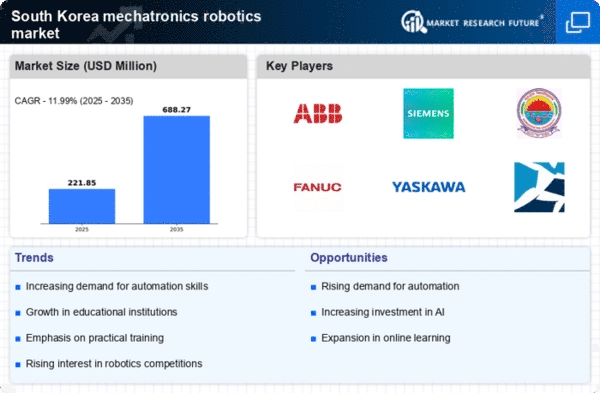
As per Market Research Future analysis, the South Korea mechatronics robotics-courses market Size was estimated at 198.1 USD Million in 2024. The South Korea mechatronics robotics-courses market is projected to grow from 221.85 USD Million in 2025 to 688.27 USD Million by 2035, exhibiting a compound annual growth rate (CAGR) of 11.9% during the forecast period 2025 - 2035

Key Market Trends & Highlights

The South Korea mechatronics robotics-courses market is experiencing robust growth driven by technological advancements and educational reforms.

  • The integration of AI in the curriculum is becoming increasingly prevalent, enhancing the learning experience for students.
  • Industry-academia collaboration is strengthening, facilitating a smoother transition from education to employment in the robotics sector.
  • There is a notable emphasis on practical skills training, which is essential for meeting the demands of the evolving job market.
  • Rising demand for automation skills and government initiatives are key drivers propelling the growth of the mechatronics robotics-courses market.

Market Size & Forecast

2024 Market Size 198.1 (USD Million)
2035 Market Size 688.27 (USD Million)
CAGR (2025 - 2035) 11.99%

Major Players

ABB (CH), Siemens (DE), KUKA (DE), FANUC (JP), Yaskawa (JP), Boston Dynamics (US), Universal Robots (DK), Rockwell Automation (US), Omron (JP)

Our Impact
Enabled $4.3B Revenue Impact for Fortune 500 and Leading Multinationals
Partnering with 2000+ Global Organizations Each Year
30K+ Citations by Top-Tier Firms in the Industry

South Korea Mechatronics Robotics Courses Market Trends

the mechatronics robotics-courses market in South Korea is currently experiencing significant changes, driven by advancements in technology and a growing demand for skilled professionals in automation and robotics. Educational institutions are increasingly integrating mechatronics into their curricula, reflecting the rising interest among students in this interdisciplinary field. This shift is likely influenced by the country's robust manufacturing sector, which seeks to enhance productivity through automation. Furthermore, government initiatives aimed at promoting STEM education are fostering a conducive environment for the growth of this market. As a result, the mechatronics robotics-courses market is poised for expansion, with more institutions offering specialized programs to meet the needs of the industry. In addition, the collaboration between academia and industry is becoming more pronounced, with partnerships forming to develop training programs that align with real-world applications. This trend suggests a commitment to equipping students with practical skills that are directly applicable in the workforce. Moreover, the increasing integration of artificial intelligence and machine learning into mechatronics education indicates a forward-thinking approach to curriculum development. Overall, the mechatronics robotics-courses market is likely to continue evolving, adapting to technological advancements and the changing landscape of the job market.

Integration of AI in Curriculum

The incorporation of artificial intelligence into mechatronics robotics-courses is becoming more prevalent. Educational institutions are recognizing the importance of AI in enhancing automation and robotics capabilities. This trend indicates a shift towards more advanced training, preparing students for future challenges in the industry.

Industry-Academia Collaboration

There is a growing trend of partnerships between educational institutions and industry players. These collaborations aim to create training programs that reflect the current needs of the job market. Such initiatives are likely to enhance the relevance of mechatronics robotics-courses, ensuring that graduates possess the skills required by employers.

Focus on Practical Skills

The mechatronics robotics-courses market is increasingly emphasizing hands-on training and practical skills. Institutions are adopting project-based learning approaches, allowing students to engage in real-world applications. This focus on experiential learning is expected to better prepare graduates for careers in automation and robotics.

South Korea Mechatronics Robotics Courses Market Drivers

Government Initiatives and Funding

Government initiatives play a crucial role in shaping the mechatronics robotics-courses market in South Korea. The government has recognized the importance of fostering innovation and technological advancement, leading to increased funding for educational programs in robotics and mechatronics. Recent reports indicate that public investment in STEM education has risen by 20% over the past year, aimed at enhancing the skill set of the workforce. This financial support not only facilitates the development of new courses but also encourages collaboration between educational institutions and industry leaders. As a result, the mechatronics robotics-courses market is likely to benefit from enhanced resources, improved infrastructure, and a more robust curriculum that meets the demands of a rapidly evolving technological landscape.

Industry-Specific Training Programs

The emergence of industry-specific training programs is reshaping the mechatronics robotics-courses market in South Korea. As various sectors, such as manufacturing, healthcare, and logistics, increasingly adopt robotics solutions, there is a growing need for tailored educational programs that address specific industry requirements. Recent surveys indicate that 70% of employers prefer candidates with specialized training in robotics relevant to their field. In response, educational institutions are collaborating with industry partners to develop customized courses that provide practical skills and knowledge. This trend not only enhances the employability of graduates but also strengthens the alignment between education and industry needs, thereby fostering growth in the mechatronics robotics-courses market.

Rising Demand for Automation Skills

The mechatronics robotics-courses market in South Korea is experiencing a notable surge in demand for automation skills. As industries increasingly adopt automation technologies, the need for skilled professionals proficient in mechatronics and robotics is becoming paramount. According to recent data, the automation sector is projected to grow by approximately 15% annually, driving educational institutions to enhance their course offerings. This trend indicates a shift towards integrating advanced robotics and mechatronics into the curriculum, ensuring that students are equipped with the necessary skills to meet industry requirements. Consequently, the mechatronics robotics-courses market is likely to expand, as educational providers respond to this growing demand by developing specialized programs that align with the evolving needs of the workforce.

Technological Advancements in Robotics

Technological advancements are significantly influencing the mechatronics robotics-courses market in South Korea. The rapid evolution of robotics technologies, including artificial intelligence, machine learning, and sensor technologies, necessitates continuous updates to educational curricula. Institutions are increasingly incorporating these advancements into their courses to ensure that students are well-versed in the latest developments. For instance, the integration of AI in robotics is expected to create new job opportunities, with estimates suggesting a potential increase of 30% in related employment by 2027. This dynamic environment compels educational providers to adapt their offerings, thereby driving growth in the mechatronics robotics-courses market as they strive to prepare students for future challenges.

Increased Focus on Research and Development

An increased focus on research and development (R&D) within the mechatronics robotics-courses market is evident in South Korea. Educational institutions are prioritizing R&D initiatives to advance knowledge and innovation in robotics and mechatronics. This emphasis on R&D is supported by partnerships with technology firms and research organizations, facilitating access to cutting-edge resources and expertise. Data suggests that R&D investment in the robotics sector has grown by 25% over the last two years, reflecting a commitment to fostering innovation. As a result, students enrolled in mechatronics robotics courses are likely to benefit from exposure to pioneering research projects, enhancing their learning experience and preparing them for future careers in a competitive job market.


Market Segment Insights

By Platform: Online (Largest) vs. Offline (Fastest-Growing)

In the South Korea mechatronics robotics-courses market, online platforms dominate the landscape, capturing a significant share of the learner demographic. The convenience and accessibility offered by online courses attract a broad audience ranging from beginners to advanced practitioners, solidifying their position as the preferred mode of instruction. This trend is reflected in the growing number of institutions transitioning to or expanding their online offerings, catering to varying skill levels and preferences. Conversely, offline courses are emerging as the fastest-growing segment, appealing to individuals seeking hands-on experience and direct interaction with instructors. This resurgence is driven by the increasing importance placed on practical skills and networking opportunities, as well as the desire for immersive learning experiences. Institutions are responding to this demand by innovating their offline programs, thus enhancing their attractiveness among learners looking for personal engagement in their education.

Platform: Online (Dominant) vs. Offline (Emerging)

Online courses in the South Korea mechatronics robotics-courses market are characterized by their accessibility, flexibility, and a wide array of offerings. They cater to various learning paces and styles, making them appealing to a diverse audience, from novices to seasoned professionals seeking continuing education. The integration of technology in online learning, including virtual labs and interactive simulations, enhances the educational experience. On the other hand, offline courses are increasingly recognized as an emerging option for students valuing the direct mentorship and practical, hands-on training they provide. They foster a learning environment that encourages collaboration and immediate feedback, essential for complex subjects like mechatronics and robotics. The growing interest in offline modalities suggests a balanced approach is emerging in educational preferences.

By Application: Manufacturing (Largest) vs. Automotive (Fastest-Growing)

The South Korea mechatronics robotics-courses market showcases a diverse distribution among its application segments, with manufacturing taking the largest share. This segment benefits from substantial investment in automation and efficiency, which drives a large volume of courses tailored to meet the evolving skill requirements in this industry. Meanwhile, the automotive sector is witnessing remarkable growth as manufacturers increasingly incorporate robotics for enhanced production and innovative vehicle technologies. As industry demands shift towards automation and advanced robotics, the growth trends indicate a surge in interest in robotics courses, particularly focused on automotive applications. This growth is fueled by technological advancements in electric vehicles and autonomous driving systems, pushing educational institutions to develop specialized training programs. The consistent need for skilled labor in manufacturing also underpins the stability of this sector, highlighting the importance of robotics education in maintaining industry competitiveness.

Manufacturing (Dominant) vs. Automotive (Emerging)

The manufacturing segment stands out as the dominant force in the South Korea mechatronics robotics-courses market, driven by the integration of robotics in production lines and continuous improvement initiatives. These courses emphasize practical skills that align with industry needs, including automation technologies and smart factory solutions. In contrast, the automotive sector is emerging as a focal point for robotics education, with courses rapidly evolving to cover topics such as autonomous vehicles and advanced manufacturing processes. This shift reflects the automotive industry's dynamic nature and its reliance on mechatronic innovations to tackle challenges such as efficiency, safety, and sustainability. Both segments play a critical role in preparing a skilled workforce capable of navigating the complexities of modern technology.

Get more detailed insights about South Korea Mechatronics Robotics Courses Market

Key Players and Competitive Insights

The mechatronics robotics-courses market in South Korea is characterized by a dynamic competitive landscape, driven by rapid technological advancements and increasing demand for automation across various sectors. Key players such as ABB (CH), Siemens (DE), and FANUC (JP) are strategically positioned to leverage their extensive expertise in robotics and automation. ABB (CH) focuses on innovation through its investment in AI and machine learning, enhancing the capabilities of its robotic systems. Siemens (DE) emphasizes digital transformation, integrating IoT solutions into its robotics offerings, which allows for improved efficiency and data analytics. Meanwhile, FANUC (JP) is expanding its global footprint, particularly in Asia, to capitalize on the growing demand for robotics training and education, thereby shaping a competitive environment that prioritizes technological advancement and regional expansion.The business tactics employed by these companies include localizing manufacturing and optimizing supply chains to enhance responsiveness to market demands. The market structure appears moderately fragmented, with several players competing for market share while also collaborating on various initiatives. This collective influence of key players fosters a competitive atmosphere where innovation and operational efficiency are paramount.

In August ABB (CH) announced a partnership with a leading South Korean university to develop a specialized curriculum focused on robotics and automation. This collaboration aims to bridge the skills gap in the workforce, ensuring that students are equipped with the necessary knowledge to thrive in the evolving job market. Such initiatives not only enhance ABB's brand presence but also contribute to the overall growth of the mechatronics education sector in South Korea.

In September Siemens (DE) launched a new training program that incorporates virtual reality (VR) technology to simulate real-world robotics scenarios. This innovative approach to education is designed to provide students with hands-on experience in a controlled environment, thereby improving learning outcomes. The strategic importance of this initiative lies in its potential to attract more students to the field of robotics, ultimately fostering a more skilled workforce.

In October FANUC (JP) unveiled a new online platform aimed at providing accessible training resources for robotics enthusiasts and professionals alike. This platform offers a range of courses, from beginner to advanced levels, and is expected to significantly increase the accessibility of robotics education. By democratizing access to training, FANUC positions itself as a leader in the educational aspect of the robotics market, which could lead to increased brand loyalty and market share.

As of November current competitive trends in the mechatronics robotics-courses market include a strong emphasis on digitalization, sustainability, and the integration of AI technologies. Strategic alliances among key players are increasingly shaping the landscape, as companies recognize the value of collaboration in driving innovation. Looking ahead, competitive differentiation is likely to evolve from traditional price-based competition to a focus on technological innovation, reliability in supply chains, and the ability to provide comprehensive training solutions. This shift underscores the importance of adapting to market demands and leveraging advanced technologies to maintain a competitive edge.

Key Companies in the South Korea Mechatronics Robotics Courses Market include

Industry Developments

Recent developments in the South Korea Mechatronics Robotics Courses Market reveal a dynamic landscape. Ulsan National Institute of Science and Technology has also strengthened its curriculum to include advanced robotics, responding to growing industry demands. POSTECH and KAIST have launched collaborative programs aimed at enhancing interdisciplinary skills among students, fostering innovation in robotics and AI applications. 

Currently, no major mergers or acquisitions have been publicly announced in this domain involving the specified companies. The market has seen significant activity, with Seoul National University and Hanyang University expanding their programs in robotics since 2021, reflecting the increasing demand for skilled professionals in the sector and the ongoing evolution of robotics technology in South Korea.

Future Outlook

South Korea Mechatronics Robotics Courses Market Future Outlook

The Mechatronics Robotics Courses Market is projected to grow at 11.99% CAGR from 2025 to 2035, driven by technological advancements, increased automation, and rising demand for skilled professionals.

New opportunities lie in:

  • Development of specialized online certification programs for industry-specific applications.
  • Partnerships with tech firms for hands-on training workshops.
  • Creation of subscription-based learning platforms for continuous education in robotics.

By 2035, the market is expected to be robust, reflecting substantial growth and innovation.

Market Segmentation

South Korea Mechatronics Robotics Courses Market Platform Outlook

  • Online
  • Offline

South Korea Mechatronics Robotics Courses Market Application Outlook

  • Manufacturing
  • Automotive
  • Drones
  • Space
  • Others

Report Scope

MARKET SIZE 2024 198.1(USD Million)
MARKET SIZE 2025 221.85(USD Million)
MARKET SIZE 2035 688.27(USD Million)
COMPOUND ANNUAL GROWTH RATE (CAGR) 11.99% (2025 - 2035)
REPORT COVERAGE Revenue Forecast, Competitive Landscape, Growth Factors, and Trends
BASE YEAR 2024
Market Forecast Period 2025 - 2035
Historical Data 2019 - 2024
Market Forecast Units USD Million
Key Companies Profiled ABB (CH), Siemens (DE), KUKA (DE), FANUC (JP), Yaskawa (JP), Boston Dynamics (US), Universal Robots (DK), Rockwell Automation (US), Omron (JP)
Segments Covered Platform, Application
Key Market Opportunities Growing demand for advanced automation skills drives expansion in the mechatronics robotics-courses market.
Key Market Dynamics Growing demand for advanced mechatronics robotics courses driven by technological advancements and industry needs in South Korea.
Countries Covered South Korea
Leave a Comment

FAQs

What is the market size of the South Korea Mechatronics Robotics Courses Market in 2024?

The market size for the South Korea Mechatronics Robotics Courses Market is expected to be valued at 198.1 million USD in 2024.

What is the projected market size of the South Korea Mechatronics Robotics Courses Market by 2035?

By 2035, the market is expected to reach a value of 693.4 million USD.

What is the expected CAGR for the South Korea Mechatronics Robotics Courses Market from 2025 to 2035?

The expected compound annual growth rate for the market is 12.063% from 2025 to 2035.

Who are the key players in the South Korea Mechatronics Robotics Courses Market?

Major players in the market include Hyundai Motor Company, KAIST, Samsung Electronics, and LG Electronics, among others.

How is the South Korea Mechatronics Robotics Courses Market segmented by platform?

The market is segmented into online and offline platforms, with both contributing significantly to the overall size.

What is the market value for online mechatronics robotics courses in 2024?

The market value for online mechatronics robotics courses is set at 99.1 million USD in 2024.

What is the expected market value for offline mechatronics robotics courses by 2035?

The expected market value for offline courses is 346.8 million USD by 2035.

What are some key growth drivers for the South Korea Mechatronics Robotics Courses Market?

Key growth drivers include the increasing demand for automation and advancements in technology.

What is the anticipated market growth rate for the online segment compared to the offline segment?

Both segments are expected to grow significantly, with online courses leading in market value by 2035.

What impact do emerging trends have on the South Korea Mechatronics Robotics Courses Market?

Emerging trends such as enhanced technology integration and the growing interest in robotics education positively impact market growth.

Download Free Sample

Kindly complete the form below to receive a free sample of this Report

Compare Licence

×
Features License Type
Single User Multiuser License Enterprise User
Price $4,950 $5,950 $7,250
Maximum User Access Limit 1 User Upto 10 Users Unrestricted Access Throughout the Organization
Free Customization
Direct Access to Analyst
Deliverable Format
Platform Access
Discount on Next Purchase 10% 15% 15%
Printable Versions