×
Request Free Sample ×

Kindly complete the form below to receive a free sample of this Report

* Please use a valid business email

Leading companies partner with us for data-driven Insights

clients tt-cursor
Hero Background

South Korea Machine Vision Market

ID: MRFR/ICT/54118-HCR
200 Pages
Aarti Dhapte
February 2026

South Korea Machine Vision Market Size, Share and Research Report: By Product (PC-Based, Smart Camera Based), By Application (Quality Assurance & Inspection, Positioning & Guidance, Measurement, Identification) and By End-use Industry (Automation, Pharmaceuticals & Chemicals, Electronics & Semiconductor, Pulp & Paper, Printing & Labeling, Food & Beverage, Glass & Metal, Postal & Logistics, Others)-Forecast to 2035

Share:
Download PDF ×

We do not share your information with anyone. However, we may send you emails based on your report interest from time to time. You may contact us at any time to opt-out.

South Korea Machine Vision Market Infographic
Purchase Options

South Korea Machine Vision Market Summary

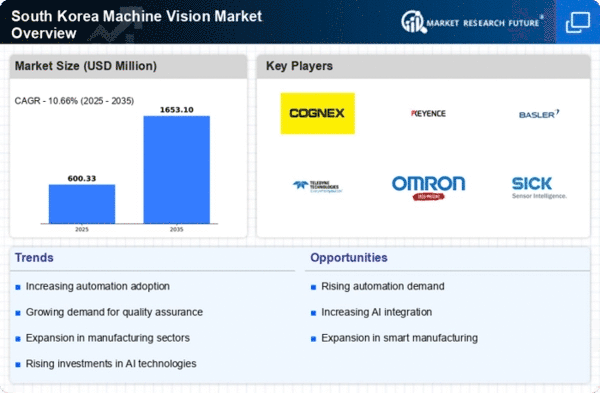
As per Market Research Future analysis, the As per Market Research Future analysis, the South Korea machine vision market size was estimated at 542.5 USD Million in 2024. The South Korea machine vision market is projected to grow from 600.33 USD Million in 2025 to 1653.1 USD Million by 2035, exhibiting a compound annual growth rate (CAGR) of 10.6% during the forecast period 2025 - 2035

Key Market Trends & Highlights

The South Korea machine vision market is poised for substantial growth driven by technological advancements and increasing automation.

  • The integration of AI technologies is transforming the machine vision landscape, enhancing capabilities and efficiency.
  • The largest segment in the South Korea machine vision market is the automotive sector, while the fastest-growing segment is expected to be electronics.
  • There is a notable emphasis on quality control, which is becoming a critical factor for manufacturers across various industries.
  • Rising demand for advanced manufacturing and government initiatives are key drivers propelling market expansion.

Market Size & Forecast

2024 Market Size 542.5 (USD Million)
2035 Market Size 1653.1 (USD Million)
CAGR (2025 - 2035) 10.66%

Major Players

Cognex Corporation (US), Keyence Corporation (JP), Basler AG (DE), Teledyne Technologies Incorporated (US), Omron Corporation (JP), SICK AG (DE), National Instruments Corporation (US), Datalogic S.p.A. (IT)

Our Impact
Enabled $4.3B Revenue Impact for Fortune 500 and Leading Multinationals
Partnering with 2000+ Global Organizations Each Year
30K+ Citations by Top-Tier Firms in the Industry

South Korea Machine Vision Market Trends

The market in South Korea is currently experiencing notable growth, driven by advancements in technology and increasing demand across various sectors. Industries such as manufacturing, automotive, and electronics are increasingly adopting machine vision systems to enhance quality control, improve operational efficiency, and reduce production costs. The integration of artificial intelligence and deep learning algorithms into machine vision applications is further propelling this trend, as these technologies enable more accurate and faster image processing capabilities. As a result, companies are investing in sophisticated machine vision solutions to remain competitive in a rapidly evolving landscape. Moreover, The South Korean government is actively supporting the development of machine vision technologies through various initiatives aimed at fostering innovation and technological advancement. This includes funding research and development projects, promoting collaboration between academia and industry, and establishing standards for machine vision technologies. The emphasis on automation and smart manufacturing aligns with the broader national strategy to enhance productivity and maintain a competitive edge in the global market. Consequently, the machine vision market is poised for continued expansion, with a focus on enhancing capabilities and addressing the specific needs of local industries.

Integration of AI Technologies

The incorporation of artificial intelligence into machine vision systems is transforming the landscape. AI enhances image recognition and processing, allowing for more precise inspections and analyses. This trend is particularly relevant in sectors such as electronics and automotive, where accuracy is paramount.

Growth in Automation

There is a marked increase in the adoption of automation technologies across various industries. Machine vision systems are integral to this shift, providing real-time data and insights that facilitate streamlined operations. This trend is expected to continue as companies seek to optimize productivity.

Focus on Quality Control

Quality assurance remains a critical concern for manufacturers. The machine vision market is responding by offering advanced solutions that ensure product consistency and compliance with standards. This focus on quality control is likely to drive further investment in machine vision technologies.

South Korea Machine Vision Market Drivers

Government Initiatives and Support

Government initiatives in South Korea are significantly influencing the machine vision market. The South Korean government has launched various programs aimed at promoting smart factories and Industry 4.0 technologies. These initiatives include financial incentives, grants, and tax benefits for companies investing in automation and machine vision systems. In 2025, it is estimated that government funding for automation technologies will exceed $300 million, further stimulating market growth. By fostering a conducive environment for technological advancement, the government is encouraging local businesses to adopt machine vision solutions, thereby enhancing operational efficiency and product quality. This support is likely to accelerate the adoption of machine vision technologies across various sectors, solidifying their importance in the industrial ecosystem.

Growing Adoption in Emerging Industries

The machine vision market is experiencing growing adoption in emerging industries within South Korea. Sectors such as robotics, agriculture, and logistics are increasingly recognizing the value of machine vision technologies for enhancing operational efficiency. For instance, in agriculture, machine vision systems are utilized for crop monitoring and quality assessment, while in logistics, they facilitate automated sorting and inventory management. By 2025, the market share of machine vision applications in these emerging sectors is projected to increase by approximately 20%. This trend suggests a diversification of the machine vision market, as it expands beyond traditional manufacturing applications. As these industries continue to evolve, the demand for machine vision solutions is likely to rise, further solidifying their role in driving innovation and efficiency.

Increased Focus on Safety and Compliance

The machine vision market is witnessing a heightened focus on safety and compliance in South Korea. Industries are increasingly required to adhere to stringent safety regulations and quality standards, particularly in sectors such as food and pharmaceuticals. Machine vision systems play a pivotal role in ensuring compliance by automating inspection processes and reducing human error. In 2025, the market for machine vision solutions aimed at safety compliance is projected to grow by approximately 15%, driven by the need for reliable quality assurance. This trend indicates a shift towards integrating machine vision technologies as essential tools for maintaining safety standards, thereby enhancing the overall integrity of production processes. As companies prioritize compliance, the machine vision market is likely to expand, offering innovative solutions tailored to meet regulatory requirements.

Rising Demand for Advanced Manufacturing

The machine vision market in South Korea is experiencing a notable surge in demand due to the country's emphasis on advanced manufacturing techniques. As industries increasingly adopt automation, the need for precise quality inspection and process control becomes paramount. In 2025, the market is projected to reach approximately $1.5 billion, reflecting a growth rate of around 12% annually. This trend is driven by sectors such as electronics, automotive, and pharmaceuticals, where machine vision systems enhance productivity and reduce operational costs. The integration of high-resolution cameras and sophisticated algorithms allows manufacturers to detect defects and ensure compliance with stringent quality standards. Consequently, the machine vision market is positioned to play a critical role in the evolution of South Korea's manufacturing landscape, fostering innovation and competitiveness.

Technological Advancements in Imaging Systems

Technological advancements in imaging systems are propelling the machine vision market forward in South Korea. Innovations such as 3D imaging, hyperspectral imaging, and deep learning algorithms are enhancing the capabilities of machine vision systems. These advancements enable more accurate defect detection and analysis, which is crucial for industries that demand high precision. In 2025, the market for advanced imaging technologies is expected to account for over 40% of the total machine vision market, reflecting a growing preference for sophisticated solutions. As companies seek to improve their operational efficiency and product quality, the adoption of these advanced imaging systems is likely to increase. This trend underscores the importance of continuous innovation in the machine vision market, as businesses strive to remain competitive in a rapidly evolving technological landscape.


Market Segment Insights

By End-User: Automotive (Largest) vs. Electronics & Semiconductors (Fastest-Growing)

The South Korea machine vision market exhibits a diverse distribution across various end-user segments. The automotive sector holds the largest share, driven by the need for enhanced automation and quality assurance in manufacturing processes. Other significant contributors include pharmaceuticals & chemicals and electronics & semiconductors, both of which capitalize on the increasing demand for precision and efficiency in production lines. The pulp & paper and food & beverage sectors also represent vital areas where machine vision technology is being effectively integrated. In terms of growth trends, the electronics & semiconductors segment is emerging as the fastest-growing area. Factors fueling this growth include rapid technological advancements and an increasing focus on miniaturization and quality control of electronic components. Additionally, the automotive industry's push toward automation and smart technologies supports significant growth in the machine vision solutions tailored for these sectors, highlighting a dynamic shift toward more complex and integrated systems that enhance operational efficiency.

Automotive (Dominant) vs. Electronics & Semiconductors (Emerging)

The automotive segment is dominant in the South Korea machine vision market, characterized by its extensive use of automated inspection and quality control systems to ensure safety and compliance in vehicle manufacturing. This sector benefits from stringent regulations and a high level of investment in advanced manufacturing technologies. In contrast, the electronics & semiconductors segment is emerging rapidly, driven by the accelerated demand for smarter devices and tighter production tolerances. Both segments emphasize high-resolution imaging and real-time analysis, but the automotive sector tends to focus on large-scale implementations, while electronics & semiconductors are pushing for innovations in system integration and miniaturization, making them crucial players in the overall market landscape.

By Product: PC-Based (Largest) vs. Smart Camera Based (Fastest-Growing)

In the South Korea machine vision market, the distribution of market share between PC-Based and Smart Camera Based systems shows a clear preference for PC-Based solutions, which currently hold the largest share. This segment's dominance is attributed to its robust processing power and flexibility in integration across various applications. However, the Smart Camera Based segment is rapidly increasing its footprint, appealing to customers seeking compact and efficient systems that are easier to deploy in diverse environments. Growth trends in the South Korea machine vision market indicate a strong upward trajectory for Smart Camera Based systems, as advancements in technology continue to enhance their capabilities. These units benefit from the push towards automation and Industry 4.0, driving their adoption in sectors such as manufacturing, logistics, and quality control. The growing demand for cost-effective and scalable solutions is also propelling the adoption of Smart Camera Based technologies, allowing them to emerge as key players against traditional PC-Based systems.

Product: PC-Based (Dominant) vs. Smart Camera Based (Emerging)

PC-Based systems enjoy a dominant position in the South Korea machine vision market due to their extensive processing capabilities, allowing for advanced image analysis and intricate programming. These systems are often preferred for large-scale applications that require high processing power and can accommodate complex algorithms. On the other hand, Smart Camera Based solutions are emerging rapidly; they provide a compact alternative that integrates processing and imaging capabilities in one device, making them ideal for smaller spaces and applications where ease of use and quick deployment are essential. The innovative features of Smart Cameras, including built-in analytics and connectivity, are attracting a growing customer base looking for efficiency and versatility.

By Application: Quality Assurance & Inspection (Largest) vs. Positioning & Guidance (Fastest-Growing)

In the South Korea machine vision market, the application segment is primarily driven by Quality Assurance & Inspection, which holds the largest market share among its counterparts. This segment benefits from stringent quality control measures across manufacturing industries, leading to an increased adoption of machine vision systems. Positioning & Guidance follows, presenting significant market presence and growth potential fueled by advancements in automation and robotics. As industries continue to emphasize operational efficiency and quality enhancement, the demand for machine vision technologies in applications such as Measurement and Identification is also on the rise. These sectors are experiencing robust growth trends partly due to the increasing complexity in manufacturing processes and the need for accurate data collection in real time. Positioning & Guidance, in particular, is expected to expand rapidly, driven by investments in smart factories and automated systems that require precise guidance and navigation capabilities.

Quality Assurance & Inspection (Dominant) vs. Measurement (Emerging)

Quality Assurance & Inspection dominates the application segment, characterized by rigorous inspection processes that ensure product standards and compliance. This segment leverages advanced imaging technologies to facilitate defect detection and improve quality control protocols in various manufacturing sectors. Meanwhile, Measurement serves as an emerging segment, integrating machine vision capabilities for precision measurement and dimensional accuracy in production. The growth in Measurement is encouraged by the rising need for meticulous data to support manufacturing analytics and innovation. Both segments highlight a focus on enhancing production efficiency and accuracy, vital for maintaining competitive advantage in the fast-evolving machine vision landscape.

Get more detailed insights about South Korea Machine Vision Market

Key Players and Competitive Insights

The machine vision market in South Korea is characterized by a dynamic competitive landscape, driven by technological advancements and increasing demand for automation across various industries. Key players such as Cognex Corporation (US), Keyence Corporation (JP), and Omron Corporation (JP) are at the forefront, leveraging innovation and strategic partnerships to enhance their market positions. Cognex Corporation (US) focuses on developing advanced vision systems that integrate artificial intelligence, while Keyence Corporation (JP) emphasizes localized manufacturing and rapid product development to meet specific customer needs. Omron Corporation (JP) is actively pursuing digital transformation initiatives, which collectively shape a competitive environment that is increasingly reliant on technological differentiation and customer-centric solutions.
The market structure appears moderately fragmented, with several players competing for market share through various business tactics. Localizing manufacturing has become a prevalent strategy, allowing companies to optimize supply chains and reduce operational costs. This approach not only enhances responsiveness to local market demands but also fosters innovation through closer collaboration with regional clients. The collective influence of these key players contributes to a competitive landscape where agility and technological prowess are paramount.
In September 2025, Cognex Corporation (US) announced the launch of a new AI-powered vision system designed to improve quality control in manufacturing processes. This strategic move is significant as it aligns with the growing trend of integrating AI into machine vision applications, potentially enhancing operational efficiency and reducing error rates in production lines. Such innovations are likely to position Cognex as a leader in the market, appealing to manufacturers seeking to modernize their operations.
In October 2025, Keyence Corporation (JP) expanded its product line by introducing a series of high-speed cameras tailored for the automotive sector. This expansion reflects Keyence's commitment to addressing the specific needs of high-demand industries, thereby strengthening its competitive edge. By focusing on high-speed imaging solutions, Keyence is likely to capture a larger share of the automotive market, which is increasingly reliant on precision and speed in manufacturing processes.
In August 2025, Omron Corporation (JP) entered into a strategic partnership with a leading robotics firm to develop integrated automation solutions that combine machine vision with robotic systems. This collaboration is indicative of a broader trend towards automation in manufacturing, where the synergy between vision systems and robotics can lead to enhanced productivity and reduced labor costs. Such partnerships may redefine operational capabilities within the sector, positioning Omron as a key player in the future of automated manufacturing.
As of November 2025, current trends in the machine vision market are heavily influenced by digitalization, sustainability, and the integration of AI technologies. Strategic alliances are increasingly shaping the competitive landscape, enabling companies to pool resources and expertise to drive innovation. The shift from price-based competition to a focus on technological advancement and supply chain reliability is evident, suggesting that future competitive differentiation will hinge on the ability to innovate and adapt to evolving market demands.

Key Companies in the South Korea Machine Vision Market include

Industry Developments

The South Korea Machine Vision Market has experienced significant developments recently, particularly with companies like Omron Corporation and KEYENCE Corporation leading advancements. In August 2023, Hyundai Vision launched new high-speed inspection systems that integrate Artificial Intelligence for quality control, enhancing production efficiency.

Furthermore, the market is witnessing a growth surge, with a reported market valuation increase driven by rising adoption in manufacturing and automation sectors. Notably, in June 2023, Datalogic announced a strategic partnership with LG Electronics to enhance automation solutions in the retail sector, further expanding their market presence.

Additionally, the trend towards Industry 4.0 is influencing investment in machine vision technologies, as firms such as Cognex Corporation and Basler AG are increasing their R&D expenditures to innovate and meet market demands.

Current market dynamics are also shaped by economic policies promoting automation in various industries as part of South Korea's broader digital transformation efforts, impacting the operational efficiency of both domestic and export-oriented manufacturing. However, major mergers and acquisitions, such as Teledyne FLIR's acquisition of a smaller imaging firm in early 2023, reflect the consolidation trends within the sector, strengthening competitive capabilities in the market.


Future Outlook

South Korea Machine Vision Market Future Outlook

The machine vision market in South Korea is projected to grow at a 10.66% CAGR from 2025 to 2035, driven by advancements in automation, AI integration, and increased demand for quality control.

New opportunities lie in:

  • Development of AI-driven inspection systems for manufacturing lines.
  • Integration of machine vision with robotics for enhanced automation.
  • Expansion of machine vision applications in agriculture for crop monitoring.

By 2035, the machine vision market is expected to achieve substantial growth and innovation.

Market Segmentation

South Korea Machine Vision Market Product Outlook

  • PC-Based
  • Smart Camera Based

South Korea Machine Vision Market End-User Outlook

  • Automotive
  • Pharmaceuticals & Chemicals
  • Electronics & Semiconductors
  • Pulp & Paper
  • Printing & Labeling
  • Food & Beverage
  • Glass & Metal
  • Postal & Logistics
  • Others

South Korea Machine Vision Market Application Outlook

  • Quality Assurance & Inspection
  • Positioning & Guidance
  • Measurement
  • Identification

Report Scope

MARKET SIZE 2024 542.5(USD Million)
MARKET SIZE 2025 600.33(USD Million)
MARKET SIZE 2035 1653.1(USD Million)
COMPOUND ANNUAL GROWTH RATE (CAGR) 10.66% (2025 - 2035)
REPORT COVERAGE Revenue Forecast, Competitive Landscape, Growth Factors, and Trends
BASE YEAR 2024
Market Forecast Period 2025 - 2035
Historical Data 2019 - 2024
Market Forecast Units USD Million
Key Companies Profiled Cognex Corporation (US), Keyence Corporation (JP), Basler AG (DE), Teledyne Technologies Incorporated (US), Omron Corporation (JP), SICK AG (DE), National Instruments Corporation (US), Datalogic S.p.A. (IT)
Segments Covered End-User, Product, Application
Key Market Opportunities Integration of artificial intelligence in machine vision systems enhances automation and quality control in manufacturing.
Key Market Dynamics Rising demand for automation drives innovation and competition in the machine vision market.
Countries Covered South Korea
Leave a Comment

FAQs

What is the expected market size of the South Korea Machine Vision Market in 2024?

The South Korea Machine Vision Market is expected to reach a value of 750.0 USD million in 2024.

What is the anticipated market size of the South Korea Machine Vision Market by 2035?

By 2035, the South Korea Machine Vision Market is projected to be valued at 2110.0 USD million.

What is the compound annual growth rate (CAGR) for the South Korea Machine Vision Market between 2025 and 2035?

The CAGR for the South Korea Machine Vision Market is expected to be 9.86% from 2025 to 2035.

Which product segment holds a significant market share in the South Korea Machine Vision Market?

The Smart Camera Based segment holds a considerable market share, valued at 450.0 USD million in 2024.

What will the value of the PC-Based segment in the South Korea Machine Vision Market be in 2035?

The PC-Based segment is expected to reach a value of 850.0 USD million by 2035.

Who are the major players in the South Korea Machine Vision Market?

Key players in the South Korea Machine Vision Market include Omron Corporation, National Instruments, and LG Electronics among others.

What are the growth drivers for the South Korea Machine Vision Market?

Advancements in automation technology and increasing demand for quality inspection are key growth drivers for the market.

What challenges could impact the growth of the South Korea Machine Vision Market?

Challenges such as high implementation costs and varying industry standards may impact market growth.

What are the key applications of machine vision in South Korea?

Key applications of machine vision include quality control, industrial automation, and robotics in various sectors.

How will global economic conditions affect the South Korea Machine Vision Market?

Current global economic conditions could impact supply chains and investments within the South Korea Machine Vision Market.

Download Free Sample

Kindly complete the form below to receive a free sample of this Report

Compare Licence

×
Features License Type
Single User Multiuser License Enterprise User
Price $4,950 $5,950 $7,250
Maximum User Access Limit 1 User Upto 10 Users Unrestricted Access Throughout the Organization
Free Customization
Direct Access to Analyst
Deliverable Format
Platform Access
Discount on Next Purchase 10% 15% 15%
Printable Versions