×
Request Free Sample ×

Kindly complete the form below to receive a free sample of this Report

* Please use a valid business email

Leading companies partner with us for data-driven Insights

clients tt-cursor
Hero Background

South Korea Hospital Services Market

ID: MRFR/HS/50721-HCR
200 Pages
Rahul Gotadki
February 2026

South Korea Hospital Services Market Research Report: Size, Share, Trend Analysis By Hospital Type (State-owned Hospital, Private Hospital, Public Community Hospital), By Service Type (Outpatient Services, Inpatient Service) and By Service Areas (Cardiovascular, Acute Care, Cancer Care, Diagnostics, Imaging, Neurorehabilitation & Psychiatry Services, Gynecology, Others) - Growth Outlook & Industry Forecast 2025 To 2035

Share:
Download PDF ×

We do not share your information with anyone. However, we may send you emails based on your report interest from time to time. You may contact us at any time to opt-out.

South Korea Hospital Services Market Infographic
Purchase Options

South Korea Hospital Services Market Summary

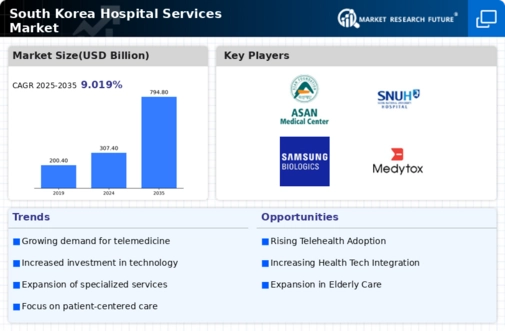
As per Market Research Future analysis, the South Korea hospital services market Size was estimated at 245.93 USD Billion in 2024. The South Korea hospital services market is projected to grow from 266.71 USD Billion in 2025 to 600.0 USD Billion by 2035, exhibiting a compound annual growth rate (CAGR) of 8.4% during the forecast period 2025 - 2035

Key Market Trends & Highlights

The South Korea hospital services market is experiencing a transformative shift driven by technological advancements and changing patient needs.

  • Technological integration is reshaping service delivery, enhancing efficiency and patient outcomes.
  • The rise of specialized services is evident, with a growing focus on tailored healthcare solutions for specific conditions.
  • Preventive care is gaining traction, reflecting a broader shift towards health maintenance rather than reactive treatment.
  • Key market drivers include an aging population and increased investment in healthcare infrastructure, which are likely to propel market growth.

Market Size & Forecast

2024 Market Size 245.93 (USD Billion)
2035 Market Size 600.0 (USD Billion)
CAGR (2025 - 2035) 8.45%

Major Players

HCA Healthcare (US), Cleveland Clinic (US), Mayo Clinic (US), Baylor Scott & White Health (US), Tenet Healthcare (US), Ascension Health (US), Universal Health Services (US), Fresenius SE & Co. KGaA (DE)

Our Impact
Enabled $4.3B Revenue Impact for Fortune 500 and Leading Multinationals
Partnering with 2000+ Global Organizations Each Year
30K+ Citations by Top-Tier Firms in the Industry

South Korea Hospital Services Market Trends

The hospital services market in South Korea is currently experiencing a dynamic transformation, driven by advancements in technology and an increasing demand for high-quality healthcare. The nation boasts a robust healthcare system, characterized by a blend of public and private providers, which enhances accessibility and efficiency. Recent initiatives by the government aim to improve healthcare infrastructure, thereby fostering innovation and enhancing patient care. Furthermore, the population's growing awareness of health issues and preventive care is influencing service offerings, leading to a shift towards outpatient services and telemedicine. In addition, the hospital services market is witnessing a rise in specialized services, particularly in fields such as oncology and cardiology. This trend is likely fueled by an aging population and a higher prevalence of chronic diseases. The integration of artificial intelligence and data analytics into hospital operations is also becoming more prevalent, suggesting a future where personalized medicine and improved patient outcomes are prioritized. Overall, the landscape of the hospital services market in South Korea appears to be evolving rapidly, with a focus on quality, accessibility, and technological integration.

Technological Integration

The hospital services market is increasingly adopting advanced technologies, such as telemedicine and electronic health records. This integration enhances patient engagement and streamlines operations, allowing for more efficient service delivery. As healthcare providers embrace digital solutions, the potential for improved patient outcomes and satisfaction rises.

Rise of Specialized Services

There is a noticeable trend towards the development of specialized services within the hospital services market. Areas such as oncology and cardiology are expanding, driven by demographic changes and the growing incidence of chronic conditions. This specialization allows hospitals to offer targeted treatments and improve overall care quality.

Focus on Preventive Care

The hospital services market is shifting towards preventive care, reflecting a broader understanding of health management. This trend is characterized by increased emphasis on wellness programs and early intervention strategies. As public awareness of health issues grows, hospitals are adapting their services to meet these changing needs.

South Korea Hospital Services Market Drivers

Aging Population

The aging population in South Korea is a crucial driver for the hospital services market. As the demographic shifts towards an older age group, the demand for healthcare services increases significantly. By 2025, it is projected that over 20% of the population will be aged 65 and older, leading to a higher prevalence of chronic diseases and complex health conditions. This demographic trend necessitates enhanced hospital services to cater to the specific needs of elderly patients. Consequently, hospitals are likely to expand their geriatric care units and specialized services, thereby increasing operational costs and investments in healthcare infrastructure. The hospital services market must adapt to these changes to ensure adequate care and support for the aging population.

Rising Health Awareness

Rising health awareness among the South Korean population is driving the hospital services market. As individuals become more informed about health issues and preventive care, there is a noticeable increase in the demand for medical services. Public health campaigns and educational programs have contributed to this trend, leading to a greater emphasis on regular check-ups and early disease detection. By 2025, it is anticipated that the number of health screenings conducted in hospitals will rise by 25%, reflecting this growing awareness. Hospitals are responding by expanding their preventive care services and wellness programs, which not only enhance patient outcomes but also foster a proactive approach to health management. This shift is likely to create new opportunities within the hospital services market.

Technological Advancements

Technological advancements are reshaping the hospital services market in South Korea. Innovations such as telemedicine, electronic health records, and advanced diagnostic tools are becoming increasingly prevalent. In 2025, it is estimated that the adoption of telehealth services could increase by approximately 30%, allowing hospitals to provide remote consultations and follow-ups. This shift not only enhances patient access to healthcare but also optimizes hospital operations by reducing wait times and improving efficiency. Furthermore, the integration of artificial intelligence in diagnostics and treatment planning is expected to revolutionize patient care. As hospitals invest in these technologies, the overall quality of services is likely to improve, attracting more patients and increasing market competitiveness.

Government Healthcare Policies

Government healthcare policies play a pivotal role in shaping the hospital services market. In South Korea, the government has implemented various initiatives aimed at improving healthcare access and affordability. For instance, the National Health Insurance System covers a significant portion of hospital services, which encourages more individuals to seek medical care. As of 2025, approximately 97% of the population is enrolled in this system, leading to increased hospital visits and service utilization. Additionally, policies promoting the establishment of new hospitals and healthcare facilities in underserved areas are likely to enhance service availability. These government initiatives not only support the growth of the hospital services market but also ensure that healthcare remains accessible to all segments of the population.

Increased Investment in Healthcare Infrastructure

Increased investment in healthcare infrastructure is a significant driver of the hospital services market. The South Korean government and private sector are channeling substantial funds into the development and modernization of hospital facilities. By 2025, it is projected that healthcare spending will reach approximately $200 billion, with a considerable portion allocated to upgrading existing hospitals and building new ones. This investment aims to enhance service delivery, improve patient experiences, and incorporate advanced medical technologies. As hospitals expand their capacities and capabilities, they are likely to attract a larger patient base, thereby stimulating growth in the hospital services market. The focus on infrastructure development is essential for meeting the evolving healthcare needs of the population.


Market Segment Insights

By Hospital Type: Private Hospital (Largest) vs. Public/ Community Hospital (Fastest-Growing)

In the South Korea hospital services market, the segmentation reveals a notable distribution among the different hospital types. Private hospitals hold a significant market share, largely due to their ability to offer tailored services and quicker patient care. State-owned hospitals, while important for public health, tend to attract a different demographic focused on cost-effective treatment. Public and community hospitals, though smaller in share, are gaining traction as they enhance accessibility to healthcare services. Over recent years, growth trends indicate a rapid increase in the adoption of public and community hospitals as they align with government initiatives aimed at improving healthcare access. The rising emphasis on healthcare quality and patient-centered services is a key driver of this segment’s growth, as patients increasingly seek facilities that prioritize their needs and offer comprehensive care options. Additionally, the expanding health awareness among the population contributes significantly to this upward trend.

Private Hospital (Dominant) vs. Public/ Community Hospital (Emerging)

Private hospitals in the South Korea hospital services market are characterized by their focus on individualized care, shorter waiting times, and a high standard of service, catering to patients willing to pay a premium for quicker and potentially more effective treatments. These facilities often capitalize on advanced medical technologies and specialized services, making them popular among affluent patients. Conversely, public and community hospitals are emerging as valuable alternatives, focusing on accessibility and affordability, thereby attracting a broader patient demographic. This shift reflects changing consumer preferences toward integrated healthcare services and preventive care, positioning public and community hospitals as vital players in enhancing overall healthcare delivery.

By Service Type: Outpatient Services (Largest) vs. Inpatient Services (Fastest-Growing)

In the South Korea hospital services market, the distribution of market share between outpatient and inpatient services is distinct. Outpatient services dominate the market due to their accessibility and the increasing preference for non-invasive procedures. This segment's widespread acceptance is supported by the growing number of ambulatory care centers and outpatient clinics that cater to various medical needs. Conversely, inpatient services, while smaller in market share, are witnessing a rapid rise in demand as hospitals expand their capacity for complex treatments requiring prolonged care. Growth trends in the service type segment reveal that the outpatient services segment is stabilized, primarily driven by advancements in telemedicine and outpatient surgical techniques. On the other hand, the inpatient services segment is experiencing significant growth fueled by an increase in chronic diseases requiring hospitalization, as well as advancements in medical technologies that enhance patient care. The integration of innovative treatment protocols is also propelling the need for more inpatient facilities, making it a focus area for healthcare providers.

Outpatient Services: Dominant vs. Inpatient Services: Emerging

Outpatient services represent the dominant segment in the South Korea hospital services market, characterized by lower costs, quicker recovery times, and growing patient preference for convenience. These services cater to a wide array of medical needs, from routine check-ups to specialized consultations, thereby fostering a robust network of outpatient facilities across urban and rural areas. In contrast, inpatient services are classified as emerging, demonstrating rapid growth driven by increasing hospital admissions for serious health conditions. The expansion of healthcare facilities and enhanced surgical capabilities indicate that this segment is adapting to meet demand, focusing on comprehensive care plans that encompass both surgical and post-operative treatments.

By Service Areas: Cardiovascular (Largest) vs. Cancer Care (Fastest-Growing)

In the South Korea hospital services market, the distribution of market share is notably led by the Cardiovascular segment, which commands the largest portion due to the high prevalence of cardiovascular diseases. Following this, the Cancer Care segment is rapidly expanding, reflecting both a growing patient population and significant investments in state-of-the-art treatment facilities and technologies. Growth trends in the South Korea hospital services market are heavily influenced by an aging population and a steady rise in lifestyle-related diseases. The demand for advanced healthcare services, particularly in cardiovascular and cancer care, is driving innovation and expansion within hospitals. Moreover, government initiatives and funding aimed at improving healthcare infrastructure are further propelling these segments, making them crucial areas for development in the coming years.

Cardiovascular (Dominant) vs. Cancer Care (Emerging)

The Cardiovascular segment remains dominant in the South Korea hospital services market, characterized by comprehensive care that includes prevention, diagnosis, and treatment of heart-related ailments. This segment benefits from advanced technologies and a high level of expertise among healthcare professionals. On the other hand, Cancer Care is emerging rapidly, propelled by increased awareness, early detection initiatives, and the availability of cutting-edge treatment options. Hospitals are investing significantly in specialized cancer centers, making this segment a vital focus for future growth. As both segments evolve, they highlight the healthcare system's responsiveness to the changing needs of the population.

Get more detailed insights about South Korea Hospital Services Market

Key Players and Competitive Insights

The hospital services market in South Korea is characterized by a competitive landscape that is increasingly shaped by innovation, digital transformation, and strategic partnerships. Key players such as HCA Healthcare (US), Cleveland Clinic (US), and Fresenius SE & Co. KGaA (DE) are actively pursuing strategies that emphasize technological advancements and enhanced patient care. HCA Healthcare (US), for instance, focuses on expanding its telehealth services, which appears to be a response to the growing demand for remote healthcare solutions. This strategic positioning not only enhances patient accessibility but also strengthens HCA's competitive edge in a market that values convenience and efficiency.
In terms of business tactics, companies are increasingly localizing their operations and optimizing supply chains to better serve the South Korean market. The competitive structure of the hospital services market is moderately fragmented, with several key players vying for market share. This fragmentation allows for a diverse range of services and innovations, as companies leverage their unique strengths to capture different segments of the market. The collective influence of these players fosters a dynamic environment where competition is driven by both quality of care and operational efficiency.
In October 2025, Cleveland Clinic (US) announced a partnership with a leading South Korean technology firm to develop AI-driven diagnostic tools. This collaboration is significant as it not only enhances Cleveland Clinic's technological capabilities but also positions it as a leader in integrating AI into clinical practice. The strategic importance of this move lies in its potential to improve diagnostic accuracy and patient outcomes, thereby reinforcing Cleveland Clinic's reputation in the market.
Similarly, in September 2025, Fresenius SE & Co. KGaA (DE) launched a new line of advanced dialysis machines tailored for the South Korean healthcare system. This initiative reflects Fresenius's commitment to addressing local healthcare needs while also expanding its product offerings. The introduction of these machines is likely to enhance patient care and operational efficiency in dialysis treatment, which is crucial given the rising prevalence of kidney diseases in the region.
As of November 2025, the hospital services market is witnessing trends that emphasize digitalization, sustainability, and the integration of AI technologies. Strategic alliances are becoming increasingly important, as companies recognize the value of collaboration in driving innovation and improving service delivery. The competitive differentiation is expected to evolve, shifting from traditional price-based competition to a focus on technological innovation, quality of care, and supply chain reliability. This transition suggests that companies that prioritize these aspects will likely emerge as leaders in the hospital services market.

Key Companies in the South Korea Hospital Services Market include

Industry Developments

Recent developments in the South Korea Hospital Services Market illustrate a growing emphasis on technology integration and expanded healthcare accessibility. In September 2023, Samsung Medical Center announced advancements in telemedicine services, enhancing remote patient monitoring systems to improve healthcare delivery across various demographics. Asan Medical Center is investing in artificial intelligence-driven diagnostics, which is expected to streamline patient treatment processes. In August 2023, Hallym University Medical Center expanded its partnership with global health technology firms to improve patient care and operational efficiency. 

Additionally, Merger and Acquisition activity has been notable, with Severance Hospital engaging in strategic collaborations to bolster its service offerings in September 2023. The market is witnessing increased hospital valuations, driven particularly by Seoul National University Hospital and Korea University Medical Center's investments in cutting-edge medical technology and facilities over the past two years. Such advancements are contributing to a healthier competitive landscape within the South Korean healthcare sector, ensuring that hospitals are better equipped to meet the growing demands of the population.

In 2022, Samsung Biologics reported significant growth in biopharmaceutical services, reflecting a robust aim to enhance international market share.

Future Outlook

South Korea Hospital Services Market Future Outlook

The Hospital Services Market in South Korea is projected to grow at an 8.45% CAGR from 2025 to 2035, driven by technological advancements, increasing healthcare demand, and policy reforms.

New opportunities lie in:

  • Telehealth service expansion for remote patient monitoring
  • Integration of AI-driven diagnostics in clinical workflows
  • Development of specialized outpatient surgical centers for efficiency

By 2035, the hospital services market is expected to be robust, reflecting substantial growth and innovation.

Market Segmentation

South Korea Hospital Services Market Service Type Outlook

  • Outpatient Services
  • Inpatient Services

South Korea Hospital Services Market Hospital Type Outlook

  • State-owned Hospital
  • Private Hospital
  • Public/ Community Hospital

South Korea Hospital Services Market Service Areas Outlook

  • Cardiovascular
  • Acute Care
  • Cancer Care
  • Diagnostics and Imaging
  • Neurorehabilitation & Psychiatry Services
  • Gynecology
  • Others

Report Scope

MARKET SIZE 2024 245.93(USD Billion)
MARKET SIZE 2025 266.71(USD Billion)
MARKET SIZE 2035 600.0(USD Billion)
COMPOUND ANNUAL GROWTH RATE (CAGR) 8.45% (2025 - 2035)
REPORT COVERAGE Revenue Forecast, Competitive Landscape, Growth Factors, and Trends
BASE YEAR 2024
Market Forecast Period 2025 - 2035
Historical Data 2019 - 2024
Market Forecast Units USD Billion
Key Companies Profiled HCA Healthcare (US), Cleveland Clinic (US), Mayo Clinic (US), Baylor Scott & White Health (US), Tenet Healthcare (US), Ascension Health (US), Universal Health Services (US), Fresenius SE & Co. KGaA (DE)
Segments Covered Hospital Type, Service Type, Service Areas
Key Market Opportunities Integration of telehealth services enhances patient access and optimizes hospital resource utilization.
Key Market Dynamics Technological advancements and regulatory changes are reshaping competitive dynamics in the hospital services market.
Countries Covered South Korea
Leave a Comment

FAQs

What is the expected market size of the South Korea Hospital Services Market in 2024?

The South Korea Hospital Services Market is expected to be valued at 307.41 USD Billion in 2024.

What will be the market value of the South Korea Hospital Services Market by 2035?

By 2035, the market is projected to reach a value of 794.77 USD Billion.

What is the expected CAGR for the South Korea Hospital Services Market from 2025 to 2035?

The market is anticipated to grow at a CAGR of 9.019% from 2025 to 2035.

Which hospital type is expected to dominate the South Korea Hospital Services Market in 2024?

The Private Hospital segment is expected to dominate the market, valued at 120.0 USD Billion in 2024.

What is the anticipated market value for State-owned Hospitals in 2035?

The market value for State-owned Hospitals is projected to be 133.0 USD Billion in 2035.

What market value is expected for Public/Community Hospitals in 2024?

Public/Community Hospitals are expected to have a market value of 127.41 USD Billion in 2024.

Who are the key players in the South Korea Hospital Services Market?

Key players include Samsung Medical Center, Asan Medical Center, and Severance Hospital among others.

What is the projected market growth rate for the Private Hospital segment by 2035?

The Private Hospital segment is expected to grow to 320.0 USD Billion by 2035.

What challenges does the South Korea Hospital Services Market currently face?

The market faces challenges such as regulatory changes and the need for technological advancements.

How does the South Korea Hospital Services Market compare regionally to other healthcare markets?

The South Korea Hospital Services Market holds a significant position regionally, reflecting robust healthcare capabilities and advanced technology.

Download Free Sample

Kindly complete the form below to receive a free sample of this Report

Compare Licence

×
Features License Type
Single User Multiuser License Enterprise User
Price $4,950 $5,950 $7,250
Maximum User Access Limit 1 User Upto 10 Users Unrestricted Access Throughout the Organization
Free Customization
Direct Access to Analyst
Deliverable Format
Platform Access
Discount on Next Purchase 10% 15% 15%
Printable Versions