×
Request Free Sample ×

Kindly complete the form below to receive a free sample of this Report

* Please use a valid business email

Leading companies partner with us for data-driven Insights

clients tt-cursor
Hero Background

South Korea Gesture Recognition Market

ID: MRFR/ICT/63524-HCR
200 Pages
Aarti Dhapte
February 2026

South Korea Gesture Recognition Market Size, Share and Research Report: By Technology (Sensor, 2D Gesture Technology, 3D Gesture Technology), By Application (Automotive, Healthcare, Consumer Electronics, Transportation, Commercial, IT/Telecom) and By Product (Touchless, Touch-Based)- Industry Forecast to 2035

Share:
Download PDF ×

We do not share your information with anyone. However, we may send you emails based on your report interest from time to time. You may contact us at any time to opt-out.

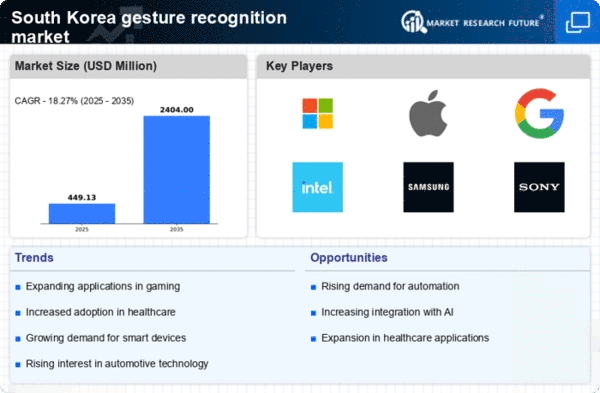
South Korea Gesture Recognition Market Infographic
Purchase Options

South Korea Gesture Recognition Market Summary

As per Market Research Future analysis, the South Korea gesture recognition market Size was estimated at 379.75 USD Million in 2024. The South Korea gesture recognition market is projected to grow from 449.13 USD Million in 2025 to 2404.0 USD Million by 2035, exhibiting a compound annual growth rate (CAGR) of 18.2% during the forecast period 2025 - 2035

Key Market Trends & Highlights

The South Korea gesture recognition market is poised for substantial growth driven by technological advancements and increasing demand for touchless interfaces.

  • The automotive sector emerges as the largest segment, integrating gesture recognition for enhanced user experience.
  • Healthcare applications represent the fastest-growing segment, leveraging gesture technology for improved patient interaction.
  • Smart home integration is gaining traction, reflecting a broader trend towards automation and convenience in daily life.
  • Technological advancements in AI and rising demand for touchless interfaces are key drivers propelling market expansion.

Market Size & Forecast

2024 Market Size 379.75 (USD Million)
2035 Market Size 2404.0 (USD Million)
CAGR (2025 - 2035) 18.27%

Major Players

Microsoft (US), Apple (US), Google (US), Intel (US), Samsung (KR), Sony (JP), Amazon (US), NVIDIA (US), GestureTek (CA)

Our Impact
Enabled $4.3B Revenue Impact for Fortune 500 and Leading Multinationals
Partnering with 2000+ Global Organizations Each Year
30K+ Citations by Top-Tier Firms in the Industry

South Korea Gesture Recognition Market Trends

The gesture recognition market is experiencing notable advancements, particularly in South Korea, where technology adoption is rapidly evolving. The integration of gesture recognition systems into various sectors, including automotive, healthcare, and entertainment, is becoming increasingly prevalent. This trend is driven by the growing demand for intuitive user interfaces and enhanced interaction experiences. As South Korea continues to invest in research and development, the market is likely to witness innovative solutions that leverage artificial intelligence and machine learning, further enhancing the capabilities of gesture recognition technologies. Moreover, the emphasis on smart devices and the Internet of Things (IoT) is propelling the gesture recognition market forward. South Korean consumers are increasingly seeking seamless interactions with their devices, which is fostering the development of gesture-based controls. This shift not only improves user experience but also aligns with the country's vision of becoming a leader in smart technology. As the market evolves, collaboration between tech companies and research institutions is expected to yield significant advancements, positioning South Korea as a key player in the gesture recognition landscape.

Integration in Automotive Sector

The gesture recognition market is witnessing a surge in applications within the automotive industry. South Korean manufacturers are increasingly incorporating gesture-based controls in vehicles, allowing drivers to interact with infotainment systems without physical contact. This trend enhances safety and convenience, aligning with the growing demand for advanced driver-assistance systems.

Healthcare Applications

In the healthcare sector, gesture recognition technology is being adopted to facilitate patient interactions and improve medical procedures. South Korean hospitals are exploring touchless interfaces to minimize infection risks and enhance the efficiency of healthcare delivery. This trend indicates a shift towards more hygienic and user-friendly solutions in medical environments.

Smart Home Integration

The gesture recognition market is also expanding within the smart home sector. South Korean consumers are increasingly adopting smart devices that utilize gesture controls for seamless operation. This trend reflects a broader movement towards home automation, where intuitive interfaces enhance user engagement and convenience.

South Korea Gesture Recognition Market Drivers

Technological Advancements in AI

The gesture recognition market in South Korea is experiencing a surge due to rapid advancements in artificial intelligence (AI) technologies. These innovations enhance the accuracy and efficiency of gesture recognition systems, making them more appealing for various applications. For instance, the integration of machine learning algorithms allows for improved pattern recognition, which is crucial for applications in gaming and virtual reality. The market is projected to grow at a CAGR of approximately 25% over the next five years, driven by these technological improvements. As AI continues to evolve, the gesture recognition market is likely to see increased investment and development, further solidifying its position in the tech landscape.

Increased Investment in Smart Cities

The South Korean government's commitment to developing smart cities is a key driver for the gesture recognition market. As urban areas become more technologically advanced, the need for intuitive and efficient human-computer interaction systems grows. Gesture recognition technology is being integrated into various smart city applications, including traffic management and public safety systems. The gesture recognition market is likely to benefit from this trend, with investments in smart city projects expected to exceed $10 billion by 2027. This influx of funding will facilitate the development of innovative solutions that leverage gesture recognition to improve urban living.

Rising Demand for Touchless Interfaces

In South Korea, the growing demand for touchless interfaces is significantly influencing the gesture recognition market. This trend is largely driven by consumer preferences for hygiene and convenience, particularly in public spaces and smart devices. The gesture recognition market is adapting to this shift by developing systems that allow users to interact with devices without physical contact. This is particularly relevant in sectors such as retail and hospitality, where touchless technology can enhance customer experiences. Market analysts estimate that the touchless interface segment could account for over 30% of the overall gesture recognition market by 2026, indicating a robust growth trajectory.

Growing Adoption in Education Technology

The gesture recognition market is also witnessing growth due to its increasing adoption in education technology within South Korea. Educational institutions are exploring innovative ways to enhance learning experiences, and gesture recognition technology offers interactive and engaging methods for students. This trend is particularly evident in STEM education, where gesture-based learning tools can facilitate hands-on experiences. The gesture recognition market is likely to see a rise in demand for educational applications, with projections indicating a potential market size of $500 million by 2026. This growth reflects a broader trend towards integrating technology in education, aiming to improve student engagement and learning outcomes.

Expansion of Gaming and Entertainment Sectors

The gaming and entertainment sectors in South Korea are rapidly expanding, creating a fertile ground for the gesture recognition market. As consumers increasingly seek immersive experiences, gesture recognition technology is becoming a vital component in gaming consoles and virtual reality platforms. The gesture recognition market is projected to capture a significant share of this growth, with revenues from gaming applications expected to reach $1.5 billion by 2025. This expansion is driven by the demand for more interactive and engaging gameplay, which gesture recognition can uniquely provide, thereby enhancing user satisfaction and engagement.


Market Segment Insights

By Technology: Sensor (Largest) vs. 3D Gesture Technology (Fastest-Growing)

In the South Korea gesture recognition market, the Sensor segment holds a dominant share, primarily due to its extensive applications in various industries such as consumer electronics, automotive, and healthcare. Additionally, 2D Gesture Technology follows closely, leveraging advancements in camera technology and software algorithms to enhance user experience. Conversely, 3D Gesture Technology, though currently smaller in market share, exhibits rapid growth as emerging applications and improved hardware continue to drive innovation and adoption. Growth trends show a significant shift towards 3D Gesture Technology, which is gaining traction thanks to its ability to offer more immersive user experiences and precise gesture recognition. This is largely driven by the increasing demand for intuitive user interfaces in smart devices and the proliferation of virtual and augmented reality applications. Furthermore, advancements in machine learning and sensor technologies are accelerating the development and deployment of gesture recognition solutions across diverse sectors.

Technology: Sensor (Dominant) vs. 2D Gesture Technology (Emerging)

The Sensor segment stands out as the dominant force within the market, characterized by its robust performance and widespread integration into various devices, enabling seamless interaction and control. In contrast, 2D Gesture Technology is viewed as an emerging segment, continually evolving with the advent of new algorithms and camera systems. While Sensors provide foundational support for gesture recognition, 2D technology focuses on enhancing user engagement through basic gesture detection and feedback mechanisms. The growth trajectory of the 2D segment aligns with enhanced accessibility and lower costs of implementation, appealing to a broader range of applications and consumer devices, though it remains a step behind the comprehensive capabilities offered by Sensors.

By Application: Consumer Electronics (Largest) vs. Automotive (Fastest-Growing)

In the South Korea gesture recognition market, the distribution among application segments reveals consumer electronics as the largest segment, driven by the increasing demand for smart devices that incorporate advanced gesture control functionalities. Automotive follows as a significant player, benefiting from rising trends in autonomous driving and enhanced user interfaces that integrate gesture recognition technology. Growth trends indicate that while consumer electronics continues to dominate the market, automotive applications are emerging rapidly, driven by technology advancements and increased investments in autonomy by major automotive manufacturers. Healthcare and transportation sectors are also witnessing growth, fueled by innovative use cases such as remote patient monitoring and hands-free controls, creating new revenue streams for gesture recognition solutions.

Consumer Electronics: Dominant vs. Automotive: Emerging

Consumer electronics stands out in the South Korea gesture recognition market as the dominant segment, characterized by a wide array of devices such as smartphones, tablets, and smart TVs that leverage gesture technology for enhanced user interaction. The demand for intuitive control methods is pushing manufacturers to integrate sophisticated gesture recognition capabilities. Conversely, the automotive sector, while currently an emerging segment, is showing strong potential for growth, driven by a shift toward advanced driver-assistance systems (ADAS) and infotainment features that utilize gesture control. As automotive manufacturers increasingly adopt gesture recognition to improve safety and convenience, this segment is projected to experience significant advancements and market expansion.

By Product: Touchless (Largest) vs. Touch-Based (Fastest-Growing)

In the South Korea gesture recognition market, Touchless technology holds the largest market share, reflecting a significant preference for contactless interactions among consumers and businesses alike. As the demand for hygiene and safety escalates, Touchless solutions are being adopted across various sectors, including retail, healthcare, and hospitality, contributing to its dominant position in the marketplace. Meanwhile, Touch-Based systems are emerging as the fastest-growing segment, driven by advances in screen technology and user interface design. As developers push for more intuitive experiences, the integration of sophisticated touchpoint systems is gaining traction. This growth is further fueled by the rising demand for enhanced user engagement and interaction, particularly in gaming and smart home applications.

Touchless (Dominant) vs. Touch-Based (Emerging)

Touchless gesture recognition technology stands out as the dominant player in the South Korea gesture recognition market, characterized by its ability to deliver seamless user experiences without physical contact. This segment's efficacy in maintaining hygiene and minimizing transmission risks enhances its appeal across multiple industries. Conversely, Touch-Based systems are emerging, emphasizing direct interaction and tactile feedback, which enrich user engagement. Their rapid development is supported by innovations in haptic technology and improved sensor capabilities, positioning them to capture a growing share of the market as businesses seek to create more interactive and engaging environments.

Get more detailed insights about South Korea Gesture Recognition Market

Key Players and Competitive Insights

The gesture recognition market is currently characterized by a dynamic competitive landscape, driven by rapid technological advancements and increasing demand for intuitive user interfaces across various sectors. Key players such as Microsoft (US), Samsung (KR), and Google (US) are at the forefront, leveraging their extensive research and development capabilities to enhance their product offerings. Microsoft (US) focuses on integrating gesture recognition into its Azure cloud services, thereby enhancing user engagement and operational efficiency. Meanwhile, Samsung (KR) is strategically positioning itself by embedding gesture recognition technology into its consumer electronics, aiming to create a seamless user experience. Google (US) appears to be concentrating on AI-driven gesture recognition solutions, which could potentially redefine user interaction paradigms in smart devices.The market structure is moderately fragmented, with a mix of established players and emerging startups. Companies are increasingly localizing manufacturing and optimizing supply chains to enhance responsiveness to market demands. This localized approach not only reduces operational costs but also fosters innovation tailored to regional preferences. The collective influence of these key players shapes a competitive environment where agility and technological prowess are paramount.

In October Samsung (KR) announced a partnership with a leading AI firm to develop advanced gesture recognition algorithms aimed at improving accessibility features in its devices. This strategic move underscores Samsung's commitment to inclusivity and positions it favorably in a market that increasingly values user-centric design. By enhancing accessibility, Samsung (KR) not only broadens its customer base but also aligns with global trends emphasizing social responsibility.

In September Microsoft (US) unveiled a new suite of tools within its Azure platform that incorporates gesture recognition capabilities for enterprise applications. This initiative is significant as it allows businesses to leverage gesture-based interactions, potentially increasing productivity and user satisfaction. By integrating this technology into its cloud services, Microsoft (US) reinforces its position as a leader in digital transformation, catering to the evolving needs of modern enterprises.

In August Google (US) launched a new gesture recognition feature for its smart home devices, enabling users to control their environments with simple hand movements. This innovation not only enhances user convenience but also reflects a broader trend towards automation and smart living. By prioritizing gesture recognition, Google (US) is likely to strengthen its competitive edge in the rapidly growing smart home market, appealing to tech-savvy consumers seeking seamless integration of technology into their daily lives.

As of November the competitive trends in the gesture recognition market are increasingly defined by digitalization, AI integration, and sustainability. Strategic alliances among key players are shaping the landscape, fostering innovation and enhancing product offerings. The shift from price-based competition to a focus on technological advancement and supply chain reliability is evident. Companies that prioritize innovation and adaptability are likely to thrive, as the market continues to evolve towards more sophisticated and user-friendly solutions.

Key Companies in the South Korea Gesture Recognition Market include

Industry Developments

The South Korea Gesture Recognition Market has been experiencing significant advancements, driven by increasing investments in artificial intelligence and human-computer interaction technologies. Recent developments in 2023 include Samsung Electronics expanding its gesture recognition capabilities in smart devices, while LG Electronics has been enhancing gesture-based user interfaces in its home appliance range. SK Telecom is focusing on integrating gesture recognition into telecommunications services, aiming to improve user experience and accessibility.

In terms of mergers and acquisitions, in June 2023, Kakao Corp announced its partnership with Simplicity AI to enhance gesture recognition features across its platforms, a move that has garnered attention from various industry stakeholders. The market has been growing rapidly, with a reported valuation surge attributed to innovative offerings from companies like Coretronic Corporation and Hanwha Techwin. 

These developments reflect a broader trend within South Korea's tech industry, emphasizing the importance of gesture recognition technology in various sectors, from consumer electronics to security systems. The last couple of years have also seen a notable increase in collaborative projects and R&D initiatives among the leading companies, highlighting a positive outlook for the future of the gesture recognition market in South Korea.

Future Outlook

South Korea Gesture Recognition Market Future Outlook

The Gesture Recognition Market is projected to grow at 18.27% CAGR from 2025 to 2035, driven by advancements in AI, increasing demand for touchless interfaces, and expanding applications in various sectors.

New opportunities lie in:

  • Development of gesture-controlled smart home devices
  • Integration of gesture recognition in automotive safety systems
  • Expansion of gesture-based interfaces in healthcare applications

By 2035, the gesture recognition market is expected to achieve substantial growth and innovation.

Market Segmentation

South Korea Gesture Recognition Market Product Outlook

  • Touchless
  • Touch-Based

South Korea Gesture Recognition Market Technology Outlook

  • Sensor
  • 2D Gesture Technology
  • 3D Gesture Technology

South Korea Gesture Recognition Market Application Outlook

  • Automotive
  • Healthcare
  • Consumer Electronics
  • Transportation
  • Commercial
  • IT/Telecom

Report Scope

MARKET SIZE 2024 379.75(USD Million)
MARKET SIZE 2025 449.13(USD Million)
MARKET SIZE 2035 2404.0(USD Million)
COMPOUND ANNUAL GROWTH RATE (CAGR) 18.27% (2025 - 2035)
REPORT COVERAGE Revenue Forecast, Competitive Landscape, Growth Factors, and Trends
BASE YEAR 2024
Market Forecast Period 2025 - 2035
Historical Data 2019 - 2024
Market Forecast Units USD Million
Key Companies Profiled Microsoft (US), Apple (US), Google (US), Intel (US), Samsung (KR), Sony (JP), Amazon (US), NVIDIA (US), GestureTek (CA)
Segments Covered Technology, Application, Product
Key Market Opportunities Integration of gesture recognition in smart home devices enhances user experience and accessibility.
Key Market Dynamics Rising demand for touchless interfaces drives innovation in gesture recognition technology across various sectors.
Countries Covered South Korea
Leave a Comment

FAQs

What is the expected market size of the South Korea Gesture Recognition Market in 2024?

The South Korea Gesture Recognition Market is expected to be valued at 450.0 million USD in 2024.

What will be the market size in 2035 for the South Korea Gesture Recognition Market?

By 2035, the South Korea Gesture Recognition Market is projected to reach a value of 3500.0 million USD.

What will be the CAGR of the South Korea Gesture Recognition Market from 2025 to 2035?

The market is expected to grow at a CAGR of 20.5% from 2025 to 2035.

Which technology segment will dominate the South Korea Gesture Recognition Market?

The sensor technology segment is anticipated to be valued at 180.0 million USD in 2024 and is projected to grow to 1000.0 million USD by 2035.

What is the market size for 2D Gesture Technology in 2024?

2D Gesture Technology is expected to have a market size of 150.0 million USD in 2024.

What is the expected value of the 3D Gesture Technology segment in 2035?

The 3D Gesture Technology segment is projected to reach 1600.0 million USD in 2035.

Who are the key players in the South Korea Gesture Recognition Market?

Major players include Naver Corporation, SK Telecom, Samsung Electronics, and LG Electronics among others.

What are the key applications driving growth in the South Korea Gesture Recognition Market?

Applications in gaming, virtual reality, and smart home devices are driving significant growth in this market.

What are the expected growth opportunities in the South Korea Gesture Recognition Market?

Emerging trends in artificial intelligence and increased demand for touchless control systems present growth opportunities.

What challenges does the South Korea Gesture Recognition Market face?

Challenges include technological limitations and the need for improved accuracy in gesture detection systems.

Download Free Sample

Kindly complete the form below to receive a free sample of this Report

Compare Licence

×
Features License Type
Single User Multiuser License Enterprise User
Price $4,950 $5,950 $7,250
Maximum User Access Limit 1 User Upto 10 Users Unrestricted Access Throughout the Organization
Free Customization
Direct Access to Analyst
Deliverable Format
Platform Access
Discount on Next Purchase 10% 15% 15%
Printable Versions