×
Request Free Sample ×

Kindly complete the form below to receive a free sample of this Report

* Please use a valid business email

Leading companies partner with us for data-driven Insights

clients tt-cursor
Hero Background

South Korea Generative Ai In Gaming Market

ID: MRFR/ICT/58133-HCR
200 Pages
Aarti Dhapte
February 2026

South Korea Generative AI in Gaming Market Size, Share and Research Report: By Application (Game Development, Content Generation, Character Design, Level Design, Testing and Quality Assurance), By Platform (PC, Console, Mobile, Cloud Gaming), By Deployment Type (On-Premises, Cloud-Based) and By End User (Game Developers, Gaming Studios, Independent Developers) - Industry Forecast to 2035

Share:
Download PDF ×

We do not share your information with anyone. However, we may send you emails based on your report interest from time to time. You may contact us at any time to opt-out.

South Korea Generative Ai In Gaming Market Infographic
Purchase Options

South Korea Generative Ai In Gaming Market Summary

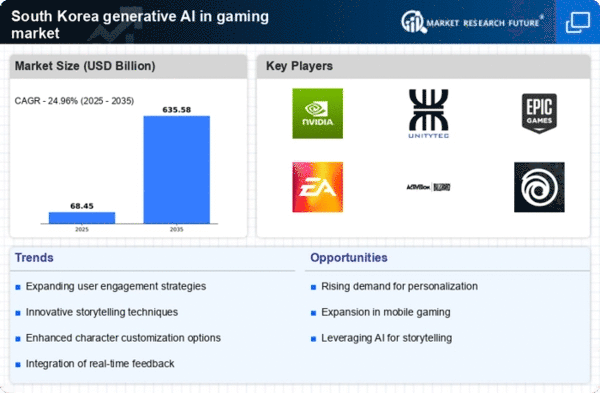
As per Market Research Future analysis, the South Korea generative ai-in-gaming market size was estimated at 54.78 USD Billion in 2024. The South Korea generative ai-in-gaming market is projected to grow from 68.45 USD Billion in 2025 to 635.58 USD Billion by 2035, exhibiting a compound annual growth rate (CAGR) of 24.9% during the forecast period 2025 - 2035

Key Market Trends & Highlights

The South Korea generative AI-in-gaming market is poised for substantial growth driven by technological advancements and evolving consumer preferences.

  • Personalized gaming experiences are becoming increasingly prevalent, enhancing player engagement and satisfaction.
  • Dynamic content generation is revolutionizing game development, allowing for more immersive and varied gameplay.
  • Enhanced multiplayer interactions are fostering community building and social connectivity among gamers.
  • Technological advancements in AI and rising demand for mobile gaming are key drivers propelling market expansion.

Market Size & Forecast

2024 Market Size 54.78 (USD Billion)
2035 Market Size 635.58 (USD Billion)
CAGR (2025 - 2035) 24.96%

Major Players

NVIDIA (US), Unity Technologies (US), Epic Games (US), Electronic Arts (US), Activision Blizzard (US), Ubisoft (FR), Bandai Namco Entertainment (JP), Square Enix (JP)

Our Impact
Enabled $4.3B Revenue Impact for Fortune 500 and Leading Multinationals
Partnering with 2000+ Global Organizations Each Year
30K+ Citations by Top-Tier Firms in the Industry

South Korea Generative Ai In Gaming Market Trends

The generative ai-in-gaming market is experiencing notable growth. This growth is driven by advancements in artificial intelligence technologies and increasing consumer demand for immersive gaming experiences. In South Korea, a country renowned for its vibrant gaming culture, developers are increasingly integrating generative AI to enhance gameplay, create dynamic narratives, and personalize user experiences. This integration not only enriches the gaming environment but also fosters a more engaging interaction between players and the game world. As a result, the market is witnessing a surge in innovative game designs that leverage AI capabilities, appealing to a diverse audience. Moreover, the South Korean gaming industry is characterized by a strong emphasis on mobile gaming, which is further propelled by the adoption of generative AI. This technology allows for the creation of unique content tailored to individual player preferences, thereby enhancing user retention and satisfaction. The collaboration between AI developers and gaming studios is likely to intensify, leading to the emergence of new gaming genres and experiences. As the generative ai-in-gaming market continues to evolve, it appears poised to redefine the landscape of interactive entertainment in South Korea, making it a focal point for both local and international stakeholders.

Personalized Gaming Experiences

The generative ai-in-gaming market is increasingly focused on creating personalized experiences for players. By utilizing AI algorithms, games can adapt to individual player behaviors and preferences, offering tailored content that enhances engagement. This trend is particularly relevant in South Korea, where gamers seek unique and immersive experiences.

Dynamic Content Generation

Another prominent trend involves the use of generative AI for dynamic content generation. This technology enables the creation of in-game assets, such as characters, environments, and storylines, on-the-fly. In South Korea, this capability allows developers to keep games fresh and exciting, catering to the fast-paced nature of the gaming community.

Enhanced Multiplayer Interactions

The generative ai-in-gaming market is also witnessing advancements in multiplayer interactions. AI-driven systems can facilitate more realistic and engaging interactions among players, enhancing the social aspect of gaming. In South Korea, where multiplayer gaming is immensely popular, this trend is likely to foster stronger community ties and collaborative gameplay.

South Korea Generative Ai In Gaming Market Drivers

Cultural Embrace of Gaming

The cultural significance of gaming in South Korea serves as a powerful driver for the generative ai-in-gaming market. Gaming is not merely a pastime; it is an integral part of social interaction and entertainment. This cultural embrace fosters a conducive environment for innovation and adoption of new technologies, including generative AI. As players seek more engaging and interactive experiences, the demand for AI-driven content is likely to rise. The generative ai-in-gaming market stands to benefit from this cultural phenomenon, as developers strive to create games that resonate with local players. This alignment between cultural values and technological advancements may lead to a more vibrant gaming ecosystem, further propelling the growth of the generative ai-in-gaming market.

Evolving Consumer Expectations

Consumer expectations in the gaming industry are evolving rapidly, significantly impacting the generative ai-in-gaming market. Players are increasingly seeking unique and personalized experiences, which generative AI can provide through tailored content and adaptive gameplay. As the gaming landscape becomes more competitive, developers are compelled to innovate continuously to meet these rising expectations. In South Korea, where gaming is a major form of entertainment, the demand for high-quality, engaging content is paramount. This shift in consumer behavior suggests that the generative ai-in-gaming market will need to adapt and evolve, potentially leading to the development of new gaming paradigms. The ability to leverage AI to create immersive experiences may become a key differentiator for success in this dynamic market.

Rising Demand for Mobile Gaming

The increasing popularity of mobile gaming is a crucial driver for the generative ai-in-gaming market. With over 80% of the population engaging in mobile gaming, developers are compelled to create more engaging and personalized experiences. The integration of generative AI allows for dynamic content creation tailored to individual player preferences, enhancing user satisfaction. As mobile gaming continues to dominate the gaming landscape, the generative ai-in-gaming market is expected to grow significantly. In 2025, the mobile gaming segment is projected to account for nearly 50% of the total gaming revenue in South Korea, underscoring the importance of AI technologies in meeting consumer demands. This trend suggests that the generative ai-in-gaming market will play a pivotal role in shaping the future of mobile gaming.

Technological Advancements in AI

The rapid evolution of artificial intelligence technologies is a primary driver for the generative ai-in-gaming market. In South Korea, advancements in machine learning and neural networks have enabled developers to create more sophisticated gaming experiences. This has led to a surge in demand for AI-driven content generation tools, which are projected to grow by approximately 25% annually. As developers increasingly adopt these technologies, the generative ai-in-gaming market is likely to expand, offering players more immersive and personalized experiences. Furthermore, the integration of AI in game design processes enhances creativity and efficiency, allowing for the production of high-quality games at a faster pace. This trend indicates a robust future for the generative ai-in-gaming market, as both developers and players benefit from these innovations.

Increased Investment in Gaming Startups

Investment in gaming startups focusing on generative AI is witnessing a notable rise in South Korea. Venture capitalists and tech firms are increasingly recognizing the potential of AI-driven gaming solutions, leading to a significant influx of funding. In 2025, investments in this sector are expected to exceed $500 million, reflecting a growing confidence in the generative ai-in-gaming market. This financial support enables startups to innovate and develop cutting-edge technologies that enhance gameplay and user engagement. As these companies push the boundaries of what is possible in gaming, the overall market is likely to experience accelerated growth. The influx of capital not only fosters innovation but also attracts talent, further enriching the ecosystem surrounding the generative ai-in-gaming market.


Market Segment Insights

By Application: Game Development (Largest) vs. Content Generation (Fastest-Growing)

The South Korea generative ai-in-gaming market shows a significant distribution of market share among various application segment values. Game Development stands out as the largest segment, driven by the increasing demand for innovative game titles. This segment is well-established, capturing a substantial portion of the market, whereas Content Generation, though smaller, shows remarkable growth, reflecting the rising trends in user-generated content and personalized gaming experiences. Growth trends indicate that the generative AI tools in gaming are becoming indispensable, particularly for Content Generation and Character Design. As developers seek faster production times and cost efficiency, the adoption of AI-driven solutions in these areas is rapidly increasing. Factors such as the need for high-quality content and immersive experiences continue to drive technological advancements, propelling the market forward and solidifying its competitive landscape.

Game Development: Dominant vs. Content Generation: Emerging

Game Development is recognized as the dominant application in the South Korea generative ai-in-gaming market, characterized by its foundational role in shaping the gaming experience. This segment benefits from a robust infrastructure and significant investments, allowing developers to leverage generative AI for complex processes like world-building and storytelling. Conversely, Content Generation emerges as a key player, fueled by the demand for dynamic and engaging player-created content. This segment is increasingly leveraging AI to enable personalized experiences, providing tools that help non-professional creators engage in game design. As these segments evolve, their interplay will define the future trajectory of the gaming landscape.

By Platform: PC (Largest) vs. Mobile (Fastest-Growing)

In the South Korea generative ai-in-gaming market, the distribution of market share among platforms reflects a competitive landscape. PC gaming leads as the largest segment, driven by an extensive array of titles and the preference for high-performance gaming experiences. Mobile platforms have seen substantial growth, capturing a significant share as gaming becomes more accessible to a broader audience. Cloud gaming, while emerging, is still developing its market presence. The growth trends within the South Korea generative ai-in-gaming market indicate a shifting preference towards mobile gaming, particularly among younger demographics. Technological advancements in mobile platforms are enhancing the gaming experience, allowing for richer content and interactivity. Meanwhile, PC gaming continues to innovate, integrating generative AI to improve game design and player engagement. These trends reflect changing consumer behaviors and technological advancements that are shaping the future of gaming.

PC (Dominant) vs. Mobile (Emerging)

The PC segment remains dominant in the South Korea generative ai-in-gaming market, characterized by its robust graphics and elaborate gameplay mechanics that cater to hardcore gamers. This platform not only supports a vast library of games but also benefits from regular updates and community engagement, fostering a loyal user base. On the other hand, mobile gaming is an emerging segment, appealing to casual gamers seeking convenience and portability. The rise of mobile gaming is fueled by advancements in smartphone technology and a growing preference for quick, accessible gaming experiences. As developers leverage generative AI to create engaging content and dynamic gameplay on mobile, this segment is anticipated to continually evolve and expand its share in the market.

By Deployment Type: Cloud-Based (Largest) vs. On-Premises (Fastest-Growing)

In the South Korea generative ai-in-gaming market, the market share distribution between deployment types illustrates a clear preference for cloud-based solutions. This type is currently the most prominent choice among game developers and companies due to its scalability and accessibility. Conversely, on-premises deployments, while less popular, are experiencing a resurgence as organizations seek to maintain greater control over their infrastructure and data security. This shift is particularly driven by high-profile gaming studios that prioritize custom solutions for their operations. Growth trends within the deployment type segment reveal an intriguing landscape, as the demand for cloud-based solutions demonstrates robust stability driven by advancements in internet infrastructure and the growing acceptance of subscription models. On-premises setups are emerging as the fastest-growing option, appealing to those looking for enhanced performance and security in game development. Factors such as increasing concerns over data privacy and the desire for customization have fueled this growth, signaling a shift in the mindset of developers toward a hybrid approach in deployment strategies.

Deployment Type: Cloud-Based (Dominant) vs. On-Premises (Emerging)

Cloud-based deployment in the South Korea generative ai-in-gaming market is characterized by its flexibility and lower entry barriers for smaller studios, allowing for rapid scaling and a wide reach across various devices and platforms. This segment dominates the market as many companies increasingly rely on cloud infrastructures for their gaming solutions. On the other hand, on-premises deployment is becoming an emerging choice driven by the needs for comprehensive data security and bespoke development environments. This segment caters primarily to larger studios and organizations with specific requirements for tailored solutions, thus contributing to the diversification of the market landscape.

By End User: Game Developers (Largest) vs. Independent Developers (Fastest-Growing)

In the South Korea generative ai-in-gaming market, the distribution of market share among the end user segments shows that game developers hold the largest share, reflecting their established presence and infrastructure within the industry. Gaming studios follow closely, leveraging their capability to produce high-quality content, while independent developers are emerging as a significant player, showcasing innovation and creativity despite having a smaller market share initially. The growth trends within this segment are driven by increasing demand for innovative game mechanics and superior user experiences. Game developers are capitalizing on established relationships with major platforms, while independent developers are experiencing explosive growth, thanks to lower barriers to entry and the rise of crowdfunding platforms. As technology continues to evolve, the dynamic between these segments is likely to shift, with independent developers increasingly capturing the attention of players and investors alike.

Game Developers (Dominant) vs. Independent Developers (Emerging)

Game developers are currently regarded as the dominant force within the South Korea generative ai-in-gaming market due to their extensive resources, experience, and established fan base. They have well-defined processes for integrating generative AI to enhance gameplay, optimize development, and create immersive environments. On the other hand, independent developers represent an emerging segment characterized by their agility and innovation. They leverage generative AI to develop unique gaming experiences that can compete with larger studios, often targeting niche markets. This contrast illustrates how dominant players can maintain their position while emerging players disrupt traditional game development with fresh ideas and concepts. As both segments continue to evolve, their interplay will likely shape the future landscape of the gaming industry.

Get more detailed insights about South Korea Generative Ai In Gaming Market

Key Players and Competitive Insights

The generative ai-in-gaming market is currently characterized by a dynamic competitive landscape, driven by rapid technological advancements and increasing consumer demand for immersive gaming experiences. Key players such as NVIDIA (US), Unity Technologies (US), and Epic Games (US) are at the forefront, leveraging their technological prowess to innovate and enhance gameplay. NVIDIA (US) focuses on developing advanced graphics processing units (GPUs) that integrate generative AI capabilities, thereby enabling developers to create more realistic environments and characters. Unity Technologies (US) emphasizes its platform's versatility, allowing developers to harness AI tools for procedural content generation, which streamlines the game development process. Epic Games (US) continues to expand its Unreal Engine, incorporating AI-driven features that enhance user engagement and creativity, thus shaping a competitive environment that prioritizes innovation and technological integration.
In terms of business tactics, companies are increasingly localizing their operations to better cater to regional markets, optimizing supply chains to enhance efficiency. The competitive structure of the market appears moderately fragmented, with several key players exerting substantial influence. This fragmentation allows for a diverse range of offerings, yet the collective strength of these major companies drives a trend towards consolidation and strategic partnerships, which are becoming essential for maintaining competitive advantage.
In October 2025, NVIDIA (US) announced a partnership with a leading South Korean game developer to integrate its latest AI-driven graphics technology into upcoming titles. This collaboration is poised to enhance the visual fidelity of games, potentially setting new standards in the industry. The strategic importance of this partnership lies in NVIDIA's ability to leverage local expertise while expanding its footprint in the Asian gaming market, which is known for its high demand for cutting-edge technology.
In September 2025, Unity Technologies (US) launched a new suite of AI tools aimed at simplifying the game development process for indie developers. This initiative is significant as it democratizes access to advanced technology, allowing smaller studios to compete more effectively with larger entities. By lowering the barriers to entry, Unity is likely to foster innovation and creativity within the gaming community, which could lead to a surge in unique game titles.
In August 2025, Epic Games (US) unveiled a new AI-driven feature within its Unreal Engine that allows developers to create adaptive game narratives based on player behavior. This move is particularly noteworthy as it aligns with the growing trend of personalized gaming experiences. By enabling developers to craft more engaging and responsive narratives, Epic Games is positioning itself as a leader in the evolution of interactive storytelling in gaming.
As of November 2025, the competitive trends in the generative ai-in-gaming market are increasingly defined by digitalization, sustainability, and the integration of AI technologies. Strategic alliances are shaping the landscape, as companies recognize the need for collaboration to drive innovation. The shift from price-based competition to a focus on technological advancement and supply chain reliability is evident, suggesting that future competitive differentiation will hinge on the ability to innovate and adapt to changing consumer preferences.

Key Companies in the South Korea Generative Ai In Gaming Market include

Industry Developments

Recent developments in the South Korea Generative AI in Gaming Market have been quite dynamic, with SK Telecom initiating research partnerships to enhance AI-driven game development. NCSoft has been actively integrating AI technology in its titles, which has led to a noticeable boost in user retention rates. In January 2024, NCSoft officially debuted VARCO Studio, their proprietary generative AI platform for gaming asset development, which includes character art, text generation, and voice synthesis, marking a significant step forward in AI integration. 

In February 2024, SK Telecom collaborated with Perplexity AI, a US AI firm, to create AI-powered conversational agents and infrastructure that may enable gaming apps and improve user experiences .Krafton showed out NVIDIA ACE-powered co-playable NPCs at CES 2025 in January 2025, exhibiting next-generation AI-driven NPCs that interact dynamically with gamers.

Moreover, Pearl Abyss and Nexon are focusing on enhancing game experiences through AI, aiming to adjust real-time content delivery based on player interactions. The overall market has seen a substantial growth in valuation, driven by the increasing demand for immersive and personalized gaming experiences. This trend has been vital for companies like Krafton, Netmarble, and Riot Games as they explore AI's potential in game design and player interaction, further solidifying South Korea's position as a leader in the gaming industry.

Future Outlook

South Korea Generative Ai In Gaming Market Future Outlook

The generative ai-in-gaming market is projected to grow at a 24.96% CAGR from 2025 to 2035, driven by technological advancements and increasing consumer demand.

New opportunities lie in:

  • Development of AI-driven narrative generation tools for immersive storytelling.
  • Creation of personalized gaming experiences through adaptive AI algorithms.
  • Integration of AI in game testing to enhance quality assurance processes.

By 2035, the market is expected to be robust, driven by innovation and strategic investments.

Market Segmentation

South Korea Generative Ai In Gaming Market End User Outlook

  • Game Developers
  • Gaming Studios
  • Independent Developers

South Korea Generative Ai In Gaming Market Platform Outlook

  • PC
  • Console
  • Mobile
  • Cloud Gaming

South Korea Generative Ai In Gaming Market Application Outlook

  • Game Development
  • Content Generation
  • Character Design
  • Level Design
  • Testing and Quality Assurance

South Korea Generative Ai In Gaming Market Deployment Type Outlook

  • On-Premises
  • Cloud-Based

Report Scope

MARKET SIZE 2024 54.78(USD Billion)
MARKET SIZE 2025 68.45(USD Billion)
MARKET SIZE 2035 635.58(USD Billion)
COMPOUND ANNUAL GROWTH RATE (CAGR) 24.96% (2025 - 2035)
REPORT COVERAGE Revenue Forecast, Competitive Landscape, Growth Factors, and Trends
BASE YEAR 2024
Market Forecast Period 2025 - 2035
Historical Data 2019 - 2024
Market Forecast Units USD Billion
Key Companies Profiled NVIDIA (US), Unity Technologies (US), Epic Games (US), Electronic Arts (US), Activision Blizzard (US), Ubisoft (FR), Bandai Namco Entertainment (JP), Square Enix (JP)
Segments Covered Application, Platform, Deployment Type, End User
Key Market Opportunities Integration of immersive storytelling and personalized gameplay through generative AI technologies in gaming.
Key Market Dynamics Rapid advancements in generative AI technology are reshaping game development and player engagement in South Korea.
Countries Covered South Korea
Leave a Comment

FAQs

What is the expected market size of the South Korea Generative AI in Gaming Market in 2024?

The expected market size in 2024 is valued at 91.35 million USD.

What is the projected market size for the South Korea Generative AI in Gaming Market by 2035?

The projected market size by 2035 is expected to reach 319.75 million USD.

What is the expected compound annual growth rate (CAGR) for the South Korea Generative AI in Gaming Market from 2025 to 2035?

The expected CAGR for the market from 2025 to 2035 is 12.063%.

Which application within the South Korea Generative AI in Gaming Market holds the highest valuation in 2024?

In 2024, the application with the highest valuation is Game Development, valued at 25.0 million USD.

What will be the market size for Content Generation in the South Korea Generative AI in Gaming Market by 2035?

By 2035, the market size for Content Generation is projected to be 70.0 million USD.

Who are the major players in the South Korea Generative AI in Gaming Market?

Major players in the market include SK Telecom, NCSoft, Smilegate, and Nexon among others.

What is the expected market value for Testing and Quality Assurance in 2024?

The expected market value for Testing and Quality Assurance in 2024 is 11.35 million USD.

How much growth is anticipated for the Level Design application by 2035?

Level Design is anticipated to grow to a value of 60.0 million USD by 2035.

What are some key growth drivers in the South Korea Generative AI in Gaming Market?

Key growth drivers include advancements in AI technology and increasing demand for innovative gaming experiences.

What challenges might the South Korea Generative AI in Gaming Market face in the coming years?

Potential challenges include regulatory issues and the need for high-quality content generation.

Download Free Sample

Kindly complete the form below to receive a free sample of this Report

Compare Licence

×
Features License Type
Single User Multiuser License Enterprise User
Price $4,950 $5,950 $7,250
Maximum User Access Limit 1 User Upto 10 Users Unrestricted Access Throughout the Organization
Free Customization
Direct Access to Analyst
Deliverable Format
Platform Access
Discount on Next Purchase 10% 15% 15%
Printable Versions