×
Request Free Sample ×

Kindly complete the form below to receive a free sample of this Report

* Please use a valid business email

Leading companies partner with us for data-driven Insights

clients tt-cursor
Hero Background

South Korea Enterprise Video Market

ID: MRFR/ICT/58347-HCR
200 Pages
Aarti Dhapte
February 2026

South Korea Enterprise Video Market Size, Share and Research Report: By Component (Hardware, Software), By Application (Training & Development, Corporate Learning), By Delivery Mode (Video Conferencing, Web Conferencing), and By Industries (BFSI, Manufacturing, Media & Entertainment, Healthcare)- Industry Forecast to 2035

Share:
Download PDF ×

We do not share your information with anyone. However, we may send you emails based on your report interest from time to time. You may contact us at any time to opt-out.

South Korea Enterprise Video Market Infographic
Purchase Options

South Korea Enterprise Video Market Summary

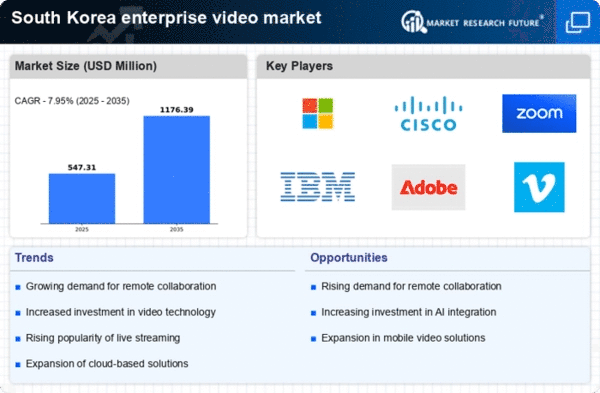
As per Market Research Future analysis, the South Korea enterprise video market Size was estimated at 507.0 USD Million in 2024. The South Korea enterprise video market is projected to grow from 547.31 USD Million in 2025 to 1176.39 USD Million by 2035, exhibiting a compound annual growth rate (CAGR) of 7.9% during the forecast period 2025 - 2035

Key Market Trends & Highlights

The South Korea enterprise video market is experiencing robust growth driven by technological advancements and evolving user needs.

  • The market is witnessing increased adoption of cloud-based solutions, enhancing accessibility and scalability.
  • Focus on enhanced security features is becoming paramount as organizations prioritize data protection.
  • Integration of AI and analytics is transforming user experiences, enabling more personalized and efficient video interactions.
  • Rising demand for remote collaboration tools and investment in digital transformation initiatives are key drivers propelling market growth.

Market Size & Forecast

2024 Market Size 507.0 (USD Million)
2035 Market Size 1176.39 (USD Million)
CAGR (2025 - 2035) 7.95%

Major Players

Microsoft (US), Cisco (US), Zoom (US), IBM (US), Adobe (US), Vimeo (US), Kaltura (US), Brightcove (US), Panopto (US)

Our Impact
Enabled $4.3B Revenue Impact for Fortune 500 and Leading Multinationals
Partnering with 2000+ Global Organizations Each Year
30K+ Citations by Top-Tier Firms in the Industry

South Korea Enterprise Video Market Trends

The enterprise video market in South Korea is currently experiencing a notable transformation, driven by advancements in technology and changing consumer preferences. Organizations are increasingly adopting video solutions to enhance communication, training, and collaboration among employees. This shift is largely influenced by the growing demand for remote work solutions and the need for effective digital engagement strategies. As a result, various sectors, including education, healthcare, and corporate environments, are integrating video platforms to streamline operations and improve productivity. The rise of mobile devices and high-speed internet connectivity further supports this trend, enabling seamless access to video content across different locations. Moreover, the enterprise video market is witnessing a surge in innovative features such as artificial intelligence and machine learning integration. These technologies are enhancing video analytics, enabling organizations to gain insights into viewer engagement and content effectiveness. Additionally, the focus on security and compliance is becoming increasingly paramount, as businesses seek to protect sensitive information shared through video communications. Overall, the enterprise video market in South Korea appears poised for continued growth, with organizations recognizing the value of video as a critical tool for fostering collaboration and driving business success.

Increased Adoption of Cloud-Based Solutions

Organizations are increasingly shifting towards cloud-based video platforms, which offer flexibility and scalability. This trend allows businesses to access video services without the need for extensive on-premises infrastructure, thereby reducing costs and enhancing operational efficiency.

Focus on Enhanced Security Features

As video communications become integral to business operations, there is a growing emphasis on security measures. Companies are prioritizing platforms that provide robust encryption and compliance with data protection regulations to safeguard sensitive information.

Integration of AI and Analytics

The incorporation of artificial intelligence and advanced analytics into video solutions is gaining traction. These technologies enable organizations to analyze viewer behavior and engagement, allowing for more targeted content delivery and improved user experiences.

South Korea Enterprise Video Market Drivers

Focus on Enhanced User Experience

In the competitive landscape of the enterprise video market, there is a pronounced focus on enhancing user experience. Companies are increasingly prioritizing intuitive interfaces and seamless integration with other tools to improve user satisfaction. Research indicates that organizations that invest in user-friendly video solutions experience a 25% increase in employee engagement during virtual meetings. This emphasis on user experience is crucial for retaining clients and attracting new users in a crowded market. As a result, the enterprise video market is likely to see continued innovation aimed at simplifying the user journey and maximizing engagement.

Expansion of Mobile Video Solutions

The enterprise video market in South Korea is witnessing an expansion of mobile video solutions, driven by the increasing use of smartphones and tablets in professional settings. As mobile technology continues to advance, employees expect the ability to access video conferencing and collaboration tools on-the-go. This shift is reflected in the growing number of mobile applications designed for video communication, which are projected to capture a significant share of the market. Analysts estimate that mobile video solutions could account for over 40% of total video conferencing usage by 2026. This trend underscores the necessity for the enterprise video market to innovate and adapt to mobile-first strategies.

Growing Emphasis on Training and Development

The enterprise video market in South Korea is increasingly influenced by the growing emphasis on training and development programs. Companies are recognizing the value of video content in delivering effective training sessions, particularly in a remote work context. Video-based learning solutions are becoming essential for onboarding new employees and upskilling existing staff. Data indicates that organizations utilizing video for training report a 50% increase in knowledge retention compared to traditional methods. This trend highlights the potential of video as a powerful tool for enhancing workforce capabilities, thereby propelling the enterprise video market forward.

Rising Demand for Remote Collaboration Tools

The enterprise video market in South Korea experiences a notable surge in demand for remote collaboration tools. As organizations increasingly adopt hybrid work models, the need for effective communication solutions becomes paramount. Video conferencing platforms, which facilitate real-time interaction, are witnessing heightened usage. According to recent data, the market for video conferencing solutions is projected to grow by approximately 15% annually. This trend indicates a shift towards more flexible work environments, where employees can connect seamlessly from various locations. Consequently, the enterprise video market is adapting to meet these evolving needs, offering innovative features that enhance user experience and engagement.

Investment in Digital Transformation Initiatives

In South Korea, businesses are significantly investing in digital transformation initiatives, which directly impacts the enterprise video market. Organizations recognize the importance of leveraging technology to improve operational efficiency and customer engagement. As a result, the demand for video solutions that integrate with existing digital infrastructures is on the rise. Reports suggest that companies are allocating up to 30% of their IT budgets towards digital transformation efforts, which includes upgrading video communication tools. This investment not only enhances internal collaboration but also improves customer interactions, thereby driving growth within the enterprise video market.


Market Segment Insights

By Component: Hardware (Largest) vs. Software (Fastest-Growing)

In the component segment of the South Korea enterprise video market, hardware dominates the landscape, portraying a significant portion of the market share. With robust demand for video conferencing systems, recording devices, and codecs, vendors are focusing on enhancing hardware capabilities to improve user experiences. This consolidation of hardware influences overall market dynamics, reinforcing its position as the largest segment among the components. Conversely, software represents the fastest-growing segment, driven by increasing adoption of cloud-based solutions and collaboration tools. The shift towards remote working and digital communication has accelerated the demand for interactive software solutions and analytics tools tailored for enterprise needs. This growth is also supported by constant advancements in AI and machine learning, which are integrated into video software applications, further enhancing their efficiency and appeal.

Hardware: Dominant vs. Software: Emerging

The hardware segment in the South Korea enterprise video market encompasses essential equipment such as cameras, microphones, and integrated systems, which are fundamental to effective video communication. As businesses prioritize quality in virtual interactions, hardware solutions have become critical for ensuring seamless connectivity and user experience. However, software is emerging rapidly, offering innovative applications for video conferencing, collaboration, and streaming. This software segment enables organizations to leverage cloud technologies, enhancing flexibility and accessibility. As enterprises increasingly seek integrated solutions, the interplay between hardware and software is reshaping the landscape, with software poised to capture greater market attention in the coming years.

By Application: Training & Development (Largest) vs. Corporate Learning (Fastest-Growing)

In the South Korea enterprise video market, the Training & Development segment holds the largest share, reflecting the strong emphasis organizations place on skill enhancement and workforce capability building. Corporate Learning, while smaller in share, has been rapidly gaining traction as businesses seek to integrate continuous education within their operational frameworks. This duality in market share underscores the diverse priorities companies have regarding employee education and development. Growth trends in this segment highlight a substantial shift towards digital solutions, driven by technological advancements and the necessity for remote content delivery. Increasing investment in employee onboarding processes and an evolving corporate culture that values learning agility are major factors propelling Corporate Learning forward. As enterprises adapt to a more flexible workforce, these segments are poised for significant evolution and growth in the coming years.

Training & Development (Dominant) vs. Corporate Learning (Emerging)

Training & Development is the dominant segment in the South Korea enterprise video market, recognized for its crucial role in enhancing employee skills and overall productivity. This segment is characterized by a high adoption rate of video-based learning modules, enabling companies to engage employees more effectively. Meanwhile, Corporate Learning is an emerging segment, appealing to organizations looking to foster a culture of continuous learning and professional development. This segment leverages innovative delivery methods and content customization, providing tailored learning experiences. The increased focus on leadership training and specialized skills development, particularly in tech-driven industries, positions Corporate Learning as a fast-growing area that is reshaping how businesses approach employee education.

By Delivery Mode: Video Conferencing (Largest) vs. Web Conferencing (Fastest-Growing)

In the South Korea enterprise video market, Video Conferencing holds the largest market share, significantly outpacing the Web Conferencing segment. This dominance is largely attributed to the increasing demand for real-time communication solutions in corporate environments, where face-to-face interaction is becoming essential, even in virtual settings. Web Conferencing, while smaller in share, is rapidly gaining traction as businesses seek more flexible and accessible options for remote collaboration through browser-based platforms. The growth trends for the video conferencing segment are driven by technological advancements, increased mobile device usage, and the growing acceptance of hybrid work environments. As organizations continue to adapt to flexible work models, the need for video conferencing tools that offer seamless integration, enhanced user experience, and advanced features are becoming critical. In contrast, Web Conferencing is emerging as a cost-effective solution, appealing to startups and smaller enterprises looking for budget-friendly options that enable virtual meetings without heavy infrastructure requirements.

Video Conferencing (Dominant) vs. Web Conferencing (Emerging)

Video Conferencing stands out as the dominant segment within the South Korea enterprise video market, characterized by its extensive feature set that facilitates high-quality, interactive communication. Enterprises are increasingly prioritizing platforms that provide robust security, user-friendly interfaces, and scalability to accommodate growing user numbers. In contrast, Web Conferencing is emerging as an accessible option, particularly favored by smaller businesses due to its low cost and ease of use. This segment is appealing for organizations that require minimal setup and the ability to host meetings directly from a web browser, reflecting a shift towards flexible and cost-efficient solutions. The adoption trends indicate a potential for significant growth in this area, as more companies embrace remote work and digital tools.

By Industry: Media & Entertainment (Largest) vs. Healthcare (Fastest-Growing)

In the South Korea enterprise video market, the market share is predominantly held by the Media & Entertainment sector, which leverages video technology for content creation and distribution. This segment significantly outpaces others, reflecting its deep integration into business practices and consumer engagement strategies. Meanwhile, Healthcare is capturing increasing interest, with a growing share as telehealth and video consultations become mainstream in a post-pandemic world. The growth trends within these segments are driven by unique needs and advancements. The Media & Entertainment sector continues to evolve, driven by innovation and audience demand, making it a robust player. In contrast, the Healthcare sector's rapid expansion is fueled by technological advancements and the necessity for remote healthcare services, illustrating a shift towards more digital, accessible patient care solutions.

Media & Entertainment: Dominant vs. Healthcare: Emerging

The Media & Entertainment segment stands as a dominant force in the South Korea enterprise video market, primarily due to its extensive usage in streaming services, broadcasting, and corporate communications. This segment is characterized by high investment in technology for content delivery and production, making it an essential part of business operations. On the other hand, Healthcare is emerging as a vital player, with the increasing adoption of video conferencing solutions for remote consultations and training. This segment is rapidly gaining traction, reflecting the healthcare industry's adaptation to digital transformation, and the need for efficient patient communication and service delivery.

Get more detailed insights about South Korea Enterprise Video Market

Key Players and Competitive Insights

The enterprise video market in South Korea is characterized by a dynamic competitive landscape, driven by rapid technological advancements and increasing demand for digital communication solutions. Major players such as Microsoft (US), Cisco (US), and Zoom (US) are strategically positioned to leverage their extensive resources and innovative capabilities. Microsoft (US) focuses on integrating its video solutions with its broader suite of productivity tools, enhancing user experience and collaboration. Cisco (US), on the other hand, emphasizes security and scalability in its offerings, catering to enterprises with stringent compliance requirements. Zoom (US) continues to expand its market presence through user-friendly interfaces and robust customer support, which collectively shapes a competitive environment that is increasingly reliant on technological innovation and user-centric solutions.Key business tactics within this market include localizing services and optimizing supply chains to better meet regional demands. The competitive structure appears moderately fragmented, with several key players vying for market share while also collaborating through strategic partnerships. This collective influence of major companies fosters an environment where innovation is paramount, and companies are incentivized to differentiate their offerings through unique features and enhanced service delivery.

In October Microsoft (US) announced the launch of a new AI-driven feature for its Teams platform, aimed at enhancing real-time video translation capabilities. This strategic move is likely to bolster its competitive edge by catering to a diverse user base, facilitating seamless communication across language barriers. Such innovations not only enhance user engagement but also position Microsoft (US) as a leader in the integration of AI within enterprise video solutions.

In September Cisco (US) unveiled a partnership with a leading cybersecurity firm to enhance the security features of its Webex platform. This collaboration underscores Cisco's commitment to providing secure video conferencing solutions, which is increasingly critical in a landscape where data privacy concerns are paramount. By prioritizing security, Cisco (US) aims to attract enterprises that require robust compliance measures, thereby solidifying its market position.

In August Zoom (US) expanded its services by introducing a new tier of enterprise solutions tailored for large organizations. This strategic expansion reflects Zoom's intent to capture a larger share of the enterprise market by offering customized solutions that address specific organizational needs. Such moves indicate a shift towards more personalized service offerings, which may enhance customer loyalty and retention in a competitive market.

As of November current trends in the enterprise video market are heavily influenced by digitalization, sustainability, and the integration of AI technologies. Strategic alliances among key players are shaping the landscape, fostering innovation and enhancing service delivery. The competitive differentiation is likely to evolve from traditional price-based competition towards a focus on technological innovation, reliability, and sustainability. Companies that can effectively leverage these trends will likely emerge as leaders in the market, setting new standards for enterprise video solutions.

Key Companies in the South Korea Enterprise Video Market include

Industry Developments

The transition to AI-enhanced business video and communication services was marked by LG Uplus's February 2025 MWC Barcelona premiere of the generative AI platforms ixi-Gen and the on-device AI assistant ixi-O.LG Uplus further highlighted its "All-in-AI" approach in mid-2024, committing billions of dollars and implementing a number of AI-centric data centers and models to support enterprise B2B video and smart factory solutions.

Simultaneously, SK Telecom is advancing its AI transformation. At MWC 2025, it demonstrated AI-powered data center and video-understanding solutions, such as self-governing robots and LLM-based contact center tools, which are tangible advances in the direction of its goal of becoming a telecom business that prioritizes AI.Samsung Electronics has also contributed by establishing AI-powered experience studios in Seoul, incorporating smart camera features and real-time interpretation for the Galaxy S24 series.

These studios are tightly linked to carrier services like SK Telecom and LG Uplus. In addition to expanding its AI contact center platform Aicen Cloud and introducing AI-driven industrial safety and service quality solutions domestically, KT Corporation strengthened its AI commitments through a strategic cooperation with Microsoft that was highlighted at MWC.With Whale On, Naver finally improved its business video capabilities, allowing for browser-based conferences with up to 500 people. This was reinforced by ongoing improvements in streaming and translation features.

Future Outlook

South Korea Enterprise Video Market Future Outlook

The enterprise video market in South Korea is projected to grow at a 7.95% CAGR from 2025 to 2035, driven by increasing demand for remote collaboration and enhanced video analytics.

New opportunities lie in:

  • Development of AI-driven video content management systems
  • Expansion of cloud-based video conferencing solutions
  • Integration of immersive technologies for virtual training environments

By 2035, the enterprise video market is expected to achieve substantial growth and innovation.

Market Segmentation

South Korea Enterprise Video Market Industry Outlook

  • BFSI
  • Manufacturing
  • Media & Entertainment
  • Healthcare

South Korea Enterprise Video Market Component Outlook

  • Hardware
  • Software

South Korea Enterprise Video Market Application Outlook

  • Training & Development
  • Corporate Learning

South Korea Enterprise Video Market Delivery Mode Outlook

  • Video Conferencing
  • Web Conferencing

Report Scope

MARKET SIZE 2024 507.0(USD Million)
MARKET SIZE 2025 547.31(USD Million)
MARKET SIZE 2035 1176.39(USD Million)
COMPOUND ANNUAL GROWTH RATE (CAGR) 7.95% (2025 - 2035)
REPORT COVERAGE Revenue Forecast, Competitive Landscape, Growth Factors, and Trends
BASE YEAR 2024
Market Forecast Period 2025 - 2035
Historical Data 2019 - 2024
Market Forecast Units USD Million
Key Companies Profiled Microsoft (US), Cisco (US), Zoom (US), IBM (US), Adobe (US), Vimeo (US), Kaltura (US), Brightcove (US), Panopto (US)
Segments Covered Component, Application, Delivery Mode, Industry
Key Market Opportunities Integration of artificial intelligence in enterprise video market enhances user engagement and operational efficiency.
Key Market Dynamics Rising demand for secure video conferencing solutions drives innovation in the enterprise video market.

Countries Covered South Korea
Leave a Comment

FAQs

What is the expected market size of the South Korea Enterprise Video Market in 2024?

The South Korea Enterprise Video Market is expected to be valued at 500.0 million USD in 2024.

What will be the market value of the South Korea Enterprise Video Market in 2035?

By 2035, the South Korea Enterprise Video Market is anticipated to reach a value of 1200.0 million USD.

What is the projected CAGR for the South Korea Enterprise Video Market from 2025 to 2035?

The expected CAGR for the South Korea Enterprise Video Market is 8.284% during the forecast period from 2025 to 2035.

Which segment is expected to grow faster within the South Korea Enterprise Video Market?

The software segment is projected to grow rapidly, reaching 720.0 million USD by 2035 from 300.0 million USD in 2024.

What will be the hardware market value in the South Korea Enterprise Video Market by 2035?

The hardware component of the South Korea Enterprise Video Market is expected to be valued at 480.0 million USD by 2035.

Who are the major players in the South Korea Enterprise Video Market?

Key players in the South Korea Enterprise Video Market include LG Uplus, Samsung Electronics, SK Telecom, Hyundai, and Daum Kakao among others.

What role do emerging trends play in the South Korea Enterprise Video Market?

Emerging trends such as increased remote work and digital collaboration are expected to drive growth in the South Korea Enterprise Video Market.

What challenges might the South Korea Enterprise Video Market face in the coming years?

Challenges such as intense competition and evolving technology standards may impact the South Korea Enterprise Video Market.

How has the global scenario affected the South Korea Enterprise Video Market?

The global scenario is influencing demand for enterprise video solutions, supporting the growth of the South Korea Enterprise Video Market.

Which componenthardware or softwarehas a larger market share in the South Korea Enterprise Video Market?

In 2024, the software component holds a larger market share valued at 300.0 million USD compared to hardware at 200.0 million USD.

Download Free Sample

Kindly complete the form below to receive a free sample of this Report

Compare Licence

×
Features License Type
Single User Multiuser License Enterprise User
Price $4,950 $5,950 $7,250
Maximum User Access Limit 1 User Upto 10 Users Unrestricted Access Throughout the Organization
Free Customization
Direct Access to Analyst
Deliverable Format
Platform Access
Discount on Next Purchase 10% 15% 15%
Printable Versions