×
Request Free Sample ×

Kindly complete the form below to receive a free sample of this Report

* Please use a valid business email

Leading companies partner with us for data-driven Insights

clients tt-cursor
Hero Background

South Korea Disposable Endoscope Market

ID: MRFR/HC/50040-HCR
200 Pages
Rahul Gotadki
February 2026

South Korea Disposable Endoscope Market Research Report By Product Type (Rigid Endoscope, Flexible Endoscope, Video Endoscope), By Application (Gastroenterology, Urology, Pulmonology, ENT, Cardiology), By End User (Hospitals, Ambulatory Surgical Centers, Specialty Clinics) and By Distribution Channel (Direct Sales, Distributors, Online Sales) - Growth & Industry Forecast 2025 To 2035

Share:
Download PDF ×

We do not share your information with anyone. However, we may send you emails based on your report interest from time to time. You may contact us at any time to opt-out.

South Korea Disposable Endoscope Market Infographic
Purchase Options

South Korea Disposable Endoscope Market Summary

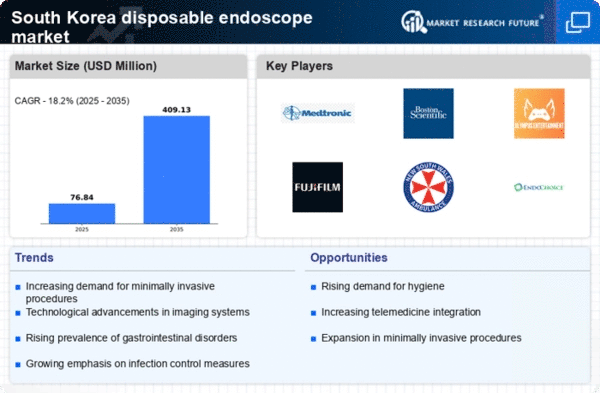
As per Market Research Future analysis, the South Korea disposable endoscope market size was estimated at 65.01 USD Million in 2024. The South Korea disposable endoscope market is projected to grow from 76.84 $ Million in 2025 to 409.13 $ Million by 2035, exhibiting a compound annual growth rate (CAGR) of 18% during the forecast period 2025 - 2035

Key Market Trends & Highlights

The South Korea disposable endoscope market is poised for substantial growth driven by technological advancements and heightened infection control awareness.

  • Technological advancements in disposable endoscopes are enhancing diagnostic capabilities and procedural efficiency.
  • The largest segment in the market is anticipated to be gastrointestinal endoscopes, while the fastest-growing segment is likely to be urological endoscopes.
  • Infection control awareness is driving healthcare facilities to adopt disposable endoscopes to minimize cross-contamination risks.
  • Rising demand for minimally invasive procedures and increased healthcare expenditure are key drivers propelling market growth.

Market Size & Forecast

2024 Market Size 65.01 (USD Million)
2035 Market Size 409.13 (USD Million)
CAGR (2025 - 2035) 18.2%

Major Players

Medtronic (US), Boston Scientific (US), Olympus (JP), Fujifilm (JP), Ambu (DK), EndoChoice (US), Conmed (US), Stryker (US)

Our Impact
Enabled $4.3B Revenue Impact for Fortune 500 and Leading Multinationals
Partnering with 2000+ Global Organizations Each Year
30K+ Citations by Top-Tier Firms in the Industry

South Korea Disposable Endoscope Market Trends

The disposable endoscope market in South Korea is currently experiencing notable growth, driven by advancements in medical technology and increasing demand for minimally invasive procedures. The healthcare sector is witnessing a shift towards disposable devices, which offer enhanced safety and convenience. This trend is largely attributed to the rising awareness of infection control and the need for efficient healthcare solutions. As hospitals and clinics prioritize patient safety, the adoption of disposable endoscopes is likely to rise, reflecting a broader commitment to improving healthcare outcomes. Moreover, the regulatory environment in South Korea appears to support innovation in the medical device sector. Government initiatives aimed at promoting research and development are fostering a conducive atmosphere for the introduction of new products. This is complemented by the increasing investment in healthcare infrastructure, which is expected to further stimulate the disposable endoscope market. As the population ages and the prevalence of chronic diseases rises, the demand for advanced diagnostic tools is anticipated to grow, positioning the market for sustained expansion in the coming years.

Technological Advancements

Recent innovations in imaging technology and materials are enhancing the performance of disposable endoscopes. These advancements are likely to improve diagnostic accuracy and patient outcomes, making them more appealing to healthcare providers.

Infection Control Awareness

The heightened focus on infection prevention in medical settings is driving the shift towards disposable endoscopes. Their single-use nature minimizes the risk of cross-contamination, aligning with the healthcare industry's commitment to patient safety.

Regulatory Support for Innovation

The South Korean government is actively promoting the development of medical devices, including disposable endoscopes. This regulatory support is expected to encourage manufacturers to invest in new technologies and expand their product offerings.

South Korea Disposable Endoscope Market Drivers

Increased Healthcare Expenditure

The rise in healthcare expenditure in South Korea is significantly impacting the disposable endoscope market. With the government and private sectors investing more in healthcare infrastructure, there is a growing availability of advanced medical technologies, including disposable endoscopes. In 2025, healthcare spending is expected to reach around $200 billion, which may lead to increased procurement of disposable endoscopes by hospitals and clinics. This investment is likely to enhance the quality of care provided to patients, as disposable endoscopes are associated with lower infection rates and improved patient outcomes. Consequently, the disposable endoscope market is poised for substantial growth as healthcare facilities seek to upgrade their equipment to meet rising patient demands.

Focus on Patient Safety and Hygiene

The emphasis on patient safety and hygiene in South Korea is a crucial driver for the disposable endoscope market. As healthcare providers strive to minimize the risk of infections, the adoption of single-use endoscopes is becoming more prevalent. Disposable endoscopes eliminate the need for reprocessing and sterilization, thereby reducing the potential for cross-contamination. This focus on hygiene is reflected in the increasing guidelines and recommendations from health authorities advocating for the use of disposable devices in clinical settings. The disposable endoscope market is likely to benefit from this trend, as hospitals and clinics prioritize patient safety and seek to implement best practices in infection control.

Regulatory Support for Medical Devices

Regulatory support for medical devices in South Korea is fostering growth in the disposable endoscope market. The government has implemented streamlined approval processes for innovative medical technologies, which encourages manufacturers to introduce new disposable endoscope products. This supportive regulatory environment is likely to enhance competition and drive advancements in product design and functionality. As a result, the disposable endoscope market is expected to experience an influx of new entrants and innovative solutions, ultimately benefiting healthcare providers and patients alike. The proactive stance of regulatory bodies may also lead to increased consumer confidence in disposable endoscopes, further propelling market growth.

Technological Innovations in Endoscopy

Technological innovations in endoscopy are significantly influencing the disposable endoscope market. The introduction of advanced imaging technologies and enhanced visualization techniques is making disposable endoscopes more effective and appealing to healthcare providers. Innovations such as high-definition imaging and flexible designs are improving diagnostic capabilities, which may lead to increased adoption rates. The disposable endoscope market is expected to expand as manufacturers continue to invest in research and development to create more sophisticated products. This trend suggests that as technology evolves, the market will likely see a surge in demand for disposable endoscopes that offer superior performance and reliability.

Rising Demand for Minimally Invasive Procedures

The increasing preference for minimally invasive procedures in South Korea is driving the disposable endoscope market. Patients and healthcare providers are increasingly favoring these techniques due to their associated benefits, such as reduced recovery times and lower risk of complications. As a result, the demand for disposable endoscopes, which facilitate these procedures, is expected to rise. The disposable endoscope market is projected to witness a growth rate of approximately 15% annually, reflecting the shift towards less invasive surgical options. This trend is further supported by advancements in endoscopic technology, which enhance the efficacy and safety of these procedures, thereby encouraging more healthcare facilities to adopt disposable endoscopes as a standard practice.


Market Segment Insights

By Type: Flexible Endoscope (Largest) vs. Video Endoscope (Fastest-Growing)

In the South Korea disposable endoscope market, the segment is primarily dominated by flexible endoscopes, which account for a significant share due to their versatility and ease of use. Rigid endoscopes hold a smaller market share as they are primarily used in specific procedures, while video endoscopes are gaining traction due to advancements in imaging technology. However, flexible endoscopes remain the preferred choice among healthcare professionals and institutions. The growth trends within this segment are driven by increasing demand for minimally invasive procedures and enhanced visualization capabilities. Flexible endoscopes have been at the forefront, adapting to advancements in technology, while video endoscopes are witnessing rapid acceptance due to their high-definition imaging. As the South Korea disposable endoscope market evolves, these trends indicate a shift toward more innovative and user-friendly endoscopic solutions.

Flexible Endoscope (Dominant) vs. Video Endoscope (Emerging)

Flexible endoscopes represent the dominant force in the South Korea disposable endoscope market due to their adaptability and broad range of applications in various medical fields. These endoscopes allow for minimally invasive procedures, resulting in quicker recovery times and better patient outcomes. In contrast, video endoscopes are emerging as a preferred choice for modern medical facilities, offering superior image quality and real-time visualization that enhance diagnostic accuracy. While flexible endoscopes have established themselves as essential tools, video endoscopes are quickly gaining traction as healthcare providers recognize the importance of detailed imaging in treatment planning and execution. The balance between these two segments reflects the market's ongoing evolution and commitment to improving patient care.

By Application: Gastroenterology (Largest) vs. Urology (Fastest-Growing)

In the South Korea disposable endoscope market, Gastroenterology holds the largest share, dominating the application segments with its extensive use in diagnostic and therapeutic procedures. Urology, although smaller in share, is rapidly gaining traction as medical professionals increasingly adopt disposable endoscopes for minimally invasive surgeries, enhancing patient comfort and reducing infection risks. Growth in these segments is significantly driven by technological advancements and the rising demand for outpatient procedures. The increasing prevalence of gastrointestinal and urological disorders propels the development and use of superior disposable endoscopes designed for efficiency and effectiveness. Additionally, the trend towards minimally invasive methods in healthcare has fueled the popularity of these applications, as healthcare providers prioritize patient safety and operational efficiency.

Gastroenterology (Dominant) vs. Urology (Emerging)

Gastroenterology continues to dominate the South Korea disposable endoscope market due to its broad application in various diagnostic and therapeutic procedures including colonoscopy and gastroscopy. This segment is characterized by a high volume of procedures performed annually and a strong emphasis on hygiene and patient safety, which disposable endoscopes provide. On the other hand, Urology is emerging as a significant player, propelled by a growing prevalence of urological diseases and advancements in technology that improve surgical outcomes. This segment attracts investment for innovative product development, as practitioners seek to offer less invasive alternatives, thus enhancing patient care. Both segments are vital for healthcare delivery, each addressing critical needs in their respective fields.

By End User: Hospitals (Largest) vs. Ambulatory Surgical Centers (Fastest-Growing)

In the South Korea disposable endoscope market, hospitals represent the largest segment, capturing the majority of market share. These facilities are heavily invested in advanced diagnostic and surgical technologies, making them prime consumers of disposable endoscopes. The significant volume of procedures performed in hospitals contributes to their dominance, as they require reliable and efficient equipment to enhance patient outcomes and streamline operations. Conversely, ambulatory surgical centers are recognized as the fastest-growing segment within this market. The increased preference for minimally invasive procedures, combined with a shift towards outpatient care, drives this growth. These centers prioritize cost-effective and safe solutions for their patients, leading to a higher adoption rate of disposable endoscopes. As healthcare continues to evolve, specialty clinics also play a crucial role in utilizing these instruments, but their growth is comparatively steady.

Hospitals (Dominant) vs. Ambulatory Surgical Centers (Emerging)

Hospitals are the dominant end-user in the South Korea disposable endoscope market, characterized by their large-scale operations and comprehensive patient care services. They typically maintain robust budgets for advanced medical technologies. In contrast, ambulatory surgical centers are emerging with a focus on efficiency and patient satisfaction, providing same-day surgery services that cater to rising consumer demand for quicker recovery times. This shift allows them to leverage disposable endoscopes effectively. Specialty clinics, while vital, follow behind these two segments, often focusing on niche areas of practice and benefiting from increasing patient traffic. Each segment plays a crucial role in influencing market dynamics, with hospitals providing stability and ambulatory surgical centers driving innovation and growth.

By Distribution Channel: Direct Sales (Largest) vs. Online Sales (Fastest-Growing)

In the South Korea disposable endoscope market, the distribution of sales among various channels reveals direct sales as the largest segment, commanding a significant share of the market. Distributors also play a vital role, leveraging established networks to enhance accessibility and convenience. Online sales, while currently smaller, are rapidly gaining traction, benefiting from the increasing trend towards digital purchasing in the healthcare sector. The growth trends in this segment are driven by increasing demand for disposable endoscopes and a shift towards more convenient purchasing options. Direct sales continue to thrive owing to strong relationships between manufacturers and healthcare providers. Online sales are recognized as the fastest-growing segment, fueled by advancements in e-commerce, greater product awareness, and the rise of telemedicine facilitating easier access to medical supplies.

Direct Sales (Dominant) vs. Online Sales (Emerging)

Direct sales remain the dominant force in the South Korea disposable endoscope market, characterized by strong manufacturer-to-provider relationships that ensure a steady supply chain. This channel allows manufacturers to maintain close control over pricing and distribution, providing tailored solutions for hospitals and clinics. In contrast, online sales are emerging rapidly as consumer buying behavior shifts, characterized by convenience and a broader range of available products. This channel appeals particularly to smaller medical facilities seeking efficiency and cost-effectiveness. As online platforms improve their offerings and logistics, the appeal of online sales is expected to grow, positioning it as a formidable competitor against traditional direct sales.

Get more detailed insights about South Korea Disposable Endoscope Market

Key Players and Competitive Insights

The disposable endoscope market in South Korea is characterized by a dynamic competitive landscape, driven by technological advancements and increasing demand for minimally invasive procedures. Key players such as Medtronic (US), Boston Scientific (US), and Olympus (JP) are at the forefront, each adopting distinct strategies to enhance their market presence. Medtronic (US) focuses on innovation, particularly in developing advanced imaging technologies, while Boston Scientific (US) emphasizes strategic partnerships to expand its product offerings. Olympus (JP), on the other hand, leverages its strong brand reputation and extensive distribution network to maintain a competitive edge. Collectively, these strategies contribute to a robust competitive environment, fostering continuous improvement and innovation within the market.In terms of business tactics, companies are increasingly localizing manufacturing to reduce costs and improve supply chain efficiency. This approach not only enhances responsiveness to market demands but also aligns with the growing trend of sustainability in manufacturing processes. The market structure appears moderately fragmented, with several players vying for market share, yet the influence of major companies remains significant. Their combined efforts in optimizing supply chains and localizing production are likely to shape the competitive dynamics in the coming years.

In October Medtronic (US) announced the launch of a new line of disposable endoscopes designed to enhance visualization during procedures. This strategic move is expected to solidify its position in the market by addressing the increasing demand for high-quality imaging solutions. The introduction of these products may not only attract new customers but also reinforce Medtronic's commitment to innovation in the disposable endoscope segment.

In September Boston Scientific (US) entered into a partnership with a local South Korean medical device manufacturer to co-develop next-generation disposable endoscopes. This collaboration is strategically significant as it allows Boston Scientific to leverage local expertise and accelerate its product development cycle. By tapping into regional insights, the company aims to enhance its competitive positioning and better meet the specific needs of South Korean healthcare providers.

In August Olympus (JP) expanded its distribution network in South Korea by acquiring a local distributor specializing in endoscopic products. This acquisition is likely to enhance Olympus's market reach and improve its supply chain capabilities. By integrating local distribution channels, Olympus can respond more effectively to market demands and strengthen its foothold in the region.

As of November the competitive trends in the disposable endoscope market are increasingly defined by digitalization, sustainability, and the integration of artificial intelligence (AI) in product development. Strategic alliances are becoming more prevalent, enabling companies to pool resources and expertise to drive innovation. Looking ahead, it appears that competitive differentiation will increasingly hinge on technological advancements and supply chain reliability, rather than solely on price. This shift suggests a potential evolution in market dynamics, where companies that prioritize innovation and sustainability may emerge as leaders in the disposable endoscope market.

Key Companies in the South Korea Disposable Endoscope Market include

Industry Developments

The South Korea Disposable Endoscope Market has witnessed significant developments, particularly with advancements in technology and increasing demand for minimally invasive procedures. Companies like Smith and Nephew, Olympus Corporation, and Medtronic are spearheading innovations to enhance patient outcomes. In recent months, there has been a notable uptick in the market valuation, driven by a growing preference for disposable devices due to infection control protocols.

In June 2023, Boston Scientific held a seminar on advanced endoscopy techniques, highlighting the market's progressive nature. Concurrently, in September 2023, Stryker Corporation launched a new line of disposable endoscopes, responding to increasing demand for single-use devices that reduce the risk of hospital-acquired infections. Furthermore, merger and acquisition activities are vital, with Integrated Endoscopy announcing its acquisition of a smaller firm to expand its product line in July 2023, thereby enhancing its competitive positioning. The South Korean government is also emphasizing the importance of Healthcare Technology Regulatory Frameworks, ensuring the safety and effectiveness of new technologies.

Future Outlook

South Korea Disposable Endoscope Market Future Outlook

The Disposable Endoscope Market in South Korea is projected to grow at an 18.2% CAGR from 2025 to 2035, driven by technological advancements and increasing demand for minimally invasive procedures.

New opportunities lie in:

  • Development of AI-integrated disposable endoscopes for enhanced diagnostics.
  • Expansion of telemedicine platforms incorporating disposable endoscopes.
  • Partnerships with hospitals for bulk procurement agreements.

By 2035, the market is expected to achieve substantial growth, positioning itself as a leader in innovative medical solutions.

Market Segmentation

South Korea Disposable Endoscope Market Type Outlook

  • Rigid Endoscope
  • Flexible Endoscope
  • Video Endoscope

South Korea Disposable Endoscope Market End User Outlook

  • Hospitals
  • Ambulatory Surgical Centers
  • Specialty Clinics

South Korea Disposable Endoscope Market Application Outlook

  • Gastroenterology
  • Urology
  • Pulmonology
  • ENT
  • Cardiology

South Korea Disposable Endoscope Market Distribution Channel Outlook

  • Direct Sales
  • Distributors
  • Online Sales

Report Scope

MARKET SIZE 2024 65.01(USD Million)
MARKET SIZE 2025 76.84(USD Million)
MARKET SIZE 2035 409.13(USD Million)
COMPOUND ANNUAL GROWTH RATE (CAGR) 18.2% (2025 - 2035)
REPORT COVERAGE Revenue Forecast, Competitive Landscape, Growth Factors, and Trends
BASE YEAR 2024
Market Forecast Period 2025 - 2035
Historical Data 2019 - 2024
Market Forecast Units USD Million
Key Companies Profiled Medtronic (US), Boston Scientific (US), Olympus (JP), Fujifilm (JP), Ambu (DK), EndoChoice (US), Conmed (US), Stryker (US)
Segments Covered Type, Application, End User, Distribution Channel
Key Market Opportunities Growing demand for infection control drives innovation in the disposable endoscope market.
Key Market Dynamics Rising demand for innovative disposable endoscopes driven by regulatory changes and technological advancements in South Korea.
Countries Covered South Korea
Leave a Comment

FAQs

What is the expected market size of the South Korea Disposable Endoscope Market in 2024?

The South Korea Disposable Endoscope Market is expected to be valued at 92.8 million USD in 2024.

What is the projected market size for the South Korea Disposable Endoscope Market by 2035?

By 2035, the South Korea Disposable Endoscope Market is projected to reach 210.0 million USD.

What is the expected compound annual growth rate (CAGR) for the South Korea Disposable Endoscope Market from 2025 to 2035?

The market is expected to experience a CAGR of 7.707% from 2025 to 2035.

Which product type will dominate the South Korea Disposable Endoscope Market in 2035?

In 2035, the Flexible Endoscope segment is expected to be dominant, valued at 80.0 million USD.

Who are the major players in the South Korea Disposable Endoscope Market?

Key players in the market include Smith & Nephew, Cook Medical, Boston Scientific, and Olympus Corporation.

What will be the market value of the Rigid Endoscope by 2035?

The Rigid Endoscope segment is expected to be valued at 60.0 million USD by 2035.

What is the market value for the Video Endoscope segment in 2024?

The Video Endoscope segment is estimated to be valued at 32.8 million USD in 2024.

How does the growth rate of the South Korea Disposable Endoscope Market compare across different product types?

All product types, including Rigid, Flexible, and Video Endoscopes, are expected to demonstrate significant growth by 2035.

What are the growth drivers for the South Korea Disposable Endoscope Market?

Increasing demand for minimally invasive procedures and advancements in endoscopic technologies are key growth drivers.

What is the overall market trend for the South Korea Disposable Endoscope Market toward 2035?

The overall trend indicates significant growth in the Disposable Endoscope Market, driven by technological innovations and increasing healthcare needs.

Download Free Sample

Kindly complete the form below to receive a free sample of this Report

Compare Licence

×
Features License Type
Single User Multiuser License Enterprise User
Price $4,950 $5,950 $7,250
Maximum User Access Limit 1 User Upto 10 Users Unrestricted Access Throughout the Organization
Free Customization
Direct Access to Analyst
Deliverable Format
Platform Access
Discount on Next Purchase 10% 15% 15%
Printable Versions