×
Request Free Sample ×

Kindly complete the form below to receive a free sample of this Report

* Please use a valid business email

Leading companies partner with us for data-driven Insights

clients tt-cursor
Hero Background

South Korea Citric Acid Market

ID: MRFR/FnB/56575-HCR
128 Pages
Snehal Singh
February 2026

South Korea Citric Acid Market Size, Share, Industry Trend & Analysis Research Report By Form (Anhydrous, Liquid), By Function (Acidulant, Antioxidant, Preservative, Flavoring Agent) and By Application (Food & Beverages, Pharmaceuticals & Nutraceuticals, Personal Care, Others) - Forecast to 2035

Share:
Download PDF ×

We do not share your information with anyone. However, we may send you emails based on your report interest from time to time. You may contact us at any time to opt-out.

South Korea Citric Acid Market Infographic
Purchase Options

South Korea Citric Acid Market Summary

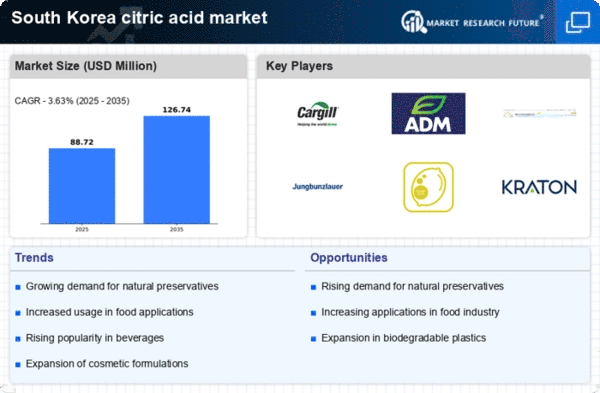
As per Market Research Future analysis, the South Korea citric acid market Size was estimated at 85.61 USD Million in 2024. The South Korea citric acid market is projected to grow from 88.72 USD Million in 2025 to 126.74 USD Million by 2035, exhibiting a compound annual growth rate (CAGR) of 3.6% during the forecast period 2025 - 2035

Key Market Trends & Highlights

The South Korea citric acid market is experiencing robust growth driven by diverse applications and increasing health awareness.

  • The food and beverage sector remains the largest segment, reflecting a rising demand for citric acid as a flavoring and preservative agent.
  • Pharmaceutical applications are emerging as the fastest-growing segment, indicating a shift towards utilizing citric acid in drug formulations.
  • Sustainability initiatives are gaining traction, with manufacturers focusing on eco-friendly production methods to meet consumer expectations.
  • Key market drivers include growing health consciousness and the expansion of the beverage industry, which are propelling citric acid usage across various applications.

Market Size & Forecast

2024 Market Size 85.61 (USD Million)
2035 Market Size 126.74 (USD Million)
CAGR (2025 - 2035) 3.63%

Major Players

Cargill (US), Archer Daniels Midland (US), Huangshi Xinghua Biochemical (CN), Jungbunzlauer (AT), Citric Acid (US), Kraton Corporation (US), Weifang Ensign Industry (CN), Shandong Juxin Chemical (CN)

Our Impact
Enabled $4.3B Revenue Impact for Fortune 500 and Leading Multinationals
Partnering with 2000+ Global Organizations Each Year
30K+ Citations by Top-Tier Firms in the Industry

South Korea Citric Acid Market Trends

The citric acid market in South Korea is currently experiencing notable growth, driven by increasing demand across various sectors, including food and beverage, pharmaceuticals, and cosmetics. The rising awareness of health and wellness among consumers has led to a greater preference for natural preservatives and flavor enhancers, which citric acid provides. Additionally, the food industry is adapting to changing consumer preferences, emphasizing the need for clean-label products. This shift is likely to bolster the market as manufacturers seek to incorporate citric acid into their formulations to meet these evolving demands. Moreover, the regulatory environment in South Korea appears to support the expansion of the citric acid market. Government initiatives aimed at promoting food safety and quality standards may encourage the use of citric acid as a safe and effective ingredient. Furthermore, the increasing trend of sustainability in production processes could lead to innovations in citric acid manufacturing, potentially enhancing its appeal in various applications. As the market continues to evolve, stakeholders must remain vigilant to adapt to these changes and capitalize on emerging opportunities.

Rising Demand in Food and Beverage Sector

The food and beverage sector is witnessing a surge in demand for citric acid, primarily due to its role as a natural preservative and flavor enhancer. As consumers increasingly seek healthier options, manufacturers are incorporating citric acid into products to align with clean-label trends.

Pharmaceutical Applications

Citric acid is gaining traction in the pharmaceutical industry, where it is utilized as an excipient in drug formulations. The growing focus on improving drug stability and bioavailability is likely to drive the adoption of citric acid in this sector.

Sustainability Initiatives

Sustainability is becoming a key focus in the citric acid market, with manufacturers exploring eco-friendly production methods. This trend aligns with broader environmental goals and may enhance the market's appeal to environmentally conscious consumers.

South Korea Citric Acid Market Drivers

Rising Export Opportunities

The citric acid market in South Korea is likely to benefit from rising export opportunities. As the country enhances its production capabilities, there is a growing potential to supply citric acid to international markets. Recent trade data indicates that South Korea's exports of citric acid have increased by 12% over the past year, driven by demand from neighboring countries. This trend suggests that the citric acid market could see significant growth as manufacturers explore new markets and establish trade relationships. The ability to export not only boosts revenue but also positions South Korean producers as key players in the regional citric acid market.

Growing Health Consciousness

The increasing health consciousness among consumers in South Korea appears to be a pivotal driver for the citric acid market. As individuals become more aware of the nutritional content of their food, there is a notable shift towards natural ingredients. Citric acid, recognized for its role as a natural preservative and flavor enhancer, aligns well with this trend. The market data indicates that the demand for organic and clean-label products has surged, with a growth rate of approximately 15% annually. This shift is likely to propel the citric acid market, as manufacturers seek to incorporate healthier alternatives into their formulations, thereby enhancing product appeal and meeting consumer expectations.

Expansion of the Beverage Industry

The beverage industry in South Korea is experiencing robust growth, which significantly impacts the citric acid market. With a rising preference for flavored and functional beverages, citric acid serves as a crucial ingredient for flavor enhancement and acidity regulation. Recent statistics suggest that the non-alcoholic beverage sector has expanded by over 10% in the past year, creating a substantial demand for citric acid. This trend is likely to continue, as consumers increasingly seek refreshing and innovative drink options. Consequently, the citric acid market is poised to benefit from this expansion, as beverage manufacturers incorporate citric acid to improve taste and shelf life.

Technological Advancements in Production

Technological advancements in the production of citric acid are likely to play a significant role in shaping the market landscape in South Korea. Innovations in fermentation technology and bioprocessing methods have enhanced production efficiency and reduced costs. This is particularly relevant as the citric acid market seeks to meet the growing demand while maintaining competitive pricing. Recent developments indicate that production costs have decreased by approximately 20% due to these advancements. As a result, manufacturers can offer citric acid at more attractive prices, potentially increasing market penetration and expanding applications across various sectors, including food, beverages, and pharmaceuticals.

Increased Application in Personal Care Products

The application of citric acid in personal care products is emerging as a notable driver for the market in South Korea. With a growing emphasis on skincare and cosmetic formulations, citric acid is valued for its exfoliating properties and pH balancing capabilities. The personal care sector has witnessed a growth rate of approximately 8% annually, indicating a rising demand for products that incorporate natural ingredients. This trend is likely to enhance the citric acid market, as manufacturers seek to formulate effective and safe personal care products. The versatility of citric acid in various applications positions it as a key ingredient in the evolving personal care landscape.


Market Segment Insights

By Form: Anhydrous (Largest) vs. Liquid (Fastest-Growing)

In the South Korea citric acid market, the market share distribution shows that Anhydrous is the largest segment due to its extensive application in food and beverage products, where its stability and concentrated formulation are preferred. Conversely, the Liquid form, while smaller in share, is gaining traction for its versatility in applications like pharmaceuticals and cosmetics, catering to a shift in consumer preferences towards easy-to-use products. Growth trends in the South Korea citric acid market indicate that the Liquid form is emerging as the fastest-growing segment. This growth is driven by increasing demand for clean-label products, alongside the rise in health-conscious consumer behaviors. The adaptability of Liquid citric acid for various formulations and the push for sustainable packaging are significant contributors to its accelerated growth potential.

Anhydrous: Dominant vs. Liquid: Emerging

Anhydrous citric acid is recognized as the dominant segment in the South Korea citric acid market, favored for its high stability and concentrated form that suits various applications, particularly in the food and beverage industry. Its widespread use in the production of flavored drinks, confectionery, and preservation processes underlines its importance. On the other hand, the Liquid form is characterized as an emerging segment, finding favor in sectors like cosmetics and pharmaceuticals. The ease of incorporation into formulations and the trend towards liquid alternatives makes it adaptable, catering to the growing market for versatile and convenient products. This segment's growth potential is significantly bolstered by changing consumer preferences and the demand for innovation in formulation.

By Function: Acidulant (Largest) vs. Antioxidant (Fastest-Growing)

In the South Korea citric acid market, the distribution of market share among the various functions reveals that Acidulants dominate with a significant share, followed by Antioxidants, Preservatives, and Flavoring Agents. Acidulants are widely used in food and beverage applications, accounting for a substantial portion of the market due to their essential role in enhancing flavor and acidity. The Antioxidant segment, while smaller currently, exhibits robust growth as consumers increasingly seek natural preservation solutions, reflecting a shift towards health-conscious options. Growth trends in this segment indicate a strong upward trajectory, driven by rising demand in the food and beverage sector combined with a growing preference for clean-label products. The Acidulant category is bolstered by its established presence in products such as soft drinks and candy, while Antioxidants are becoming pivotal as industries respond to consumer trends. This evolution is expected to further enhance the dynamics of the South Korea citric acid market, with innovation and regulatory changes also playing crucial roles in shaping future prospects.

Acidulant: Dominant vs. Antioxidant: Emerging

The Acidulant segment is characterized by its extensive use in a range of products, particularly in food and beverages, where it is utilized to enhance flavor, maintain pH balance, and preserve freshness. This dominant position is supported by its well-established applications and broad acceptance among manufacturers. In contrast, the Antioxidant segment is emerging rapidly as consumers show increased interest in healthier and naturally preserved products. Antioxidants help prevent oxidation and spoilage, catering to the clean-label trend. This emerging category is leveraging innovations to create new formulations that appeal to health-conscious consumers, thus positioning itself for rapid growth in the competitive landscape of the South Korea citric acid market.

By Application: Food & Beverages (Largest) vs. Pharmaceuticals & Nutraceuticals (Fastest-Growing)

In the South Korea citric acid market, the application segments reveal a substantial variation in market share dynamics. The Food & Beverages sector is the most significant contributor, capturing a major portion of the market due to the increasing demand for flavor enhancement and preservation in various food products. Pharmaceuticals & Nutraceuticals follow closely, reflecting a strong presence as consumers increasingly seek health-related products enriched with citric acid for its beneficial attributes. Growth trends in this segment are influenced by shifts in consumer preferences towards healthier food options and natural ingredients in food and pharmaceutical applications. The Food & Beverages sector continues to thrive amidst the trend of clean label products, while Pharmaceuticals & Nutraceuticals is experiencing rapid growth due to the heightened focus on wellness and preventative healthcare results, positioning itself as a key player in the evolving market landscape.

Food & Beverages (Dominant) vs. Pharmaceuticals & Nutraceuticals (Emerging)

The Food & Beverages segment remains the dominant force in the South Korea citric acid market, characterized by its broad utilization in products ranging from soft drinks to processed foods, enhancing flavor and extending shelf life. This segment's stronghold is maintained by the robust consumer base and diverse applications, making citric acid an essential ingredient in food preservation. On the other hand, the Pharmaceuticals & Nutraceuticals segment is emerging rapidly as consumers become more health-conscious and seek dietary supplements with citric acid for its proven health benefits. This segment's growth is driven by increasing investments in research for health applications, potentially expanding its market share significantly as more innovative products hit the shelves.

Get more detailed insights about South Korea Citric Acid Market

Key Players and Competitive Insights

The citric acid market in South Korea is characterized by a competitive landscape that is increasingly shaped by innovation, sustainability, and strategic partnerships. Key players such as Cargill (US), Archer Daniels Midland (US), and Jungbunzlauer (AT) are actively pursuing strategies that emphasize product differentiation and operational efficiency. Cargill (US), for instance, focuses on enhancing its production capabilities through technological advancements, while Archer Daniels Midland (US) is known for its extensive supply chain optimization efforts. Jungbunzlauer (AT) appears to be leveraging its strong R&D capabilities to develop sustainable citric acid solutions, which collectively contribute to a dynamic competitive environment.The market structure is moderately fragmented, with several players vying for market share. Localizing manufacturing has emerged as a key tactic among these companies, allowing them to reduce logistics costs and respond swiftly to regional demand fluctuations. Supply chain optimization is also critical, as it enables firms to maintain competitive pricing while ensuring product availability. The collective influence of these key players fosters a competitive atmosphere where innovation and operational excellence are paramount.

In October Cargill (US) announced the launch of a new citric acid production facility in South Korea, aimed at increasing its output capacity by 30%. This strategic move is likely to enhance Cargill's market presence and meet the growing demand for citric acid in various applications, including food and beverage. The facility is expected to utilize advanced production technologies, thereby improving efficiency and sustainability in operations.

In September Archer Daniels Midland (US) entered into a strategic partnership with a local South Korean firm to enhance its distribution network for citric acid. This collaboration is anticipated to streamline supply chain processes and improve market penetration, allowing Archer Daniels Midland to better serve its customers in the region. The partnership underscores the importance of local alliances in navigating the competitive landscape and responding to consumer preferences.

In August Jungbunzlauer (AT) unveiled a new line of biodegradable citric acid products, targeting the growing demand for sustainable ingredients in the food industry. This initiative not only aligns with global sustainability trends but also positions Jungbunzlauer as a leader in eco-friendly solutions. The introduction of these products is expected to attract environmentally conscious consumers and enhance the company's competitive edge.

As of November the citric acid market is witnessing trends that emphasize digitalization, sustainability, and the integration of AI technologies. Strategic alliances are increasingly shaping the competitive landscape, enabling companies to leverage shared resources and expertise. Looking ahead, it is likely that competitive differentiation will evolve, with a shift from price-based competition to a focus on innovation, technology, and supply chain reliability. This transition may redefine market dynamics, compelling companies to invest in R&D and sustainable practices to maintain their competitive advantage.

Key Companies in the South Korea Citric Acid Market include

Industry Developments

Recent developments in the South Korea Citric Acid Market have highlighted a growing trend towards increased production capacity and innovation among key players. In 2023, companies such as CJ CheilJedang and Daesang Corporation have reported significant investments in technology upgrades aimed at enhancing yield efficiency and quality in citric acid production. The demand for citric acid across various sectors, including food and beverages, pharmaceuticals, and cosmetics, continues to surge, contributing to positive market valuation growth.

Notably, in March 2023, CJ CheilJedang announced plans to expand its citric acid manufacturing facility, focusing on sustainable practices and lower emissions, aligning with national environmental goals. 

Over the past two to three years, other significant movements included a strategic partnership between Laiwu Zhanggou Group and Hyundai Biotech aimed at co-developing novel fermentation technologies, enhancing their competitive edge in the market. Acquisitions have also shaped the landscape; for instance, Shandong Fuyang Biotechnology's recent acquisition of a citric acid plant in South Korea has strengthened its regional presence. The changing dynamics in production and demand emphasize the increasing importance of these companies in the evolving citric acid sector within South Korea's market landscape.

Future Outlook

South Korea Citric Acid Market Future Outlook

The Citric Acid Market is projected to grow at 3.63% CAGR from 2025 to 2035, driven by increasing demand in food and beverage applications, pharmaceuticals, and personal care products.

New opportunities lie in:

  • Expansion of citric acid applications in plant-based food products.
  • Development of sustainable production methods to reduce costs.
  • Investment in R&D for innovative citric acid derivatives.

By 2035, the citric acid market is expected to achieve robust growth, reflecting evolving consumer preferences and industrial applications.

Market Segmentation

South Korea Citric Acid Market Form Outlook

  • Anhydrous
  • Liquid

South Korea Citric Acid Market Function Outlook

  • Acidulant
  • Antioxidant
  • Preservative
  • Flavoring Agent

South Korea Citric Acid Market Application Outlook

  • Food & Beverages
  • Pharmaceuticals & Nutraceuticals
  • Personal Care
  • Others

Report Scope

MARKET SIZE 2024 85.61(USD Million)
MARKET SIZE 2025 88.72(USD Million)
MARKET SIZE 2035 126.74(USD Million)
COMPOUND ANNUAL GROWTH RATE (CAGR) 3.63% (2025 - 2035)
REPORT COVERAGE Revenue Forecast, Competitive Landscape, Growth Factors, and Trends
BASE YEAR 2024
Market Forecast Period 2025 - 2035
Historical Data 2019 - 2024
Market Forecast Units USD Million
Key Companies Profiled Cargill (US), Archer Daniels Midland (US), Huangshi Xinghua Biochemical (CN), Jungbunzlauer (AT), Citric Acid (US), Kraton Corporation (US), Weifang Ensign Industry (CN), Shandong Juxin Chemical (CN)
Segments Covered Form, Function, Application
Key Market Opportunities Growing demand for natural preservatives in food and beverage sectors enhances opportunities in the citric acid market.
Key Market Dynamics Rising demand for natural preservatives drives innovation and competition in the citric acid market.
Countries Covered South Korea
Leave a Comment

FAQs

What is the expected market size of the South Korea Citric Acid Market in 2024?

The South Korea Citric Acid Market is expected to be valued at 68.54 million USD in 2024.

What will be the projected market value for the South Korea Citric Acid Market by 2035?

By 2035, the South Korea Citric Acid Market is projected to reach a value of 106.63 million USD.

What is the expected compound annual growth rate (CAGR) for the South Korea Citric Acid Market from 2025 to 2035?

The South Korea Citric Acid Market is expected to experience a CAGR of 4.1% from 2025 to 2035.

Which segment of the South Korea Citric Acid Market holds the highest value in 2024?

In 2024, the Liquid form of citric acid is valued at 41.04 million USD, making it the highest segment.

How much is the Anhydrous form of citric acid expected to be valued at in 2035?

The Anhydrous form of citric acid is expected to be valued at 42.14 million USD in 2035.

Who are the key players operating in the South Korea Citric Acid Market?

Major players in the South Korea Citric Acid Market include Tate & Lyle, CJ CheilJedang, and Daesang Corporation, among others.

What are the primary applications driving the growth of the South Korea Citric Acid Market?

The primary applications include food and beverage, pharmaceuticals, and personal care industries, contributing to market growth.

What is the projected market size for the Liquid form of citric acid by 2035?

The Liquid form of citric acid is projected to reach 64.49 million USD by 2035.

What growth opportunities exist within the South Korea Citric Acid Market?

The growth opportunities are driven by increasing demand in food preservation and rising health consciousness.

Are there any challenges affecting the growth of the South Korea Citric Acid Market?

Challenges include fluctuating raw material prices and competition from alternative acids in various applications.

Download Free Sample

Kindly complete the form below to receive a free sample of this Report

Compare Licence

×
Features License Type
Single User Multiuser License Enterprise User
Price $4,950 $5,950 $7,250
Maximum User Access Limit 1 User Upto 10 Users Unrestricted Access Throughout the Organization
Free Customization
Direct Access to Analyst
Deliverable Format
Platform Access
Discount on Next Purchase 10% 15% 15%
Printable Versions