×
Request Free Sample ×

Kindly complete the form below to receive a free sample of this Report

* Please use a valid business email

Leading companies partner with us for data-driven Insights

clients tt-cursor
Hero Background

South Korea AI in Transportation Market

ID: MRFR/ICT/57095-HCR
200 Pages
Aarti Dhapte
February 2026

South Korea AI In Transportation Market Size, Share and Trends Analysis Report By Offering (Hardware, Services, Software), By IoT Communication Technology (Cellular, LPWAN, LoRaWAN, Z-Wave, Zigbee, NFC, Bluetooth, Others), By Application (Autonomous Truck, Semi-autonomous Truck, Truck Platooning, Human-Machine Interface (HMI), Predictive Maintenance, Precision & Mapping, Traffic Detection, Computer Vision-Powered Parking Management, Road Condition Monitoring, Automatic Traffic Incident Detection, Driver Monitoring, Others), and By Machine Learning Technology (Deep Learning, Computer Vision, Natural Language Processing, Context Awareness)- Forecast to 2035

Share:
Download PDF ×

We do not share your information with anyone. However, we may send you emails based on your report interest from time to time. You may contact us at any time to opt-out.

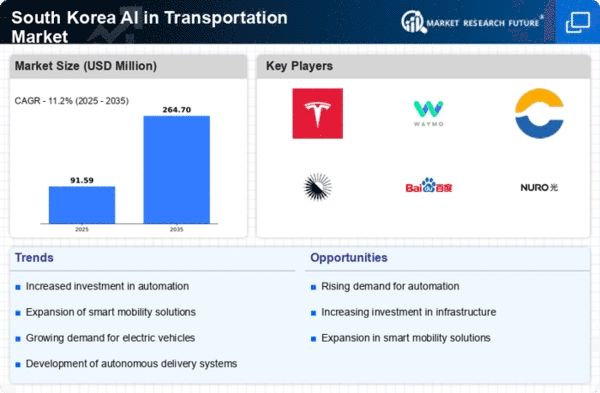
South Korea AI in Transportation Market Infographic
Purchase Options

South Korea AI in Transportation Market Summary

As per Market Research Future analysis, the AI in Transportation Market Valuation was estimated at 82.37 USD Million in 2024. The Ai In-transportation market is projected to grow from 91.59 USD Million in 2025 to 264.7 USD Million by 2035, exhibiting a compound annual growth rate (CAGR) of 11% during the forecast period 2025 - 2035

Key Market Trends & Highlights

The South Korea AI in-transportation market is experiencing robust growth driven by technological advancements and urbanization.

  • The rise of autonomous vehicles is reshaping the transportation landscape in South Korea.
  • Smart traffic management systems are increasingly being adopted to enhance urban mobility.
  • Integration of AI in public transport is gaining traction, particularly in metropolitan areas.
  • Government initiatives and support, along with urbanization, are key drivers propelling market growth.

Market Size & Forecast

2024 Market Size 82.37 (USD Million)
2035 Market Size 264.7 (USD Million)
CAGR (2025 - 2035) 11.2%

Major Players

Tesla (US), Waymo (US), Cruise (US), Aurora (US), Baidu (CN), Nuro (US), Mobileye (IL), Zoox (US), Pony.ai (CN)

Our Impact
Enabled $4.3B Revenue Impact for Fortune 500 and Leading Multinationals
Partnering with 2000+ Global Organizations Each Year
30K+ Citations by Top-Tier Firms in the Industry

South Korea AI in Transportation Market Trends

The is witnessing notable advancements, particularly in South Korea, where the integration of artificial intelligence technologies is reshaping transportation systems. The government has been proactive in promoting smart mobility solutions, which include autonomous vehicles and intelligent traffic management systems. This initiative aligns with the nation's broader goals of enhancing urban mobility and reducing congestion. Furthermore, the collaboration between public and private sectors is fostering innovation, leading to the development of cutting-edge applications that improve safety and efficiency in transportation. In addition, South Korea's commitment to sustainability is influencing the ai in-transportation market. The emphasis on reducing carbon emissions and promoting eco-friendly transportation options is driving investments in electric and hybrid vehicles equipped with AI capabilities. As a result, the market is likely to witness a surge in demand for smart transportation solutions that not only enhance user experience but also contribute to environmental goals. Overall, The AI in Transportation Market is expected to grow, supported by government initiatives and a strong focus on technological innovation.

Rise of Autonomous Vehicles

The ai in-transportation market is witnessing a significant rise in the development and deployment of autonomous vehicles. South Korea's government is actively supporting research and testing of self-driving technologies, which are expected to enhance road safety and reduce traffic congestion. This trend indicates a shift towards more efficient transportation systems.

Smart Traffic Management Systems

There is a growing emphasis on smart traffic management systems that utilize AI to optimize traffic flow. These systems analyze real-time data to adjust traffic signals and manage congestion effectively. South Korea's urban areas are increasingly adopting these technologies to improve overall transportation efficiency.

Integration of AI in Public Transport

The integration of AI technologies in public transport is becoming more prevalent. South Korea is investing in AI-driven solutions to enhance the user experience, such as predictive analytics for service scheduling and personalized travel information. This trend aims to make public transportation more accessible and efficient.

South Korea AI in Transportation Market Drivers

Technological Advancements in AI

The continuous evolution of AI technologies is a key driver for the ai in-transportation market in South Korea. Innovations in machine learning, computer vision, and data analytics are enabling the development of sophisticated transportation solutions. For instance, AI algorithms are being utilized to optimize route planning and improve vehicle performance, which can lead to cost savings of up to 20% for transportation companies. Additionally, advancements in sensor technologies are enhancing the capabilities of autonomous vehicles, making them safer and more reliable. As these technologies mature, they are likely to be adopted more widely across the transportation sector, further propelling the growth of the ai in-transportation market.

Government Initiatives and Support

The South Korean government actively promotes the development of the ai in-transportation market through various initiatives and funding programs. With a focus on enhancing transportation safety and efficiency, the government has allocated approximately $1 billion to support research and development in this sector. This financial backing is expected to stimulate innovation and attract private investments, thereby accelerating the adoption of AI technologies in transportation. Furthermore, regulatory frameworks are being established to facilitate the integration of AI solutions, which may lead to a more streamlined process for companies entering the market. As a result, the ai in-transportation market is likely to experience significant growth, driven by both public and private sector collaboration.

Urbanization and Population Growth

Rapid urbanization in South Korea is contributing to increased demand for efficient transportation solutions, thereby driving the ai in-transportation market. As urban populations continue to swell, the need for smart transportation systems becomes more pressing. In 2025, urban areas are projected to house over 80% of the population, leading to congestion and inefficiencies in existing transport networks. AI technologies, such as predictive analytics and real-time traffic management, are being implemented to address these challenges. The integration of AI can potentially reduce traffic congestion by up to 30%, enhancing overall urban mobility. Consequently, the ai in-transportation market is positioned to benefit from the ongoing urbanization trends, as cities seek innovative solutions to manage their transportation needs.

Environmental Concerns and Sustainability

Growing environmental concerns are prompting South Korea to seek sustainable transportation solutions, thereby influencing the ai in-transportation market. The government has set ambitious targets to reduce greenhouse gas emissions by 40% by 2030, which necessitates the adoption of cleaner technologies. AI can play a pivotal role in this transition by optimizing fuel consumption and reducing emissions in transportation systems. For example, AI-driven traffic management systems can minimize idle times and improve traffic flow, potentially decreasing emissions by 15%. As public awareness of environmental issues increases, the demand for AI solutions that promote sustainability in transportation is expected to rise, driving growth in the ai in-transportation market.

Consumer Demand for Enhanced Mobility Solutions

There is a growing consumer demand for enhanced mobility solutions in South Korea, which is significantly impacting the ai in-transportation market. As lifestyles evolve, individuals are seeking more convenient, efficient, and personalized transportation options. The rise of ride-sharing services and on-demand transportation solutions reflects this shift in consumer preferences. AI technologies are being leveraged to provide tailored mobility services, such as dynamic routing and personalized travel recommendations. This trend is expected to continue, with the market for mobility-as-a-service projected to reach $10 billion by 2027. Consequently, the ai in-transportation market is likely to expand as companies innovate to meet the changing demands of consumers.

Market Segment Insights

By Offering: Hardware (Largest) vs. Services (Fastest-Growing)

In the South Korea ai in-transportation market, the distribution of market share among offerings is led primarily by hardware, which commands a significant portion due to its essential role in enabling AI functionalities such as data processing and real-time analytics. Services are making strides, reflecting a growing trend towards integrated solutions that enhance user experience and operational efficiency. This dynamic situation points to a market that values both the stability of established hardware and the innovative potential of service-oriented offerings. The growth trends within this segment show that while hardware remains dominant, services are rapidly gaining traction, driven by the increasing adoption of AI technologies in transportation. Factors contributing to this shift include the demand for personalized services, the integration of AI with existing infrastructure, and the push for smarter transportation solutions. As businesses strive to optimize efficiency and minimize costs, the services segment is expected to witness expanded investments and development, positioning it for robust growth in the coming years.

Hardware: Essential (Dominant) vs. Services: Innovative (Emerging)

In the South Korea ai in-transportation market, hardware is characterized by its foundational role, providing the necessary infrastructure to support AI applications such as autonomous vehicles and logistics optimization. Companies rely heavily on advanced hardware components like sensors, cameras, and computing units to sustain AI functionalities, establishing hardware as a key focal point. On the other hand, services are becoming increasingly innovative, offering tailored solutions that create seamless integration with transportation systems. As a rapidly emerging segment, services focus on enhancing operational effectiveness, user engagement, and data analytics. The competitive landscape is evolving, with service providers leveraging technological advancements to address the dynamic needs of users, thereby reshaping the operational framework of the entire market.

By IoT Communication Technology: Cellular (Largest) vs. LPWAN (Fastest-Growing)

The South Korea ai in-transportation market showcases a diverse array of IoT communication technologies with Cellular leading the charge in market share. It serves as the backbone for real-time data transmission and vehicular communication, significantly outperforming other technologies. In contrast, LPWAN has carved out a notable niche due to its low power consumption, making it indispensable for long-range sensor applications, which are increasingly critical in transportation logistics. The growth trajectory of this segment is influenced by the rising demand for connected vehicles and smart transportation solutions. Innovations in Cellular networks, including the rollout of 5G, are enhancing connectivity and driving adoption rates. Meanwhile, LPWAN technologies are gaining traction due to their efficiency and cost-effectiveness, helping to facilitate the expansion of IoT applications in smart transportation systems. This dual momentum indicates a vibrant and growing landscape for IoT communication technologies.

Cellular (Dominant) vs. LPWAN (Emerging)

Cellular technology remains the dominant communication method within the South Korea ai in-transportation market, supporting high-speed data transfer and vehicle-to-everything (V2X) communication. Its extensive infrastructure and established reliability make it the preferred choice for critical applications that require constant connectivity. Conversely, LPWAN is emerging as a viable option, specifically designed for low-power, long-range communication needs. It is particularly suitable for applications such as fleet monitoring and logistics tracking where low energy consumption and cost efficiency are vital. As demand for efficient IoT solutions grows, both Cellular and LPWAN play increasingly complementary roles in realizing smart transportation initiatives.

By Application: Predictive Maintenance (Largest) vs. Traffic Detection (Fastest-Growing)

The market for applications in the South Korea ai in-transportation market showcases significant diversity, with predictive maintenance holding the largest share due to its critical role in ensuring vehicle efficiency and safety. Other noteworthy segments include traffic detection and human-machine interfaces, which are gaining traction as urbanization increases and digital transformation accelerates, leading to a more interconnected transportation ecosystem. Growth trends indicate a strong upward trajectory for traffic detection technologies, driven by increasing investments in smart city initiatives and the need for real-time data analytics to improve traffic flow and reduce congestion. Furthermore, advancements in AI and machine learning techniques are enhancing the capabilities of these applications, making them indispensable for modern transportation systems, thus contributing to a competitive landscape where innovation plays a key role.

Predictive Maintenance (Dominant) vs. Traffic Detection (Emerging)

Predictive maintenance is a dominant force in the South Korea ai in-transportation market, characterized by its ability to substantially reduce operational costs and prevent potential failures through real-time data monitoring and analysis. This segment focuses on utilizing AI algorithms to predict mechanical issues before they arise, thus prolonging vehicle lifespan and enhancing safety standards. On the other hand, traffic detection emerges as a rapidly growing segment, leveraging advanced sensors and data analytics tools to optimize traffic management processes. Its ability to provide instant insights into traffic patterns and conditions positions it as a crucial contributor to the development of smart cities, making it increasingly vital for urban planners and transport authorities aiming to improve mobility and reduce congestion.

By Machine Learning Technology: Deep Learning (Largest) vs. Natural Language Processing (Fastest-Growing)

The South Korea ai in-transportation market exhibits a diverse range of machine learning technologies, with Deep Learning commanding the largest share due to its ability to effectively process vast amounts of data and enhance predictive analytics. Computer Vision also plays a significant role, leveraging visual data for vehicle recognition and accident prevention, while Context Awareness is more niche but integral for providing personalized user experiences. As the market evolves, Natural Language Processing is emerging as the fastest-growing segment, driven by increasing demands for voice-activated systems and smarter communication interfaces in vehicles. The overall growth is propelled by advancements in hardware capabilities, rising investments in AI research, and the challenge of optimizing transportation systems through intelligent technologies, ensuring safer and more efficient travel options.

Deep Learning (Dominant) vs. Computer Vision (Emerging)

Deep Learning is characterized by its sophisticated neural networks that analyze complex datasets, facilitating improvements in automated driving features and traffic management systems. It stands out as the dominant technology in the automated driving sphere, enabling significant capabilities such as real-time decision making and advanced image processing. In contrast, Computer Vision, while an emerging technology, is gaining traction for its applications in object recognition, lane detection, and safety enhancements. It plays a vital supportive role in the overall functionality of autonomous vehicles, working in tandem with Deep Learning algorithms to interpret visual data effectively. The synergy between these technologies positions them as critical components in the safe and efficient evolution of transportation solutions.

Get more detailed insights about South Korea AI in Transportation Market

Key Players and Competitive Insights

The ai in-transportation market is currently characterized by rapid technological advancements and a competitive landscape that is increasingly shaped by innovation and strategic partnerships. Key players such as Tesla (US), Waymo (US), and Baidu (CN) are at the forefront, each adopting distinct strategies to enhance their market positioning. Tesla (US) continues to focus on its autonomous driving technology, leveraging its extensive data collection from its fleet to refine its AI algorithms. Meanwhile, Waymo (US) emphasizes safety and regulatory compliance, actively engaging with local governments to facilitate the deployment of its self-driving vehicles. Baidu (CN), on the other hand, is investing heavily in AI research and development, aiming to integrate its autonomous driving solutions with smart city initiatives, thereby enhancing urban mobility.The business tactics employed by these companies reflect a nuanced understanding of the market's structure, which appears to be moderately fragmented yet dominated by a few key players. Localizing manufacturing and optimizing supply chains are critical strategies that these companies are employing to reduce costs and improve efficiency. The collective influence of these major players is shaping a competitive environment where technological prowess and operational agility are paramount.

In October Tesla (US) announced a partnership with a South Korean tech firm to develop advanced AI systems for its autonomous vehicles. This collaboration is expected to enhance Tesla's capabilities in real-time data processing and machine learning, potentially giving it a competitive edge in the rapidly evolving market. The strategic importance of this partnership lies in its potential to accelerate Tesla's innovation cycle and improve its product offerings in the region.

In September Waymo (US) expanded its autonomous ride-hailing service to additional cities in South Korea, marking a significant step in its international growth strategy. This expansion not only increases Waymo's market presence but also allows the company to gather diverse data sets, which are crucial for refining its AI algorithms. The strategic move underscores Waymo's commitment to establishing a robust operational footprint in Asia, which is seen as a key growth market for autonomous transportation.

In August Baidu (CN) launched a new initiative aimed at integrating its autonomous driving technology with public transportation systems in South Korea. This initiative is designed to enhance the efficiency of urban mobility and reduce traffic congestion. The strategic importance of this move lies in Baidu's ability to position itself as a leader in smart city solutions, thereby expanding its influence beyond traditional automotive applications.

As of November the competitive trends in the ai in-transportation market are increasingly defined by digitalization, sustainability, and the integration of AI technologies. Strategic alliances are becoming more prevalent, as companies recognize the need to collaborate to enhance their technological capabilities and market reach. Looking ahead, it appears that competitive differentiation will increasingly hinge on innovation and technological advancements rather than price-based competition. Companies that can effectively leverage their supply chain reliability and technological prowess are likely to emerge as leaders in this dynamic market.

Key Companies in the South Korea AI in Transportation Market include

Industry Developments

In order to improve reliability and safety, Hyundai Rotem and LG CNS started a pilot project in November 2024 to install AI-powered predictive maintenance systems on high-speed train lines. These systems use machine-learning algorithms to identify equipment anomalies prior to failures.

Seoul Metro unveiled an AI-enhanced crowd management system in February 2025 that combines predictive analytics and real-time surveillance data to streamline platform operations and ease traffic. By April 2025, SK Telecom will have introduced an AI-powered traffic-light control system for Busan that reduces average vehicle delay by 15% by dynamically adjusting signal timings using reinforcement learning.

In order to safely traverse mixed traffic circumstances, Kakao Mobility launched a trial of AI-powered driverless shuttle services in May 2025 on Jeju Island. The services use computer vision and onboard deep-learning models.

These programs demonstrate South Korea's active adoption of AI in transportation, ranging from road infrastructure and autonomous mobility to rail and urban transit, underscoring the country's dedication to intelligent, effective, and secure travel environments.

Future Outlook

South Korea AI in Transportation Market Future Outlook

The AI in Transportation Market is projected to grow at 11.2% CAGR from 2025 to 2035, driven by advancements in autonomous technology, increased demand for efficiency, and regulatory support.

New opportunities lie in:

  • Development of AI-driven predictive maintenance solutions for fleet management.
  • Integration of AI in traffic management systems to optimize urban mobility.
  • Creation of personalized AI-based logistics platforms for last-mile delivery.

By 2035, the market is expected to achieve substantial growth, driven by innovation and strategic investments.

Market Segmentation

South Korea AI in Transportation Market Offering Outlook

  • Hardware
  • Services
  • Software

South Korea AI in Transportation Market Application Outlook

  • Autonomous Truck
  • Semi-autonomous Truck
  • Truck Platooning
  • Human-Machine Interface (HMI)
  • Predictive Maintenance
  • Precision & Mapping
  • Traffic Detection
  • Computer Vision-Powered Parking Management
  • Road Condition Monitoring
  • Automatic Traffic Incident Detection
  • Driver Monitoring
  • Others

South Korea AI in Transportation Market Machine Learning Technology Outlook

  • Deep Learning
  • Computer Vision
  • Natural Language Processing
  • Context Awareness

South Korea AI in Transportation Market IoT Communication Technology Outlook

  • Cellular
  • LPWAN
  • LoRaWAN
  • Z-Wave
  • Zigbee
  • NFC
  • Bluetooth
  • Others

Report Scope

MARKET SIZE 2024 82.37(USD Million)
MARKET SIZE 2025 91.59(USD Million)
MARKET SIZE 2035 264.7(USD Million)
COMPOUND ANNUAL GROWTH RATE (CAGR) 11.2% (2025 - 2035)
REPORT COVERAGE Revenue Forecast, Competitive Landscape, Growth Factors, and Trends
BASE YEAR 2024
Market Forecast Period 2025 - 2035
Historical Data 2019 - 2024
Market Forecast Units USD Million
Key Companies Profiled Tesla (US), Waymo (US), Cruise (US), Aurora (US), Baidu (CN), Nuro (US), Mobileye (IL), Zoox (US), Pony.ai (CN)
Segments Covered Offering, IoT Communication Technology, Application, Machine Learning Technology
Key Market Opportunities Integration of autonomous vehicle technology with smart city infrastructure enhances efficiency in the ai in-transportation market.
Key Market Dynamics Rapid advancements in artificial intelligence are reshaping transportation efficiency and safety standards in South Korea.
Countries Covered South Korea
Leave a Comment

FAQs

What is the expected market size of the South Korea AI In Transportation Market in 2024?

The South Korea AI In Transportation Market is expected to be valued at 96.25 million USD in 2024.

How much is the South Korea AI In Transportation Market projected to grow by 2035?

By 2035, the market is projected to grow significantly to 334.3 million USD.

What is the expected CAGR for the South Korea AI In Transportation Market from 2025 to 2035?

The expected CAGR for the market from 2025 to 2035 is 11.984%.

Which segment of the South Korea AI In Transportation Market is expected to have the highest growth from 2024 to 2035?

The Services segment is anticipated to see substantial growth, rising from 36.25 million USD in 2024 to 130.5 million USD in 2035.

What is the expected market value for the Hardware segment in 2035?

The Hardware segment is expected to reach a value of 105.0 million USD by 2035.

Who are the major players in the South Korea AI In Transportation Market?

Key players in the market include Tmap Mobility, Hyundai, Kakao, LG Electronics, and SK Telecom.

What opportunities exist in the South Korea AI In Transportation Market?

Emerging trends in technology and increasing demand for smart transportation solutions create numerous opportunities in the market.

Is there a particular industry or application driving growth in the South Korea AI In Transportation Market?

Mobility as a Service is a significant application driving growth in the AI In Transportation Market.

What challenges are currently faced by the South Korea AI In Transportation Market?

Challenges include rapidly evolving technology and the necessity for substantial investments for development.

How will global economic conditions impact the South Korea AI In Transportation Market?

Global economic conditions can influence investment patterns and technology adoption rates, thereby impacting market growth.

Download Free Sample

Kindly complete the form below to receive a free sample of this Report

Compare Licence

×
Features License Type
Single User Multiuser License Enterprise User
Price $4,950 $5,950 $7,250
Maximum User Access Limit 1 User Upto 10 Users Unrestricted Access Throughout the Organization
Free Customization
Direct Access to Analyst
Deliverable Format
Platform Access
Discount on Next Purchase 10% 15% 15%
Printable Versions