×
Request Free Sample ×

Kindly complete the form below to receive a free sample of this Report

* Please use a valid business email

Leading companies partner with us for data-driven Insights

clients tt-cursor
Hero Background

South Korea Advanced Energy Storage Systems Market

ID: MRFR/EnP/52542-HCR
200 Pages
Chitranshi Jaiswal
February 2026

South Korea Advanced Energy Storage Systems Market Research Report By Application (Grid Storage, Transportation, Others), By Technology (Mechanical, Thermal, Electro Chemical, Others), By Storage Type (Batteries, Flywheels, Compressed Air Storage, Pumped Hydro-Power, Others) and By End User (Residential, Non-Residential) -Growth & Industry Forecast to 2035

Share:
Download PDF ×

We do not share your information with anyone. However, we may send you emails based on your report interest from time to time. You may contact us at any time to opt-out.

South Korea Advanced Energy Storage Systems Market Infographic
Purchase Options

South Korea Advanced Energy Storage Systems Market Summary

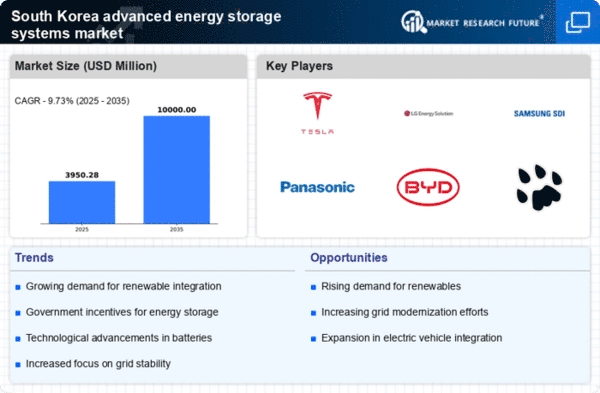
As per Market Research Future analysis, the South Korea advanced energy storage systems market size was estimated at 3600.0 USD Million in 2024. The South Korea advanced energy-storage-systems market is projected to grow from 3950.28 USD Million in 2025 to 10000.0 USD Million by 2035, exhibiting a compound annual growth rate (CAGR) of 9.7% during the forecast period 2025 - 2035

Key Market Trends & Highlights

The South Korea advanced energy-storage-systems market is poised for substantial growth driven by technological advancements and government support.

  • Government initiatives are increasingly promoting the adoption of advanced energy-storage systems across South Korea.
  • Technological advancements in battery storage solutions are enhancing efficiency and reducing costs in the market.
  • The demand for renewable energy integration is driving the growth of energy-storage systems, particularly in urban areas.
  • Rising energy costs and increased investment in renewable energy are key drivers propelling market expansion.

Market Size & Forecast

2024 Market Size 3600.0 (USD Million)
2035 Market Size 10000.0 (USD Million)
CAGR (2025 - 2035) 9.73%

Major Players

Tesla Inc (US), LG Energy Solution (KR), Samsung SDI (KR), Panasonic Corporation (JP), BYD Company Limited (CN), CATL (CN), Siemens AG (DE), General Electric Company (US), Hitachi Ltd (JP)

Our Impact
Enabled $4.3B Revenue Impact for Fortune 500 and Leading Multinationals
Partnering with 2000+ Global Organizations Each Year
30K+ Citations by Top-Tier Firms in the Industry

South Korea Advanced Energy Storage Systems Market Trends

The advanced energy-storage-systems market is experiencing notable growth, driven by the increasing demand for renewable energy sources and the need for efficient energy management solutions. South Korea's commitment to reducing carbon emissions and enhancing energy security has led to significant investments in advanced technologies. The government has implemented various policies to promote the adoption of energy-storage systems, which are essential for balancing supply and demand in a rapidly evolving energy landscape. As a result, the market is witnessing a surge in innovative solutions, including lithium-ion batteries, flow batteries, and other emerging technologies. In addition, the integration of advanced energy-storage systems into the national grid is becoming increasingly important. This integration supports the stability of the energy supply while facilitating the transition to a more sustainable energy system. The collaboration between public and private sectors is fostering research and development initiatives, which are likely to enhance the performance and efficiency of energy-storage technologies. Overall, the advanced energy-storage-systems market is poised for continued expansion, reflecting South Korea's strategic focus on sustainable energy solutions and technological advancement.

Government Initiatives and Support

The South Korean government is actively promoting the advanced energy-storage-systems market through various initiatives. Policies aimed at enhancing energy efficiency and reducing greenhouse gas emissions are driving investments in energy-storage technologies. Financial incentives and subsidies are being offered to encourage the adoption of these systems, which are crucial for integrating renewable energy sources into the grid.

Technological Advancements

Innovations in battery technology are significantly impacting the advanced energy-storage-systems market. Research institutions and companies are focusing on developing more efficient and cost-effective energy-storage solutions. Advancements in materials science and engineering are leading to improved performance, longer lifespans, and reduced costs, making these systems more accessible to a wider range of applications.

Growing Demand for Renewable Energy Integration

The increasing reliance on renewable energy sources in South Korea is creating a robust demand for advanced energy-storage systems. As the share of solar and wind energy in the energy mix rises, the need for reliable storage solutions becomes more critical. Energy-storage systems play a vital role in managing the intermittency of renewable energy, ensuring a stable and reliable power supply.

South Korea Advanced Energy Storage Systems Market Drivers

Rising Energy Costs

The advanced energy-storage-systems market in South Korea is experiencing a notable surge due to the increasing costs of traditional energy sources. As energy prices rise, consumers and businesses are seeking more cost-effective solutions. Energy storage systems provide a viable alternative, allowing users to store energy during off-peak hours and utilize it when prices are higher. This shift not only enhances energy efficiency but also reduces reliance on expensive grid power. In 2025, energy costs in South Korea are projected to increase by approximately 15%, further driving the demand for advanced energy-storage systems. The market is expected to grow as stakeholders recognize the financial benefits of investing in these technologies, which can lead to substantial savings over time.

Technological Innovation

Technological innovation plays a crucial role in shaping the advanced energy-storage-systems market in South Korea. Continuous advancements in battery technology, such as improvements in lithium-ion and solid-state batteries, are enhancing the efficiency and capacity of energy storage systems. These innovations are making energy storage more accessible and affordable for consumers and businesses alike. In 2025, the market is expected to witness a 25% increase in the adoption of advanced energy-storage systems, driven by these technological breakthroughs. As manufacturers develop more efficient and longer-lasting batteries, the appeal of energy storage solutions grows, leading to increased market penetration and a shift towards more sustainable energy practices.

Environmental Regulations

The advanced energy-storage-systems market is significantly influenced by stringent environmental regulations in South Korea. The government has implemented various policies aimed at reducing carbon emissions and promoting sustainable energy practices. These regulations encourage the adoption of energy storage technologies, as they facilitate the integration of renewable energy sources into the grid. In 2025, it is estimated that compliance with these regulations will drive a 20% increase in the adoption of advanced energy-storage systems. Companies are increasingly investing in these solutions to meet regulatory requirements and enhance their sustainability profiles. This trend not only supports environmental goals but also positions businesses favorably in a market that is progressively leaning towards eco-friendly practices.

Consumer Awareness and Adoption

Consumer awareness regarding the benefits of energy storage is on the rise in South Korea, significantly impacting the advanced energy-storage-systems market. As individuals and businesses become more informed about the advantages of energy storage, such as cost savings and energy independence, the demand for these systems is expected to grow. Educational campaigns and outreach programs are playing a pivotal role in enhancing public understanding. By 2025, it is anticipated that consumer adoption of advanced energy-storage systems will increase by 30%, driven by a greater appreciation for energy management solutions. This growing awareness is likely to foster a more competitive market, encouraging innovation and further advancements in energy storage technologies.

Increased Investment in Renewable Energy

The advanced energy-storage-systems market is benefiting from the heightened investment in renewable energy projects across South Korea. As the country aims to transition to a low-carbon economy, significant funds are being allocated to solar and wind energy initiatives. Energy storage systems are essential for managing the intermittent nature of these renewable sources, ensuring a stable energy supply. In 2025, investments in renewable energy are projected to reach $10 billion, with a substantial portion directed towards integrating advanced energy-storage solutions. This trend not only supports the growth of the energy-storage market but also aligns with national goals for energy independence and sustainability.


Market Segment Insights

By Application: Grid Storage (Largest) vs. Transportation (Fastest-Growing)

In the South Korea advanced energy-storage-systems market, Grid Storage currently holds the largest market share, driven by its essential role in stabilizing the electrical grid and integrating renewable energy sources. Transportation follows closely, representing a significant portion of the market as electric vehicles gain traction, reflecting the growing demand for efficient energy solutions across various sectors. This distribution underscores the importance of Grid Storage while highlighting the increasing investments in Transportation technologies. The growth trends within this segment are largely influenced by government policies promoting renewable energy and sustainable practices. The rise in electric vehicle adoption continues to push the Transportation segment forward, with innovations in battery technologies driving efficiency improvements. Additionally, the ongoing development of smart grids enhances the relevance of Grid Storage, ensuring reliable energy supply and advance the overall market dynamics within this segment.

Grid Storage: Dominant vs. Transportation: Emerging

Grid Storage stands out as the dominant application in the South Korea advanced energy-storage-systems market, primarily due to its critical function in maintaining grid stability and supporting renewable energy integration. Its established infrastructure and significant investment enable it to cater to utility-scale applications, positioning it as an indispensable component of modern energy systems. On the other hand, the Transportation segment is emerging quickly, fueled by the rapid adoption of electric vehicles and advancements in battery technology. This segment appeals to consumers seeking sustainable transportation options, and its growth is supported by favorable government incentives and increasing environmental awareness. Together, these segments illustrate the diverse applications of energy storage, with Grid Storage leading the way while Transportation captures rapid advancements.

By Technology: Electro Chemical (Largest) vs. Mechanical (Fastest-Growing)

In the South Korea advanced energy-storage-systems market, the Electro Chemical segment holds the largest market share due to its widespread application in various storage solutions and efficiency in energy management. Following closely behind, the Mechanical segment is gaining traction and provides an alternative that appeals to environmentally conscious consumers. As industry players innovate and enhance their offerings, the market share distribution is expected to evolve, showcasing the rapid adoption of diverse energy-storage technologies. Growth trends in the South Korea advanced energy-storage-systems market are being propelled by increased demand for renewable energy and advancements in battery technologies. The Electro Chemical segment benefits from these trends, supported by the ongoing transition towards electric vehicles. Meanwhile, the Mechanical segment is witnessing popularity driven by its sustainable and cost-effective nature, making it a vital part of the future energy landscape. Overall, these segments are positioned to reshape how energy is stored and used, promoting a more efficient sustainable future.

Technology: Electro Chemical (Dominant) vs. Mechanical (Emerging)

The Electro Chemical segment is characterized by its high efficiency and versatility, making it the dominant force in the South Korea advanced energy-storage-systems market. As battery technologies evolve, this segment is expected to maintain its leading position by facilitating the recharge of renewable energy sources and supporting electric grids. On the other hand, the Mechanical segment, identified as emerging, presents a promising alternative with its kinetic energy storage capabilities. This technology offers a more environmentally friendly option, appealing to industries looking to reduce their carbon footprint. As both segments continue to grow, the blend of traditional and innovative technologies will play a crucial role in shaping the country's energy strategies.

By Storage Type: Batteries (Largest) vs. Pumped Hydro-Power (Fastest-Growing)

In the South Korea advanced energy-storage-systems market, the distribution of market share among different storage types reveals that batteries hold the largest share, significantly dominating the landscape. Following batteries, pumped hydro-power is emerging as a key player, with compressed air storage and flywheels trailing behind. Other storage methods also add diversity to the market but represent a smaller portion of the entire segment, signifying varied preferences among users for energy storage solutions. Growth trends in this segment are driven by the increasing demand for renewable energy sources and the need for efficient energy management solutions. Batteries are seeing widespread adoption due to their versatility and declining costs, making them the preferred choice across many applications. Meanwhile, pumped hydro-power, though currently smaller in share, is gaining traction quickly as infrastructure investments increase and environmental regulations favor its sustainable approach, positioning it as the fastest-growing segment.

Batteries (Dominant) vs. Pumped Hydro-Power (Emerging)

Batteries dominate the South Korea advanced energy-storage-systems market due to their ability to provide rapid response times and high energy densities, making them suitable for various applications, from consumer electronics to large-scale energy storage for grid management. Their production is becoming increasingly economical, driven by advancements in technology and increasing manufacturing scales. In contrast, pumped hydro-power is emerging as a significant alternative, capitalizing on geographical advantages and its ability to store large amounts of energy efficiently. It is characterized by its low operational costs and long lifespan, but it requires significant initial investment and is limited to areas with suitable topography. This makes the two segments complementary in addressing the diverse energy storage needs.

Get more detailed insights about South Korea Advanced Energy Storage Systems Market

Key Players and Competitive Insights

The advanced energy-storage-systems market in South Korea is characterized by a dynamic competitive landscape, driven by increasing demand for renewable energy integration and grid stability. Major players such as LG Energy Solution (KR), Samsung SDI (KR), and Tesla Inc (US) are at the forefront, each adopting distinct strategies to enhance their market positioning. LG Energy Solution (KR) focuses on innovation in battery technology, particularly in solid-state batteries, while Samsung SDI (KR) emphasizes partnerships with automotive manufacturers to expand its electric vehicle (EV) battery supply. Tesla Inc (US), on the other hand, leverages its brand strength and technological advancements to penetrate the energy storage market, particularly through its Powerwall and Powerpack products, which cater to both residential and commercial sectors. Key business tactics within this market include localizing manufacturing and optimizing supply chains to reduce costs and improve efficiency. The competitive structure appears moderately fragmented, with several key players exerting influence over market dynamics. This fragmentation allows for a variety of strategies to coexist, fostering innovation and competition among established firms and new entrants alike. In October 2025, LG Energy Solution (KR) announced a strategic partnership with a leading South Korean utility company to develop a large-scale energy storage project aimed at enhancing grid reliability. This collaboration is significant as it not only strengthens LG's position in the domestic market but also aligns with national goals for renewable energy adoption, potentially increasing the company's market share in the energy storage sector. In September 2025, Samsung SDI (KR) unveiled its latest generation of lithium-ion batteries, which reportedly offer a 20% increase in energy density compared to previous models. This advancement is crucial as it positions Samsung to meet the growing demands of the EV market, where battery performance is paramount. The introduction of these batteries could enhance Samsung's competitive edge, particularly in the rapidly evolving automotive sector. In November 2025, Tesla Inc (US) expanded its Gigafactory operations in South Korea, aiming to double its production capacity for energy storage systems. This expansion is indicative of Tesla's commitment to the region and its strategy to capitalize on the increasing demand for energy storage solutions. By enhancing production capabilities, Tesla is likely to strengthen its market presence and respond more effectively to customer needs. As of November 2025, current trends in the advanced energy-storage-systems market include a pronounced shift towards digitalization, sustainability, and the integration of artificial intelligence (AI) in operational processes. Strategic alliances among key players are shaping the competitive landscape, fostering innovation and collaboration. Looking ahead, competitive differentiation is expected to evolve, with a greater emphasis on technological advancements and supply chain reliability rather than solely on price. This shift suggests that companies will need to invest in R&D and strategic partnerships to maintain a competitive edge in an increasingly complex market.

Key Companies in the South Korea Advanced Energy Storage Systems Market include

Industry Developments

The South Korea Advanced Energy Storage Systems Market is experiencing significant developments, driven by technological advancements and increasing investments. In October 2023, POSCO Energy announced a collaboration with Hanwha Q CELLS to enhance battery storage solutions aimed at improving renewable energy utilization. KSTAR recently unveiled a new energy storage system, designed to support the growing demand for electric vehicles and residential energy storage.

Meanwhile, LG Energy Solution is expanding its market footprint by increasing production capacity to meet the rising global demand for lithium-ion batteries.In more recent activity, SK Innovation focuses on strategic partnerships to broaden its capabilities in the energy storage sector.

EcoPro has also reported an increase in its market valuation as it ventures into sustainable energy solutions.Mergers and acquisitions have reshaped the landscape, with Samsung SDI acquiring a stake in Tmax Power in August 2023 to strengthen their position in the energy sector, while Hyundai Energy Solutions has been picking up pace in its Research and Development initiatives regarding energy storage systems. Over the past few years, significant capital influx and supportive governmental policies have further accelerated advancements within the South Korean energy storage market.


Future Outlook

South Korea Advanced Energy Storage Systems Market Future Outlook

The Advanced Energy Storage Systems Market is projected to grow at a 9.73% CAGR from 2025 to 2035, driven by technological advancements, increasing renewable energy integration, and supportive government policies.

New opportunities lie in:

  • Development of modular energy storage solutions for commercial applications. Investment in AI-driven energy management systems for optimized performance. Expansion of battery recycling initiatives to create sustainable supply chains.

By 2035, the market is expected to achieve substantial growth, positioning itself as a leader in energy innovation.

Market Segmentation

South Korea Advanced Energy Storage Systems Market Technology Outlook

  • Mechanical
  • Thermal
  • Electro Chemical
  • Others

South Korea Advanced Energy Storage Systems Market Application Outlook

  • Grid Storage
  • Transportation
  • Others

South Korea Advanced Energy Storage Systems Market Storage Type Outlook

  • Batteries
  • Flywheels
  • Compressed Air Storage
  • Pumped Hydro-Power
  • Others

Report Scope

MARKET SIZE 2024 3600.0(USD Million)
MARKET SIZE 2025 3950.28(USD Million)
MARKET SIZE 2035 10000.0(USD Million)
COMPOUND ANNUAL GROWTH RATE (CAGR) 9.73% (2025 - 2035)
REPORT COVERAGE Revenue Forecast, Competitive Landscape, Growth Factors, and Trends
BASE YEAR 2024
Market Forecast Period 2025 - 2035
Historical Data 2019 - 2024
Market Forecast Units USD Million
Key Companies Profiled Tesla Inc (US), LG Energy Solution (KR), Samsung SDI (KR), Panasonic Corporation (JP), BYD Company Limited (CN), CATL (CN), Siemens AG (DE), General Electric Company (US), Hitachi Ltd (JP)
Segments Covered Application, Technology, Storage Type
Key Market Opportunities Growing demand for renewable energy integration drives innovation in advanced energy-storage-systems market.
Key Market Dynamics Rising demand for renewable energy drives innovation in advanced energy-storage-systems, enhancing grid stability and efficiency.
Countries Covered South Korea
Leave a Comment

FAQs

What is the expected market size of the South Korea Advanced Energy Storage Systems Market by 2024?

The South Korea Advanced Energy Storage Systems Market is expected to be valued at 3.5 USD Billion by the year 2024.

What will be the market value in 2035 for Advanced Energy Storage Systems in South Korea?

By 2035, the South Korea Advanced Energy Storage Systems Market is projected to reach 13.8 USD Billion.

What is the expected CAGR for the South Korea Advanced Energy Storage Systems Market from 2025 to 2035?

The market is expected to grow at a CAGR of 13.283 percent during the forecast period from 2025 to 2035.

What is the market size for the Grid Storage application segment in 2024?

The Grid Storage application segment of the South Korea Advanced Energy Storage Systems Market is valued at 1.4 USD Billion in 2024.

How much will the Transportation application segment be valued at in 2035?

The Transportation application segment is expected to reach a value of 5.5 USD Billion by the year 2035.

Who are the major players in the South Korea Advanced Energy Storage Systems Market?

Key players include POSCO Energy, KSTAR, FLEXINERGY, and Korea Electric Power Corporation among others.

What is the projected market size for the Others application segment by 2035?

The Others application segment is anticipated to be valued at 2.7 USD Billion in 2035.

What will be the grid storage market value in 2035?

The grid storage market is expected to grow to 5.6 USD Billion by 2035.

What are the growth drivers for the South Korea Advanced Energy Storage Systems Market?

The growth of the market is driven by increasing demand for renewable energy integration and grid stability.

What opportunities exist in the South Korea Advanced Energy Storage Systems Market?

There are significant opportunities in enhancing energy efficiency and expanding technological advancements in storage solutions.

Download Free Sample

Kindly complete the form below to receive a free sample of this Report

Compare Licence

×
Features License Type
Single User Multiuser License Enterprise User
Price $4,950 $5,950 $7,250
Maximum User Access Limit 1 User Upto 10 Users Unrestricted Access Throughout the Organization
Free Customization
Direct Access to Analyst
Deliverable Format
Platform Access
Discount on Next Purchase 10% 15% 15%
Printable Versions